
Trump Signs $70 Billion 'Secure America Act,' Securing ICE and CBP Funding Through 2029
President Trump has signed a $70 billion funding package for federal immigration agencies, ending a historic 75-day partial shutdown of the Department of Homeland Security. The legislation bankrolls the administration's enforcement operations through the end of his term, bypassing future congressional budget battles.
By Factlen Editorial Team
- Immigration Enforcement Advocates
- Prioritizes border security, law enforcement funding, and the removal of undocumented immigrants without operational restrictions.
- Oversight & Reform Proponents
- Argues that federal immigration agencies require strict accountability, operational guardrails, and regular congressional oversight.
- State & Local Authorities
- Focuses on how federal immigration funding and 287(g) agreements impact local policing, community trust, and municipal resources.
What's not represented
- · Immigrant advocacy organizations directly representing undocumented communities.
- · Families of the citizens killed during the January Minneapolis operation.
Why this matters
The Secure America Act guarantees funding for Immigration and Customs Enforcement (ICE) and Customs and Border Protection (CBP) through the end of President Trump's term, effectively insulating his mass deportation agenda from future congressional budget battles. It also ends a record 75-day partial shutdown of the Department of Homeland Security that had disrupted federal operations since mid-February.
Key points
- President Trump signed the Secure America Act, providing $70 billion to ICE, CBP, and DHS through September 2029.
- The legislation ends a 75-day partial shutdown of the Department of Homeland Security, the longest in U.S. history.
- Republicans used the budget reconciliation process to pass the bill without Democratic support, bypassing a Senate filibuster.
- The funding secures the administration's immigration enforcement and deportation operations through the end of Trump's term.
- Democrats had blocked funding since January, demanding operational reforms after two U.S. citizens were killed during an ICE raid.
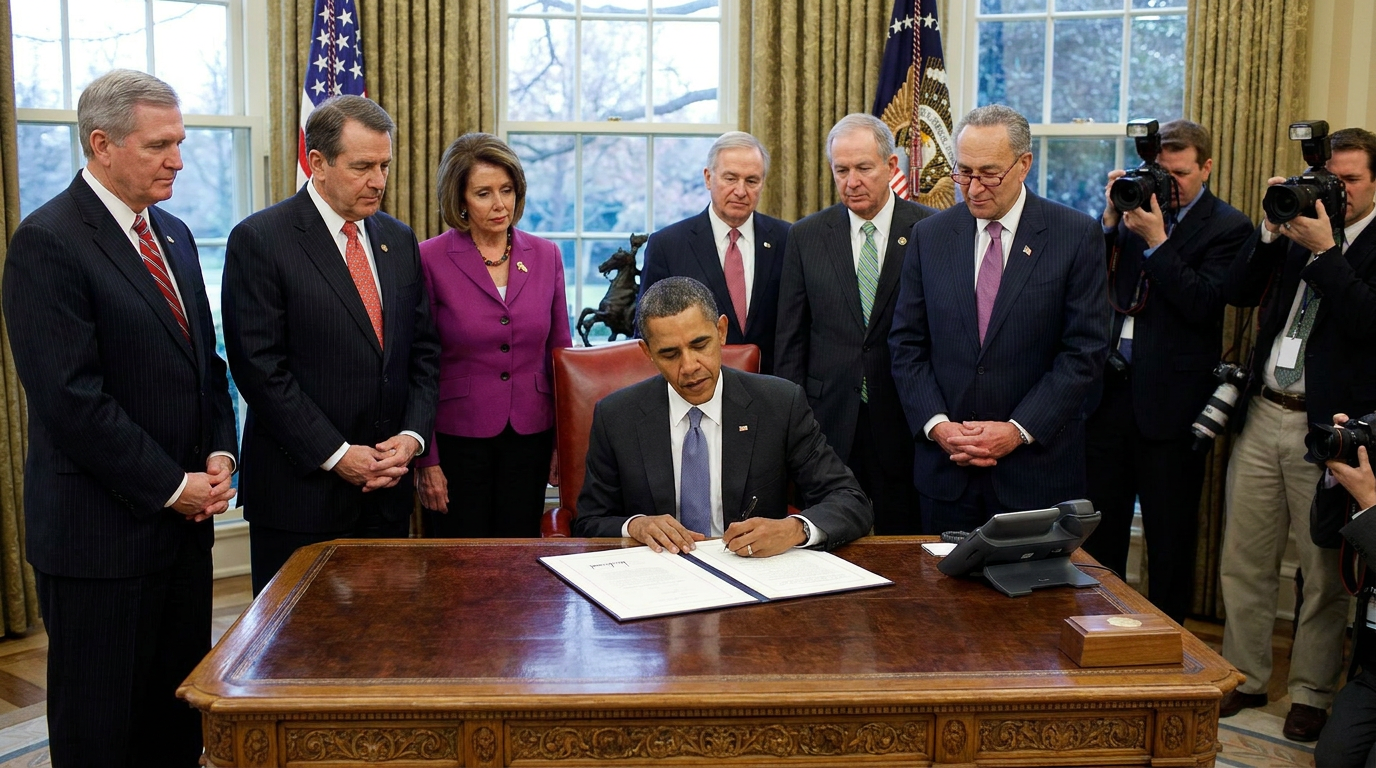
President Donald Trump has signed the "Secure America Act" into law, authorizing roughly $70 billion in funding for federal immigration enforcement agencies through September 2029. The legislation, signed Wednesday in the Oval Office, ends a historic 75-day partial shutdown of the Department of Homeland Security (DHS) and guarantees financial backing for the administration's border and deportation operations through the remainder of Trump's presidency.[1][2]
The package allocates approximately $38 billion to Immigration and Customs Enforcement (ICE), $26 billion to Customs and Border Protection (CBP), and an additional $5 billion to broader DHS operations. By securing this funding through the end of fiscal year 2029, the Republican-led Congress has effectively bypassed the annual appropriations process for these agencies, insulating them from future legislative standoffs even if political control shifts in the upcoming midterm elections.[1][4][6]

"This morning, I'm thrilled to sign the Secure America Act to immediately and fully fund the Department of Homeland Security through the end of my term," Trump stated during the signing ceremony, flanked by Republican congressional leaders. He praised ICE and Border Patrol agents as "heroes" and emphasized that the resources would be used to defend borders, combat cartels, and enforce the nation's immigration laws.[1][2]
The bill's passage concludes a bitter, months-long political impasse that paralyzed much of the DHS. The standoff originated in late January following the deaths of two U.S. citizens, Alex Pretti and Renee Good, who were killed by federal agents in Minneapolis during an intensive immigration enforcement operation.[1][3]
In response to the Minneapolis incident, congressional Democrats boycotted DHS funding, demanding sweeping operational reforms. Their conditions included requiring judicial warrants for agents entering private property, mandating body cameras, prohibiting officers from wearing masks, and banning immigration arrests at sensitive locations like hospitals, schools, and churches.[4][6]
In response to the Minneapolis incident, congressional Democrats boycotted DHS funding, demanding sweeping operational reforms.
Republican leadership and administration officials, including "Border Czar" Tom Homan, rejected the bulk of these demands, arguing that such restrictions would endanger law enforcement and hinder their ability to apprehend dangerous individuals. The resulting deadlock triggered a 75-day partial shutdown of the DHS starting in mid-February—the longest such lapse in U.S. history.[1][4][5]

To break the stalemate, Republicans utilized the budget reconciliation process, a legislative maneuver that allows the majority party to pass bills with direct budgetary impacts without needing bipartisan support to overcome a Senate filibuster. The Senate approved the measure following an 18-hour marathon voting session, and the House narrowly passed it 214–212 largely along party lines, with independent Representative Kevin Kiley joining Democrats in opposition.[1][2][6]
The newly unlocked funds will support a massive expansion of the nation's immigration apparatus. For ICE, the $31 billion earmarked for interior enforcement will finance personnel, transportation for repatriations, IT upgrades, and the expansion of 287(g) agreements, which allow state and local police to collaborate on federal immigration enforcement. CBP's $26 billion will fund border security technology, screening efforts, and additional agents at ports of entry.[1][4][5]

Democrats have fiercely criticized the maneuver and the resulting legislation. House Minority Leader Hakeem Jeffries condemned the package, stating that Republicans had given the administration "another $70bn blank check, with no oversight, no accountability and no guardrails." Critics warn the funding will transform the agencies into a "small military force" dedicated to executing the administration's stated goal of deporting one million undocumented immigrants annually.[1][6]
Conversely, Republican proponents argue the reconciliation route was a necessary response to Democratic obstruction. Representative Tom Cole, chair of the House Appropriations Committee, stated he was reluctant to use the maneuver but blamed Democrats for misusing the filibuster to force the issue. Meanwhile, conservative hardliners in the House, such as Representatives Chip Roy and Tim Burchett, secured promises from leadership to introduce future legislation that would permanently codify Trump's immigration policies into law.[3][6]
With the Secure America Act now enacted, the DHS is fully funded and operational. Government and industry leaders are already pivoting to implement the massive influx of resources, with upcoming summits scheduled to address how the agencies will deploy new surveillance technologies, artificial intelligence, and expanded operational capabilities across the country.[5]
How we got here
Jan. 24, 2026
Two U.S. citizens are killed during an immigration enforcement operation in Minneapolis, sparking protests.
Mid-Feb. 2026
Democrats block DHS funding over demands for ICE and CBP reforms, triggering a partial department shutdown.
April 30, 2026
Legislation is signed funding most of the DHS, but excluding ICE and CBP, continuing the standoff for those agencies.
June 9, 2026
The House narrowly passes the $70 billion Secure America Act via budget reconciliation, following Senate approval.
June 10, 2026
President Trump signs the bill into law, ending the 75-day funding lapse and securing agency budgets through 2029.
Viewpoints in depth
The Administration & Congressional Republicans
Argues the funding is essential for national security and law enforcement.
Republican leaders and the Trump administration maintain that the $70 billion package is a necessary investment to secure the border, dismantle criminal cartels, and enforce existing immigration laws. They view the budget reconciliation maneuver as a justified response to Democratic obstructionism, arguing that Democrats exploited the deaths in Minneapolis to push an anti-law-enforcement agenda. By securing funding through 2029, proponents believe they have successfully protected ICE and CBP from being weaponized in future partisan budget battles.
Congressional Democrats & Civil Rights Advocates
Views the legislation as a dangerous blank check for a mass deportation agenda.
Opponents of the Secure America Act argue that bypassing the standard appropriations process removes critical congressional oversight from agencies that require strict accountability. Following the deaths of two U.S. citizens during an ICE operation in January, Democrats demanded operational guardrails—such as mandatory body cameras and bans on masks—which were entirely excluded from the final bill. Critics warn that the unprecedented three-year funding runway will allow the administration to build a massive deportation and detention apparatus without any checks on potential civil rights abuses.
What we don't know
- How quickly ICE and CBP will be able to deploy the massive influx of capital to hire new personnel and acquire technology.
- Whether the promised follow-up legislation to permanently codify Trump's immigration policies will gain enough traction to pass the House.
- How state and local law enforcement agencies will respond to the expanded funding for 287(g) cooperation agreements.
Key terms
- Budget Reconciliation
- A special parliamentary procedure in Congress that expedites the passage of certain budgetary legislation by allowing it to bypass the Senate filibuster with a simple majority vote.
- 287(g) Agreements
- Programs that allow the Department of Homeland Security to delegate specific immigration enforcement authority to state and local law enforcement agencies.
- Appropriations Process
- The annual legislative procedure through which Congress allocates federal funds to various government departments and agencies.
Frequently asked
Why was the Department of Homeland Security shut down?
The DHS experienced a partial shutdown because congressional Democrats refused to authorize funding for ICE and CBP without attaching operational reforms, such as mandatory body cameras, following a deadly raid in Minneapolis.
How long does this new funding last?
The Secure America Act funds ICE and CBP through the end of fiscal year 2029, which extends roughly eight months beyond the end of President Trump's current term.
How did Republicans pass the bill without Democrats?
Republicans utilized the budget reconciliation process, a legislative tool that allows bills with direct budgetary impacts to pass the Senate with a simple majority, bypassing the 60-vote filibuster threshold.
Sources
Source coverage
6 outlets
3 viewpoints surfaced






[1]The GuardianOversight & Reform Proponents
ICE, borders and DHS: what’s in Trump’s $70bn immigration crackdown bill?
Read on The Guardian →[2]CBS NewsImmigration Enforcement Advocates
Trump signs $70 billion immigration bill, capping lengthy fight over ICE funding
Read on CBS News →[3]The Washington PostOversight & Reform Proponents
House passes $70 billion immigration enforcement package, ending DHS funding lapse
Read on The Washington Post →[4]Center for Immigration StudiesImmigration Enforcement Advocates
Congress (Finally) Passes Immigration-Enforcement Funding Bill for ICE and CBP
Read on Center for Immigration Studies →[5]Executive GovImmigration Enforcement Advocates
Trump Signs Secure America Act Into Law
Read on Executive Gov →[6]The Daily RecordOversight & Reform Proponents
Republicans approve $70 billion for immigration enforcement
Read on The Daily Record →

More in news politics
See all 5 stories →Middle East Diplomacy
US and Iran Near Interim Agreement to Halt Hostilities: What the Deal Contains
0 sources

Union Contracts
House Passes Sweeping Labor Bill Mandating Strict Timelines for First Union Contracts
0 sources
US-Iran Deal
US and Iran on the Brink of Historic Interim Peace Agreement to End War
0 sources

Every angle. Every day.
Get news politics stories with full source coverage and perspective breakdowns delivered to your inbox.