
Inside the $75 Billion SpaceX IPO: How the Largest Public Debut in History Worked
SpaceX has completed the largest initial public offering in global financial history, raising $75 billion and democratizing access to the commercial space economy.
By Factlen Editorial Team
- Growth Investors
- Focuses on the limitless total addressable market of space infrastructure and Starlink's recurring revenue.
- Market Structure & Regulatory Analysts
- Analyzes the mechanics of absorbing a historic equity block and the optimal pricing dynamics of mega-IPOs.
- Space Economy Strategists
- Views the IPO as a critical catalyst that will unlock venture capital for the broader commercial aerospace sector.
What's not represented
- · Environmental advocates concerned about orbital debris
- · Astronomers impacted by satellite constellations
Why this matters
The $75 billion SpaceX IPO is the largest in history, democratizing access to the commercial space economy by allowing everyday retail investors and 401(k) holders to own a stake in the company's future.
Key points
- SpaceX raised $75 billion in its IPO, shattering the previous global record held by Saudi Aramco.
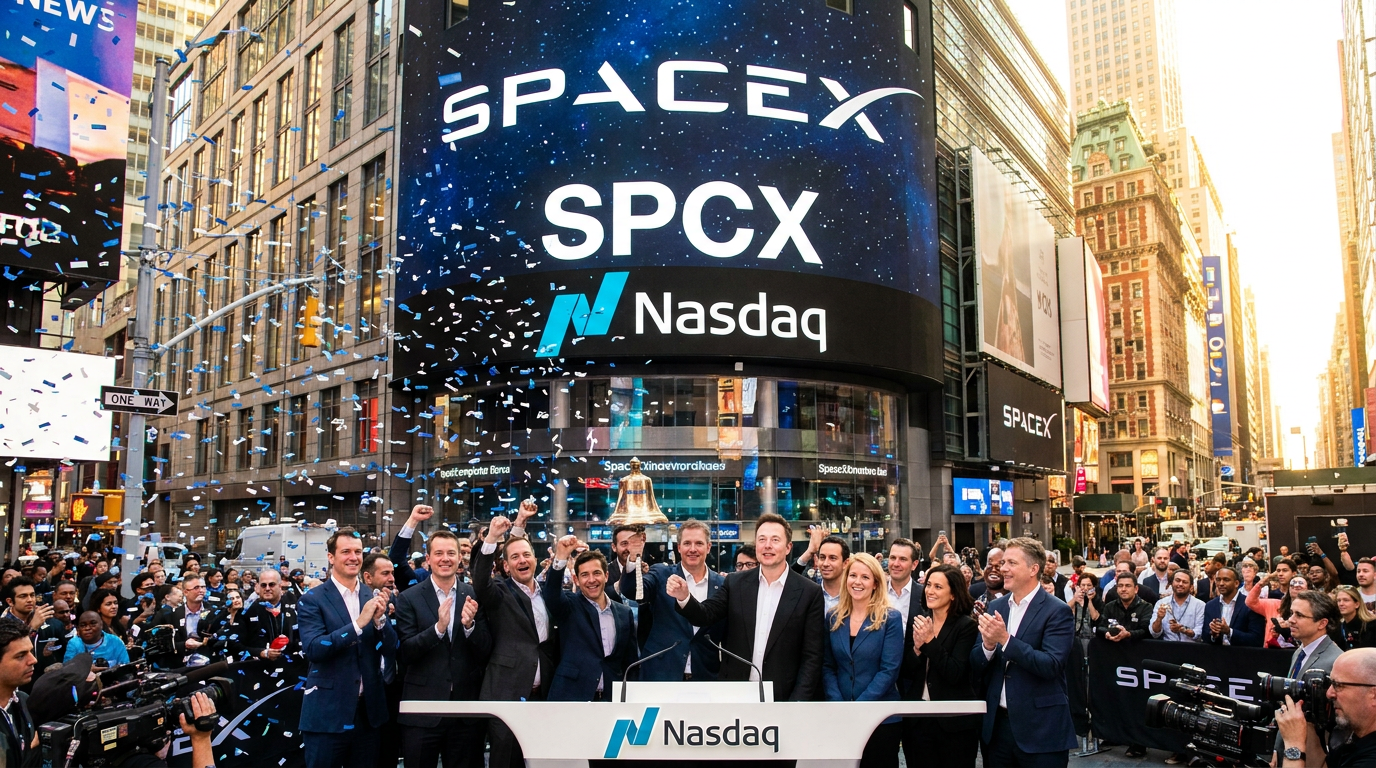
- Shares opened at $150 and closed up 19% on their first day of trading on the Nasdaq.
- The offering generated massive paper wealth for early employees and engineers.
- Institutional demand was heavily driven by the recurring subscription revenue of the Starlink satellite network.
- The capital will fund the development of Starship, Mars colonization, and space-based infrastructure.
- The successful debut paves the way for other highly anticipated mega-IPOs in the AI sector.
For decades, the public markets have waited for the commercial space industry to mature from a capital-intensive venture experiment into a liquid, publicly traded asset class. That transition arrived with historic force on Friday, as Space Exploration Technologies Corp.—better known as SpaceX—completed the largest initial public offering in global financial history. By selling 555.6 million shares at $135 each, the company raised a staggering $75 billion, shattering the previous record held by Saudi Aramco's $26 billion debut in 2019. The sheer scale of the offering immediately rewired the landscape of mega-cap technology stocks, instantly minting a new titan on the Nasdaq exchange and fundamentally altering the composition of major equity indices.[1][2][3]
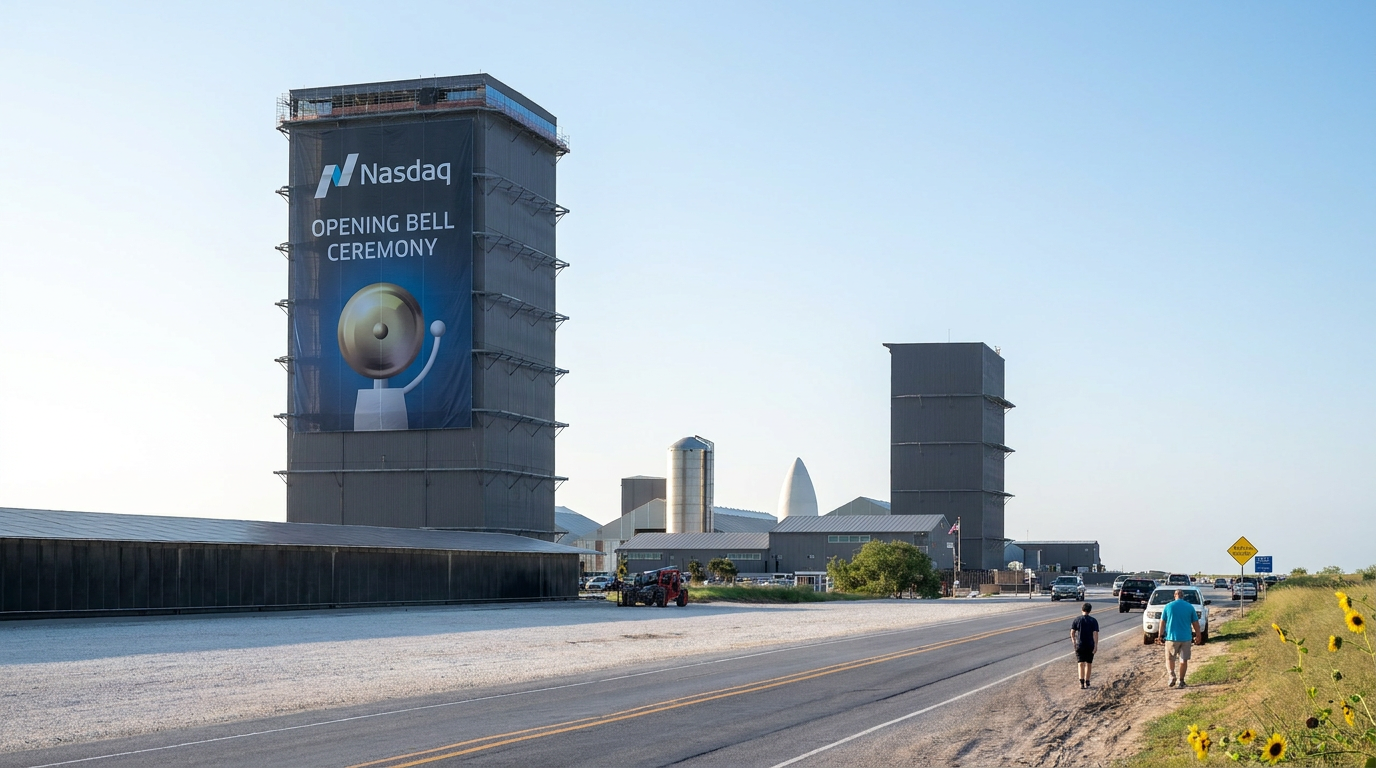
The mechanics of the debut bucked several Wall Street norms, reflecting the unique leverage held by a company with virtually no peer competitors. After pricing at $135 on Thursday evening, the stock—trading under the ticker symbol SPCX—opened at $150 and steadily climbed throughout its first session. It ultimately closed at $160.95, representing a 19% premium over its offering price and pushing the company's implied total equity valuation well past the $200 billion mark. The opening bell, rung at the company's Starbase headquarters in Texas rather than a New York trading floor, signaled a deliberate distancing from traditional financial centers, even as the company absorbed unprecedented amounts of their capital.[2][3]
Beyond the corporate balance sheet, the offering triggered one of the most concentrated wealth-creation events in modern corporate history. Thousands of early employees and engineers, who had previously held illiquid equity grants, suddenly found themselves in possession of marketable securities with deep institutional demand. Financial analysts tracking the debut noted that the paper wealth generated for the company's workforce in a single day was theoretically sufficient to purchase every residential property in mid-sized Texas municipalities. This sudden liquidity is expected to create localized economic booms in the regions where the company operates, mirroring the regional wealth effects seen during the early tech booms of the late 1990s.[1]

To understand how a private entity absorbs $75 billion in a single transaction, one must look at the underlying regulatory and structural mechanisms of the offering. The process began months ago with the confidential filing of a Form S-1 registration statement with the U.S. Securities and Exchange Commission. This document, which eventually became public, provided the first unvarnished look at the company's internal financials, stripping away the mystique of venture capital valuations and replacing it with audited revenue streams. The S-1 revealed that the company is no longer just a launch provider; it is a sprawling telecommunications and infrastructure conglomerate masquerading as a rocket manufacturer.[4][7]
Preparing the market infrastructure to handle the SPCX listing required weeks of intensive system testing by major brokerages and the Nasdaq exchange itself. Market makers were acutely aware of the technical glitches that marred Facebook's highly anticipated IPO in 2012, which caused hours of trading uncertainty and significant financial losses. To prevent a repeat, clearinghouses and trading desks stress-tested their order-routing algorithms to ensure they could process the massive volume of retail and institutional buy orders without crashing. The flawless execution of the debut was a testament to the modernized plumbing of the U.S. equity markets, which seamlessly digested the largest single-day equity injection on record.[3][7]
The financial engine justifying this unprecedented valuation is Starlink, the company's low-Earth orbit satellite internet constellation. While the reusable Falcon 9 rockets capture the public's imagination, institutional investors focused heavily on the recurring, high-margin subscription revenue generated by millions of Starlink terminals deployed globally. Financial disclosures indicated that this telecommunications division provides the steady cash flow necessary to subsidize the company's more speculative and capital-intensive research and development projects. In essence, public market investors are buying a high-growth internet service provider that happens to own its proprietary delivery mechanism.[4][7]
The $75 billion raised is not simply a payout to early investors; it is a massive war chest earmarked for some of the most ambitious engineering projects in human history. Corporate leadership has explicitly stated that the capital will finance the ongoing development of the Starship heavy-lift vehicle, the establishment of a permanent human presence on Mars, and the deployment of novel space-based infrastructure, including solar-powered data centers. These initiatives require capital expenditures on a scale that private venture markets can no longer support, necessitating the shift to the deeper pools of public equity.[2][4]

For the everyday retail investor, the IPO represents a democratization of access to a generational technology company. Previously, exposure to the commercial space sector was restricted to accredited investors, venture capital funds, and private equity firms. As SPCX begins trading, it is slated for rapid inclusion in major market benchmarks, including the Nasdaq 100 and the Russell indices. This index inclusion means that millions of Americans will automatically become indirect shareholders through their passive 401(k) retirement accounts and mutual funds, fundamentally linking the retirement security of the middle class to the success of the space economy.[2][5]
For the everyday retail investor, the IPO represents a democratization of access to a generational technology company.
From an academic perspective, the pricing dynamics of the offering offer a textbook case study in the delicate art of IPO underpricing. Financial economists generally view a first-day pop of 15% to 20% as the optimal sweet spot for a mega-IPO. It is large enough to reward the institutional investors who took the initial risk of buying the allocation, generating positive media coverage and trading momentum, but not so large that the issuing company feels it left money on the table. The 19% surge in SPCX shares perfectly threads this needle, satisfying both the issuing executives and the broader market apparatus.[5][6]
Despite the successful debut, retail investors are now grappling with the classic dilemma of whether it is too late to buy into the momentum. Financial advisors frequently point to the historical trajectory of other mega-cap disruptors, noting that initial public offerings are often just the starting line for long-term compounding. Comparisons are inevitably drawn to the early trading days of other electric vehicle and tech giants, where early volatility eventually gave way to massive multi-year gains for investors who maintained a long-term horizon and tolerated the inherent risks of emerging industries.[1][7]
The ripple effects of the offering extend far beyond the aerospace sector, providing a massive windfall for the Wall Street institutions that facilitated the deal. Major investment banks, which underwrote the offering and managed the order book, are expected to report bumper trading income for the second quarter. The sheer volume of shares changing hands, combined with the elevated volatility typical of a newly listed mega-cap stock, creates a highly profitable environment for market makers and trading desks. Analysts have noted that investors often overlook the direct financial upside that these blockbuster listings provide to the banking sector itself.[1]

More broadly, the successful absorption of a $75 billion space equity serves as a powerful catalyst for the entire commercial aerospace ecosystem. For years, smaller launch providers, satellite manufacturers, and orbital logistics startups have struggled to secure late-stage funding, as venture capitalists worried about the lack of viable exit opportunities. The SPCX debut proves that the public markets possess a deep, structural appetite for space-based business models, effectively unlocking the exit door for dozens of smaller competitors and likely sparking a new wave of investment across the sector.[3][7]
However, this unprecedented valuation is not without significant uncertainty and execution risk. The company's roadmap relies heavily on the successful commercialization of the Starship platform, a vehicle that is still undergoing iterative testing and faces stringent regulatory oversight from aviation and environmental authorities. Furthermore, the deployment of tens of thousands of satellites has raised concerns regarding orbital debris management and astronomical interference. If the company encounters prolonged delays in its launch cadence or faces unexpected regulatory roadblocks, the premium valuation attached to its shares could contract sharply.[4][7]
Finally, the market's enthusiastic reception of the offering signals a broader readiness for the next wave of generational technology debuts. With the space sector now successfully integrated into the public markets, attention is rapidly shifting toward the artificial intelligence industry. The liquidity and risk appetite demonstrated during the SPCX listing suggest that the market is primed to absorb upcoming, highly anticipated IPOs from AI leaders like OpenAI and Anthropic. In this sense, the space debut is not just an isolated event, but the opening chapter of a massive structural rotation in the public equity markets.[2][3]

Ultimately, the $75 billion initial public offering marks a profound maturation point for both the company and the broader financial ecosystem. It bridges the gap between science fiction and fiduciary duty, transforming interplanetary ambitions into quarterly earnings reports and SEC filings. As the stock settles into its regular trading rhythm, the true test will be whether the company can consistently deliver the exponential growth required to justify its historic valuation, proving that the commercialization of space is not just a technological marvel, but a sustainable financial reality.[7]
How we got here
2019
Saudi Aramco sets the previous global IPO record by raising $26 billion.
Early 2026
SpaceX confidentially files its Form S-1 with the SEC, revealing the financial strength of its Starlink division.
June 11, 2026
SpaceX officially prices its offering at $135 per share, aiming to raise $75 billion.
June 12, 2026
Elon Musk rings the opening bell at Starbase, Texas, and SPCX shares begin trading on the Nasdaq.
June 12, 2026 (Close)
SPCX closes at $160.95, marking a 19% first-day surge and validating the historic valuation.
Viewpoints in depth
Growth Investors' View
Viewing the IPO as a generational entry point into a monopolistic infrastructure provider.
For growth-oriented investors, the $200 billion implied valuation is easily justified by the company's dual monopolies in reusable launch vehicles and low-Earth orbit satellite internet. They argue that Starlink alone operates as a high-margin telecommunications giant with a virtually limitless total addressable market, capable of funding the more speculative Mars ambitions. From this perspective, the 19% first-day pop is just the beginning of a multi-decade compounding trajectory similar to early investments in major tech platforms.
Market Structure Analysts' View
Focusing on the flawless execution of the largest equity injection in financial history.
Financial economists and market infrastructure experts are primarily focused on the mechanics of the $75 billion raise. They highlight the meticulous preparation by Wall Street banks and the Nasdaq exchange to avoid the technical failures that plagued previous mega-IPOs. Furthermore, academics point to the 19% underpricing as a perfectly calibrated maneuver—ensuring enough day-one momentum to satisfy institutional buyers without excessively diluting the capital raised for the company's balance sheet.
Space Economy Strategists' View
Seeing the liquidity event as the rising tide that will lift the entire commercial aerospace sector.
Industry strategists view the SpaceX IPO not merely as a single company's milestone, but as the unlocking of the commercial space sector as a mature asset class. For years, venture capital has hesitated to fund capital-intensive space startups due to a lack of clear exit strategies. By proving that public markets possess a deep, structural appetite for space equities, this IPO provides a definitive exit pathway, likely triggering a new wave of funding for smaller satellite manufacturers, orbital logistics firms, and competing launch providers.
What we don't know
- Whether the company can maintain its aggressive Starship development timeline without regulatory delays.
- How the eventual inclusion of SPCX into major indices will impact the volatility of the broader Nasdaq 100.
- If the success of this IPO will immediately trigger public filings from AI giants like OpenAI and Anthropic.
Key terms
- Initial Public Offering (IPO)
- The process by which a private company offers its shares to the public for the first time, allowing it to raise capital from everyday investors.
- Underpricing
- The strategic practice of listing an IPO slightly below its true market value to ensure a first-day price surge and strong trading momentum.
- Form S-1
- The initial registration form required by the SEC for U.S. companies planning to go public, detailing their business model, risks, and audited financials.
- Index Inclusion
- When a newly public company is added to major stock market benchmarks, forcing passive mutual funds and ETFs to automatically buy its shares.
Frequently asked
What is the ticker symbol for SpaceX?
SpaceX is trading on the Nasdaq Stock Exchange under the ticker symbol SPCX.
How much money did the SpaceX IPO raise?
The company raised $75 billion, making it the largest initial public offering in global financial history.
Can retail investors buy SpaceX stock?
Yes. Beyond direct stock purchases, retail investors will soon gain indirect exposure as the company is added to major indices like the Nasdaq 100, which are tracked by standard 401(k) mutual funds.
What will the IPO funds be used for?
The $75 billion war chest is earmarked for capital-intensive projects, including the development of the Starship heavy-lift vehicle, Mars colonization efforts, and space-based solar data centers.
Sources
Source coverage
7 outlets
3 viewpoints surfaced







[1]MarketWatchGrowth Investors
How Elon Musk nailed the SpaceX IPO: ‘I’m not sure that this could have gone much better’
Read on MarketWatch →[2]CBS NewsGrowth Investors
SpaceX stock soars 19% on first day of trading following record-breaking $75 billion IPO
Read on CBS News →[3]CNBCGrowth Investors
SpaceX prices record $75 billion IPO, eyes Nasdaq debut
Read on CNBC →[4]U.S. Securities and Exchange CommissionMarket Structure & Regulatory Analysts
Form S-1 Registration Statement: Space Exploration Technologies Corp.
Read on U.S. Securities and Exchange Commission →[5]Journal of Financial EconomicsMarket Structure & Regulatory Analysts
Pricing Dynamics and Retail Allocation in Mega-IPOs
Read on Journal of Financial Economics →[6]University of Florida Warrington College of BusinessMarket Structure & Regulatory Analysts
Initial Public Offerings: Updated Statistics
Read on University of Florida Warrington College of Business →[7]Factlen Editorial TeamSpace Economy Strategists
Synthesis by Factlen editorial team
Read on Factlen Editorial Team →
More in finance
See all 5 stories →
Every angle. Every day.
Get finance stories with full source coverage and perspective breakdowns delivered to your inbox.