
How Bidirectional Charging is Turning Electric Vehicles into Massive Home Batteries
Vehicle-to-Home (V2H) technology is reaching mainstream adoption in 2026, allowing electric vehicles to provide days of backup power and slash household utility bills.
By Factlen Editorial Team
- Homeowners & EV Drivers
- Value V2H for energy independence, blackout resilience, and lowering daily utility bills through peak shaving.
- Automakers & Hardware Providers
- View bidirectional charging as a major value-add that justifies EV premiums and opens new revenue streams in home energy management.
- Grid Operators & Utilities
- See EVs as distributed energy resources that can alleviate evening peak demand and stabilize the grid without building new power plants.
What's not represented
- · Renters and multi-family housing residents who cannot install personal bidirectional chargers
- · Independent electricians tasked with installing complex transfer switches
Why this matters
For the first time, the massive battery you already paid for in your driveway can protect your home from blackouts and actively lower your daily electricity bill, fundamentally changing the economics of EV ownership.
Key points
- Vehicle-to-Home (V2H) technology allows electric vehicles to power a house, acting as a massive backup battery.
- A typical EV battery holds nearly ten times the energy of a standard stationary home battery.
- Homeowners can save thousands by charging off-peak and powering their home during expensive evening hours.
- 2026 marks a tipping point as major automakers make bidirectional hardware standard across new models.
- Unlike Vehicle-to-Grid (V2G), V2H operates entirely behind the meter and requires no utility permission.
The automotive industry is undergoing a quiet but profound shift in 2026. For years, the electric vehicle transition was framed entirely around tailpipe emissions and transportation. But as battery capacities have swelled, a second, arguably more disruptive wave of innovation has arrived: the transformation of the car into a mobile power plant.[2]
The math behind this shift is staggering. A standard stationary home battery, such as a Tesla Powerwall, holds roughly 13.5 kilowatt-hours (kWh) of electricity. Meanwhile, a modern electric vehicle like the Ford F-150 Lightning carries up to 131 kWh of usable capacity. That is nearly ten times the energy storage, sitting idle in the garage for 95 percent of its life.[6]

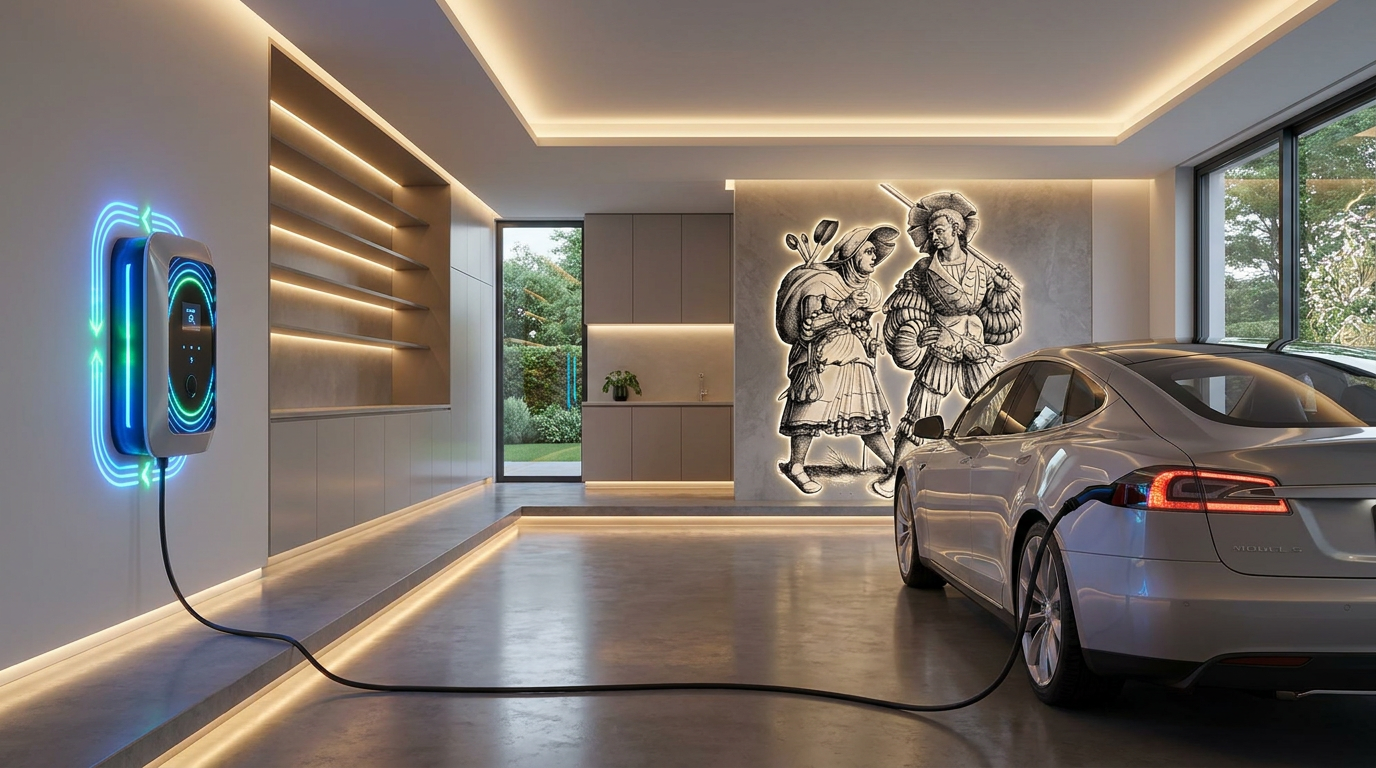
Unlocking that dormant capacity relies on a technology called Vehicle-to-Home (V2H) bidirectional charging. Standard EV chargers act as one-way valves, pushing alternating current (AC) from the grid into the vehicle, where it is converted to direct current (DC) and stored. Bidirectional chargers feature sophisticated power electronics that can reverse this flow, converting the battery's DC power back into AC to feed the home's electrical panel.[7]
While the concept has existed in niche applications for over a decade, 2026 marks the tipping point for mainstream adoption. Major automakers are standardizing the hardware. General Motors is expanding V2H capabilities across its entire retail portfolio of Ultium-based EVs, while brands like BMW, Mercedes-Benz, and Tesla are activating bidirectional features in their latest models.[5][8]

For homeowners, the most immediate draw is blackout resilience. As extreme weather events increasingly strain aging power grids, the EV offers a silent, emission-free alternative to a diesel generator. A fully charged, large-capacity EV can power an average American home for three to ten days, keeping refrigerators running, medical devices powered, and HVAC systems online during extended outages.[6]
But V2H is not just an emergency fail-safe; it is an active financial tool. Through a practice known as time-of-use (TOU) arbitrage, homeowners can program their systems to buy electricity from the grid overnight when rates are rock-bottom—often around $0.12 per kWh.[7]
But V2H is not just an emergency fail-safe; it is an active financial tool.
When evening arrives and utility rates spike to peak pricing—sometimes exceeding $0.45 per kWh in markets like California—the home automatically disconnects from the grid and draws power from the car. The homeowner effectively runs their evening appliances on cheap, overnight electricity.[7]

The savings from this daily cycle are substantial. A comprehensive study by the University of Michigan found that utilizing V2H could slash an EV owner's lifetime charging costs by 40 to 90 percent, translating to thousands of dollars in savings. By turning the vehicle into an active energy asset, the financial burden of charging is heavily mitigated.[3]
The technology becomes even more potent when paired with rooftop solar panels. Currently, about one in four EV owners also has a home solar array. Without a home battery, excess solar energy generated during the day is often exported back to the grid for pennies on the dollar.[4]
V2H changes that equation entirely. Instead of exporting surplus solar power, the home can funnel it directly into the EV's massive battery. When the sun goes down, the house draws on that stored solar energy, drastically increasing the household's self-consumption rate and reducing reliance on fossil-fuel-heavy evening grid power.[1][4]
Crucially, V2H is scaling faster than its more complex sibling, Vehicle-to-Grid (V2G). While V2G involves exporting power back to the utility network to earn credits, it requires navigating a labyrinth of regulations, metering rules, and retailer approvals. V2H operates entirely "behind the meter," meaning homeowners do not need utility permission to power their own houses.[1]

Despite the clear benefits, widespread adoption still faces hurdles, primarily in upfront costs. While the massive battery is already paid for inside the car, the external hardware required to use it is not cheap. Installing a bidirectional charger and the necessary automatic transfer switch—which safely isolates the home from the grid during an outage—typically costs between $1,500 and $8,000.[6]
There is also lingering consumer anxiety about battery degradation. Repeatedly discharging an EV battery to power a house constitutes "micro-cycling," which can theoretically accelerate wear. However, automakers are increasingly confident in their battery management software, which limits the depth of these discharges, and companies like Ford and Nissan now explicitly cover V2H usage under their standard battery warranties.[3][9]
Ultimately, the rise of bidirectional charging represents a fundamental reimagining of energy infrastructure. By 2036, the global bidirectional charging market is projected to reach $5.8 billion, turning millions of parked cars into a distributed network of energy resources. The electric vehicle is no longer just a way to get from point A to point B; it is the cornerstone of the modern, resilient home.[2]
How we got here
2013
Nissan introduces the Leaf with CHAdeMO bidirectional charging, pioneering early V2H concepts.
2022
Ford launches the F-150 Lightning with Intelligent Backup Power, bringing V2H to the mainstream US market.
2024
Several states and utilities launch pilot programs to test the grid impact of bidirectional charging.
2026
Major automakers, including GM and BMW, make V2H hardware standard across their new EV lineups.
Viewpoints in depth
Homeowners & EV Drivers
Focus on the immediate, tangible benefits of V2H behind the meter.
For consumers, the appeal of bidirectional charging lies entirely behind the meter. They are less concerned with stabilizing the national grid and more focused on keeping the lights on during severe weather and slashing their monthly utility bills. The ability to avoid buying a $10,000 stationary home battery by utilizing the car they already own fundamentally changes the economics of EV ownership. The primary friction point for this group remains the high upfront cost of installing the specialized charger and transfer switch.
Automakers & Hardware Providers
View bidirectional charging as a crucial differentiator and a gateway to new revenue.
For manufacturers, bidirectional charging is a necessary feature in an increasingly competitive EV market. Companies like GM and Ford are expanding into comprehensive energy management ecosystems, selling not just the car, but the bidirectional charger, the transfer switch, and the software to run it all. This strategy transforms automakers from one-time vehicle sellers into lifelong home energy partners, creating a sticky ecosystem that rivals traditional tech companies.
Grid Operators & Utilities
See EVs as a tool to flatten the demand curve and avoid building new power plants.
Utilities view the millions of EVs hitting the road as either a looming crisis or a massive opportunity. If every EV charges at 6 PM, the grid could buckle. But if those EVs power their owners' homes during the evening peak and charge at 2 AM, they effectively flatten the demand curve. Utilities are highly motivated to incentivize V2H adoption, as utilizing distributed EV batteries is vastly cheaper than building and maintaining expensive new natural gas peaker plants.
What we don't know
- How quickly the cost of bidirectional chargers and transfer switches will drop as the technology scales.
- Whether long-term, daily micro-cycling will have unforeseen impacts on EV battery longevity over a 10-year lifespan.
- How utility companies might alter Time-of-Use rate structures if millions of homes stop buying evening power.
Key terms
- Bidirectional Charging
- Technology that allows electricity to flow both into an electric vehicle's battery and back out to a home or the grid.
- Vehicle-to-Home (V2H)
- A system where an EV supplies power directly to a house, acting as a massive backup battery.
- Vehicle-to-Grid (V2G)
- A system where an EV exports stored energy back to the public utility grid, often for financial compensation.
- Time-of-Use (TOU) Rates
- A utility pricing structure where electricity costs more during peak demand hours (usually evenings) and less during off-peak hours (overnight).
- Automatic Transfer Switch
- A device that safely disconnects a home from the public power grid during an outage, allowing the EV to power the house without backfeeding dangerous voltage to utility lines.
Frequently asked
Does powering my home degrade my EV's battery faster?
Micro-cycling does add some wear, but modern EV battery management systems keep discharges shallow to protect longevity. Automakers like Ford and Nissan now explicitly cover V2H usage in their standard battery warranties.
What happens if I need to drive during a blackout?
You can set reserve limits in the charger's companion app, ensuring the car never drains below a certain range (e.g., 50 miles) so you always have enough power to drive in an emergency.
Can I use any electric vehicle for V2H?
No. Both the vehicle and the home charger must support bidirectional charging. While it is becoming a standard feature on new models in 2026, many older EVs only support one-way charging.
Sources
Source coverage
9 outlets
3 viewpoints surfaced









[1]Energy MattersHomeowners & EV Drivers
Vehicle to Home is the Bidirectional Upgrade You'll Use in 2026
Read on Energy Matters →[2]Torque NewsAutomakers & Hardware Providers
The Battery on Wheels Revolution And Why 2026 Marks the Dawn of the $5.8 Billion Vehicle-to-Grid Era
Read on Torque News →[3]Engineers IrelandGrid Operators & Utilities
EV-to-home energy supply could cut charging costs by up to 90%
Read on Engineers Ireland →[4]American Solar Energy SocietyGrid Operators & Utilities
V2H: Vehicle-to-Home Bi-Directional Charging
Read on American Solar Energy Society →[5]EcoFlowAutomakers & Hardware Providers
Bidirectional Charging (V2G) in 2026: Which Cars Finally Support It?
Read on EcoFlow →[6]NuWattHomeowners & EV Drivers
Bidirectional EV Charging & V2H in 2026: Can Your EV Replace a Home Battery?
Read on NuWatt →[7]AMPECOGrid Operators & Utilities
What is Vehicle-to-Home (V2H) and How It Works?
Read on AMPECO →[8]PCMagAutomakers & Hardware Providers
GM's Newest EVs Will Be Able to Power Your Home by 2026
Read on PCMag →[9]StacyknowsHomeowners & EV Drivers
Bidirectional Charging Explained: Your 2026 EV Guide
Read on Stacyknows →


Every angle. Every day.
Get home stories with full source coverage and perspective breakdowns delivered to your inbox.