
Hardside vs. Softside Luggage: The Ultimate Carry-On Material Comparison
A comprehensive trade-off analysis between polycarbonate hardshells and ballistic nylon softshells to help you choose a carry-on that will last a decade.
By Factlen Editorial Team
- Hardshell Advocates
- Prioritize impact protection, weather resistance, and sleek, lightweight designs.
- Softshell Traditionalists
- Value exterior organization, flexibility, and extreme abrasion resistance.
- Pragmatic Testers
- Focus on long-term value, warranty quality, and real-world durability over shell material.
What's not represented
- · Budget travelers who rely on cheaper ABS plastic or basic polyester bags rather than premium materials.
- · Backpackers who eschew wheeled luggage entirely in favor of wearable travel packs.
Why this matters
A high-quality carry-on is a decade-long investment that dictates how smoothly you navigate airports, hotel rooms, and overhead bins. Choosing the wrong material can lead to broken zippers, damaged valuables, and the frustration of replacing your luggage every few years.
Key points
- Polycarbonate hardshells offer superior impact protection and weather resistance, making them ideal for carrying fragile items.
- Ballistic nylon softshells provide unmatched abrasion resistance and the convenience of exterior pockets for quick access.
- Hardshells require double the floor space to open due to their clamshell design, while softshells use a space-saving lid opening.
- Despite their armored appearance, polycarbonate carry-ons are often lighter than high-denier nylon bags.
- The best choice depends on your travel style: hardshells excel in protection and aesthetics, while softshells win on flexibility and organization.
The search for the perfect carry-on suitcase is a rite of passage for any frequent traveler. With airlines strictly enforcing size limits and overhead bin space becoming a competitive sport, the luggage you choose can make or break a journey. At the center of this decision is a decades-old debate: should you invest in a rigid hardside case or a flexible softside bag?[7]
The stakes are higher than simply aesthetics. A broken wheel, a cracked shell, or a busted zipper in the middle of a busy terminal is a traveler's worst nightmare. Modern luggage engineering has advanced significantly, leaving travelers to choose between two dominant, high-performance materials: polycarbonate for hardshells and ballistic nylon for softshells.[2][7]
Understanding the structural differences between these two materials is essential. Polycarbonate is a thermoplastic polymer designed to flex under pressure, while ballistic nylon is a thick, synthetic fabric originally developed for military flak jackets. Each material dictates not just how the bag looks, but how it packs, how it rolls, and how it survives the rigors of modern air travel.[5][6]
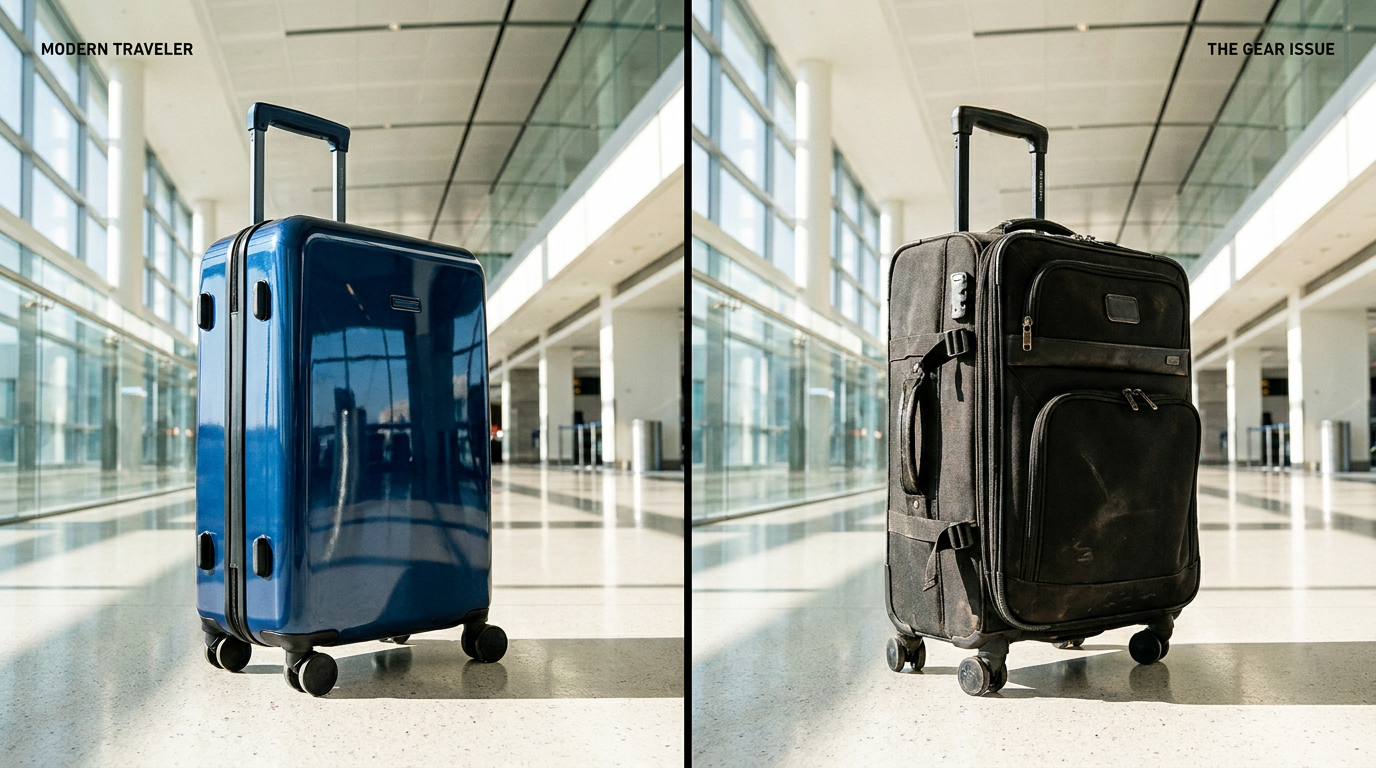
For polycarbonate hardshells, the primary argument centers on impact resistance and weatherproofing. The rigid exterior acts as a protective armor for fragile items like laptops, camera lenses, or glass souvenirs. Furthermore, the non-porous surface effortlessly repels rain, snow, and accidental spills, allowing travelers to wipe the bag clean with a damp cloth.[4][6]

Against polycarbonate, the drawbacks are largely spatial and cosmetic. Hardshells utilize a clamshell design, meaning the bag opens down the middle into two equal halves. This requires double the floor space to pack or unpack—a significant frustration in cramped hotel rooms. Additionally, polycarbonate lacks exterior pockets, forcing travelers to open the entire suitcase just to retrieve a laptop or a boarding pass. Aesthetically, while polycarbonate bends rather than breaks, it is highly susceptible to visible scuffs and scratches over time.[2][3]
The evidence for polycarbonate's performance is robust. Independent testing labs consistently find that high-quality polycarbonate can absorb immense blunt force, denting inward and then popping back into its original shape. Premium brands utilizing this material typically produce carry-ons weighing between seven and eight pounds, making them surprisingly lightweight despite their armored appearance.[5][6]
Independent testing labs consistently find that high-quality polycarbonate can absorb immense blunt force, denting inward and then popping back into its original shape.
For ballistic nylon softshells, the case rests on exterior organization and flexibility. Softside bags feature a lid-style opening, requiring minimal space to access the main compartment. The inclusion of deep exterior pockets allows travelers to stash jackets, books, and electronics for instant access during security checks. Crucially, the fabric has inherent give, meaning a slightly overpacked softshell can often be squeezed and squished into a tight overhead bin where a rigid hardshell would be rejected.[2][4]

Against ballistic nylon, the primary complaints involve weight and weather vulnerability. High-denier nylon requires a heavy internal chassis to maintain its shape, often making premium softside bags heavier than their plastic counterparts. Furthermore, while the fabric is treated to be water-resistant, it is not waterproof; a suitcase left on a rainy tarmac will eventually absorb moisture. Finally, fabric is much harder to clean, holding onto dust, odors, and stains more stubbornly than a smooth plastic shell.[5][6]
The evidence supporting high-denier nylon is undeniable, particularly regarding longevity. Ballistic nylon is virtually immune to the scuffs, scratches, and cracks that plague hardshells. In rigorous, decade-long evaluations by consumer testing groups, premium nylon bags like the Travelpro Platinum Elite consistently take top honors for their ability to survive years of airline abuse without showing significant wear. However, these bags typically weigh between eight and ten pounds, a noticeable increase over polycarbonate.[1][3]
When comparing capacity and expansion, the two materials diverge sharply. Softside luggage almost universally features zippered expansion gussets, allowing travelers to add up to two inches of depth for the return trip. While some modern hardshells offer expansion, their rigid nature means they cannot stretch to accommodate an oddly shaped item. The clamshell design of a hardshell forces a disciplined, organized approach to packing, whereas a softshell's cavernous main compartment is more forgiving of last-minute stuffing.[2][4]

Price is another critical metric in this trade-off analysis. Premium polycarbonate carry-ons from direct-to-consumer brands typically range from $275 to $400, offering excellent value for the technology. In contrast, top-tier ballistic nylon bags from legacy brands often command prices between $365 and $700 or more. The higher cost of nylon is often justified by the inclusion of complex organizational features, garment folders, and robust lifetime warranties that cover airline damage.[1][7]
Ultimately, the decision comes down to matching the material to the specific demands of the journey. There is no single winner without conditions; the best choice depends entirely on how, where, and why you travel.[7]
A polycarbonate hardshell fits well when you frequently travel with fragile electronics, prioritize a lightweight bag, and prefer a sleek, modern aesthetic. It is the ideal companion for travelers who use packing cubes, value weather resistance, and do not mind opening their bag fully to access their belongings. It does not fit well when you rely on exterior pockets for quick access or frequently find yourself trying to cram an overstuffed bag into a tiny regional jet overhead bin.[2][6]

Conversely, a ballistic nylon softshell fits well when you value extreme abrasion resistance, need exterior pockets for on-the-go organization, and prefer a lid-style opening for packing in tight spaces. It is the gold standard for business travelers and chronic overpackers who need a bag that can stretch. It does not fit well when you are strictly minimizing weight, traveling to destinations with heavy rainfall, or carrying delicate items that require rigid protection.[1][4]
How we got here
1980s
Ballistic nylon is introduced to consumer luggage, setting a new standard for softside durability.
2000s
Polycarbonate emerges as a premium hardshell material, offering a lighter, flexible alternative to heavy plastics.
2010s
Four-wheel 'spinner' designs become the industry standard, heavily favoring the rigid structure of hardshell bags.
2020s
Direct-to-consumer brands popularize sleek, minimalist polycarbonate carry-ons, sparking a resurgence in hardshell popularity.
Viewpoints in depth
The Hardshell Case
Prioritizes impact protection, weather resistance, and lightweight maneuverability.
Advocates for polycarbonate hardshells emphasize the material's ability to absorb blunt force by flexing and popping back into shape. They point out that hardshells offer superior protection for fragile items like laptops or camera gear, and their non-porous surfaces easily wipe clean after being dragged through rain or snow. For travelers who want a sleek, modern aesthetic and a bag that glides effortlessly on four spinner wheels, the hardshell is the undisputed champion.
The Softshell Case
Values exterior organization, squeezability, and extreme abrasion resistance.
Softshell loyalists argue that travel is fundamentally unpredictable, requiring a bag that can adapt. Ballistic nylon—originally developed for military flak jackets—resists tearing and scuffing far better than any plastic shell. Proponents highlight the unmatched convenience of exterior pockets for stashing a boarding pass or a jacket at the last minute. Furthermore, the lid-style opening of most softside bags requires half the floor space of a hardshell clamshell, making it vastly superior for packing in cramped hotel rooms.
The Tester Consensus
Focuses on warranty, wheel quality, and long-term cost-per-use over shell material.
Independent testing labs and frequent fliers argue that the hard-versus-soft debate misses the point. The true differentiators of a buy-it-for-life suitcase are the components that break first: the wheels, the telescoping handle, and the zippers. Testers consistently recommend investing in brands with robust, no-questions-asked lifetime warranties. Whether you choose polycarbonate or nylon, a bag backed by a company willing to repair airline damage will always outlast a cheaper alternative, making the initial premium price tag a wise long-term investment.
What we don't know
- How future airline weight restrictions might force travelers to abandon heavier ballistic nylon bags in favor of ultra-light materials.
- Whether emerging composite materials will eventually bridge the gap, offering the exterior pockets of a softshell with the impact resistance of a hardshell.
Key terms
- Polycarbonate
- A lightweight, flexible thermoplastic polymer used in premium hardshell luggage that bends under impact rather than cracking.
- Ballistic Nylon
- A thick, tough synthetic fabric originally developed for military use, known for its extreme resistance to abrasion and tearing.
- Clamshell Design
- A suitcase style that opens in the middle into two equal halves, typical of hardshell luggage.
- Denier
- A unit of measurement used to determine the thickness and weight of fabric threads; higher denier indicates stronger, heavier material.
- Spinner Wheels
- Four wheels mounted on the bottom of a suitcase that rotate 360 degrees, allowing the bag to be pushed upright in any direction.
Frequently asked
Is hardside or softside luggage lighter?
Surprisingly, polycarbonate hardside luggage is often lighter than high-quality ballistic nylon softside luggage, which requires heavy internal frames and thick fabrics.
Can softside luggage protect fragile items?
While softside bags offer some padding, hardshell polycarbonate suitcases provide significantly better impact protection for electronics and fragile souvenirs.
Which type of luggage is easier to fit in overhead bins?
Softside luggage has the advantage here; its flexible fabric can often be squeezed or squished into tight overhead compartments, whereas a rigid hardshell cannot.
Are hardshell suitcases waterproof?
They are highly water-resistant and will protect your belongings from rain and spills much better than fabric, though the zippers are usually not fully waterproof.
Sources
Source coverage
7 outlets
3 viewpoints surfaced






[1]WirecutterPragmatic Testers
The Best Carry-On Luggage
Read on Wirecutter →[2]ForbesPragmatic Testers
Hardside Vs. Softside Luggage: Which Is Better For Your Travel Needs?
Read on Forbes →[3]OutdoorGearLabPragmatic Testers
Best Carry-On Luggage of 2025
Read on OutdoorGearLab →[4]TravelproSoftshell Traditionalists
Hardside vs Softside Luggage - What's Best for You?
Read on Travelpro →[5]Delsey ParisHardshell Advocates
What Is the Most Durable Luggage Material?
Read on Delsey Paris →[6]Béis TravelHardshell Advocates
The Most Durable Luggage Materials for Frequent Flyers
Read on Béis Travel →[7]Factlen Editorial TeamPragmatic Testers
Synthesis by Factlen editorial team
Read on Factlen Editorial Team →

More in shopping
See all 25 stories →Home Appliances
Heat Pump Dryers: The 2026 Buying Guide and Explainer
0 sources
Display Tech
OLED vs. Mini-LED in 2026: The Ultimate Home Theater Trade-Off Analysis
0 sources

TV Tech
OLED vs. Mini-LED: Choosing the Right Premium TV in 2026
0 sources

Home Electrification
The 2026 Guide to Buying a Heat Pump: Ratings, Rebates, and Avoiding Costly Mistakes
0 sources

Every angle. Every day.
Get shopping stories with full source coverage and perspective breakdowns delivered to your inbox.