
Heat Pump Dryers: The 2026 Buying Guide and Explainer
Heat pump dryers are rapidly replacing traditional vented models due to massive energy savings and ventless installation, but buyers face a learning curve with longer drying times and higher upfront costs.
By Factlen Editorial Team
- Efficiency & Climate Advocates
- Focuses on the massive reduction in energy consumption and the elimination of fossil-fuel reliance.
- Consumer Testing Experts
- Highlights the practical trade-offs consumers face, particularly regarding drying speed and upfront costs.
- Appliance Technicians
- Emphasizes the importance of routine maintenance and the benefits of flexible installation.
What's not represented
- · Landlords and property managers balancing upfront appliance costs against tenant utility savings.
- · Commercial laundromat operators evaluating cycle turnover times.
Why this matters
Replacing a traditional dryer with a heat pump model is one of the single most impactful steps a household can take to lower utility bills and reduce carbon emissions. However, the technology requires a shift in daily laundry habits, making it crucial to understand the trade-offs before investing.
Key points
- Heat pump dryers use up to 70% less energy than traditional vented models.
- The ventless design allows them to be installed anywhere with a standard outlet and drain.
- Lower operating temperatures prevent fabric shrinkage and extend the life of clothing.
- Drying cycles take significantly longer, often ranging from two to four hours.
- Users must regularly clean a secondary condenser filter to maintain efficiency.
- Government rebates up to $840 are available in the US to offset higher upfront costs.
The laundry room is undergoing a quiet but profound revolution in 2026. For decades, the standard method for drying clothes involved a brute-force approach: baking garments with high-intensity electric or gas heat and then blasting the resulting damp, hot exhaust through a duct and out a hole in the wall. While effective at rapid drying, this traditional method is notoriously inefficient and tough on fabrics. Today, that legacy approach is being rapidly phased out across global markets in favor of advanced heat pump technology. Driven by stricter energy regulations, generous government incentives, and a growing consumer awareness of household carbon footprints, heat pump dryers have transitioned from a niche European luxury to the mainstream standard for modern home appliance upgrades.[6][7]
Unlike traditional vented models that constantly pull in fresh room air and expel it outside, a heat pump dryer operates on a highly efficient closed-loop refrigeration system. The mechanism is fundamentally similar to how a home air conditioner or refrigerator works, but applied to laundry. The machine pulls ambient air from the drum and passes it through a cold evaporator coil to rapidly extract the moisture from the wet clothes. Instead of venting that air away, the system then routes the dry air through a warm condenser coil to reheat it before sending it right back into the tumbling drum. This continuous cycle of extracting water and recycling the same heated air eliminates the massive energy waste associated with constantly heating new air from scratch.[3][5]
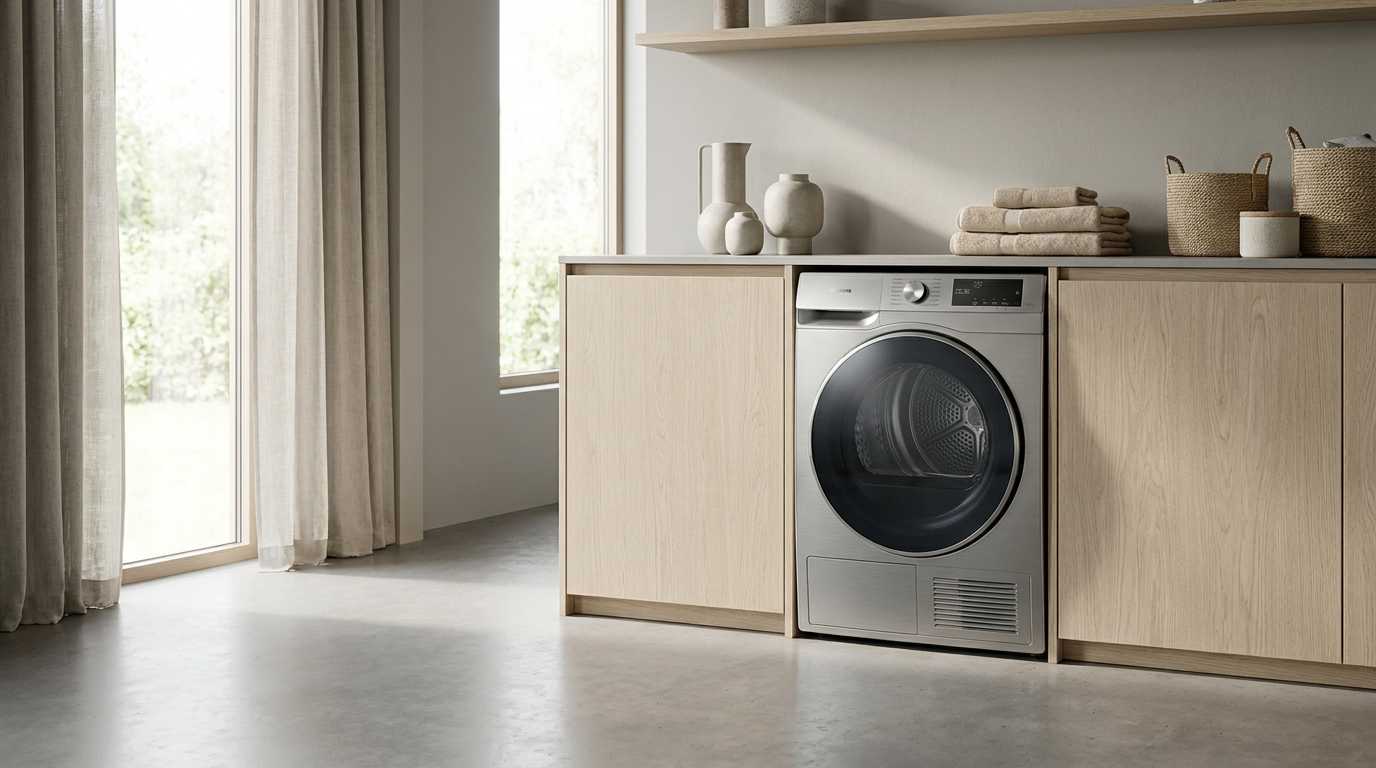
Because it completely recycles its own internal air, a heat pump dryer requires absolutely no external ventilation. This ventless design is a game-changer for home layout and installation flexibility. Without the need to route a bulky four-inch exhaust hose through walls or windows, the appliance can be installed virtually anywhere in a home that has a standard electrical outlet and a way to drain water. Homeowners are increasingly placing these units in hallway closets, under kitchen counters, or in interior bathrooms where traditional dryers could never safely operate. The extracted moisture is either collected in a pull-out tank that the user empties manually after a few loads, or it can be pumped directly into the same drain pipe used by the washing machine.[1][3]

The primary driver behind this sweeping industry shift is sheer electrical efficiency. Traditional electric dryers are often the second most power-hungry appliance in a home, trailing only the HVAC system. By recycling heat rather than generating it continuously with high-wattage resistance coils, heat pump models drastically cut power consumption. According to the U.S. Department of Energy's Energy Star program, certified heat pump dryers use approximately 70% less energy than conventional electric models. For a busy household running multiple loads of laundry per week, this translates to hundreds of dollars in utility savings annually. Over the typical ten-to-fifteen-year lifespan of a major appliance, the compounded energy savings easily offset the higher initial purchase price of the machine.[3][4]
To accelerate the adoption of this efficient technology, governments worldwide are heavily subsidizing the transition. In the United States, the Inflation Reduction Act's Home Energy Rebates Program offers point-of-sale discounts of up to $840 for low- and moderate-income households installing Energy Star-certified heat pump dryers. Electric utilities in many regions also offer local rebates that can be stacked with federal incentives. Meanwhile, in markets like the United Kingdom and Australia, tightening energy efficiency mandates are effectively pushing older, energy-wasting vented models off the market entirely. These financial incentives are designed to make the cleaner, more efficient technology accessible to a broader range of consumers, easing the friction of the higher upfront retail cost.[3][6]

Beyond lowering utility bills, heat pump technology fundamentally changes how clothes and textiles are treated during the drying process. Traditional vented dryers rely on scorching high heat that essentially cooks fabrics to evaporate water quickly. Over time, this aggressive baking process leads to noticeable garment shrinkage, faded colors, and the premature breakdown of elastic fibers. Heat pump models, by contrast, operate at significantly lower temperatures—often hovering around 120 degrees Fahrenheit compared to the 150 degrees or more found in conventional units. By gently coaxing moisture out of the garments through continuous dehumidification rather than extreme heat, these dryers dramatically extend the lifespan of wardrobes and keep delicate fabrics looking new for much longer.[5][6]
Beyond lowering utility bills, heat pump technology fundamentally changes how clothes and textiles are treated during the drying process.
However, this gentler approach comes with a distinct learning curve for new owners accustomed to the old way of doing laundry. Clothes emerging from a heat pump dryer often feel slightly cool and faintly damp to the touch immediately after the cycle ends. Appliance testing experts note that leaving approximately 4.5% to 6% residual moisture in the fabric is actually the ideal sweet spot for textile health. This microscopic level of moisture prevents the severe fiber damage and static cling caused by over-drying, even if it defies the hot, bone-dry expectations set by decades of using traditional machines. Users quickly learn that a quick shake of the garment in room-temperature air makes that perceived dampness vanish instantly.[4][7]
The most common and significant complaint from first-time heat pump dryer buyers is the speed of the cycle. Because they rely on lower temperatures and dehumidification rather than brute-force heat, heat pump dryers take substantially longer to finish a load. A standard load of everyday cottons might take up to two hours to dry completely, compared to 45 minutes in a vented model. When tackling heavy, moisture-retaining items like thick winter bedding, denim jeans, or large comforters, the drying time can easily stretch to three or four hours. For busy households used to churning through multiple loads of laundry in a single Saturday afternoon, this slower pace requires a deliberate adjustment to their weekly chore schedule.[1][2]

Historically, one of the major barriers to adopting heat pump dryers in North America was their physical size. Early models were largely limited to compact, 24-inch European-style dimensions that couldn't accommodate the massive loads typical of American households. However, the 2026 appliance market has completely solved this issue, featuring full-size 9-kilogram and 10-kilogram drums capable of handling king-size duvets and large family loads with ease. Major appliance brands have introduced hybrid models and full-size stacked WashTowers that bring uncompromising heat pump efficiency to massive capacities, ensuring that buyers no longer have to choose between saving energy and washing a week's worth of clothes at once.[1][6]
Another hidden but highly valuable benefit of heat pump technology is its electrical flexibility. While traditional electric dryers require a dedicated, heavy-duty 220-volt circuit to power their massive heating elements, the low power draw of a heat pump allows for different configurations. Several premium manufacturers now offer 110-volt heat pump models that can plug into a standard, everyday household wall outlet. This innovation is a massive boon for renters, owners of older homes, or anyone looking to relocate their laundry setup to a different floor. It completely eliminates the need to hire an electrician to run expensive new heavy-gauge wiring, drastically reducing the total cost of installation.[1][7]
Despite the numerous advantages, the sophisticated closed-loop system does require more active and consistent maintenance from the user. In a traditional dryer, most lint is simply blown out the exhaust vent into the yard. In a ventless heat pump dryer, all of that debris stays inside the machine. In addition to cleaning the standard lint trap inside the door after every single load, owners must regularly clean a secondary filter or vacuum the delicate condenser fins located at the bottom of the unit. Failing to keep these secondary components clear of lint, dust, and pet hair will severely restrict internal airflow, causing drying times to skyrocket and eventually leading to expensive compressor failures.[1][3]

To help mitigate user error and maximize efficiency, modern heat pump units are increasingly equipped with sophisticated smart features. Advanced AI-driven moisture sensors constantly monitor the humidity levels inside the drum, automatically terminating the cycle the exact moment the clothes reach the target dryness. This auto-sensing capability prevents the machine from running needlessly, saving even more energy and further protecting fabrics from unnecessary tumbling. Additionally, many 2026 models feature Wi-Fi connectivity and companion smartphone apps that alert users exactly when the secondary condenser filter needs cleaning, taking the guesswork out of routine maintenance and ensuring the appliance operates at peak performance for years.[3][6]
The broader environmental math heavily favors the widespread adoption of this new technology. Beyond the direct electricity savings, heat pump dryers offer a secondary efficiency boost to the entire home. Traditional vented dryers actively suck expensive, climate-controlled air—air you've already paid to heat in the winter or cool in the summer—out of your house and blast it outdoors, forcing your HVAC system to work harder to replace it. Ventless dryers leave your home's conditioned air exactly where it is. Combined with the industry's transition to low global-warming-potential refrigerants like R-290, replacing a conventional dryer with a heat pump model is one of the most impactful single steps a household can take to shrink its carbon footprint.[3][5]
Ultimately, upgrading to a heat pump dryer in 2026 requires a conscious shift in household laundry habits. Users must plan for longer, slower cycles, commit to a slightly more involved maintenance routine, and adjust their expectations regarding how clothes feel the moment they leave the drum. However, for those willing to adapt to the new rhythm, the trade-offs are overwhelmingly positive. The combination of massive long-term energy savings, remarkably gentle fabric care, and the sheer convenience of ventless, anywhere-installation makes the heat pump dryer the definitive, future-proof choice for the modern home.[7]
How we got here
Early 2000s
Heat pump dryers are introduced to the European market, gaining popularity due to strict energy costs and smaller homes.
2018
Major brands like Miele transition their entire dryer lineups to heat pump technology, phasing out traditional vented models.
2023
The US Inflation Reduction Act introduces up to $840 in rebates for low- and moderate-income households purchasing heat pump dryers.
2026
Full-size 10kg heat pump models and hybrid WashTowers become the standard recommendation for modern home appliance upgrades globally.
Viewpoints in depth
Efficiency & Climate Advocates
Focuses on the massive reduction in energy consumption and the elimination of fossil-fuel reliance.
For environmental groups and energy regulators, the heat pump dryer is a critical piece of the home electrification puzzle. Because these units use up to 70% less electricity than conventional models and operate on a closed-loop system, they drastically reduce a household's carbon footprint. Advocates emphasize that by pairing a heat pump dryer with a clean energy grid or home solar panels, consumers can effectively eliminate the emissions associated with one of the home's most power-hungry chores. The availability of substantial government rebates further underscores the policy push to make this technology the new standard.
Consumer Testing Experts
Highlights the practical trade-offs consumers face, particularly regarding drying speed and upfront costs.
Independent testing agencies acknowledge the long-term financial and environmental benefits but caution buyers about the day-to-day realities of the technology. The primary friction point is time: a load that takes 45 minutes in a vented dryer might take over two hours in a heat pump model. Furthermore, testers note that the sweet spot for fabric care leaves clothes with about 4.5% residual moisture, meaning garments won't have the hot, bone-dry feel many users expect. Experts advise that while the long-term savings are real, buyers must be prepared to adjust their laundry routines and absorb a higher initial purchase price.
Appliance Technicians
Emphasizes the importance of routine maintenance and the benefits of flexible installation.
From a service and installation perspective, heat pump dryers offer both significant advantages and new challenges. Technicians praise the ventless design and the availability of 110-volt models, which allow the units to be installed in closets or apartments without expensive electrical or ductwork upgrades. However, they also warn that the closed-loop system is highly sensitive to restricted airflow. Users must diligently clean not only the primary lint trap but also the secondary condenser filter. Neglecting this maintenance is the leading cause of extended drying times and premature component failure in heat pump models.
What we don't know
- Whether the higher upfront cost of heat pump dryers will drop significantly as manufacturing scales up globally.
- How the long-term reliability of the complex closed-loop compressors will compare to the simple heating elements of traditional dryers over a 15-year lifespan.
- If consumer frustration with longer drying times will slow adoption rates in markets historically accustomed to 45-minute laundry cycles.
Key terms
- Heat Pump Dryer
- A ventless appliance that uses a closed-loop refrigeration system to heat air, extract moisture, and recycle the heat to dry clothes efficiently.
- Condenser Dryer
- A ventless dryer that extracts moisture using a heat exchanger but relies on a traditional, energy-intensive heating element rather than a heat pump.
- Vented Dryer
- A traditional dryer that heats room air, passes it through wet clothes, and expels the hot, damp exhaust outside through a wall duct.
- Closed-Loop System
- A continuous cycle where the same air is repeatedly cooled to remove moisture and heated to dry clothes, preventing energy waste.
- R-290 Refrigerant
- A highly efficient, eco-friendly chemical compound used in modern heat pump compressors that has a very low global warming potential.
Frequently asked
Do I need a wall vent to install a heat pump dryer?
No. Heat pump dryers are entirely ventless. They collect extracted moisture in a pull-out tank that you empty manually, or they can pump the water directly into your washing machine's drain pipe.
Why do my clothes feel slightly damp when the cycle ends?
Heat pump dryers are designed to leave about 4.5% to 6% moisture in fabrics. This prevents the severe fiber damage and shrinkage caused by the bone-dry baking of traditional dryers; the perceived dampness vanishes quickly in room air.
Are heat pump dryers more expensive to buy?
Yes, they typically cost $200 to $700 more upfront than standard electric dryers. However, government rebates and massive long-term energy savings usually offset the initial price difference over the life of the appliance.
Can a heat pump dryer handle a king-size comforter?
Yes, modern 2026 models feature large 9kg and 10kg drums capable of handling heavy bedding, though bulky items may take three to four hours to dry completely.
Sources
Source coverage
7 outlets
3 viewpoints surfaced







[1]Yale ApplianceAppliance Technicians
Heat Pump Dryer Buying Guide & Reviews
Read on Yale Appliance →[2]Consumer NZConsumer Testing Experts
Clothes dryer buying guide
Read on Consumer NZ →[3]Energy StarEfficiency & Climate Advocates
Save Energy and Money and Protect the Climate With Heat Pump Dryers
Read on Energy Star →[4]CHOICEConsumer Testing Experts
Heat pump dryers buying guide
Read on CHOICE →[5]Elephant EnergyEfficiency & Climate Advocates
What is the difference between an electric dryer and a heat pump dryer?
Read on Elephant Energy →[6]Go AssistConsumer Testing Experts
Tumble Dryer Buying Guide
Read on Go Assist →[7]Factlen Editorial TeamAppliance Technicians
Synthesis by Factlen editorial team
Read on Factlen Editorial Team →
More in shopping
See all 24 stories →Display Tech
OLED vs. Mini-LED in 2026: The Ultimate Home Theater Trade-Off Analysis
0 sources

TV Tech
OLED vs. Mini-LED: Choosing the Right Premium TV in 2026
0 sources

Home Electrification
The 2026 Guide to Buying a Heat Pump: Ratings, Rebates, and Avoiding Costly Mistakes
0 sources
Used EVs
The Complete Guide to Buying a Used EV: Battery Health, Tax Credits, and Hidden Value
0 sources

Every angle. Every day.
Get shopping stories with full source coverage and perspective breakdowns delivered to your inbox.