
Do At-Home Red Light Therapy Masks Actually Work? An Evidence Review
Clinical data shows that at-home LED masks can genuinely boost collagen and reduce acne, but modest device power means consumers must commit to months of daily use to see results.
By Factlen Editorial Team
- Clinical Dermatologists
- Emphasize that while the science is sound, at-home devices cannot match the power of in-office treatments.
- Medical Researchers
- Focus on the proven biological mechanisms of photobiomodulation at the cellular level.
- Consumer Tech Reviewers
- Evaluate devices based on usability, comfort, and price-to-performance ratios.
- Factlen Editorial
- Synthesizes the evidence to provide a grounded consumer verdict.
What's not represented
- · Aesthetician device manufacturers
- · Budget skincare consumers
Why this matters
Consumers are spending hundreds of dollars on at-home light therapy devices based on social media hype. Understanding the clinical evidence ensures you invest in treatments that actually work and sets realistic expectations for your skin health.
Key points
- Red light therapy (photobiomodulation) works by stimulating mitochondria to produce more cellular energy.
- Clinical trials confirm that consistent use increases collagen density and reduces the appearance of fine lines.
- Devices combining red and blue light are highly effective at reducing inflammatory acne lesions.
- At-home masks are significantly less powerful than in-office lasers, requiring months of daily use to see results.
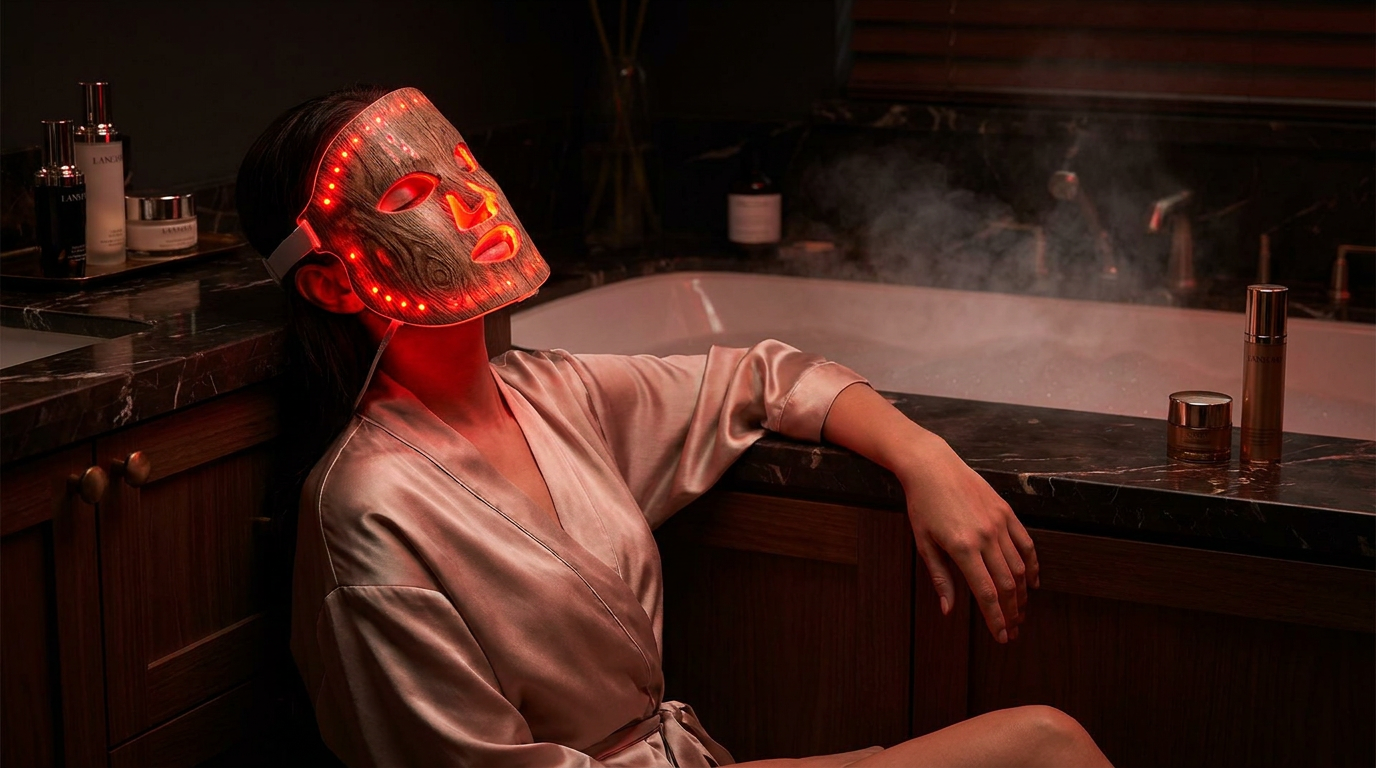
The explosion of LED face masks on social media and in online shopping carts has transformed a once-niche clinical treatment into a mainstream daily habit. Glowing red masks, which often look more like science-fiction props than wellness tools, now dominate consumer review sites like Wirecutter and beauty influencer feeds. Retailing anywhere from $150 to well over $600, these wearable devices promise to erase fine lines, clear stubborn acne, and rejuvenate aging skin—all from the comfort of a living room couch, without the need for injections or recovery downtime.[5][7]
But in a beauty and wellness industry notorious for exaggerated marketing and fleeting trends, consumers are right to be skeptical of such sweeping claims. To separate the genuine science from the snake oil, we conducted a comprehensive review of the clinical data, medical meta-analyses, and dermatological consensus surrounding at-home red light therapy. The ultimate verdict? The underlying biology is highly documented and very real, but the consumer devices demand an intense level of patience and consistency that many buyers are unprepared for.[7]
The clinical term for red light therapy is photobiomodulation. It relies on the biological principle that specific wavelengths of the electromagnetic spectrum are "bioactive" in human tissue. When visible red light (typically between 630 and 660 nanometers) and invisible near-infrared light (between 810 and 850 nanometers) penetrate the skin, they do not simply warm the surface. Instead, they are absorbed directly by the mitochondria—the microscopic power plants located inside our cells.[1][2]

This targeted light absorption triggers a cascade of chemical reactions that significantly increase the production of adenosine triphosphate (ATP), which serves as the primary energy currency of the cell. With more available energy, cells can function much more efficiently. In the context of skin health, this energy boost specifically stimulates fibroblasts, the specialized cells responsible for synthesizing structural proteins like collagen and elastin, while simultaneously working to reduce cellular inflammation.[2][4]
The strongest and most consistent evidence for at-home red light therapy centers on skin rejuvenation and the reversal of photoaging. A rigorous controlled study tracking women who used an LED mask twice a week for 12 weeks found highly specific, measurable improvements in their skin structure. Rather than relying on subjective user surveys, researchers utilized clinical grading and imaging to track the physical changes occurring beneath the skin barrier over the three-month period.[6]
The results were striking: participants experienced a 38% decrease in the appearance of crow's feet and a 24% improvement in overall skin firmness. More impressively, ultrasound measurements confirmed a 48% increase in actual collagen density beneath the skin. Harvard Health notes that while an at-home mask is not a "miracle fix" comparable to a surgical facelift or a deep chemical peel, the biological mechanism for reducing fine lines and lightening dark spots is well-documented and effective over time.[1][6]

Beyond anti-aging, red light therapy is increasingly marketed as an acne treatment. Red light alone is highly effective at calming the inflammatory response of angry, cystic breakouts, reducing the redness and swelling associated with the lesions. However, for active acne clearance and prevention, clinical evidence points to dual-wavelength devices that combine red light with blue light (typically around 415 to 445 nanometers).[3][4]
Beyond anti-aging, red light therapy is increasingly marketed as an acne treatment.
A controlled clinical trial published in PubMed Central evaluated patients using a combined 445nm blue and 630nm red light therapy mask over a 12-week period. The researchers found that the at-home LED device reduced inflammatory acne lesions by over 24%. The mechanism is a one-two punch: the blue light actively destroys the Cutibacterium acnes bacteria responsible for the infection, while the red light accelerates the healing of the resulting blemishes and prevents scarring.[3]
Beyond cosmetic facial applications, near-infrared (NIR) wavelengths penetrate much deeper into the dermis and underlying tissue, reaching muscles and joints. The Cleveland Clinic highlights that NIR therapy is increasingly utilized in sports medicine and physical therapy to assist with wound healing, muscle recovery, and joint pain associated with chronic conditions like tendinopathy, rheumatoid arthritis, and osteoarthritis of the knee.[2][4]
In fact, the foundational research for photobiomodulation was conducted by NASA in the 1990s. Scientists originally experimented with red light to grow plants in space, and subsequently discovered its efficacy in helping heal wounds in astronauts living in zero-gravity environments, where cellular repair naturally slows down. Today, clinical-grade red light is a standard component of photodynamic therapy, used in oncology to treat early skin cancers and severe tissue damage.[2]
If the scientific backing is so robust, why do some consumer reviews report zero visible results? The answer lies in a concept known as dosimetry—the actual power output, or irradiance, of the specific device being used. Clinical LED panels utilized in a dermatologist's office are massive, highly calibrated machines that often deliver 100+ mW/cm² of light energy directly into the patient's skin.[7]

In stark contrast, many popular at-home masks deliver only 20 to 40 mW/cm² of irradiance. Because the light energy is significantly weaker, the exposure time must be vastly longer to achieve the same cellular dose. Dermatologists warn that consumers must use their home devices for 10 to 20 minutes a day, three to five times a week, for up to six months before seeing peak results—a level of commitment that many buyers abandon after just a few weeks.[1][7]
When it comes to safety, the profile of red light therapy is exceptionally strong. Unlike tanning beds or prolonged sun exposure, red and near-infrared light devices do not emit any ultraviolet (UV) radiation. They will not tan the skin, they do not damage cellular DNA, and they do not increase the risk of developing skin cancer. The American Academy of Dermatology considers them broadly safe for regular home use.[1][4]
However, there are two primary safety caveats that consumers must be aware of. First, devices that emit blue light carry a risk of photochemical retinopathy if the user stares directly into the LEDs; protective blackout goggles are strongly recommended during acne treatments. Second, masks that sit completely flush against the skin and overheat can inadvertently stimulate melanocytes, potentially worsening hyperpigmentation or melasma in sensitive individuals.[4][6]
Ultimately, at-home red light therapy is a scientifically validated biological tool, not a magic wand. For consumers willing to invest in a high-quality device and build a consistent, daily habit over several months, the clinical evidence strongly supports measurable gains in collagen production, clearer skin, and reduced inflammation. But for those expecting overnight transformations, the reality of photobiomodulation will likely fall short of the social media hype.[7]
How we got here
1990s
NASA experiments with red light to grow plants in space and heal astronaut wounds.
2014
Early controlled trials use ultrasound to confirm red light increases skin collagen density.
2021
Photobiomodulation gains mainstream dermatological acceptance for anti-aging and inflammation.
2025
Meta-analyses confirm at-home LED masks effectively reduce acne lesions when combined with blue light.
Viewpoints in depth
Clinical Dermatologists
Emphasize that while the science is sound, at-home devices cannot match the power of in-office treatments.
Dermatologists generally support the use of red light therapy as a safe, non-invasive adjunct to a broader skincare routine. However, they frequently caution patients about the 'dosimetry gap.' Because consumer masks are engineered to be universally safe and avoid burning the skin, their power output is intentionally capped. Clinicians stress that patients expecting the dramatic, rapid results of a medical-grade laser will be disappointed by an at-home mask, which requires months of strict adherence to yield visible changes.
Medical Researchers
Focus on the proven biological mechanisms of photobiomodulation at the cellular level.
For researchers studying cellular biology, red light therapy is not a cosmetic trend but a well-documented metabolic intervention. Studies consistently show that specific wavelengths of light interact directly with the cytochrome c oxidase enzyme within mitochondria. This interaction upregulates ATP production and modulates oxidative stress. Researchers view the cosmetic benefits—like increased collagen and reduced acne—as downstream side effects of this fundamental improvement in cellular energy and repair capacity.
Consumer Tech Reviewers
Evaluate devices based on usability, comfort, and price-to-performance ratios.
Product reviewers approach LED masks through the lens of consumer electronics. They prioritize factors like battery life, the comfort of the silicone or hard plastic shell, and whether the device easily integrates into a busy daily routine. Reviewers often point out that the 'best' mask isn't necessarily the one with the highest theoretical irradiance, but the one that is comfortable enough that a user will actually wear it for 15 minutes every single day for six months.
What we don't know
- The exact long-term effects of daily blue light exposure on the retina from poorly fitted masks.
- Whether the benefits of at-home red light therapy plateau after the first year of consistent use.
- The precise irradiance threshold required to trigger hyperpigmentation in melasma-prone skin.
Key terms
- Photobiomodulation
- The scientific term for red light therapy; using specific light wavelengths to stimulate cellular function.
- Mitochondria
- The 'power plants' of cells that absorb red light to produce more ATP energy.
- Fibroblasts
- Cells in the connective tissue that produce collagen and elastin, stimulated by red light.
- Irradiance
- The power density of a light therapy device, measuring how much light energy actually reaches the skin.
- Near-Infrared (NIR) Light
- Invisible wavelengths (810-850 nm) that penetrate deeper than red light to target muscle and joint inflammation.
Frequently asked
Can red light therapy cause skin cancer?
No. Unlike tanning beds, red light devices do not emit ultraviolet (UV) rays and do not damage cellular DNA.
How often do I need to use an at-home mask?
Clinical studies suggest using the device 3 to 5 times a week for 10 to 20 minutes per session, for at least 3 to 4 months.
Do I need to wear eye protection?
Yes. While red light is generally safe, devices that also emit blue light for acne can pose a risk to the retina if stared at directly.
Is an at-home mask as good as a dermatologist's laser?
No. In-office clinical panels are significantly more powerful, delivering faster and more dramatic results than consumer masks.
Sources
Source coverage
7 outlets
4 viewpoints surfaced







[1]Harvard Health PublishingClinical Dermatologists
Red light therapy for skin care
Read on Harvard Health Publishing →[2]Cleveland ClinicClinical Dermatologists
Red Light Therapy: Benefits, Side Effects & Uses
Read on Cleveland Clinic →[3]PubMed CentralMedical Researchers
Efficacy and Tolerability of a Combined 445nm and 630nm Over-the-counter Light Therapy Mask for the Treatment of Mild-to-moderate Acne Vulgaris
Read on PubMed Central →[4]WebMDClinical Dermatologists
Red Light Therapy: Effectiveness, Treatment, and Risks
Read on WebMD →[5]The New York TimesConsumer Tech Reviewers
The Best Red Light Therapy Skin Care Devices
Read on The New York Times →[6]ClinicalTrials.govMedical Researchers
The Effects of an LED Face Mask On Skin Health
Read on ClinicalTrials.gov →[7]Factlen Editorial TeamFactlen Editorial
Synthesis by Factlen editorial team
Read on Factlen Editorial Team →

More in shopping
See all 25 stories →Home Appliances
Heat Pump Dryers: The 2026 Buying Guide and Explainer
0 sources
Display Tech
OLED vs. Mini-LED in 2026: The Ultimate Home Theater Trade-Off Analysis
0 sources
TV Tech
OLED vs. Mini-LED: Choosing the Right Premium TV in 2026
0 sources
Home Electrification
The 2026 Guide to Buying a Heat Pump: Ratings, Rebates, and Avoiding Costly Mistakes
0 sources
Every angle. Every day.
Get shopping stories with full source coverage and perspective breakdowns delivered to your inbox.