
2026 Rivian R2 vs. Tesla Model Y: Choosing the Right Midsize Electric SUV
The highly anticipated Rivian R2 challenges the updated Tesla Model Y, offering buyers a choice between rugged off-road utility and aerodynamic highway efficiency.
By Factlen Editorial Team
- Pragmatic Commuters
- Focuses on the Model Y's lower starting price, immediate availability, and proven highway efficiency.
- Adventure Enthusiasts
- Values the Rivian R2's ground clearance, boxy cargo utility, and dedicated off-road capabilities.
- Tech & Efficiency Analysts
- Compares the raw data, noting the R2's surprising EPA efficiency metrics against Tesla's established software dominance.
What's not represented
- · Traditional auto mechanics evaluating the long-term repairability of the two platforms.
- · Urban apartment dwellers assessing the ease of parking the boxier R2 versus the Model Y.
Why this matters
For the first time, the world's best-selling electric vehicle faces a direct, comparably priced competitor that offers a fundamentally different philosophy. Buyers now have a genuine choice between a sleek, aerodynamic commuter and a rugged, adventure-ready utility vehicle without breaking the $50,000 mark.
Key points
- The Tesla Model Y starts at $41,630, while the Rivian R2 will start at $44,990 when base models arrive in 2027.
- Rivian's R2 offers 90.1 cubic feet of cargo space with fold-flat seats, beating the Model Y's 76 cubic feet.
- Both vehicles offer over 325 miles of maximum range in their long-range configurations.
- The Model Y features a sleek, aerodynamic design optimized for highway efficiency and sporty handling.
- The R2 embraces a boxy, traditional SUV design with 9.6 inches of ground clearance for off-road capability.
- Both SUVs utilize the NACS charging port, allowing seamless access to the Tesla Supercharger network.
The electric vehicle landscape in 2026 has matured, and the midsize SUV segment is no longer a one-horse race. Tesla's Model Y, fresh off its highly anticipated "Juniper" refresh, remains the undisputed heavyweight champion of the electric crossover world, offering widespread availability and proven technology. However, Rivian's newly launched R2 has arrived to directly challenge that dominance, bringing a distinctly different flavor to the $45,000-to-$60,000 price bracket and giving consumers a genuine side-by-side choice.[1][2][3]
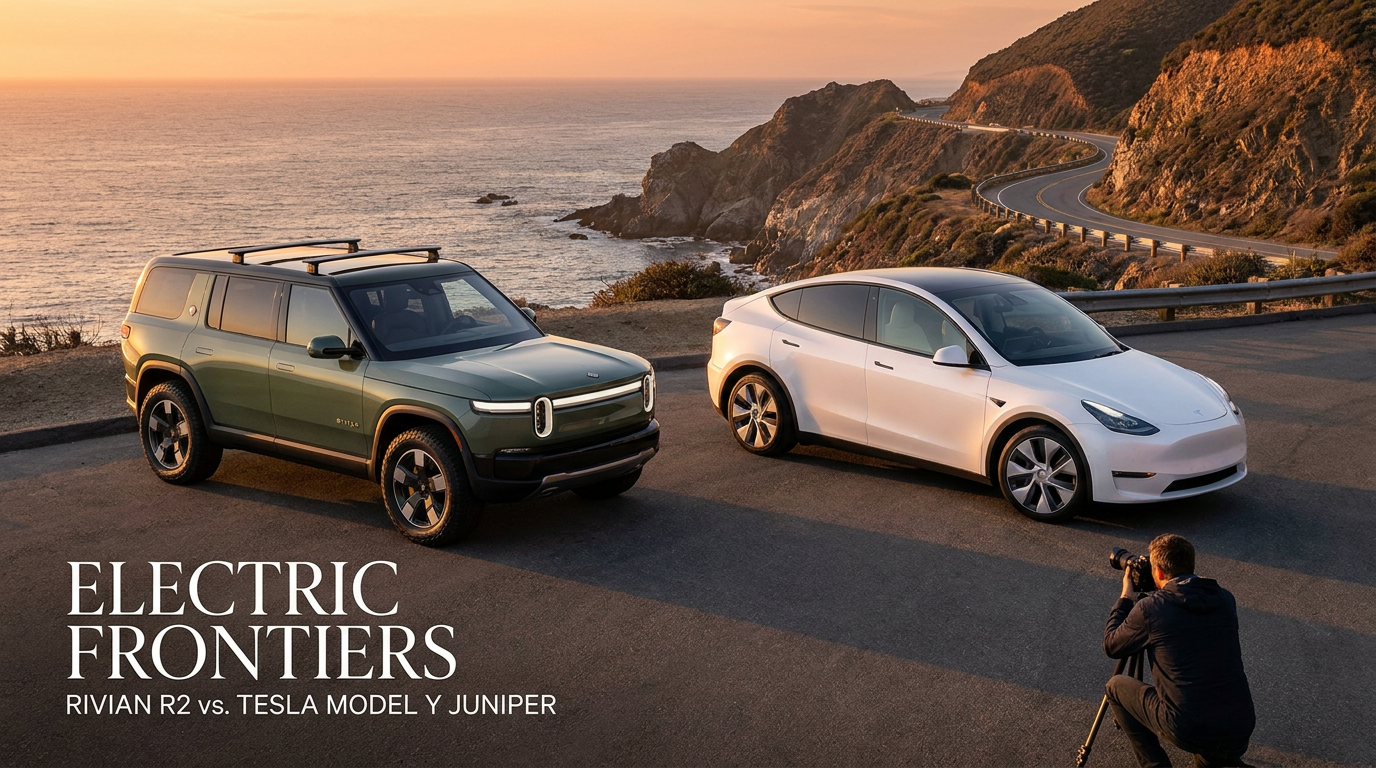
The most glaring difference between the two vehicles is their physical footprint and design ethos. The Model Y retains its teardrop, aerodynamic shape, optimized for maximum highway efficiency and a sporty, car-like ride. The R2, by contrast, embraces traditional boxy SUV aesthetics. It sits over three inches taller than the Tesla, with a shorter overall length but a longer wheelbase, pushing the wheels to the corners for better approach and departure angles.[3][4]
The case for the Tesla Model Y centers on its aerodynamic efficiency, sporty on-road handling, and immediate affordability. It is designed to be the ultimate pragmatic choice for daily commuting and family hauling, offering a lower center of gravity that makes it genuinely fun to drive on twisty roads. The Juniper update further refined its ride quality and cabin quietness, addressing past criticisms of the platform.[1][4][6]
The argument against the Model Y is that it lacks genuine off-road capability and traditional utility. Its sloping roofline compromises absolute vertical cargo volume, making it harder to haul bulky, square items. Furthermore, its ultra-minimalist interior—often described as a bachelor pad with a large television—can feel too stark for buyers who prefer physical controls and a more layered, textured cabin environment.[4][5]

The evidence supporting the Model Y's dominance is found in its numbers. It starts at a highly accessible $41,630 for the base rear-wheel-drive model, which is available immediately. The Long Range all-wheel-drive variant delivers up to 327 miles of range, while the top-tier Performance trim hits 60 mph in a blistering 3.3 seconds. It also boasts a respectable 76 cubic feet of total cargo space.[1][6]
The case for the Rivian R2 is built entirely around utility and adventure. It offers a traditional SUV stance, exceptional cargo flexibility, and robust off-road hardware that the Tesla simply cannot match. Rivian designed the R2 with nature-inspired minimalism, utilizing multi-layered materials and a digital driver's display that the Model Y omits, creating a cabin that feels more like a modern designer loft.[2][4]
The case for the Rivian R2 is built entirely around utility and adventure.
The argument against the Rivian R2 primarily involves its staggered rollout and higher initial cost of entry. While the base model is advertised at $44,990, that trim will not arrive until the summer of 2027. Early adopters purchasing in 2026 are restricted to the Performance and Premium trims, which start at $57,990 and $53,990 respectively, making it a significantly more expensive proposition today than a base Model Y.[1][2]
The evidence supporting the R2's utility is substantial. It boasts 9.6 inches of ground clearance and 32-inch tires, paired with dedicated off-road driving modes. Inside, both the front and rear seats fold completely flat, yielding a massive 90.1 cubic feet of cargo space—transforming the vehicle into a makeshift camper or cargo van. Furthermore, recent EPA data shows the R2 Performance achieving an impressive 3.77 miles per kWh, edging out the Model Y Performance's efficiency under comparable conditions.[5][7]

When it comes to technology and charging, both vehicles now utilize the North American Charging Standard (NACS) port, granting the R2 seamless, adapter-free access to Tesla's expansive Supercharger network. However, they diverge sharply on autonomy. Tesla continues to rely on its camera-only Full Self-Driving suite, while Rivian has opted for a redundant "Autonomy+" system, utilizing a combination of high-resolution cameras and radar to cross-verify physical reality.[1][3]
Ultimately, the Tesla Model Y fits well when buyers prioritize immediate availability, a lower starting price, and sporty on-road dynamics. It remains the proven, reliable choice for highway commuters who want maximum aerodynamic efficiency and a vehicle that handles more like a sports sedan than a utility truck.[4][6]
Conversely, the Tesla Model Y does not fit when drivers need to navigate rough terrain, require maximum vertical cargo space for bulky outdoor gear, or simply prefer the commanding, upright seating position of a traditional sport utility vehicle.[3][4]

How we got here
March 2024
Rivian officially unveils the R2 midsize SUV, announcing a starting price of $45,000.
Late 2024
Tesla rolls out the 'Juniper' update for the Model Y, refining its design and ride quality.
April 2026
EPA certification data reveals the Rivian R2 Performance achieves 330 miles of range and high efficiency.
Spring 2026
Rivian begins initial customer deliveries of the top-tier $57,990 R2 Performance models.
Summer 2027
Expected delivery window for the base $44,990 Rivian R2 Standard trim.
Viewpoints in depth
Highway Commuters & Pragmatists
Buyers focused on daily driving efficiency, immediate availability, and proven infrastructure.
For this camp, the Tesla Model Y remains the undisputed logical choice. The teardrop shape isn't just for aesthetics; it drastically reduces drag, making the vehicle incredibly efficient at 75 mph on the highway. Combined with a starting price that undercuts the Rivian by several thousand dollars and immediate availability across all trims, pragmatists argue that the Model Y delivers exactly what 95% of drivers actually need: reliable, fast, and affordable daily transportation.
Outdoor Adventurers & Utility Seekers
Drivers who prioritize off-road capability, cargo flexibility, and rugged design.
This group views the Rivian R2 as the EV they have been waiting for. They point to the 9.6 inches of ground clearance, the shorter overhangs, and the dedicated off-road software modes as proof that the R2 is a true SUV, not just a lifted car. The ability to fold all seats flat to create a level sleeping surface, combined with the roll-down rear window for hauling surfboards or lumber, makes the R2 a highly functional tool for active lifestyles, justifying its higher initial price point.
Tech & Autonomy Observers
Analysts comparing the divergent approaches to driver assistance and software.
Tech analysts highlight the philosophical split between the two automakers. Tesla's unwavering commitment to a camera-only approach for its Full Self-Driving suite relies on massive data collection and neural net training. Rivian, conversely, is launching its Autonomy+ system with a redundant suite of high-resolution cameras and radar. Observers note that while Tesla has the advantage of millions of miles of real-world testing, Rivian's sensor redundancy may offer more robust performance in poor weather conditions.
What we don't know
- How the base $44,990 Rivian R2 Standard trim will perform in real-world range tests once it launches in 2027.
- Whether Tesla will introduce further price cuts to the Model Y to undercut the Rivian R2's entry into the market.
- How Rivian's new Autonomy+ system will compare to Tesla's Full Self-Driving in independent safety evaluations.
Key terms
- NACS Port
- The North American Charging Standard, originally developed by Tesla, which allows vehicles to plug directly into Tesla Superchargers without an adapter.
- Approach Angle
- The maximum angle of a ramp or obstacle a vehicle can climb from a horizontal plane without the front bumper hitting the ground.
- Redundant Sensor Suite
- An autonomous driving system that uses multiple types of sensors (like cameras and radar) to cross-check data and improve safety.
- kWh (Kilowatt-hour)
- A unit of energy used to measure the capacity of an electric vehicle's battery pack.
Frequently asked
Which SUV has more cargo space?
The Rivian R2 has significantly more cargo space, offering 90.1 cubic feet when the seats are folded flat, compared to the Tesla Model Y's 76 cubic feet.
Can the Rivian R2 use Tesla Superchargers?
Yes, the Rivian R2 is built with a native NACS charging port, allowing it to use Tesla Superchargers without needing an adapter.
Which vehicle is faster from 0 to 60 mph?
The Tesla Model Y Performance is slightly faster, hitting 60 mph in 3.3 seconds, while the Rivian R2 Performance takes 3.6 seconds.
When can I buy the $45,000 Rivian R2?
While the R2 Performance is available now, the base $44,990 Standard trim is not scheduled to begin deliveries until the summer of 2027.
Sources
Source coverage
7 outlets
3 viewpoints surfaced







[1]Car and DriverPragmatic Commuters
2027 Rivian R2 Details, Pricing, and Specs
Read on Car and Driver →[2]EdmundsTech & Efficiency Analysts
Rivian R2 hits the heart of the EV market
Read on Edmunds →[3]ForbesAdventure Enthusiasts
Rivian R2 Is Imminent: How It Stacks Up Against The Tesla Model Y
Read on Forbes →[4]AutoblogTech & Efficiency Analysts
2026 Rivian R2 Performance vs. 2026 Tesla Model Y: Which Crossover EV Should You Choose?
Read on Autoblog →[5]CarBuzzAdventure Enthusiasts
Here's every way the new SUV is ready to beat the Model Y at its own game
Read on CarBuzz →[6]Kelley Blue BookPragmatic Commuters
Rivian R2 Pricing and Specs
Read on Kelley Blue Book →[7]EV DancesTech & Efficiency Analysts
Rivian R2 vs Tesla Model Y: EPA Data Shows Efficiency Gap
Read on EV Dances →
More in automotive
See all 12 stories →Battery Tech
Solid-State Batteries Hit the Road: How the Next Generation of EVs Actually Works
0 sources
Motorcycle Tech
How Radar and AI Are Making Motorcycles Safer Than Ever
0 sources
Battery Tech
How Solid-State Batteries Are Rewriting the Rules of Electric Vehicles
0 sources

Transit Tech
The Trackless Tram: Inside the Tech Promising to Revolutionize Public Transit
0 sources
Every angle. Every day.
Get automotive stories with full source coverage and perspective breakdowns delivered to your inbox.