
The Trackless Tram: Inside the Tech Promising to Revolutionize Public Transit
Cities worldwide are exploring 'trackless trams'—a hybrid technology promising the capacity of light rail at the cost of a bus. But as deployments expand, skeptics warn that hidden infrastructure costs and proprietary tech may complicate the transit revolution.
By Factlen Editorial Team
- Transit Innovators
- Urban planners who view ART as a cost-effective paradigm shift for mid-tier city transport.
- Skeptics & Analysts
- Critics who argue the technology is an overhyped, heavy bus that requires hidden infrastructure costs.
- Local Policymakers
- Officials concerned with the financial risks and procurement models of deploying unproven transit tech.
- Independent Researchers
- Neutral observers tracking the technical specifications and global deployment history of the vehicles.
What's not represented
- · Disability advocates on the accessibility of rubber-tired vehicles docking at platforms
- · Bus drivers' unions on the transition to semi-autonomous transit systems
Why this matters
As urban traffic congestion worsens and light rail projects become prohibitively expensive, mid-sized cities desperately need affordable mass transit. Whether trackless trams are a genuine breakthrough or just a rebranded bus will determine how billions in taxpayer infrastructure dollars are spent over the next decade.
Key points
- Trackless trams (ART) use optical sensors and rubber tires to mimic the ride and capacity of light rail without steel tracks.
- Proponents argue the technology can be deployed for a fraction of the cost of traditional rail, spurring rapid urban development.
- Skeptics caution that the 51-tonne vehicles require expensive road reinforcement, narrowing the actual cost savings.
- The technology is currently dominated by China's CRRC, raising concerns about proprietary vendor lock-in for adopting cities.
The universal urban problem is clear: cities are choking on traffic, but building traditional light rail has become prohibitively expensive and disruptive. For decades, municipal leaders have been trapped between two imperfect choices: lay down billion-dollar steel tracks, or settle for standard buses that struggle to attract choice riders and spur economic development.[7]
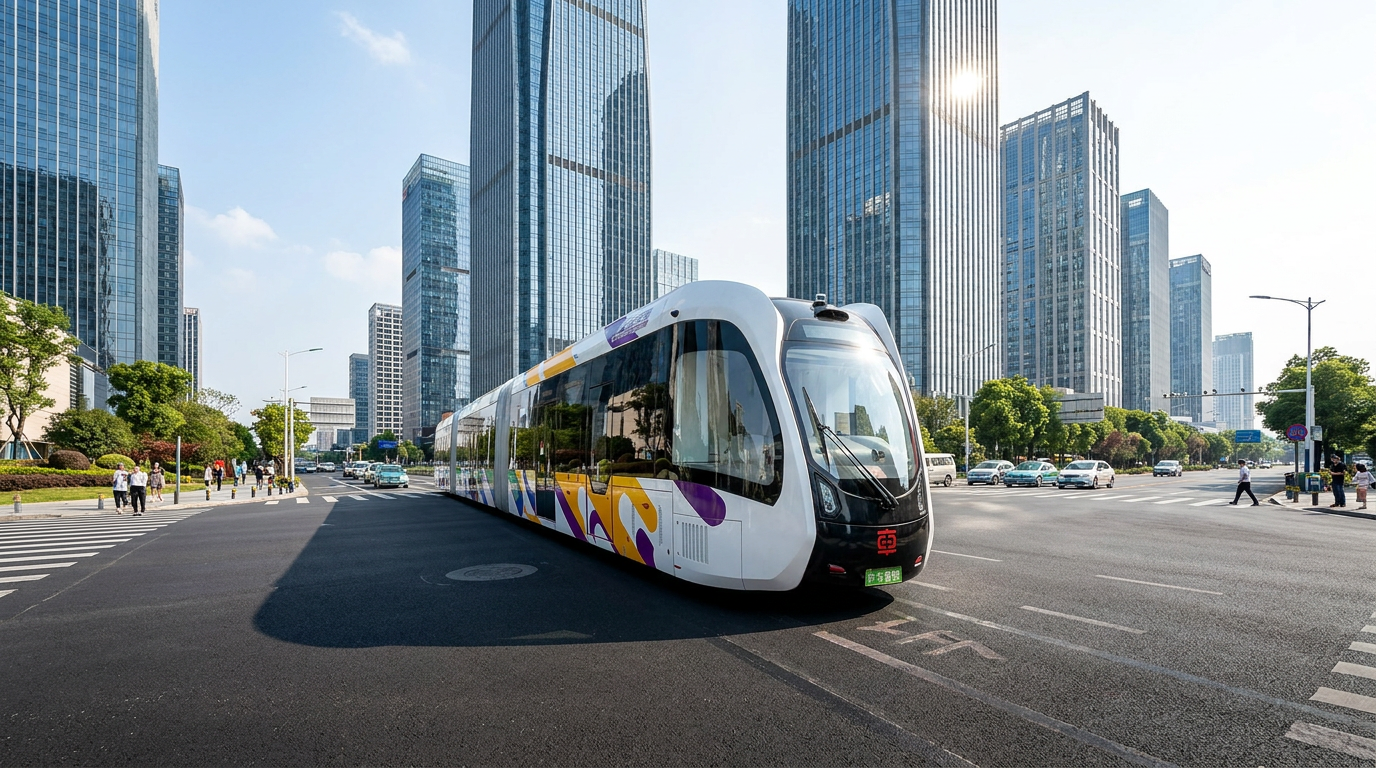
Enter the "Trackless Tram," formally known as Autonomous Rapid Transit (ART). Developed by China's state-owned rail manufacturer CRRC, it promises the holy grail of public transit: the high capacity, sleek aesthetics, and smooth ride of a train, delivered at the cost and deployment speed of a bus.[1][3]
Since its debut in Zhuzhou, China, the technology has captured the imagination of urban planners globally. From the coastal suburbs of Perth, Australia, to the planned transit network in Sarawak, Malaysia, cities are actively testing or procuring these futuristic vehicles as a silver bullet for their mobility woes.[3][6]
How exactly does a tram run without tracks? Instead of steel wheels on steel rails, ART vehicles run on heavy-duty rubber tires. They follow "virtual tracks"—a combination of painted lines on the asphalt, magnetic markers, and advanced optical sensors, including LiDAR and high-definition cameras, that guide the vehicle along a precise path.[1][2]

This optical guidance system allows the multi-carriage vehicles, which can stretch over 30 meters long, to snake through dense city streets with a perfectly aligned turning radius. The trailing carriages follow the exact path of the lead carriage, minimizing the vehicle's footprint on the road and allowing it to navigate tight urban corners that would trap a standard articulated bus.[2][3]
To maintain their green credentials, trackless trams are entirely electric, powered by either lithium-ion batteries or hydrogen fuel cells. They are designed to rapid-charge at stations while passengers board, eliminating the need for the unsightly and expensive overhead catenary wires that clutter the skylines of traditional tram networks.[1][6]
The primary driver of ART's global appeal is economics. Traditional light rail projects often cost upwards of $100 million per kilometer, largely due to the massive civil engineering required to dig up roads, relocate underground utilities, and lay steel tracks.[2][7]
Proponents estimate that trackless trams can be deployed for roughly one-fifth to one-tenth the capital cost of light rail. In Sarawak, Malaysia, officials opted for ART over a proposed light rail system, projecting costs of approximately RM70 million ($15 million) per kilometer compared to RM270 million for traditional rail, allowing them to build a much larger network for the same budget.[3]

Proponents estimate that trackless trams can be deployed for roughly one-fifth to one-tenth the capital cost of light rail.
Beyond capital savings, advocates argue that trackless trams catalyze "Transit-Oriented Development" just as effectively as permanent rail. Because the vehicles require dedicated lanes and substantial, permanent stations, they signal a long-term infrastructure commitment to real estate developers, spurring housing and retail investments along the corridor.[6]
However, a growing chorus of transit experts and engineers warns that the "trackless tram" label is a masterpiece of marketing rather than a genuine technological leap. Strip away the sleek, train-like aerodynamic shell, they argue, and you are left with a very long, very heavy articulated bus.[4]
The weight issue represents a significant hidden cost. A fully loaded, three-carriage ART vehicle can weigh up to 51 tonnes—roughly double the weight limit for standard articulated buses. This immense, concentrated load pressing down on rubber tires can quickly degrade standard municipal asphalt.[4]
As a result, cities deploying trackless trams often find they must heavily reinforce the roadbed along the entire route to prevent deep rutting and structural failure. When the cost of this heavy road reconstruction is factored in, the financial advantage over traditional Bus Rapid Transit (BRT) or even light rail begins to narrow significantly.[4]
Furthermore, the "autonomous" claim has faced real-world friction. While the vehicles feature advanced driver-assistance systems, they currently require a human operator at the helm for safety and complex traffic navigation. In late 2024, officials in Indonesia's new capital, Nusantara, reportedly returned an ART prototype to China after trials revealed the system still required excessive manual intervention.[4]

Critics also point out that the optical guidance technology is not entirely novel. Cities like Rouen, France, and Castellón, Spain, have used optically guided buses since the early 2000s. The primary innovation of the Chinese ART system, skeptics argue, is simply packaging existing bus rapid transit technology in a chassis that mimics the aesthetics of a tram.[4]
The procurement of these systems has also sparked political debate. In Johor, Malaysia, plans for an Elevated Autonomous Rapid Transit (E-ART) system have drawn scrutiny over its public-private partnership model. Watchdogs worry that private concessionaires might demand high passenger fares to recoup their investments in the unproven technology, shifting the financial risk onto daily commuters.[5]
Because ART is currently dominated by a single manufacturer—China's CRRC—cities also risk vendor lock-in. Unlike standard buses or standard-gauge rail cars, which can be purchased and serviced by dozens of global suppliers, an ART network relies on a specific, proprietary ecosystem for replacement parts, software updates, and long-term maintenance.[3][4]

Despite the valid criticisms, the trackless tram occupies a compelling middle ground in the transit landscape. For mid-sized cities that have outgrown standard buses but lack the density or tax base to justify billion-dollar light rail mega-projects, ART offers a viable, high-capacity alternative that can be deployed in a fraction of the time.[7]
The ultimate success of trackless trams will depend on honest accounting and clear expectations. If cities treat them as a premium form of Bus Rapid Transit—acknowledging the need for road reinforcement and dedicated lanes—they can deliver transformative mobility. But if they are sold as a magical, zero-cost substitute for heavy rail, disappointment is likely to follow.[7]
How we got here
2017
China's CRRC unveils the first Autonomous Rapid Transit (ART) vehicle in Zhuzhou.
2018
The first commercial ART line begins passenger operations in China.
2023
The City of Stirling in Western Australia receives an ART vehicle for the country's first trackless tram trials.
Late 2024
Indonesia returns an ART prototype from its new capital, Nusantara, citing the need for excessive manual intervention.
2025
Sarawak, Malaysia, prepares to launch its ART-based Kuching Urban Transportation System.
Viewpoints in depth
Transit Innovators' View
Trackless trams represent a paradigm shift in urban mobility, offering rail-like benefits at bus-like costs.
Urban planners and sustainability advocates argue that the primary barrier to decarbonizing city transport is the staggering capital cost of light rail. By eliminating the need for steel tracks and overhead wires, ART allows cities to deploy high-capacity, zero-emission transit rapidly. Proponents emphasize that the rail-like ride quality and dedicated stations are sufficient to spur 'Transit-Oriented Development,' attracting private investment and revitalizing urban corridors just as effectively as traditional trains.
The Skeptics' View
Critics argue the technology is overhyped, masking the limitations of heavy buses behind futuristic marketing.
Transit skeptics and engineers caution that 'trackless tram' is a contradiction in terms—it is fundamentally a guided articulated bus. They point out that the massive weight of the multi-carriage vehicles requires expensive, deep reinforcement of asphalt roads, which eats into the promised cost savings. Furthermore, they argue that the 'autonomous' label is misleading, as the vehicles still require human operators, and the proprietary nature of the technology risks locking cities into a single manufacturer for long-term maintenance.
What we don't know
- How the heavy rubber tires and 51-tonne vehicle weight will impact long-term road maintenance costs over a 20-year lifecycle.
- Whether competing manufacturers will enter the ART market to break the current proprietary vendor lock-in.
- How the optical guidance systems will perform in cities with heavy snowfall or frequent extreme weather that obscures road markings.
Key terms
- Autonomous Rapid Transit (ART)
- A high-capacity public transit system that uses multi-carriage, rubber-tired vehicles guided by optical sensors rather than physical rails.
- Bus Rapid Transit (BRT)
- A high-quality bus-based transit system that delivers fast, comfortable, and cost-effective services at metro-level capacities, usually via dedicated lanes.
- LiDAR
- Light Detection and Ranging, a remote sensing method that uses light in the form of a pulsed laser to measure variable distances, used by ART to map its surroundings.
- Transit-Oriented Development (TOD)
- Urban planning that maximizes the amount of residential, business, and leisure space within walking distance of public transport.
- Vendor Lock-in
- A situation where a customer using a product or service cannot easily transition to a competitor, often a concern with proprietary transit technologies.
Frequently asked
Do trackless trams need a driver?
Yes. Despite the "autonomous" name, current models require a human operator to monitor the systems and take over in complex traffic situations.
How are they different from a normal bus?
They are much longer, use rail-style suspension for a smoother ride, and follow a precise optical path rather than being manually steered, allowing them to navigate tight urban spaces.
Do they run on standard city roads?
While they use rubber tires, their massive weight (up to 51 tonnes) often requires cities to heavily reinforce the asphalt in their dedicated lanes to prevent rutting.
Sources
Source coverage
7 outlets
4 viewpoints surfaced







[1]World Economic ForumTransit Innovators
Trackless trams: The future of public transport?
Read on World Economic Forum →[2]WSPTransit Innovators
Examining the Emerging Potential of Trackless Rapid Transit
Read on WSP →[3]WikipediaIndependent Researchers
Autonomous Rapid Transit
Read on Wikipedia →[4]ReinvantageSkeptics & Analysts
Innovation inflation: The trackless tram illusion
Read on Reinvantage →[5]The StarLocal Policymakers
E-ART project in Johor carries significant risks, says Wee
Read on The Star →[6]Journal of Urban TechnologyTransit Innovators
Trackless Trams and the Net Zero City
Read on Journal of Urban Technology →[7]Factlen Editorial TeamIndependent Researchers
Synthesis by Factlen editorial team
Read on Factlen Editorial Team →
Every angle. Every day.
Get automotive stories with full source coverage and perspective breakdowns delivered to your inbox.