
How Radar and AI Are Making Motorcycles Safer Than Ever
Advanced Rider Assistance Systems (ARAS) are bringing adaptive cruise control and blind-spot detection to two wheels, promising to prevent up to one in six motorcycle accidents.
By Factlen Editorial Team
- Active Safety Advocates
- Argues that human error is the leading cause of accidents and must be mitigated by active technology.
- Skill & Training Proponents
- Believes that technology is a helpful safety net but cannot replace foundational riding skills and awareness.
- Industry Analysts
- Views ARAS as the next major growth vector in the global two-wheeler industry.
What's not represented
- · Automotive drivers sharing the road
- · Motorcycle insurance actuaries
Why this matters
Motorcyclists are inherently vulnerable on the road, relying heavily on human reaction time to avoid collisions. The mainstream adoption of radar and AI actively prevents accidents before they happen, making riding significantly safer for both veterans and newcomers.
Key points
- Advanced Rider Assistance Systems (ARAS) use radar and cameras to create a 360-degree safety net around motorcycles.
- Core features include Adaptive Cruise Control, Blind Spot Detection, and Forward Collision Warning.
- Bosch estimates that widespread adoption of radar-based ARAS could prevent one in six motorcycle accidents.
- The technology is rapidly expanding from premium touring motorcycles to mid-range commuter bikes and e-bikes.
- Despite technological advances, experts emphasize that ARAS is an aid, not a replacement for proper rider training and situational awareness.
Motorcycling is defined by its raw, unfiltered connection to the road. But that same exposure makes it inherently vulnerable. For decades, rider safety relied almost entirely on passive gear—helmets, leathers, and sheer situational awareness.[2][7]
In 2026, the paradigm has shifted from passive protection to active prevention. A suite of technologies known as Advanced Rider Assistance Systems (ARAS) is rapidly becoming standard equipment, migrating from ultra-premium touring bikes down to middleweight commuters.[3][5]
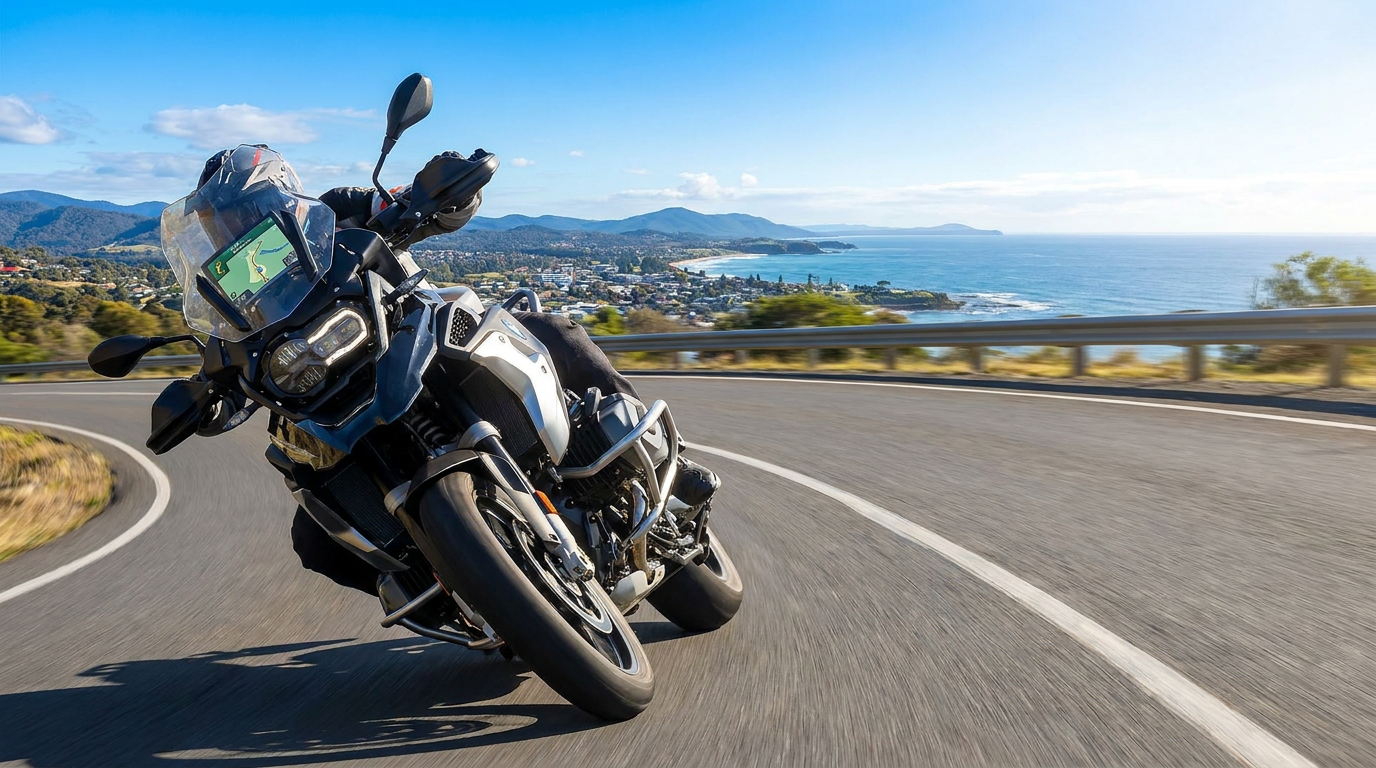
ARAS is essentially the two-wheeled equivalent of the Advanced Driver Assistance Systems (ADAS) found in modern cars, but engineered specifically for the complex physics of a vehicle that leans, pitches, and rolls.[1][6]
The core of this technological leap relies on miniaturized radar sensors mounted at the front and rear of the motorcycle, often paired with high-definition cameras and artificial intelligence.[1][3]

A front-facing radar sensor continuously scans the road ahead, detecting moving objects at a distance of up to 160 meters. Meanwhile, a rear-facing radar monitors the space behind the rider, creating a 360-degree digital safety net.[1][5]
These sensors feed data into the motorcycle's Inertial Measurement Unit (IMU)—the bike's electronic brain—which calculates the motorcycle's speed, lean angle, and acceleration hundreds of times per second.[2][7]
The most immediate benefit for daily riders is Blind Spot Detection (BSD). Because motorcyclists have a limited field of view and physically turning to check a blind spot requires taking attention away from the road ahead, lane changes are notoriously risky.[4][7]
With BSD, if the rear radar detects a vehicle approaching in the adjacent lane, a visual warning—typically a bright LED—illuminates in the corresponding rearview mirror. If the rider activates their turn signal while a vehicle is in the blind spot, the light flashes urgently.[1][4]

With BSD, if the rear radar detects a vehicle approaching in the adjacent lane, a visual warning—typically a bright LED—illuminates in the corresponding rearview mirror.
For highway cruising, Adaptive Cruise Control (ACC) is transforming long-distance touring. ACC automatically adjusts the motorcycle's speed to match the flow of traffic, maintaining a safe following distance without the rider needing to constantly roll on and off the throttle.[1][7]
The most critical safety feature, however, is the Forward Collision Warning (FCW). If the system detects that the motorcycle is closing in on a vehicle too rapidly and the rider has not reacted, it triggers acoustic and visual alerts.[1][4]
According to accident research conducted by Bosch, the leading supplier of these systems, widespread adoption of radar-based ARAS could prevent one in six motorcycle accidents.[1][4]
The market is responding aggressively to these life-saving metrics. The global ARAS market is currently experiencing a massive 35 percent compound annual growth rate, driven by consumer demand and increasingly stringent safety regulations.[5]

Despite the clear benefits, the integration of AI and radar into motorcycles has sparked a philosophical debate within the riding community. Some purists argue that relying on electronic safety nets dulls a rider's natural instincts and situational awareness.[2]
Motorcycle trainers emphasize that technology cannot replace foundational skills. Systems like ARAS are designed to assist, not to take over; a proactive mindset and proper training remain the most critical components of rider safety.[2]
Furthermore, engineering ARAS for motorcycles presents unique physical challenges. Unlike a car, a motorcycle leans deeply into corners, which can constrain the radar's projection cone and temporarily reduce its effectiveness.[6]
To compensate, companies are exploring the integration of Vehicle-to-Everything (V2X) communication, which would allow motorcycles to digitally 'talk' to surrounding cars and traffic lights, anticipating hazards before they even enter the radar's line of sight.[5]

As the technology matures, ARAS is also expanding beyond traditional motorcycles to high-speed e-bikes and urban scooters, creating a unified, connected mobility ecosystem where all two-wheeled vehicles share a baseline of active safety.[3]
How we got here
2018
Bosch announces the development of radar-based assistance systems specifically tuned for the complex physics of motorcycles.
2020
Premium manufacturers like Ducati and KTM become the first to integrate adaptive cruise control and blind-spot detection into production models.
2024
The global motorcycle ARAS market reaches a valuation of $77 million, driven by early adoption in the touring segment.
2026
ARAS technology begins trickling down to mid-displacement commuter motorcycles and high-speed e-bikes.
Viewpoints in depth
Active Safety Developers
Argues that human error is the leading cause of accidents and must be mitigated by technology.
Companies engineering these systems point to stark statistics: motorcyclists are vastly more vulnerable than car drivers, and the vast majority of crashes stem from split-second human miscalculations. By implementing radar and AI, they argue that the industry can actively prevent up to one in six accidents. Their focus is on creating a 360-degree digital shield that reacts faster than human reflexes, fundamentally shifting motorcycle safety from passive crash survival to active crash avoidance.
Riding Instructors & Purists
Believes that technology is a helpful safety net but cannot replace foundational riding skills.
Traditionalists and professional riding coaches welcome the safety benefits but caution against over-reliance on digital aids. They argue that a motorcycle's primary safety feature is the rider's brain. If riders begin trusting radar to check their blind spots or manage their following distance, their baseline situational awareness may atrophy. This camp insists that ARAS should be viewed strictly as a backup system, and that rigorous training and a proactive mindset remain the non-negotiable core of safe motorcycling.
Market Analysts
Views ARAS as the next major growth vector in the global two-wheeler industry.
Financial and industry analysts see ARAS as a massive commercial opportunity, noting a 35 percent compound annual growth rate in the sector. They track how the technology is moving from a luxury add-on for affluent touring riders to a standard expectation across all motorcycle segments. Furthermore, analysts predict that the integration of ARAS with future smart-city infrastructure and V2X communication will open entirely new revenue streams and permanently alter the economics of motorcycle manufacturing.
What we don't know
- How effectively radar systems will perform at extreme lean angles on twisty roads where the sensor's line of sight is temporarily altered.
- Whether the increased cost of ARAS components will permanently raise the price floor for entry-level motorcycles.
- How quickly Vehicle-to-Everything (V2X) communication infrastructure will be deployed to support the next generation of predictive motorcycle safety.
Key terms
- ARAS
- Advanced Rider Assistance Systems; a suite of electronic safety features, including radar and cameras, designed to help motorcyclists avoid accidents.
- IMU
- Inertial Measurement Unit; an electronic sensor that measures a motorcycle's pitch, roll, and yaw to understand its exact position and movement in space.
- Adaptive Cruise Control
- A system that automatically adjusts the motorcycle's speed to maintain a safe following distance from the vehicle ahead.
- Blind Spot Detection
- A radar-based feature that illuminates a warning light in the rearview mirror when a vehicle is in the rider's blind spot.
- V2X
- Vehicle-to-Everything; a communication technology that allows vehicles to share data with each other and with traffic infrastructure to anticipate hazards.
Frequently asked
Does ARAS automatically brake the motorcycle for me?
Generally, no. To prevent upsetting the bike's balance and throwing the rider, most systems provide acoustic and visual warnings. Some highly advanced systems may apply very light brake pressure, but they rely on the rider to execute the primary braking maneuver.
Does radar work when the motorcycle is leaning in a corner?
Deep lean angles can temporarily constrain the radar's projection cone. To compensate, the system relies heavily on the motorcycle's Inertial Measurement Unit (IMU) to understand the bike's exact orientation and adjust its tracking algorithms accordingly.
Can I turn these safety features off?
Yes. Most manufacturers allow riders to customize the sensitivity of the alerts or disable certain features entirely through the dashboard menu, ensuring the rider remains in ultimate control.
Is ARAS only available on expensive touring bikes?
While the technology debuted on flagship models, it is rapidly becoming more affordable. By 2026, ARAS features are increasingly standard on mid-range commuter motorcycles and even high-speed e-bikes.
Sources
Source coverage
7 outlets
3 viewpoints surfaced







[1]Bosch MobilityActive Safety Advocates
Advanced rider assistance systems for motorcycles
Read on Bosch Mobility →[2]BennettsSkill & Training Proponents
ARAS: The Next Frontier in Motorcycle Safety
Read on Bennetts →[3]RiderdomeActive Safety Advocates
The Future of Two Wheelers ARAS Revolutionizing Safety in Urban Mobility
Read on Riderdome →[4]CycleNewsActive Safety Advocates
Bosch Advanced Rider Assistance Systems
Read on CycleNews →[5]Intel Market ResearchIndustry Analysts
Global Motorcycle Advanced Rider Assistance System (ARAS) Market
Read on Intel Market Research →[6]Themis Advocates GroupSkill & Training Proponents
Motorcycle Advanced Rider Assistance Systems (ARAS): Implementation and Implications
Read on Themis Advocates Group →[7]CNETActive Safety Advocates
Bosch wants to use radar to make your motorcycle safer
Read on CNET →

More in automotive
See all 12 stories →Battery Tech
Solid-State Batteries Hit the Road: How the Next Generation of EVs Actually Works
0 sources
EV Market
2026 Rivian R2 vs. Tesla Model Y: Choosing the Right Midsize Electric SUV
0 sources

Battery Tech
How Solid-State Batteries Are Rewriting the Rules of Electric Vehicles
0 sources

Transit Tech
The Trackless Tram: Inside the Tech Promising to Revolutionize Public Transit
0 sources
Every angle. Every day.
Get automotive stories with full source coverage and perspective breakdowns delivered to your inbox.