
US to significantly reduce fighter jets and warships committed to NATO in Europe
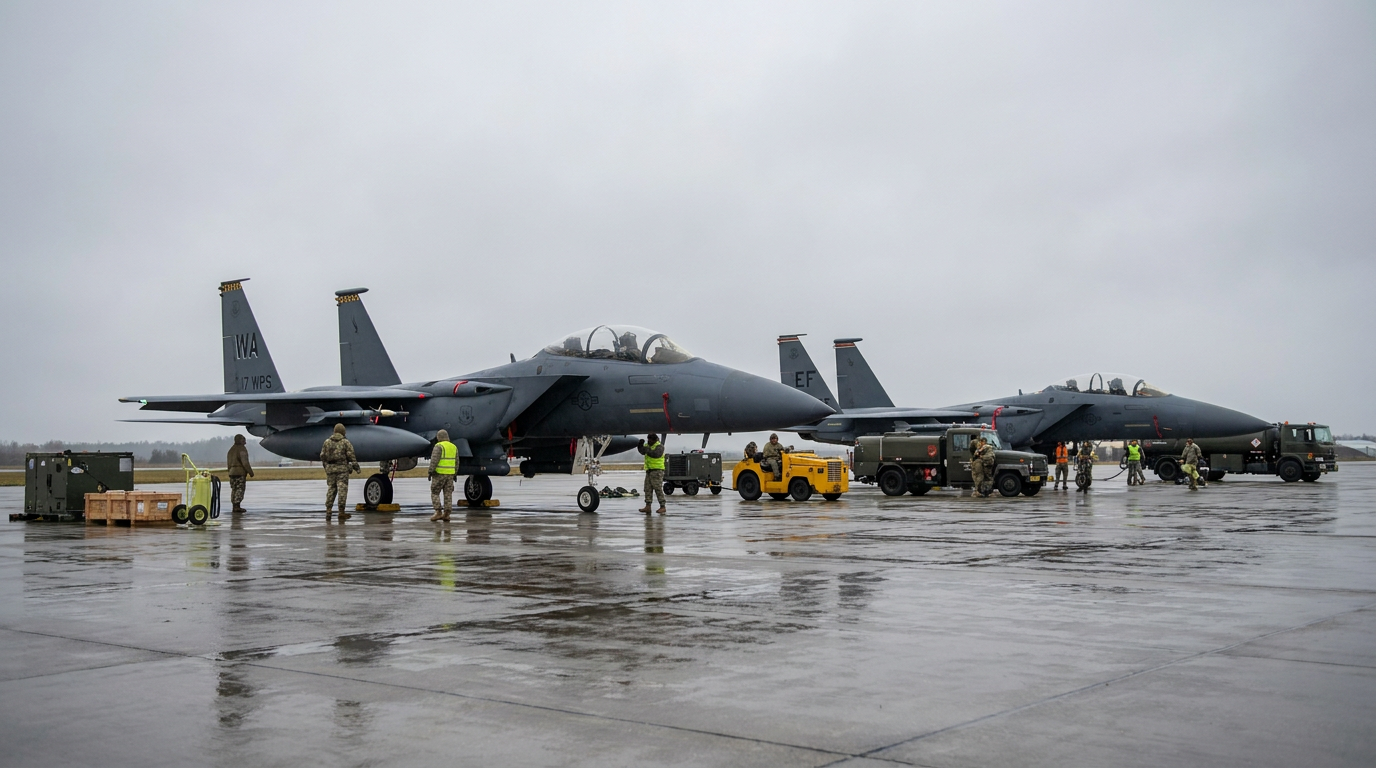
The Pentagon is scaling back its military assets allocated to NATO's European defense plans, including a one-third cut to available fighter jets and the withdrawal of naval strike groups. The move aims to force European allies to assume primary responsibility for their own conventional defense.
By Factlen Editorial Team
- U.S. Defense Strategists
- Argue that the U.S. must pivot its high-end military assets to the Indo-Pacific and that Europe is wealthy enough to defend itself conventionally.
- European Security Advocates
- Express concern that the abrupt withdrawal of U.S. long-range strike and surveillance capabilities creates a dangerous window of vulnerability against Russia.
- NATO Institutionalists
- View the transition as a necessary, albeit challenging, evolution toward a more balanced and sustainable alliance architecture.
What's not represented
- · Russian military planners assessing the shift in NATO's deterrence posture
- · Indo-Pacific allies who stand to benefit from the reallocation of U.S. naval and air assets
Why this matters
The reduction of U.S. forces marks a historic shift in the transatlantic security architecture that has underpinned European stability since World War II. By forcing European nations to rapidly backfill critical capabilities like long-range strike and aerial refueling, the move accelerates Europe's military independence while raising immediate concerns about deterrence against Russia.
Key points
- The U.S. is cutting its contribution of F-16 and F-15E fighter jets to NATO from 150 to 100.
- All eight U.S. aerial refueling tankers committed to Europe will be withdrawn.
- A U.S. aircraft carrier, a missile submarine, and a bomber group are being reallocated.
- The move is part of the Trump administration's "NATO 3.0" burden-sharing initiative.
- European allies are expected to present plans to fill the capability gaps at the July NATO summit in Ankara.
The United States is significantly scaling back the military assets it commits to NATO's European defense plans, pulling dozens of fighter jets, reconnaissance aircraft, and naval strike groups from the alliance's crisis pool. The sweeping reductions, detailed in documents shared with allies in early June, mark one of the most substantial shifts in the transatlantic security architecture since the end of the Cold War. By withdrawing high-end capabilities, Washington is accelerating its pivot toward the Indo-Pacific while forcing European nations to rapidly backfill the continent's conventional defense.[1][2]
The drawdown is the operational centerpiece of the Trump administration's "NATO 3.0" initiative. Championed by Under Secretary of Defense for Policy Elbridge Colby and Defense Secretary Pete Hegseth, the policy operates on the premise that wealthy European nations must assume primary responsibility for their own security. U.S. officials argue that the historical reliance on American military power has allowed European defense industrial bases to atrophy, creating an unsustainable burden on the Pentagon as it faces simultaneous strategic challenges from China and Iran.[4][5]
The specific cuts target the NATO Force Model, the framework that dictates which national assets are available to alliance commanders during a crisis. According to figures first reported by The New York Times, the U.S. will reduce its pool of F-16 and F-15E fighter jets available to NATO from roughly 150 to 100. Maritime reconnaissance aircraft, critical for tracking Russian submarine activity, will be cut from 26 to 15. Furthermore, all eight U.S. aerial refueling tankers previously committed to the European theater will be entirely withdrawn.[1][2][6]

The reductions extend heavily into naval and strategic strike capabilities. The Pentagon is reallocating a missile-launching submarine, an aircraft carrier strike group, and the scores of jets that support carrier operations. Additionally, one of the two U.S. bomber groups previously assigned to Europe's defense will be shifted to other global contingencies. These assets represent the core of NATO's deep-strike deterrence, capable of launching long-range Tomahawk missiles deep into adversary territory.[1][2]
The reductions extend heavily into naval and strategic strike capabilities.
U.S. Air Force Gen. Alexus G. Grynkewich, who serves dual roles as the head of U.S. European Command and NATO's Supreme Allied Commander Europe, publicly addressed the shift following a force-sourcing conference at the Supreme Headquarters Allied Powers Europe (SHAPE). "There has been an unhealthy codependence in the NATO Force Model on U.S. forces," Grynkewich stated. "President Trump, Secretary Hegseth and others have been clear that this needs to change, and it will change. The potential reality of simultaneous conflict in multiple theaters demands it."[3][4][5]

NATO's civilian leadership has publicly embraced the transition, framing it as a necessary evolution rather than an abandonment. Alliance spokesperson Allison Hart noted that reducing reliance on a single ally will ultimately put NATO on a "more sustainable footing for the decades to come." By distributing the burden of high-end military capabilities across multiple member states, the alliance aims to become more resilient and less vulnerable to the domestic political shifts of any one capital.[2][7]
Despite the optimistic institutional framing, European defense officials have expressed deep concern over the abrupt timeline. While European nations possess some similar capabilities, U.S. assets are widely viewed as a uniquely potent deterrent against Russian aggression. Experts warn that European militaries may be warier of deploying their own long-range missiles in a crisis, and the continent's defense industry cannot scale production fast enough to immediately replace the withdrawn American reconnaissance and refueling fleets.[1][6]

The pressure is now squarely on European capitals to bridge the capability gap. European allies and Canada are expected to formalize their replacement contributions by the upcoming NATO summit in Ankara on July 7-8. Grynkewich emphasized that Europe must step up "now and in the near term" with manned and unmanned aircraft, as well as naval vessels, to mitigate near-term risks. How quickly Europe can transition from relying on the American security umbrella to fielding its own integrated deterrence will define the next era of the alliance.[3][4]
How we got here
May 22, 2026
U.S. officials privately notify NATO allies in Brussels of the impending force reductions.
June 2-3, 2026
NATO military planners meet at SHAPE to assess the capability gaps left by the U.S. withdrawal.
June 12, 2026
The New York Times publishes specific details of the asset reductions, including the one-third cut to fighter jets.
July 7-8, 2026
NATO leaders are scheduled to meet at a summit in Ankara, where European nations must formalize their replacement contributions.
Viewpoints in depth
The Trump Administration's View
The U.S. must rebalance its global posture and force Europe to pay for its own defense.
U.S. defense strategists argue that Washington can no longer afford to disproportionately subsidize European security while facing growing, simultaneous threats in the Indo-Pacific and the Middle East. By forcing a "NATO 3.0" model, the administration believes it is creating a healthier, more balanced alliance where wealthy European nations take primary responsibility for their own conventional defense, allowing the Pentagon to prioritize its resources elsewhere.
European Defense Establishments
The abrupt withdrawal of U.S. assets creates a dangerous window of vulnerability.
While acknowledging the long-term need for greater self-reliance, European military planners worry about the speed of the U.S. drawdown. They argue that critical capabilities like long-range strike, strategic airlift, and nuclear-capable bombers cannot be replaced overnight. Furthermore, experts warn that European capitals may lack the political will to deploy their own long-range assets in a crisis, potentially leaving a temporary deterrence gap against Russia.
NATO Leadership
The transition is a necessary structural evolution toward a more resilient alliance.
The alliance's official stance frames the transition as a positive, albeit challenging, structural evolution. By distributing the burden of high-end military capabilities across multiple member states rather than relying overwhelmingly on the United States, NATO aims to become more resilient. Officials argue this broader distribution of responsibility will insulate the alliance from the domestic political shifts of any single member state in the future.
What we don't know
- The exact timeline for when the U.S. assets will physically depart the European theater.
- Whether European defense industries can scale production fast enough to replace the withdrawn U.S. capabilities.
- How Russia will interpret and potentially test the newly adjusted NATO force posture.
Key terms
- NATO Force Model
- The overarching framework that dictates the pool of military forces and assets member nations make available to the alliance for activation during a crisis.
- Supreme Allied Commander Europe (SACEUR)
- The highest-ranking military officer in NATO, currently U.S. Air Force Gen. Alexus G. Grynkewich, responsible for the overall direction of NATO military operations.
- NATO 3.0
- A defense policy initiative championed by the Trump administration aimed at shifting the primary burden of European conventional defense from the U.S. to European member states.
Frequently asked
Why is the U.S. reducing its military commitment to NATO?
The U.S. aims to reallocate resources to counter threats in the Indo-Pacific and force European nations to take primary responsibility for their own conventional defense.
Which specific military assets are being withdrawn?
The cuts include 50 fighter jets, 11 maritime reconnaissance aircraft, all 8 aerial refueling tankers, an aircraft carrier strike group, a missile submarine, and a bomber group.
Will this leave Europe undefended?
NATO officials state that European nations already possess or are acquiring the capabilities needed to fill the gaps, though experts warn of a temporary reduction in deterrence while the transition occurs.
Sources
Source coverage
7 outlets
3 viewpoints surfaced







[1]The New York TimesEuropean Security Advocates
US Plan Is Said to Pull a Third of Fighter Jets It Provides NATO for Europe
Read on The New York Times →[2]ReutersNATO Institutionalists
US plans major cut to fighter jets, warships for NATO operations in Europe
Read on Reuters →[3]Associated PressNATO Institutionalists
NATO's top military officer weighs alternative plans to defend Europe
Read on Associated Press →[4]Defense NewsU.S. Defense Strategists
US expects European NATO allies to swiftly increase aircraft and ships
Read on Defense News →[5]Air & Space Forces MagazineU.S. Defense Strategists
EUCOM Commander Confirms US Will Reduce Forces Committed to NATO
Read on Air & Space Forces Magazine →[6]Kyiv PostEuropean Security Advocates
US Plans to Slash Fighter Jets, Warships to NATO in Europe: Report
Read on Kyiv Post →[7]Yeni SafakNATO Institutionalists
NATO says US military cuts will strengthen alliance long-term
Read on Yeni Safak →

More in news politics
See all 39 stories →Middle East Diplomacy
US and Iran Near Interim Agreement to Halt Hostilities: What the Deal Contains
0 sources
Union Contracts
House Passes Sweeping Labor Bill Mandating Strict Timelines for First Union Contracts
0 sources

US-Iran Deal
US and Iran on the Brink of Historic Interim Peace Agreement to End War
0 sources

US-Iran Deal
US and Iran Near Interim Peace Deal to Reopen Strait of Hormuz
0 sources

Every angle. Every day.
Get news politics stories with full source coverage and perspective breakdowns delivered to your inbox.