
The Science of Emulsions: How to Master Vinaigrettes, Mayonnaise, and Pan Sauces
Understanding the chemistry of emulsifiers and shear force can transform your home cooking, turning separated oil and vinegar into silky, stable sauces.
By Factlen Editorial Team
- Culinary Scientists
- Focus on molecular interactions, shear force, precise ratios, and modern stabilizers to engineer perfect textures.
- Traditionalist Chefs
- Rely on classic French technique, sensory cues, hand-whisking, and natural emulsifiers like egg yolks and mustard.
- Home Cooks
- Seek practical, foolproof methods to prevent broken sauces and rescue mistakes without specialized laboratory equipment.
What's not represented
- · Commercial Food Manufacturers
Why this matters
A broken sauce is one of the most common and frustrating kitchen failures. By understanding the physical laws that govern oil and water, home cooks can permanently eliminate the guesswork from their recipes and confidently rescue mistakes.
Key points
- Emulsions force immiscible liquids, like oil and water, into a stable, unified mixture.
- Emulsifiers like lecithin act as chemical bridges, binding water-loving and fat-loving molecules together.
- Mechanical shear force from whisking or blending is required to shatter oil into microscopic droplets.
- Adding oil too quickly overwhelms the continuous phase, causing the sauce to break and separate.
- A broken emulsion can be rescued by starting a new continuous phase and slowly whisking the broken mixture into it.
There is a moment of pure culinary alchemy that happens in bowls and blenders across the world every day. You begin with a pool of sharp, watery vinegar and a measure of slick, heavy oil. Left to their own devices, they will stubbornly refuse to cooperate, separating into distinct, greasy layers. But with the right technique and a dash of chemistry, these antagonists transform into a silky, unified vinaigrette that clings perfectly to a leaf of lettuce. This transformation is known as emulsification, and mastering it is the single most reliable way to elevate home cooking from merely edible to restaurant-quality.[6]
To understand why a mayonnaise becomes thick and glossy, or why a pan sauce suddenly turns into a greasy puddle, you have to look at the molecular level. Water and oil are fundamentally immiscible. Water molecules are polar, meaning they have a slight electrical charge that makes them highly attracted to one another. Oil molecules are non-polar and hydrophobic; they are repelled by water. When you shake a bottle of Italian dressing, you temporarily force the oil into the water, but the moment you stop, the high surface tension between the two liquids drives them apart again.[1][2]
An emulsion is the scientific workaround to this natural separation. It is a mixture of two liquids that would ordinarily not stay mixed together, achieved by finely dispersing one liquid into the other. In the culinary world, these take two primary forms. An oil-in-water emulsion, like mayonnaise or hollandaise, features microscopic droplets of oil suspended in a water-based liquid. A water-in-oil emulsion, like butter or heavy cream, operates in reverse, with water droplets trapped within a continuous matrix of fat.[2][4]
The architecture of an emulsion relies on two distinct environments: the continuous phase and the dispersed phase. In a classic balsamic vinaigrette, the vinegar and mustard serve as the continuous phase—the base liquid that surrounds everything else. The olive oil acts as the dispersed phase, broken down into millions of tiny spheres floating within the vinegar. The success of the sauce depends entirely on keeping those dispersed droplets from finding each other and merging back into a single, separate layer of oil.[3][5]

This is where the hero of the story enters: the emulsifier. Emulsifiers are unique molecules that act as a chemical bridge between oil and water. They are amphiphilic, meaning they possess a split personality. One end of the molecule is hydrophilic, or water-loving, while the other end is lipophilic, or fat-loving. When introduced into a mixture of oil and water, these molecules immediately rush to the boundary between the two liquids, embedding their fat-loving tails into the oil droplets and leaving their water-loving heads facing outward.[5]
The most famous and powerful culinary emulsifier is lecithin, a phospholipid found abundantly in egg yolks. A single egg yolk contains enough lecithin to stabilize cups of oil, which is why it has served as the backbone of mayonnaise and hollandaise for centuries. In fact, phosphatidylcholine—the specific chemical name for the primary active component in lecithin—makes up roughly 73 percent of the phospholipids in an egg yolk, providing an incredibly efficient stabilizing force.[2][5]
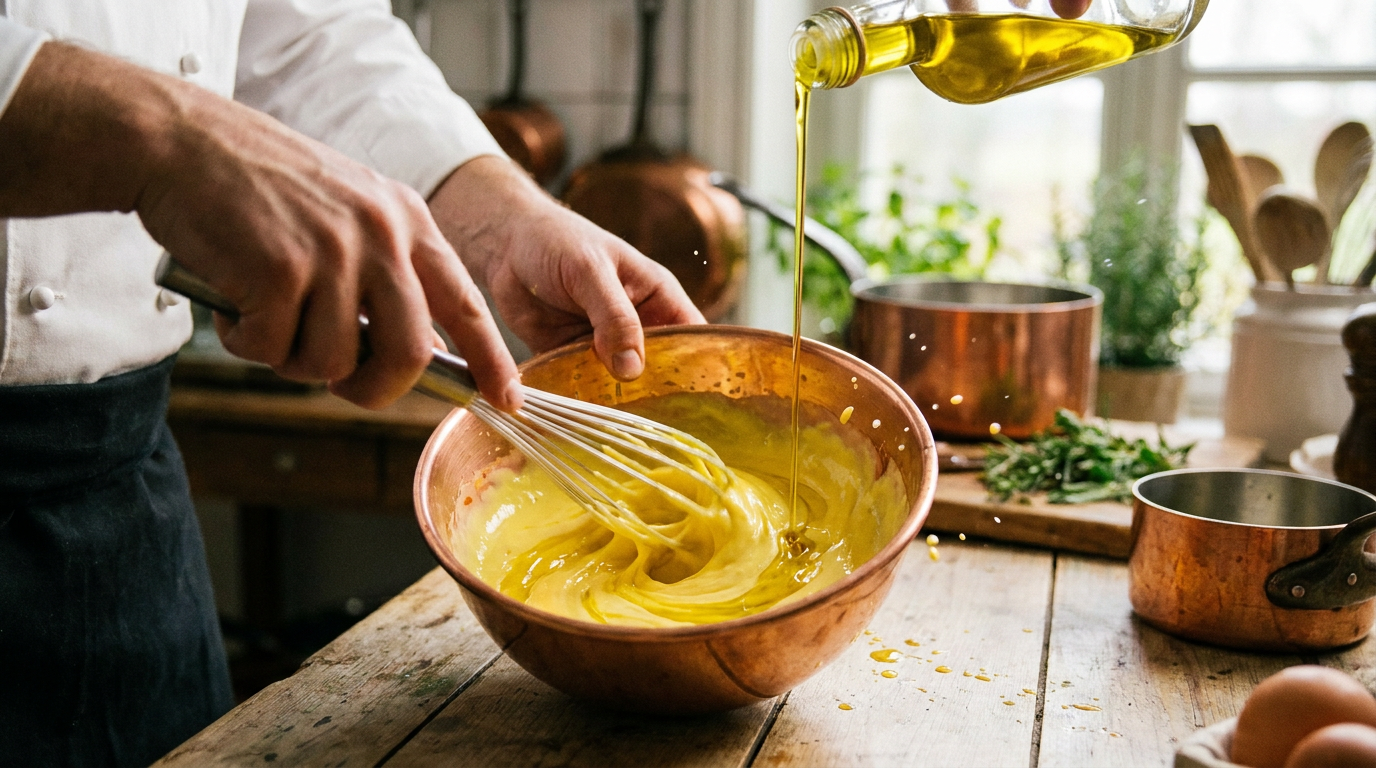
When you whisk oil into an egg yolk, the lecithin molecules coat the newly formed oil droplets like a microscopic suit of armor. This coating drastically lowers the interfacial tension between the oil and the water. More importantly, the water-loving heads of the lecithin molecules carry a slight electrical charge. Because all the coated oil droplets now have the same charge on their surface, they actively repel one another, preventing them from coalescing back into a greasy pool.[4][5]

When you whisk oil into an egg yolk, the lecithin molecules coat the newly formed oil droplets like a microscopic suit of armor.
While egg yolks are the heavyweights of the emulsification world, home cooks have a variety of other natural emulsifiers in their pantries. Mustard contains complex carbohydrates called mucilage that swell in water and help stabilize vinaigrettes. Honey, tomato paste, and mashed garlic all contain proteins and particles that physically interfere with oil droplets, keeping them separated. This is why a traditional Spanish allioli can achieve a creamy, mayonnaise-like texture using nothing but garlic, olive oil, and a mortar and pestle.[1][2]
But chemical emulsifiers are only half the equation; the other half is physics. To create an emulsion, you must apply mechanical force, known in physics as shear. Whisking vigorously by hand, streaming ingredients into a running food processor, or using an immersion blender provides the violent agitation necessary to shatter the oil into microscopic droplets. Without sufficient shear force, the oil droplets remain too large, and the emulsifier cannot effectively coat them.[1][3]
The size of these droplets directly dictates the texture and stability of the final sauce. Smaller, more uniform droplets create a tighter, thicker, and more stable emulsion. This happens because the finely dispersed oil droplets become so densely packed that they struggle to move past one another, creating friction. This friction is what gives a properly emulsified mayonnaise its luxurious, spoon-coating viscosity, transforming liquid oil and liquid vinegar into a semi-solid spread.[4][5]
The most critical rule of creating any emulsion is patience: the dispersed phase must be added to the continuous phase incredibly slowly. If you dump a cup of oil into a bowl of vinegar and egg yolks all at once, the continuous phase becomes overwhelmed. The shear force of your whisk cannot break the oil down fast enough, and the oil droplets merge before the emulsifier can coat them. By adding the oil drop by drop, or in a very thin stream, you ensure that every droplet is shattered and coated before the next wave of oil arrives.[1][3]

Temperature also plays a vital role in the stability of these delicate mixtures. Emulsions are highly sensitive to their environment. In a warm emulsion like hollandaise or béarnaise, too much heat will cause the egg yolk proteins to coagulate and scramble, instantly breaking the sauce and releasing the butterfat. Conversely, if a mayonnaise is made with oil that is too cold, the fat becomes stiff and difficult to break into small droplets, resulting in a thin, unstable mixture.[2]
There are also strict mathematical limits to how much oil a given amount of water can hold. The classic culinary ratio for a vinaigrette is three parts oil to one part vinegar. Push beyond this ratio, and the dispersed oil droplets become so crowded that they inevitably crash into one another, breaking the emulsion. While commercial kitchens use high-powered homogenizers to push these limits, home cooks are bound by the physical constraints of their whisks and blenders.[3]

When an emulsion fails—when a sauce 'breaks'—it is a visually tragic event. The mixture suddenly loses its opacity and thickness, separating into a grainy, curdled mess floating in a pool of grease. This happens through two mechanisms: flocculation, where the droplets clump together like grapes, and coalescence, where they actually merge back into a single layer of oil. A broken sauce is the result of adding oil too quickly, applying insufficient shear, or exposing the mixture to extreme temperatures.[1]
Fortunately, science offers a reliable method for rescuing a broken emulsion. Because the original mixture has lost its continuous phase, you cannot simply whisk it back together. Instead, you must start over with a fresh continuous phase—a teaspoon of water, a splash of vinegar, or a fresh egg yolk in a clean bowl. By slowly whisking the broken, greasy sauce into this new base, you re-establish the continuous phase, shattering the coalesced oil back into microscopic droplets and restoring the sauce to its former glory.[6]
Today, the science of emulsification bridges the gap between traditional culinary arts and modern food science. While a classic French chef might rely on sensory cues and the rhythmic flick of a balloon whisk to build a beurre blanc, modernist chefs utilize precise measurements of soy lecithin powder and high-shear immersion blenders to create ethereal foams and hyper-stable purees. Both approaches, however, are governed by the exact same physical laws of interfacial tension and droplet dispersion.[4][6]
Ultimately, understanding emulsification demystifies one of the most intimidating aspects of home cooking. A sauce is not a magical spell that succeeds or fails on a whim; it is a predictable physical structure built from water, fat, and force. By respecting the chemistry of emulsifiers, controlling the temperature, and applying the right amount of shear, any cook can master the invisible architecture of flavor, turning simple pantry staples into extraordinary culinary creations.[6]
Viewpoints in depth
Culinary Scientists
Focus on molecular interactions, shear force, precise ratios, and modern stabilizers to engineer perfect textures.
For food scientists and modernist chefs, emulsification is an exercise in precise physics and chemistry. They view sauces not as traditional recipes, but as engineered structures. By utilizing high-shear homogenizers and precise measurements of extracted stabilizers like soy lecithin or xanthan gum, this camp pushes the boundaries of what an emulsion can be, creating hyper-stable foams and purees that defy traditional culinary limits.
Traditionalist Chefs
Rely on classic French technique, sensory cues, hand-whisking, and natural emulsifiers like egg yolks and mustard.
The traditionalist approach is rooted in the centuries-old techniques of the French mother sauces. Rather than relying on laboratory equipment, these chefs depend on sensory feedback—the sound of the whisk hitting the bowl, the changing opacity of the sauce, and the resistance of the mixture as it thickens. They champion natural emulsifiers like egg yolks, mustard, and garlic, believing that the manual process of building an emulsion by hand imparts a superior texture and soul to the food.
Home Cooks
Seek practical, foolproof methods to prevent broken sauces and rescue mistakes without specialized laboratory equipment.
For the everyday home cook, the science of emulsification is primarily a tool for troubleshooting. This perspective values practical, foolproof methods over theoretical chemistry. Home cooks want to know exactly why their Thanksgiving gravy separated and how to fix a broken hollandaise on a Sunday morning. They rely on accessible tools like immersion blenders and simple pantry staples like mustard and honey to achieve reliable results without needing a culinary degree.
What we don't know
- While the mechanics of lecithin are well understood, food scientists are still researching how different plant-based proteins interact at the microscopic level to perfectly replicate the exact mouthfeel of egg yolks in vegan mayonnaise.
- The precise impact of varying mineral contents in municipal tap water on the electrostatic repulsion of oil droplets remains an area of active study in commercial food production.
Key terms
- Emulsion
- A mixture of two immiscible liquids, achieved by finely dispersing one into the other.
- Immiscible
- Incapable of being mixed or blended together naturally, such as oil and water.
- Amphiphilic
- A molecule possessing both water-loving (hydrophilic) and fat-loving (lipophilic) properties.
- Continuous Phase
- The base liquid in an emulsion that surrounds and suspends the microscopic droplets of the other liquid.
- Dispersed Phase
- The liquid that is broken down into microscopic droplets and suspended within the continuous phase.
- Lecithin
- A powerful natural emulsifier found abundantly in egg yolks and soybeans.
- Shear Force
- The mechanical agitation—like whisking or blending—required to shatter oil into microscopic droplets.
Frequently asked
Why did my mayonnaise break?
A broken mayonnaise usually occurs because the oil was added too quickly, overwhelming the continuous phase. It can also happen if the ingredients were too cold or if insufficient whisking (shear force) was applied.
Can I fix a broken hollandaise or mayonnaise?
Yes. Start with a fresh continuous phase—like a teaspoon of warm water or a fresh egg yolk—in a clean bowl. Slowly whisk the broken, greasy sauce into the new base drop by drop to re-emulsify it.
Is a vinaigrette a permanent emulsion?
No, a standard vinaigrette is a temporary emulsion. Without a strong emulsifier like egg yolk, the oil and vinegar will eventually separate, which is why it must be shaken or whisked immediately before serving.
What is the best tool for emulsifying sauces?
Immersion blenders and food processors provide excellent, consistent shear force for large batches. For smaller amounts, a balloon whisk used vigorously by hand is highly effective.
Sources
Source coverage
6 outlets
3 viewpoints surfaced





[1]Food52Home Cooks
How Emulsification Works - How to Emulsify Sauces, Dressings, and More
Read on Food52 →[2]MICHELIN GuideTraditionalist Chefs
Technique Thursday: What Is Emulsification?
Read on MICHELIN Guide →[3]Institute of Culinary EducationTraditionalist Chefs
How to Make Emulsified Sauces — and a Recipe!
Read on Institute of Culinary Education →[4]CHEF iQCulinary Scientists
The Science of Emulsions: Perfecting Sauces and Dressings
Read on CHEF iQ →[5]ResearchGateCulinary Scientists
Emulsification Properties of Egg Yolk Lecithin and Various Phospholipids
Read on ResearchGate →[6]Factlen Editorial TeamHome Cooks
Synthesis by Factlen editorial team
Read on Factlen Editorial Team →
More in food drink
See all 11 stories →Baking Science
The Chemistry of the Perfect Chocolate Chip Cookie
0 sources
Inclusive Design
The Rise of Sensory-Friendly Dining: How Restaurants Are Redesigning for Neurodiversity
0 sources

Baking Science
The Science of Tangzhong: How a Simple Flour Paste Creates the World's Softest Bread
0 sources
Packaging Tech
How the Fast-Food Industry Finally Eliminated 'Forever Chemicals' From Its Packaging
0 sources
Every angle. Every day.
Get food drink stories with full source coverage and perspective breakdowns delivered to your inbox.