
The Green-Collar Boom: How Vocational Education is Powering the Clean Energy Transition
Wind turbine technicians and solar installers are the fastest-growing occupations in the U.S., driving a massive expansion in vocational training and apprenticeships.
By Factlen Editorial Team
- Vocational Educators & Unions
- Trade schools and unions view the green transition as a renaissance for blue-collar apprenticeships.
- Clean Energy Industry
- Energy developers view the skilled labor shortage as the single greatest bottleneck to deploying capital.
- Labor Economists
- Economists emphasize the distinction between rapid percentage growth and the absolute size of the workforce.
What's not represented
- · Legacy fossil fuel workers transitioning to green jobs
- · Homeowners facing installation delays due to labor shortages
Why this matters
As billions of dollars flow into climate infrastructure, the primary bottleneck is no longer technology or capital, but skilled labor. This shift offers a lucrative, debt-free career path for a new generation of blue-collar workers.
Key points
- Wind turbine technicians and solar PV installers are the two fastest-growing occupations in the U.S., projected to grow 50% and 42% by 2034.
- The clean energy boom is driving a renaissance in vocational education, offering debt-free pathways to middle-class wages.
- Federal funding and state mandates have created massive demand for physical infrastructure, shifting the bottleneck from capital to skilled labor.
- While percentage growth is record-breaking, the absolute number of new jobs remains relatively small compared to massive sectors like healthcare.
- These roles require significant physical resilience, involving high-altitude climbs, heavy lifting, and exposure to extreme weather.
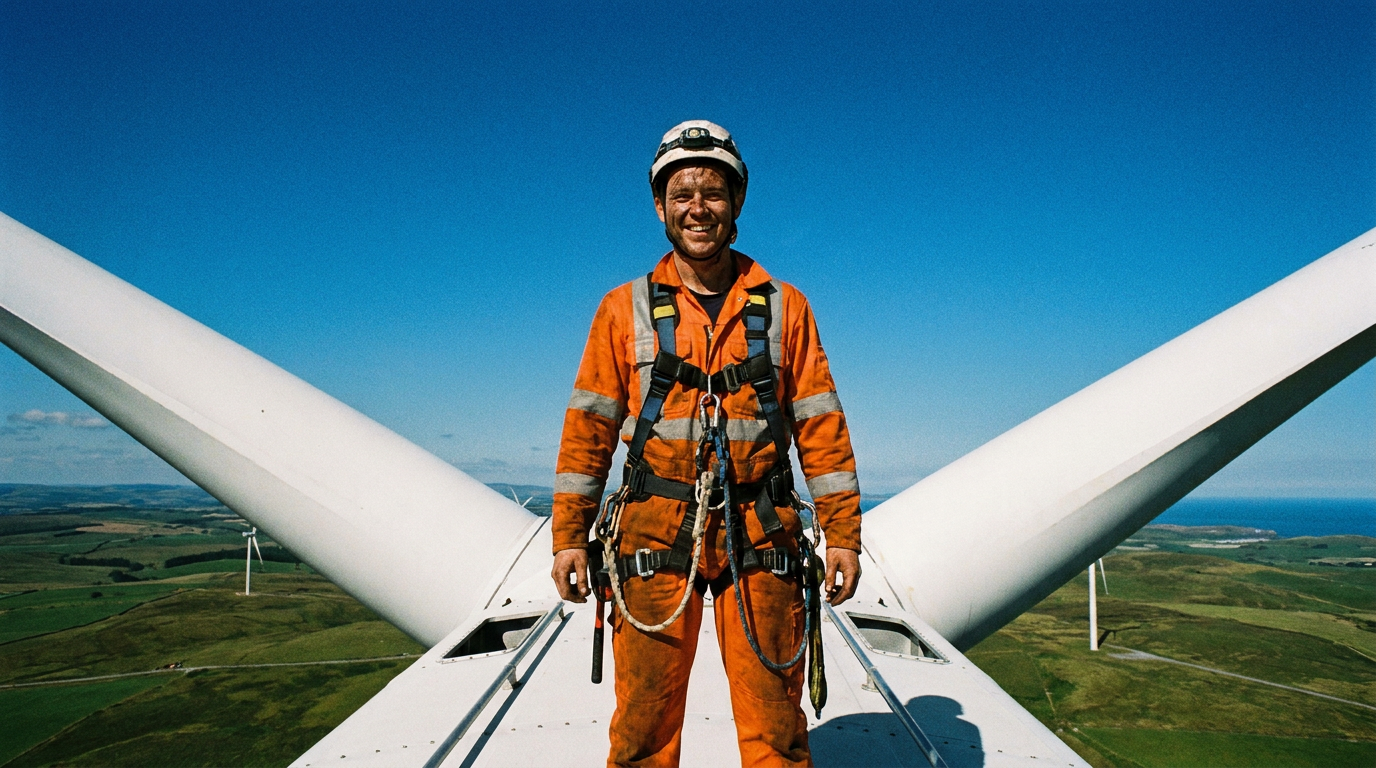
The fastest-growing occupations in the United States are not found in the air-conditioned offices of Silicon Valley, nor do they require a background in artificial intelligence. Instead, they are located on sun-baked residential rooftops and atop 300-foot steel towers on the windswept plains. As the global economy accelerates its transition away from fossil fuels, the demand for the physical infrastructure of renewable energy has created an unprecedented surge in "green-collar" jobs. These are the skilled trades responsible for assembling, wiring, and maintaining the hardware that powers the clean energy transition. The sheer volume of planned projects has transformed the labor market, turning niche environmental roles into mainstream vocational career paths.[3][4]
The data driving this shift is stark. According to the latest projections from the U.S. Bureau of Labor Statistics (BLS), employment for wind turbine service technicians is expected to grow by 50 percent between 2024 and 2034. Solar photovoltaic (PV) installers are close behind, with a projected growth rate of 42 percent. These figures represent the two fastest-growing occupations in the entire American economy, vastly outpacing the average growth rate for all other professions. This statistical reality is forcing a reevaluation of post-secondary education, as students and career-switchers increasingly look toward vocational training and apprenticeships rather than traditional four-year university degrees.[1][4]

The catalyst for this blue-collar boom is largely driven by aggressive public policy and massive capital deployment. The passage of the Inflation Reduction Act, which committed roughly $370 billion to clean energy initiatives over a decade, combined with ambitious state-level renewable mandates, has fundamentally altered the economics of energy production. Solar panels and wind turbines are being manufactured and deployed at record rates. However, the industry has quickly realized that while capital can buy hardware, it cannot independently install it. The bottleneck for the energy transition is no longer funding or technology; it is the availability of skilled human labor.[3][6]
"You cannot install a wind turbine over Zoom, and AI isn't climbing anyone's roof anytime soon," notes industry analysis on the resilience of these trades. Clean energy employment grew three times faster than the rest of the U.S. workforce in 2024, highlighting a structural shift in where economic opportunity lies. Unlike many modern knowledge-worker roles that face the looming threat of automation or offshoring, green-collar trades are inherently localized and physically demanding. They require a human presence on the ground—or in the air—to turn blueprints and manufactured components into functioning power plants.[4][5]
To meet this surging demand, the vocational education sector is undergoing a rapid evolution. Community colleges, technical schools, and labor unions are expanding their curricula to include specialized clean energy programs. The Organization for Economic Co-operation and Development (OECD) emphasizes that vocational education and training (VET) systems are the critical engine for the green transition. In many developed nations, governments are actively funding new training places in post-secondary VET programs, focusing on industrial production, clean energy, and sustainable infrastructure. The goal is to prevent severe skill bottlenecks that could stall climate targets.[2][7]

To meet this surging demand, the vocational education sector is undergoing a rapid evolution.
The training pathways for these roles are designed to be accessible and highly practical, often utilizing an "earn-while-you-learn" apprenticeship model. For aspiring wind turbine technicians, the journey typically begins with a postsecondary non-degree award or an associate degree from a technical school. These programs, which can last from six months to two years, cover electrical safety, fluid power, mechanical systems, and the crucial skill of tower climbing and self-rescue. Once hired, technicians undergo extensive on-the-job training with their specific employer or turbine manufacturer, learning the proprietary systems of the massive machines they will maintain.[1][4]
Solar photovoltaic installers generally face an even lower barrier to entry. A high school diploma or GED is often the only academic prerequisite, followed by a short-term trade certificate or direct entry into a registered apprenticeship. The day-to-day work involves a complex mix of construction and electrical skills: reading blueprints, mounting racking systems to various roof types, wiring panels to inverters, and safely connecting the array to the local electrical grid. While residential solar provides the entry point for many, commercial and utility-scale projects offer pathways to higher complexity and increased compensation.[1][8]
Financially, these green-collar trades offer a compelling value proposition for workers seeking to avoid the burden of student loan debt. In May 2024, the median annual wage for wind turbine technicians was $62,580, while solar PV installers earned a median of $51,860. However, these median figures mask significant regional and sector-specific variations. Installers working on massive utility-scale projects, particularly those affiliated with labor unions or holding full electrical licenses, can earn considerably more. The combination of solid entry-level wages, minimal educational debt, and high job security makes these roles highly competitive alternatives to traditional white-collar entry-level positions.[1][4]

Despite the impressive percentage growth, labor economists and industry analysts are careful to contextualize the absolute numbers. Because the existing baseline of wind and solar workers is relatively small compared to massive sectors like healthcare or retail, a 50 percent growth rate translates to a modest number of total new jobs. The BLS projects about 2,300 annual openings for wind turbine technicians and 4,100 for solar installers over the next decade. This means that while the field is expanding rapidly, it remains a specialized niche rather than a mass-employment sector like nursing or logistics.[1][5]
Furthermore, the physical realities of green-collar work present significant retention challenges for the industry. Wind turbine technicians must be comfortable working in confined spaces and at extreme heights, often in remote locations subject to harsh weather conditions. Solar installers spend their days performing heavy lifting and electrical work on exposed, sun-baked rooftops. The physical toll of the work means that many technicians eventually transition into supervisory roles, system design, project management, or specialized electrical inspection as they age, necessitating a constant pipeline of new, younger workers to fill the physical installation roles.[3][4]

The global nature of the energy transition means this vocational boom is not limited to the United States. The European Union, through initiatives like the T-MED Skills Agenda, is actively aligning its vocational training with the needs of the clean energy sector across the Mediterranean. Similarly, countries like India are rapidly expanding their renewable energy workforce to meet ambitious national targets. Across the globe, policymakers are recognizing that the success of international climate agreements hinges entirely on the ability to train, deploy, and retain a massive blue-collar workforce capable of physically building a decarbonized future.[2][7]
Ultimately, the rise of the green-collar worker represents a profound shift in the hierarchy of modern labor. For decades, economic prestige and policy focus have heavily favored digital innovation and university-credentialed knowledge work. The clean energy transition is forcing a correction, highlighting the indispensable value of skilled manual labor. As nations race to modernize their electrical grids and deploy renewable generation at scale, the vocational students learning to wire inverters and torque turbine bolts today will be the primary architects of the mid-century energy landscape.[5][6]
How we got here
August 2022
The US passes the Inflation Reduction Act, committing $370 billion to clean energy and supercharging demand for green trades.
2024
Clean energy employment grows three times faster than the rest of the US workforce, exposing a severe shortage of skilled installers.
May 2024
The BLS reports median wages for wind techs cross $62,000, solidifying the trade as a lucrative alternative to four-year degrees.
2025-2026
Vocational schools and community colleges rapidly expand post-secondary VET programs to address the clean energy skills bottleneck.
2034
The target year for the BLS projection, by which wind and solar technician roles are expected to have grown by 50% and 42%, respectively.
Viewpoints in depth
Vocational Educators' view
Trade schools and unions view the green transition as a renaissance for blue-collar apprenticeships.
For decades, vocational programs struggled against the cultural narrative that a four-year university degree was the only path to middle-class stability. Educators and union leaders see the clean energy boom as the ultimate vindication of the 'earn-while-you-learn' model. They argue that by aligning curricula with emerging technologies—such as advanced inverters and high-voltage battery storage—they are offering young workers a debt-free route to high-paying, future-proof careers. Their primary concern is scaling these programs fast enough, as they currently face a shortage of experienced instructors to teach the influx of new students.
The Clean Energy Industry's view
Energy developers view the skilled labor shortage as the single greatest bottleneck to deploying capital.
Clean energy developers and utility companies have secured billions in funding through federal incentives like the Inflation Reduction Act. However, they view the lack of qualified technicians as an existential threat to project timelines. The industry argues that while panel and turbine manufacturing can scale exponentially, the human workforce cannot. They are increasingly partnering directly with high schools and community colleges to build proprietary training pipelines, warning that without a massive influx of blue-collar talent, national climate targets will be mathematically impossible to achieve.
Labor Economists' view
Economists emphasize the distinction between rapid percentage growth and the absolute size of the workforce.
While celebrating the wage growth and stability of green-collar jobs, labor economists urge caution when interpreting the headline statistics. They point out that a 50 percent growth rate in wind turbine technicians only translates to a few thousand absolute jobs nationwide, because the baseline workforce is so small. Economists argue that while these trades are excellent opportunities for individuals, they will not single-handedly replace the millions of jobs lost in declining legacy industries. They view green trades as a vital, high-quality niche rather than a macroeconomic panacea.
What we don't know
- Whether vocational training programs can scale fast enough to meet the peak installation demands projected for 2030.
- How the physical toll of these jobs will affect long-term career retention rates as the current workforce ages.
- The exact impact of emerging automation on the day-to-day tasks of solar installers over the next decade.
Key terms
- Green-collar job
- A skilled trade or manual labor position directly involved in environmental sustainability or clean energy.
- Photovoltaic (PV) system
- Technology that converts sunlight directly into electricity using semiconductor materials.
- Utility-scale solar
- Large solar power plants that generate electricity fed directly into the national transmission grid, rather than powering a single home.
- Inverter
- A device that converts the variable direct current (DC) output of a solar panel into alternating current (AC) used by the electrical grid.
- Vocational Education and Training (VET)
- Educational programs that prepare students for specific trades, crafts, and careers at various levels, often bypassing a traditional bachelor's degree.
Frequently asked
Do I need a college degree to work in renewable energy?
No. The fastest-growing roles, such as solar installers and wind turbine technicians, typically require only a high school diploma followed by a trade certificate or an on-the-job apprenticeship.
Is the pay competitive without a degree?
Yes. Wind turbine technicians earn a median of $62,580, and solar installers earn $51,860, with union and utility-scale workers earning significantly more without the burden of student debt.
What is the physical toll of these jobs?
These are highly physical trades. Wind technicians must climb 300-foot towers and work in confined spaces, while solar installers perform heavy lifting and electrical work on exposed rooftops in varying weather.
Are these jobs at risk of automation?
Currently, no. While solar panel manufacturing is becoming automated, the physical installation of panels on diverse rooftops and the hands-on maintenance of wind turbines remain highly manual tasks.
Sources
Source coverage
8 outlets
3 viewpoints surfaced








[1]U.S. Bureau of Labor StatisticsLabor Economists
Wind Turbine Technicians : Occupational Outlook Handbook
Read on U.S. Bureau of Labor Statistics →[2]OECDClean Energy Industry
Vocational education and training (VET) is critical for the green economy
Read on OECD →[3]Green Fuel JournalClean Energy Industry
Renewable Energy Job Market Overview — Global Employment Trends
Read on Green Fuel Journal →[4]TradeCollegesVocational Educators & Unions
A data-driven guide to careers in clean energy trades
Read on TradeColleges →[5]ExternVocational Educators & Unions
How the BLS actually measures job growth
Read on Extern →[6]Factlen Editorial TeamLabor Economists
Synthesis by Factlen editorial team
Read on Factlen Editorial Team →[7]EuropaClean Energy Industry
EU launches T-MED initiative to boost clean tech and green skills
Read on Europa →[8]NCCERVocational Educators & Unions
Benefits of Becoming a Solar Photovoltaic Installer
Read on NCCER →

More in education
See all 11 stories →College Funding
The Rise of Micro-Scholarships: How Students Are 'Stacking' Their Way to College Funding
0 sources

Green Jobs
The Green-Collar Boom: How Vocational Training is Racing to Staff the Clean Energy Transition
0 sources
AI Tutoring
How AI Tutors Are Rewriting the Rules of Personalized Learning
0 sources

Higher Ed Affordability
The Rise of Zero-Textbook-Cost Degrees: How Open Educational Resources Are Reshaping Higher Ed
0 sources

Every angle. Every day.
Get education stories with full source coverage and perspective breakdowns delivered to your inbox.