
The Evidence on AI Tutors: How Guardrailed Chatbots Are Doubling University Learning Gains
Recent large-scale studies reveal that AI tutors can double student learning speeds, but only when strict pedagogical guardrails prevent them from simply giving away the answers.
By Factlen Editorial Team
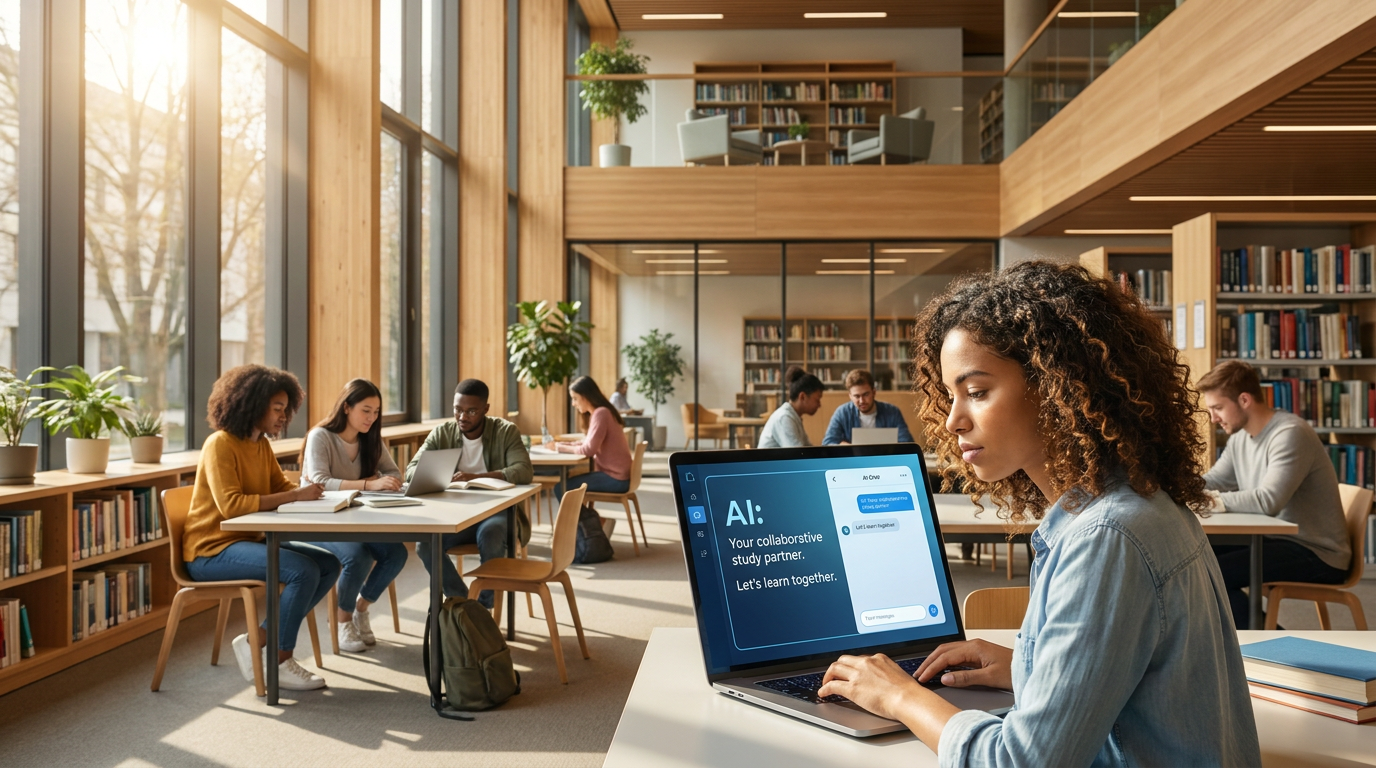
- Pedagogical Optimists
- Argue that AI tutors are the key to democratizing 1:1 mastery learning and solving Bloom's two-sigma problem at scale.
- Pragmatic Adopters
- Focus on the hybrid reality where AI handles routine scaffolding while human professors provide high-level mentorship and empathy.
- Cognitive Skeptics
- Warn that without strict guardrails, AI acts as a crutch that causes cognitive offloading and degrades independent problem-solving skills.
What's not represented
- · First-generation college students who rely heavily on institutional support
- · K-12 educators preparing students for AI-integrated universities
Why this matters
As universities rapidly integrate AI into their curricula, understanding the difference between a helpful digital tutor and a detrimental 'answer engine' is crucial for students aiming to maximize their learning and for institutions designing the future of education.
Key points
- AI tutors can double learning gains compared to traditional active learning environments.
- Unrestricted AI access can harm exam performance by up to 17% due to cognitive offloading.
- The most effective AI systems use 'pedagogical prompting' to guide students rather than give answers.
- 80% of students report that AI has positively supported their learning experience.
- Students still overwhelmingly prefer human instructors for deep academic mentorship and empathy.
The era of the AI tutor has officially moved from experimental pilot programs to institutional reality. As of early 2026, an estimated 92% of university students globally utilize generative artificial intelligence in their studies, marking the fastest adoption of any educational technology in history. But the conversation has shifted dramatically from the initial panic over plagiarism. Universities are no longer just trying to catch AI-generated essays; they are actively building and deploying AI systems to teach.[6]
The promise is intoxicating: the ability to provide every student with a personalized, infinitely patient, 24/7 tutor. This is the holy grail of education, a concept known as "Bloom's two-sigma problem," which posits that one-on-one tutoring produces learning outcomes two standard deviations higher than conventional classroom instruction. Historically, scaling 1:1 human tutoring to millions of students was economically impossible. Generative AI has changed that math.[1][8]
But as the first wave of rigorous, large-scale academic research from 2025 and 2026 is published, a complex picture is emerging. The evidence pack is clear: AI tutors can produce staggering gains in student comprehension and speed. However, when implemented poorly, they can actively degrade a student's ability to think critically and solve problems independently. The difference between a breakthrough and a crutch lies entirely in the software's pedagogical guardrails.[1]
The strongest evidence for the efficacy of AI tutoring comes from a landmark randomized controlled trial published in Scientific Reports in June 2025. Researchers tested a highly constrained, subject-specific AI tutor in a university physics course. The results were striking: students using the AI tutor learned more than twice as much as their peers in a traditional active-learning classroom.[2]
Furthermore, the AI-tutored students achieved these outsized gains in less time. The median time on task for the AI group was 49 minutes, compared to 60 minutes for the in-class learners. The effect size of the intervention was measured between 0.73 and 1.3 standard deviations—a massive leap in a field where an effect size of 0.40 is typically considered highly significant.[2]

These findings are not isolated. A 2026 second-order meta-analysis published in the Journal of Educational Computing Research, which synthesized 19 previous meta-analyses covering nearly 58,000 participants, found a moderate-to-large overall effect size of 0.67 standard deviations for AI on student learning. The Brookings Institution, reviewing multiple randomized controlled trials, concluded that students using hybrid AI models reached concept mastery 1.5 to 2 times faster than those relying on a single traditional modality.[3][5]
How exactly does the AI achieve this? The mechanism is rooted in immediate, personalized feedback. In a lecture hall of 300 students, a professor cannot pause to correct every individual misconception. An AI tutor, however, can analyze a student's specific error—whether in a physics equation or a block of Python code—and instantly provide targeted scaffolding to help them bridge the gap.[1][8]
Harvard University's famous introductory computer science course, CS50, was one of the first to deploy this at scale. By integrating a specialized AI bot, the course provided thousands of students with a "rubber duck" debugging partner. The bot was strictly instructed not to write code for the students, but rather to ask guiding questions that led the students to find their own errors.[8]
Harvard University's famous introductory computer science course, CS50, was one of the first to deploy this at scale.
This Socratic method is the critical variable. When AI is designed to act as a pedagogical guide, it forces the student to engage in "productive struggle." The student still has to do the cognitive heavy lifting, but they are prevented from getting hopelessly stuck and abandoning the assignment. This keeps motivation high and accelerates the learning loop.[1][3]

However, the research also contains a glaring warning sign. When students are given unrestricted access to powerful generative models like ChatGPT, the learning gains evaporate—and often reverse. A 2025 field experiment published in PNAS by researchers at the Wharton School demonstrated this danger vividly.[4]
The Wharton researchers gave high school students unrestricted access to ChatGPT during math practice. While the students completed their practice problems faster and with higher accuracy, their performance on subsequent exams—taken without the AI—plummeted. They scored 17% worse than the control group that had no AI assistance at all.[4]

The culprit is a phenomenon known as "cognitive offloading." When an AI acts as an "oracle" rather than a tutor, it simply provides the correct answer. The student bypasses the productive struggle entirely. Because their brain never had to wrestle with the underlying logic, the information is never encoded into long-term memory. They outsourced the thinking to the machine, and as a result, they learned nothing.[1][4]
This dichotomy—the AI as a Socratic tutor versus the AI as an answer-dispensing oracle—is the central challenge facing higher education today. The technology itself is agnostic; it will do whatever the prompt instructs it to do. Therefore, the effectiveness of AI in education is no longer a computer science problem; it is a pedagogical design problem.[1][8]
Universities are responding by building "walled gardens." Rather than letting students use raw, public-facing LLMs, institutions are developing proprietary interfaces wrapped around these models. These interfaces use "pedagogical prompting" to strictly forbid the AI from giving direct answers, forcing it to adopt the persona of a rigorous, encouraging human professor.[3][8]
Student reception to these specialized tools has been overwhelmingly positive, though grounded in reality. According to Coursera's February 2026 AI in Higher Education Report, 80% of students globally stated that AI has positively supported their learning experience. Yet, 63% reported using it for less than half of their academic tasks, indicating they view it as a supplement rather than a replacement for their own effort.[6]
Furthermore, a Spring 2025 survey by Tyton Partners found that when students need deep academic help, 84% still prefer to turn to human instructors or peers. The AI is highly valued for immediate, low-stakes friction—explaining a confusing term at 2:00 AM or helping to structure an outline—but it lacks the empathy and mentorship that students seek from human faculty.[7]

This points to the ultimate consensus in the 2026 evidence pack: AI is not replacing the university professor. Instead, it is unbundling the role of the educator. The AI handles the repetitive, time-consuming work of basic scaffolding, syntax correction, and concept review. This frees the human professor to focus on high-level synthesis, emotional support, and complex debate.[1][3][8]
The data proves that when this hybrid model is achieved, the results are transformative. By combining the infinite patience and instant availability of an AI tutor with the pedagogical guardrails necessary to prevent cognitive offloading, universities are finally inching closer to solving Bloom's two-sigma problem. The future of higher education is not automated; it is augmented.[1][2][5]
How we got here
Fall 2023
Harvard's CS50 introduces an AI bot to provide 24/7 personalized tutoring to thousands of students.
Spring 2025
PNAS publishes a Wharton study revealing that unrestricted ChatGPT use harms student exam performance by 17%.
June 2025
Scientific Reports publishes a landmark RCT showing AI tutors can double learning gains compared to traditional active learning.
February 2026
Coursera's global report finds 92% of university students now use AI, with 80% citing academic improvements.
Viewpoints in depth
Pedagogical Optimists
Researchers and technologists focused on the massive learning gains achieved through 1:1 AI tutoring.
This camp points to the staggering effect sizes seen in recent randomized controlled trials, such as the 0.73 to 1.3 standard deviations measured in the Harvard physics study. They argue that generative AI is the first technology in history capable of solving Bloom's two-sigma problem at scale. By providing infinitely patient, personalized feedback 24 hours a day, they believe AI tutors will fundamentally democratize mastery learning, allowing students of all backgrounds to grasp complex concepts at their own pace without falling behind in crowded lecture halls.
Cognitive Skeptics
Academics warning about the dangers of cognitive offloading and the loss of independent problem-solving skills.
Drawing heavily on the Wharton field experiment published in PNAS, this perspective emphasizes that learning requires 'productive struggle.' When students use AI as an oracle to bypass the friction of problem-solving, they fail to encode the underlying logic into their long-term memory. Skeptics warn that without incredibly strict, institutionally enforced guardrails, the widespread adoption of AI will result in a generation of students who appear highly capable on homework but fail spectacularly on independent, unassisted assessments.
Pragmatic Adopters
Educators and analysts advocating for a hybrid model where AI handles scaffolding and humans handle mentorship.
This viewpoint, supported by extensive student survey data from organizations like Tyton Partners and Coursera, argues that the debate shouldn't be 'AI versus human.' Instead, they advocate for unbundling the teaching role. They support building 'walled garden' AI tools that use pedagogical prompting to handle repetitive syntax correction and basic concept review. This pragmatic approach acknowledges that while AI is excellent for 2:00 AM friction, 84% of students still crave the empathy, high-level synthesis, and career mentorship that only a human professor can provide.
What we don't know
- Whether the massive learning gains seen in highly structured STEM subjects can be replicated in humanities and creative disciplines.
- The long-term impact of AI tutoring on students' baseline critical thinking skills over a four-year degree program.
- How the cost of developing proprietary, guardrailed AI tutors will affect the financial divide between elite universities and underfunded community colleges.
Key terms
- Cognitive Offloading
- The tendency to rely on external tools (like AI) to solve problems, which can prevent the brain from encoding the information into long-term memory.
- Effect Size
- A statistical metric used to measure the magnitude of a treatment's impact; in education research, anything above 0.40 standard deviations is typically considered highly significant.
- Pedagogical Prompting
- Designing an AI's underlying instructions so it acts like a Socratic tutor—asking guiding questions rather than simply providing the correct answer.
- Bloom's Two-Sigma Problem
- An educational phenomenon identified in 1984 showing that students who receive 1:1 tutoring perform two standard deviations better than students in traditional classrooms.
Frequently asked
Does AI tutoring replace human professors?
No. The consensus shows AI is best used to supplement professors by handling routine scaffolding and syntax correction, freeing human educators for high-level mentorship and complex debate.
Why did some students perform worse with AI?
When students use unrestricted AI models that simply give them the correct answers, they bypass the 'productive struggle' required to encode information into long-term memory, leading to worse exam performance.
What subjects benefit most from AI tutors?
Currently, highly structured domains like computer science, mathematics, and physics show the clearest measurable gains, as the AI can easily identify logical errors and provide targeted feedback.
Sources
Source coverage
8 outlets
3 viewpoints surfaced








[1]Factlen Editorial TeamPragmatic Adopters
Synthesis by Factlen editorial team
Read on Factlen Editorial Team →[2]Scientific ReportsPedagogical Optimists
Generative AI tutoring outperforms active learning in university physics
Read on Scientific Reports →[3]Brookings InstitutionPedagogical Optimists
Generative AI as tutor: The evidence for effectiveness
Read on Brookings Institution →[4]PNASCognitive Skeptics
Generative AI can harm learning if used as a crutch
Read on PNAS →[5]Journal of Educational Computing ResearchPragmatic Adopters
Second-order meta-analysis of artificial intelligence on student learning
Read on Journal of Educational Computing Research →[6]CourseraPragmatic Adopters
2026 AI in Higher Education Report
Read on Coursera →[7]EdSurgePragmatic Adopters
Tyton Partners Survey: How Students Are Actually Using AI in 2025
Read on EdSurge →[8]The Chronicle of Higher EducationPragmatic Adopters
The AI Tutor Revolution is Here. Does It Work?
Read on The Chronicle of Higher Education →
More in education
See all 10 stories →College Funding
The Rise of Micro-Scholarships: How Students Are 'Stacking' Their Way to College Funding
0 sources
Green Jobs
The Green-Collar Boom: How Vocational Training is Racing to Staff the Clean Energy Transition
0 sources

AI Tutoring
How AI Tutors Are Rewriting the Rules of Personalized Learning
0 sources

Higher Ed Affordability
The Rise of Zero-Textbook-Cost Degrees: How Open Educational Resources Are Reshaping Higher Ed
0 sources

Every angle. Every day.
Get education stories with full source coverage and perspective breakdowns delivered to your inbox.