
The Evidence for Agrivoltaics: How Dual-Use Solar is Reshaping Land Efficiency
A synthesis of global evidence reveals that co-locating solar panels with agriculture can increase overall land productivity by up to 73%. As policy frameworks in the EU and US mature, agrivoltaics is transitioning from a niche experiment to a cornerstone of climate-resilient farming.
By Factlen Editorial Team
- Agronomic Researchers
- Focuses on optimizing crop yields, soil health, and water retention beneath solar arrays.
- Energy Developers
- Focuses on land acquisition, project economics, and maximizing renewable energy output.
- Agricultural Policymakers
- Focuses on preserving food security, protecting rural economies, and preventing 'sham farming'.
What's not represented
- · Traditional farmers resistant to industrializing rural landscapes
- · Utility grid operators managing decentralized rural power generation
Why this matters
As the global transition to renewable energy accelerates, the competition for arable land has become a critical bottleneck. Agrivoltaics proves that we can generate massive amounts of clean electricity while simultaneously protecting crops from extreme heat and saving water, offering a rare, empirically backed win-win for both the climate and global food security.
Key points
- Agrivoltaics combines solar energy generation and agriculture on the same land, boosting overall land efficiency by up to 73%.
- The microclimate created by the panels reduces irrigation needs by 20% to 35% in arid regions.
- Shade-tolerant crops see yield increases, while sun-intensive crops like corn and wheat suffer reductions.
- The EU has harmonized agrivoltaics with agricultural subsidies, removing a major financial risk for farmers.
- Elevating solar panels to accommodate farm machinery increases initial structural costs by 10% to 20%.
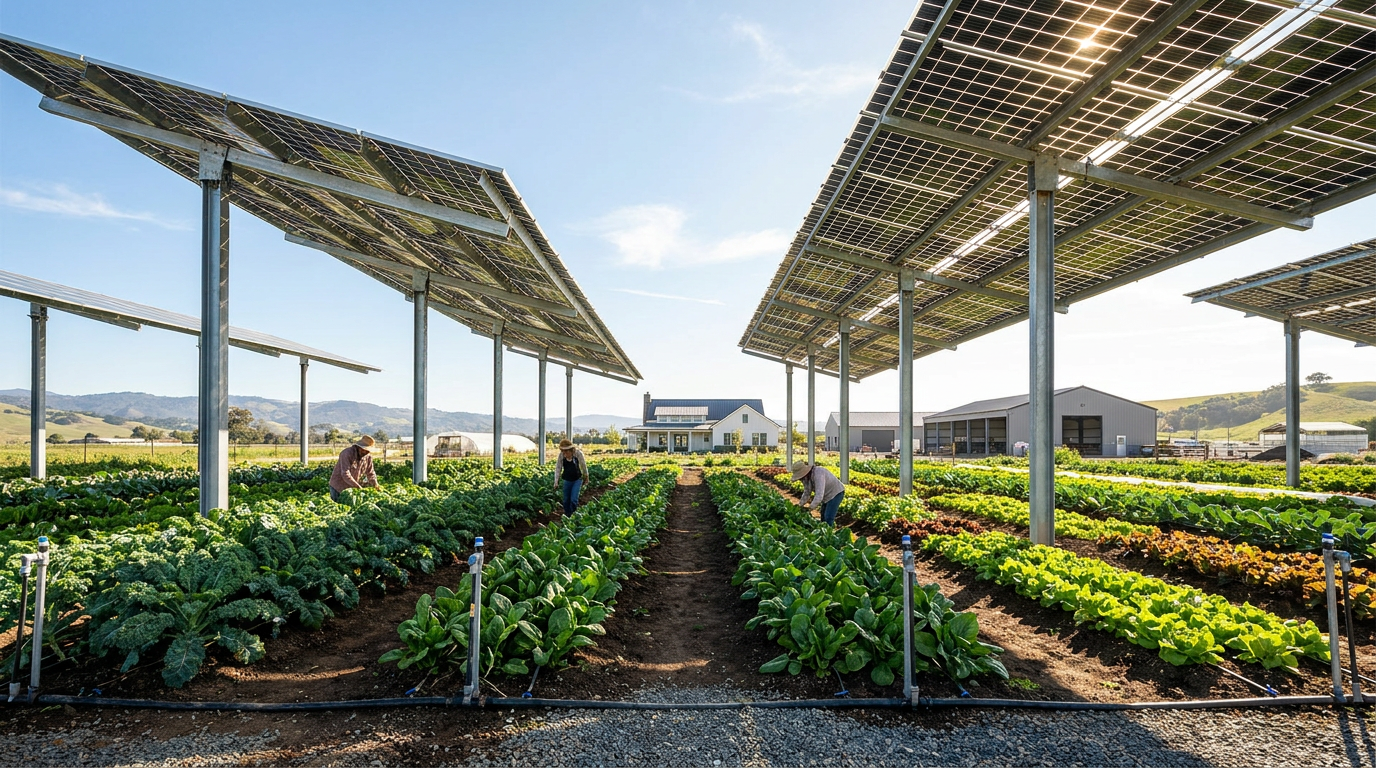
The transition to renewable energy requires vast amounts of land, sparking a growing conflict between solar developers and agricultural communities. But a rapidly maturing dual-use strategy known as "agrivoltaics" is proving that food and energy production do not have to compete.[1][7]
By elevating photovoltaic panels to allow crops, livestock, or pollinator habitats to thrive underneath, agrivoltaics fundamentally rewrites the math of land use. A 2025 systematic review of global evidence found that these integrated systems consistently achieve a "Land Equivalent Ratio" of 1.2 to 1.8, meaning they are 20% to 80% more territorially efficient than separating farms and solar plants.[1][3]
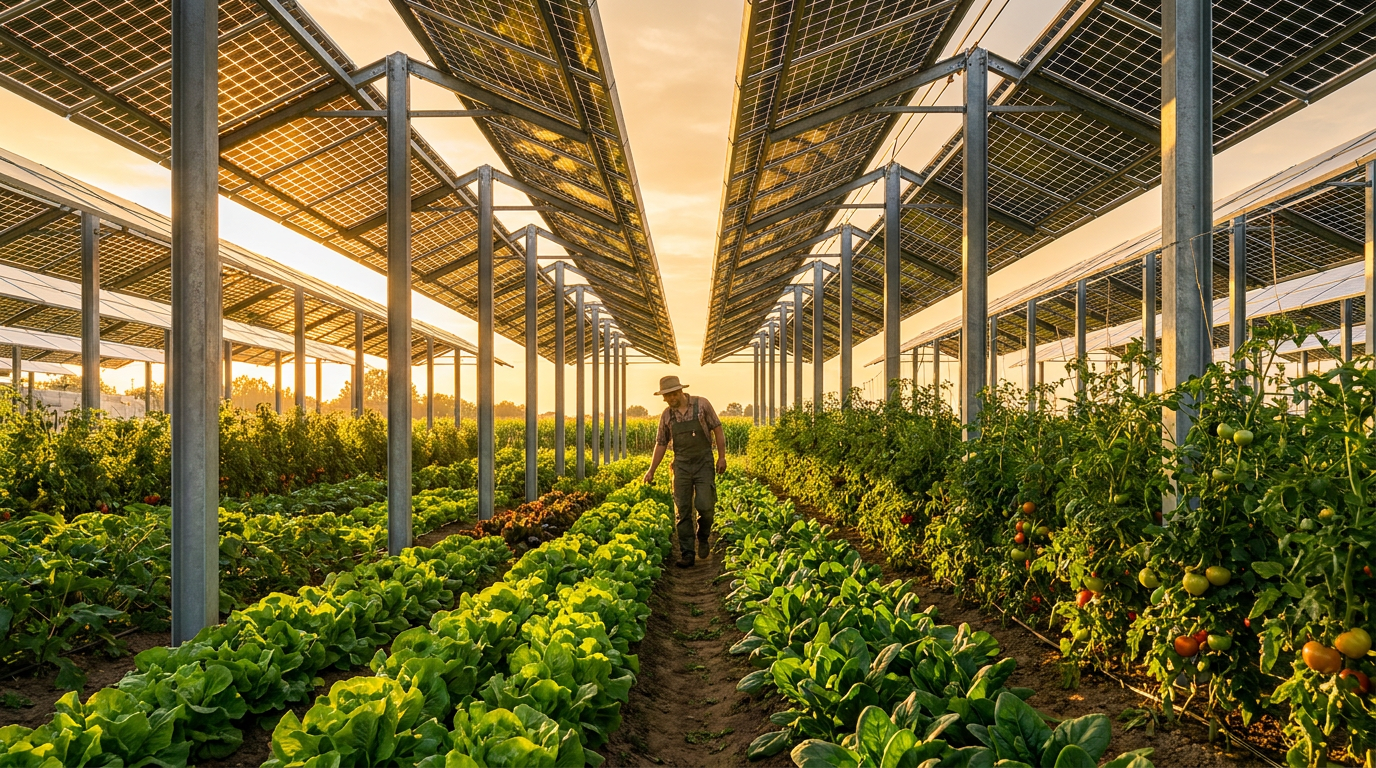
The evidence shows that the microclimate benefits flow in both directions, creating a symbiotic relationship between the infrastructure and the ecosystem. Solar panels provide partial shading, which moderates extreme soil temperatures and reduces evapotranspiration. In arid and semi-arid regions, this shading effect has been shown to cut irrigation water needs by 20% to 35%.[5][7]
Conversely, the crops themselves benefit the solar infrastructure. Vegetation releases moisture through transpiration, creating a localized evaporative cooling effect. This cooling can lower the operating temperature of the overhead photovoltaic modules by 1°C to 2°C, which measurably improves their energy conversion efficiency and extends their operational lifespan.[3][5][7]

While the energy generation is reliable, the agricultural output depends heavily on what is planted, requiring tailored agronomy. A comprehensive 2026 analysis published in Renewable and Sustainable Energy Reviews synthesized data from hundreds of operational farms to map crop compatibility, revealing that universal application is not guaranteed.[4]
Shade-tolerant crops—such as lettuce, tomatoes, berries, ginger, and turmeric—frequently exhibit yield increases of 8% to 18% under solar panels, as they are protected from heat stress and sunburn. However, sun-intensive staple crops like winter wheat and corn can suffer yield reductions of 25% to 40% due to the reduced photosynthetically active radiation reaching the soil.[4][5][7]

For land where crop cultivation is less viable, livestock integration offers the fastest return on investment. Grazing sheep beneath solar arrays has emerged as a highly successful and easily scalable model. The U.S. Department of Energy's InSPIRE research program notes that developers often pay farmers to graze sheep on solar sites, which manages vegetation naturally and represents a 75% cost savings over traditional mechanical mowing.[2]
For land where crop cultivation is less viable, livestock integration offers the fastest return on investment.
Until recently, a major barrier to agrivoltaics was regulatory uncertainty—specifically, whether farmers would lose agricultural subsidies if their land was reclassified for industrial energy use. A critical breakthrough occurred when the European Union harmonized agrivoltaics with its Common Agricultural Policy (CAP) Direct Payments.[6]
Under the updated EU guidance, land remains eligible for vital CAP subsidies as long as agricultural activity remains the primary function. This policy shift effectively removed the largest financial risk for rural landowners considering dual-use development, allowing the sector to move from pilot projects to commercial scale.[6][7]
Individual nations are also implementing strict standards to prevent "sham farming"—where developers plant token crops just to secure permits. Germany's Solarpaket 1 legislation and the DIN SPEC 91434 standard mandate that an agrivoltaic system must maintain at least 66% of the land's reference agricultural yield to qualify for preferential feed-in tariffs.[6]

Similarly, France's Agri-PV Decree requires projects to provide a demonstrable agricultural service, such as protection against climate hazards, and caps the ground coverage ratio of the solar panels to ensure adequate light penetration for the crops below.[6]
In the United States, the policy landscape remains more fragmented, driven largely by state-level incentives and the federal Inflation Reduction Act's 30% investment tax credit. The National Renewable Energy Laboratory tracks nearly 600 agrivoltaic sites across the U.S., representing over 10 gigawatts of capacity, though most remain community-scale rather than massive utility-scale deployments.[2][7]

Despite the agronomic and policy advances, structural costs and operational complexities remain the primary barriers to ubiquitous adoption. Elevating solar arrays to accommodate tractors and harvesters requires heavier steel structures, wider spacing, and deeper foundations.[3][7]
These physical modifications typically increase the initial structural capital expenditure by 10% to 20% compared to standard ground-mounted solar installations. Furthermore, integrating active farming with high-voltage electrical infrastructure introduces unique occupational safety and liability considerations that require specialized insurance and operational protocols.[2][7]
As climate change intensifies heat stress on global agriculture, the protective shading offered by agrivoltaics is shifting from a niche experiment to a vital climate-resilience strategy. By aligning clean energy deployment with food security and rural economic development, agrivoltaics offers an empirically backed framework for the next phase of the energy transition.[4][7]
How we got here
1982
The concept of agrivoltaics is first introduced by researchers Adolf Goetzberger and Armin Zastrow.
2015
The U.S. Department of Energy launches the InSPIRE project to systematically study the mutual benefits of solar and agriculture.
2021
Germany introduces the DIN SPEC 91434 standard, officially defining the criteria for agrivoltaic systems to assure primary agricultural use.
2022
The U.S. Inflation Reduction Act passes, providing a 30% investment tax credit that accelerates domestic agrivoltaic deployment.
2024
The European Union harmonizes agrivoltaics with its Common Agricultural Policy, ensuring farmers do not lose subsidies for dual-use land.
Viewpoints in depth
Agronomic Researchers
Focuses on optimizing crop yields, soil health, and water retention beneath solar arrays.
Agricultural scientists view agrivoltaics primarily as a climate-adaptation tool. They emphasize that the success of a dual-use system hinges entirely on matching the right crop to the altered microclimate. Their research highlights how partial shading can save water and protect shade-tolerant crops from extreme heat, but they caution against blanket deployments, noting that sun-intensive staple crops like corn and wheat suffer significant yield penalties under panels.
Energy Developers
Focuses on land acquisition, project economics, and maximizing renewable energy output.
For solar developers, agrivoltaics is a strategy to overcome land-use opposition and secure permits in rural communities. While they acknowledge the 10% to 20% higher upfront structural costs required to elevate panels for farm machinery, they argue that these costs are offset by reduced community resistance, dual-income streams, and the slight boost in panel efficiency caused by the evaporative cooling of the crops below.
Agricultural Policymakers
Focuses on preserving food security, protecting rural economies, and preventing 'sham farming'.
Regulators and policymakers are focused on ensuring that energy production does not cannibalize food production. They advocate for strict legal definitions—such as Germany's requirement that land maintain 66% of its historical crop yield—to ensure that developers do not simply plant token crops to exploit agricultural subsidies. Their goal is to harmonize energy incentives with existing agricultural support frameworks, like the EU's Common Agricultural Policy.
What we don't know
- How long-term soil health and microbial activity will respond to decades of partial shading.
- Whether the higher initial capital costs of elevated structures will decrease as the industry standardizes designs.
- How effectively national grids can handle the decentralized power generation from thousands of rural agrivoltaic farms.
Key terms
- Agrivoltaics
- The simultaneous use of areas of land for both solar photovoltaic power generation and agriculture.
- Evapotranspiration
- The process by which water is transferred from the land to the atmosphere by evaporation from the soil and by transpiration from plants.
- Land Equivalent Ratio (LER)
- A metric used to assess the productivity of growing two or more crops (or in this case, crops and solar energy) together compared to growing them separately.
- Photosynthetically Active Radiation (PAR)
- The specific wavelengths of light that plants use for photosynthesis, which can be reduced when solar panels cast shade.
- Common Agricultural Policy (CAP)
- The agricultural policy of the European Union, which implements a system of agricultural subsidies and other programs.
Frequently asked
What is the Land Equivalent Ratio in agrivoltaics?
The Land Equivalent Ratio (LER) measures the efficiency of dual-use land. An LER of 1.3 means that producing the same amount of solar energy and crops separately would require 30% more land than combining them in an agrivoltaic system.
Do solar panels reduce crop yields?
It depends on the crop. Shade-tolerant plants like lettuce, tomatoes, and berries often see yield increases of 8% to 18% due to reduced heat stress. However, sun-intensive crops like wheat and corn can experience yield drops of 25% to 40%.
How does agrivoltaics save water?
The partial shade provided by the solar panels lowers the soil temperature and reduces the rate of water evaporation. In arid regions, this can decrease the amount of irrigation water needed by 20% to 35%.
Can tractors still operate under the solar panels?
Yes, but the solar arrays must be specifically designed for it. The panels are elevated on taller steel structures and spaced wider apart to allow standard agricultural machinery to pass underneath, which increases the initial construction costs.
Sources
Source coverage
7 outlets
3 viewpoints surfaced







[1]U.S. Department of EnergyEnergy Developers
Agrivoltaics: Solar and Agriculture Co-Location
Read on U.S. Department of Energy →[2]National Renewable Energy LaboratoryEnergy Developers
The 5 Cs of Agrivoltaic Success Factors in the United States: Lessons from the InSPIRE Research Study
Read on National Renewable Energy Laboratory →[3]MDPIAgricultural Policymakers
Efficiency, Sustainability and Governance of Agrivoltaic Systems: A PRISMA-Based Systematic Review of Global Evidence (2010–2025)
Read on MDPI →[4]Renewable and Sustainable Energy ReviewsAgronomic Researchers
Agrivoltaics as a systems innovation: multi-dimensional benefits from global studies across climate, agriculture, energy, and ecosystems
Read on Renewable and Sustainable Energy Reviews →[5]Frontiers in Plant ScienceAgronomic Researchers
Connecting agriculture and renewable energy: insights into microclimatic changes, physiological, biochemical, and yield responses under agrivoltaics
Read on Frontiers in Plant Science →[6]Leadvent GroupAgricultural Policymakers
Explore the EU policy frameworks driving AgriVoltaics growth
Read on Leadvent Group →[7]Factlen Editorial TeamAgricultural Policymakers
Synthesis by Factlen editorial team
Read on Factlen Editorial Team →
Every angle. Every day.
Get energy stories with full source coverage and perspective breakdowns delivered to your inbox.