
How Next-Generation Geothermal is Unlocking 24/7 Clean Energy Anywhere
By adapting shale drilling techniques, enhanced geothermal systems are breaking geographic boundaries to provide the massive, round-the-clock clean power demanded by the AI boom.
By Factlen Editorial Team
- Geothermal Developers & Tech Industry
- Focused on rapid scaling to meet the explosive energy demands of AI.
- Energy Researchers & Government
- Focused on long-term grid decarbonization and unlocking superhot rock potential.
- Cautious Industry Analysts
- Focused on the structural and economic hurdles that still face the sector.
What's not represented
- · Local communities near drilling sites
- · Fossil fuel industry competitors
Why this matters
Next-generation geothermal technology unlocks the ability to generate 24/7, carbon-free electricity almost anywhere on Earth. By solving the intermittency problem of solar and wind, it provides the massive, reliable baseload power required to run AI data centers and heavy industry without accelerating climate change.
Key points
- Enhanced Geothermal Systems (EGS) use oil and gas drilling techniques to create artificial underground reservoirs, unlocking geothermal power outside of rare volcanic regions.
- The technology provides 24/7 firm baseload electricity, solving the intermittency issues that limit solar and wind power.
- Explosive energy demand from AI data centers is accelerating the industry, highlighted by Fervo Energy's $1.89 billion IPO in May 2026.
- Fervo's Cape Station project in Utah is on track to deliver its first 100 megawatts of commercial EGS power to the grid by late 2026.
- Drilling speeds have improved by 70% and well costs have dropped by 75% over the last three years, mirroring the rapid cost declines of early solar.
- Researchers are now targeting 'superhot rock' exceeding 400°C, which could multiply power output tenfold and further shrink the footprint of power plants.
The global transition to clean energy has long been haunted by a stubborn trilemma: modern economies require power that is clean, affordable, and always on. Solar and wind are clean and increasingly cheap, but they are inherently intermittent, vanishing when the sun sets or the wind dies down. Nuclear power provides steady baseload energy, but new plants are notoriously slow and expensive to build. For decades, the energy industry has searched for a "Goldilocks" solution—a renewable resource that runs 24 hours a day, 365 days a year, without emitting greenhouse gases.[8]
Enter the heat beneath our feet. Traditional geothermal energy has been utilized for over a century, but it has always been severely constrained by geography. Conventional geothermal plants require a rare alignment of natural conditions: hot underground rock, abundant fluid, and naturally permeable rock formations that allow water to circulate. Because these conditions only exist in a few volcanic regions—like Iceland, Kenya, and parts of the American West—traditional geothermal supplies less than 1 percent of the world's electricity today.[3]
That geographic limitation is now being shattered by a technological breakthrough known as Enhanced Geothermal Systems (EGS). Instead of hunting for rare natural aquifers, engineers are creating artificial reservoirs in hot, dry rock. By borrowing and adapting the horizontal drilling and hydraulic fracturing techniques pioneered during the shale oil and gas boom, developers can now engineer permeability where none naturally existed. This innovation effectively decouples geothermal energy from natural hot springs, opening up vast swaths of the planet to clean baseload power generation.[3][8]
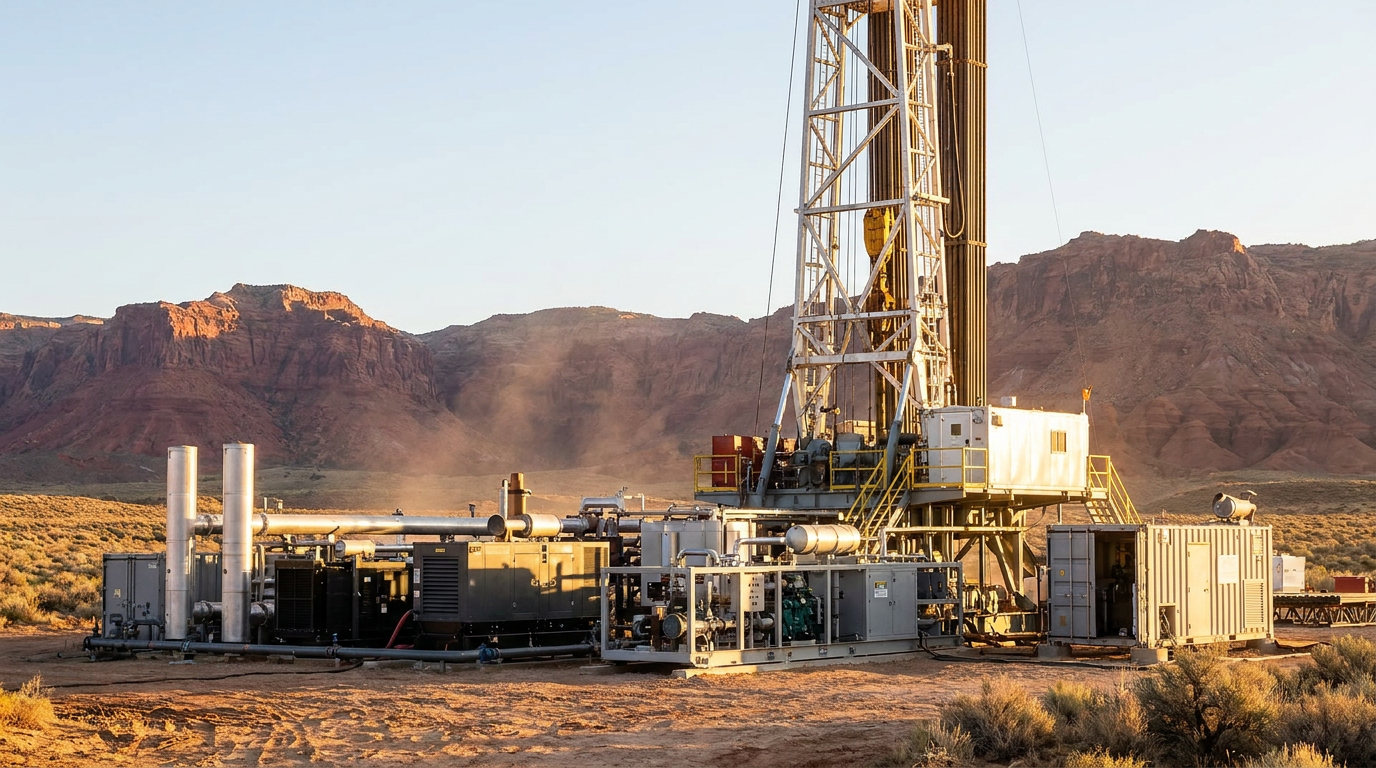
The mechanics of an Enhanced Geothermal System are a marvel of modern subsurface engineering. Developers drill an injection well thousands of feet into the earth's crust, reaching rock formations that are intensely hot but completely dry and impermeable. Water is then pumped down under carefully controlled high pressure to create a network of millimeter-thin fractures in the rock. A second well, known as the production well, is drilled nearby to intersect those fractures. As water circulates through the newly created artificial reservoir, it absorbs the earth's heat, returns to the surface as superheated fluid, and drives a turbine to generate electricity before being cooled and reinjected in a continuous loop.[1]

The scale of the prize is staggering. The United States Department of Energy estimates that with the right technological advancements, next-generation geothermal capacity in the U.S. could grow from just 4 gigawatts today to 90 gigawatts by 2050—enough to power tens of millions of homes. On a global scale, the International Energy Agency recently concluded that the technical potential of next-generation geothermal systems is sufficient to meet total global electricity demand 140 times over.[2][3]
While the climate crisis provided the initial impetus for EGS research, the sudden acceleration of the industry in 2026 is being driven by a different force: Artificial Intelligence. The explosive growth of hyperscale data centers has created an unprecedented demand for 24/7 electricity. Tech giants are locked in an arms race for compute power, but their corporate climate pledges prevent them from relying on coal or natural gas. As OpenAI CEO Sam Altman recently testified, the future abundance of AI will be strictly limited by the abundance of clean energy.[5][7]
This collision of AI energy demand and geothermal innovation culminated in a historic financial milestone in May 2026. Fervo Energy, the undisputed leader in the EGS space, went public on the Nasdaq in a massively oversubscribed $1.89 billion initial public offering. The IPO valued the Houston-based company at nearly $7.7 billion, signaling that Wall Street now views enhanced geothermal not as a speculative science experiment, but as a bankable, gigawatt-scale infrastructure asset.[4][5]
This collision of AI energy demand and geothermal innovation culminated in a historic financial milestone in May 2026.
Fervo’s valuation is anchored by its flagship development, Cape Station, located in the arid desert of Beaver County, Utah. Currently under construction, Cape Station is slated to become the world's largest EGS facility. The project is on track to deliver its first 100 megawatts of clean, firm power to the grid by late 2026, with plans to scale up to 500 megawatts by 2028. By standardizing its 50-megawatt modular designs, the company aims to construct new plants in just 18 months, perfectly matching the rapid deployment schedules demanded by data center developers.[4][7]
The tech industry is aggressively underwriting this expansion. In March 2026, Google signed a landmark Geothermal Framework Agreement with Fervo Energy, securing the right of first refusal for up to 3 gigawatts of future geothermal capacity. This massive procurement deal provides the guaranteed revenue streams necessary to secure project financing from major banks. By acting as the guaranteed buyer, hyperscalers are effectively absorbing the early-stage premium of EGS, allowing the technology to scale and eventually become cheaper for the broader public grid.[4]
And the costs are already plummeting. Much like the solar industry in the 2010s, enhanced geothermal is riding a steep learning curve. By iterating on proven oil and gas equipment rather than inventing bespoke machinery, developers have drastically reduced the time and money required to drill deep wells. Between Fervo's early 2023 pilot project and the current Cape Station buildout, drilling speeds have improved by roughly 70 percent, and overall well costs have fallen by nearly 75 percent. The industry is now aggressively targeting a long-term cost of $3,000 per kilowatt, which would make EGS highly competitive with natural gas.[4]

While EGS currently dominates the commercial landscape, it is not the only next-generation technology in development. Researchers are also advancing Closed-Loop Geothermal Systems, often referred to as Advanced Geothermal Systems (AGS). Instead of fracturing the rock to let water flow through it, AGS acts like a massive underground radiator. Fluids circulate through a sealed network of deep subterranean pipes, absorbing heat through conduction without ever physically touching the surrounding rock. This approach eliminates the need for water-intensive fracking and further expands the geographic areas where geothermal can be deployed.[1][2]
Looking further over the horizon, the holy grail of the industry is "superhot rock" geothermal. Currently, most EGS projects target rock temperatures around 200°C. However, researchers at MIT and the Department of Energy are developing technologies to drill deeper and reach rock exceeding 400°C. At these extreme temperatures and pressures, water enters a "supercritical" state where it behaves as both a liquid and a gas. Supercritical fluids can carry up to ten times more energy than standard hot water, meaning a single superhot well could produce the same amount of electricity as ten conventional wells, radically shrinking the physical footprint of power plants.[1][2]
Recognizing this immense potential, the U.S. government has stepped in to accelerate research and development. In early 2026, Congress introduced the bipartisan Next-Generation Geothermal Research and Development Act (S.4406), designed to fund field testing for superhot rock technologies. This legislative push builds on the success of the DOE’s Frontier Observatory for Research in Geothermal Energy (FORGE) in Utah, a dedicated underground laboratory where scientists and private companies collaborate to test new drilling tools and reservoir management techniques in real-world conditions.[1]
Beyond its reliability, next-generation geothermal boasts an exceptionally light environmental footprint. A geothermal power plant requires a fraction of the surface land needed for a sprawling solar array or a wind farm of equivalent capacity. Furthermore, because the systems operate in closed loops, they emit virtually no conventional air pollutants like sulfur dioxide or particulate matter, avoiding the respiratory health impacts that have historically plagued communities living near fossil fuel power plants.[3]

Despite the surging momentum, the industry still faces formidable headwinds. Geothermal developers must navigate notoriously complex and sluggish permitting processes, particularly when drilling on federal lands in the American West. Additionally, while long-term operating costs are low, the upfront capital required to drill exploratory wells and construct power plants remains daunting. Even with recent cost reductions, building out tens of gigawatts of capacity will require hundreds of billions of dollars in new investment, alongside massive upgrades to the nation's transmission grid to carry the power from remote deserts to urban load centers.[6]
There is also the critical issue of induced seismicity. Because Enhanced Geothermal Systems rely on injecting high-pressure fluids to fracture subterranean rock, the process inherently creates micro-earthquakes. While the vast majority of these events are far too small to be felt on the surface, the risk of triggering a larger seismic event requires rigorous oversight. To mitigate this, developers deploy continuous, high-temperature seismic monitoring arrays deep underground, allowing engineers to map the fracture network in real-time and adjust fluid pressures instantly to ensure the reservoir grows safely and predictably.[8]
Ultimately, the rise of next-generation geothermal represents a profound shift in global energy security. Because the earth's heat is ubiquitous, countries can harness their own domestic subsurface resources rather than relying on imported fuels or vulnerable international supply chains. As the technology matures, it promises to insulate economies from geopolitical price shocks while providing the firm, clean foundation required to power the next century of human innovation.[8]
How we got here
1960
The Geysers in California begins generating electricity, proving traditional geothermal at scale.
2023
Fervo Energy's Project Red delivers the first commercial electricity from an enhanced geothermal doublet.
Dec 2024
The IEA publishes a landmark report stating next-generation geothermal could meet global electricity demand 140 times over.
Mar 2026
Google signs a massive 3 GW geothermal framework agreement to power its data centers.
May 2026
Fervo Energy goes public in a $1.89 billion IPO, signaling Wall Street's validation of the technology.
Late 2026
Cape Station in Utah is scheduled to deliver its first 100 MW of commercial EGS power to the grid.
Viewpoints in depth
Geothermal Developers & Tech Giants
Focused on rapid scaling to meet the explosive energy demands of AI.
For developers like Fervo Energy and hyperscalers like Google, next-generation geothermal is the missing puzzle piece for the AI revolution. They argue that the technology is ready now, pointing to massive cost reductions achieved by adapting oil and gas drilling techniques. In their view, the primary bottleneck is no longer geological uncertainty, but rather the speed at which capital can be deployed and grid interconnections can be approved to power gigawatt-scale data centers.
Energy Researchers & Government
Focused on long-term grid decarbonization and unlocking superhot rock potential.
Federal agencies and academic institutions view EGS as a critical pillar for a zero-carbon grid by 2050. While they celebrate near-term commercial milestones, their focus remains on pushing the technological envelope. Researchers at MIT and the DOE are heavily invested in 'superhot rock' geothermal—drilling deeper to reach 400°C temperatures where water becomes supercritical. They argue that mastering these extreme environments will multiply power output tenfold and make geothermal economically viable virtually anywhere on Earth.
Cautious Industry Analysts
Focused on the structural and economic hurdles that still face the sector.
While acknowledging the technological breakthroughs, industry watchdogs warn against irrational exuberance. They point out that despite successful IPOs and pilot plants, the broader geothermal sector still struggles with notoriously slow permitting timelines, high upfront capital costs, and supply chain constraints. From this perspective, while the long-term promise is real, the near-term rollout will likely be slower and more localized than the most optimistic pitch decks suggest.
What we don't know
- Whether the industry can overcome notoriously slow federal permitting timelines to build out capacity at the speed tech companies demand.
- How quickly the supply chain for specialized high-temperature drilling equipment can scale to support simultaneous gigawatt-level projects.
- If the aggressive cost-reduction targets of $3,000 per kilowatt can be reliably achieved across different, more challenging geological formations.
Key terms
- Enhanced Geothermal Systems (EGS)
- A technology that creates artificial underground reservoirs by injecting fluid into hot, dry rock to extract heat for electricity generation.
- Baseload Power
- The minimum amount of electric power needed to be supplied to the electrical grid at any given time, requiring energy sources that can run 24/7.
- Advanced Geothermal Systems (AGS)
- A closed-loop geothermal method that circulates fluid through sealed underground pipes, acting like a massive subterranean radiator without fracturing the rock.
- Supercritical Water
- Water heated beyond 375°C under extreme pressure, giving it properties of both a liquid and a gas, which allows it to carry significantly more energy.
Frequently asked
What is the difference between traditional and enhanced geothermal?
Traditional geothermal requires naturally occurring underground reservoirs of hot water and steam. Enhanced Geothermal Systems (EGS) create artificial reservoirs by injecting water into dry, hot rock to create fractures.
Why is the tech industry investing in geothermal?
AI data centers require massive amounts of 24/7 electricity. Geothermal provides clean, firm baseload power that doesn't stop when the sun goes down or the wind stops blowing.
Does enhanced geothermal cause earthquakes?
Because EGS involves fracturing underground rock, it carries a risk of induced seismicity. However, developers use continuous deep-subsurface monitoring to manage and mitigate these micro-seismic events safely.
Sources
Source coverage
8 outlets
3 viewpoints surfaced








[1]Department of EnergyEnergy Researchers & Government
Enhanced Geothermal Systems
Read on Department of Energy →[2]MITEnergy Researchers & Government
Next-Generation Geothermal
Read on MIT →[3]World Resources InstituteEnergy Researchers & Government
The Promise of Next-Generation Geothermal
Read on World Resources Institute →[4]Cleantech GroupGeothermal Developers & Tech Industry
Fervo Energy IPO and the Geothermal Renaissance
Read on Cleantech Group →[5]ESG TodayGeothermal Developers & Tech Industry
Geothermal Developer Fervo Energy Raises $1.9 Billion in Upsized IPO
Read on ESG Today →[6]ThinkGeoEnergyCautious Industry Analysts
Looking ahead to 2026 in Geothermal
Read on ThinkGeoEnergy →[7]Fervo EnergyGeothermal Developers & Tech Industry
Cape Station: Next-Generation Geothermal
Read on Fervo Energy →[8]Factlen Editorial TeamEnergy Researchers & Government
Synthesis by Factlen editorial team
Read on Factlen Editorial Team →
Every angle. Every day.
Get energy stories with full source coverage and perspective breakdowns delivered to your inbox.