
How Next-Generation Nuclear Reactors Are Solving the AI Power Crisis
As artificial intelligence data centers drive unprecedented electricity demand, a new class of advanced nuclear reactors is moving from concept to construction, promising safer, modular, and more efficient baseload power.
By Factlen Editorial Team
- Nuclear Engineering & Development
- Focuses on the mechanical innovations, passive safety features, and modular construction techniques that make advanced reactors viable.
- Energy Policy & Security
- Prioritizes the geopolitical advantages of domestic fuel supply chains and the need for reliable baseload power to meet climate targets.
- Editorial Synthesis
- Provides a comprehensive overview of how technological, economic, and regulatory factors are converging to drive the nuclear renaissance.
What's not represented
- · Local communities hosting new reactor sites
- · Environmental groups opposed to all forms of nuclear energy
- · Renewable energy advocates prioritizing grid-scale battery storage
Why this matters
The exponential growth of AI requires massive amounts of continuous, zero-carbon electricity that wind and solar alone cannot provide. Next-generation nuclear technology offers a viable path to power this technological leap without accelerating climate change or compromising grid stability.
Key points
- Global data center electricity demand is projected to reach 945 TWh by 2030 due to AI expansion.
- TerraPower has begun construction on a 345-megawatt advanced nuclear plant in Wyoming.
- Generation IV reactors use advanced coolants like liquid sodium, allowing for passive safety and higher efficiency.
- The U.S. Department of Energy is converting 20 metric tons of Cold War plutonium into advanced reactor fuel.
- Tech giants like Meta and Amazon are signing long-term agreements to power data centers with advanced nuclear energy.
- SMRs are designed to be built in factories and assembled on-site, drastically reducing construction times.
The artificial intelligence revolution is colliding with a hard physical limit: the global electricity grid. As tech giants race to build massive data centers capable of training next-generation AI models, the International Energy Agency projects that global data center electricity consumption will more than double, reaching roughly 945 terawatt-hours by 2030. This surging demand has exposed a critical vulnerability in the current energy transition. While wind and solar power are expanding rapidly, their intermittent nature cannot reliably support the continuous, round-the-clock power draw of gigawatt-scale computing facilities.[2][6]
To bridge this gap, the technology and energy sectors are turning their attention back to nuclear power—but not the massive, custom-built concrete behemoths of the 20th century. A new class of advanced nuclear technology, encompassing Generation IV designs and Small Modular Reactors (SMRs), is rapidly moving from the drawing board to physical construction. These next-generation systems promise to solve the historical hurdles of nuclear energy, offering passive safety mechanisms, factory-assembled modularity, and the ability to utilize nuclear waste as fuel.[4][6]
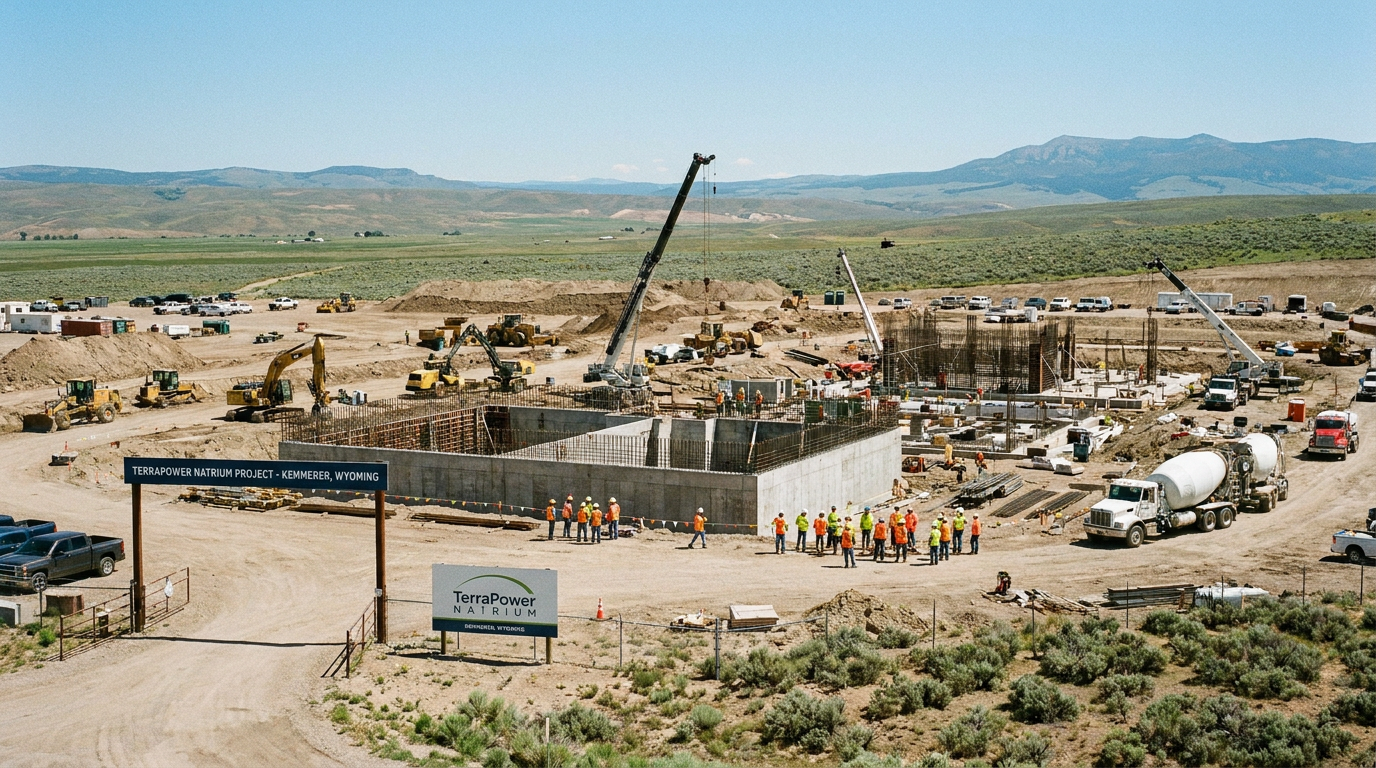
The shift from theoretical promise to commercial reality reached a major milestone in mid-2026. In Kemmerer, Wyoming, TerraPower—a nuclear innovation company founded by Bill Gates—has commenced full-scale construction on its Natrium plant. Sited near a retiring coal-fired power plant, the 345-megawatt facility is on track to become the first utility-scale advanced nuclear reactor built in the United States. The project represents a $4 billion, federally backed demonstration intended to validate that advanced reactor technology can be deployed at a commercial scale.[1]

The Natrium design exemplifies the mechanical leap of Generation IV reactors. Unlike traditional light-water reactors that use highly pressurized water to cool the nuclear core, the Natrium plant is a sodium-cooled fast reactor. Liquid sodium has a significantly higher boiling point than water, allowing the reactor to operate at much higher temperatures without requiring the massive, expensive pressurized containment domes that define older plants. This fundamental change in coolant chemistry drastically reduces both the physical footprint and the capital complexity of the facility.[1][4]
Beyond the reactor core, the Natrium plant integrates a molten salt-based thermal energy storage system. This allows the plant to operate its reactor at a steady, continuous output while storing excess heat. During periods of peak grid demand, the facility can tap into this stored heat to temporarily boost its electrical output to 500 megawatts. This flexibility makes the reactor an ideal companion to renewable energy, allowing it to ramp up power generation precisely when solar or wind yields drop.[1][2]

The tech industry has quickly recognized the strategic value of these advanced systems. Meta has already signed an agreement with TerraPower to deploy up to eight Natrium plants by 2035 to power its expanding data center footprint. Similarly, Amazon and Microsoft have secured long-term power purchase agreements tied to both existing nuclear facilities and future SMR deployments. For these companies, advanced nuclear represents the only viable pathway to achieving zero-carbon operational goals without compromising the reliability of their computing infrastructure.[1][6]
The tech industry has quickly recognized the strategic value of these advanced systems.
Safety remains the paramount concern for public acceptance, and advanced reactors address this through "passive safety" engineering. Traditional reactors rely on active safety systems—such as electrically powered backup pumps and human intervention—to cool the core during an emergency. In contrast, Generation IV reactors and SMRs are designed to cool themselves automatically using the laws of physics. If a facility loses all external power, natural circulation and gravity take over, safely dissipating the reactor's heat without the need for operator action or backup generators.[4]
These advanced designs also tackle the long-standing challenge of nuclear waste. Because fast reactors use high-energy neutrons, they consume nuclear fuel much more efficiently than traditional light-water reactors. This increased efficiency translates to a significantly smaller volume of byproduct. Furthermore, some Generation IV designs are capable of running on recycled spent fuel, effectively closing the nuclear fuel cycle and reducing both the volume and the radiotoxicity of long-term geological waste.[4][5]
Despite the technological elegance of these reactors, their deployment has been threatened by a severe supply chain bottleneck: fuel. Most advanced reactors require High-Assay Low-Enriched Uranium (HALEU), a specialized fuel that is more enriched than the fuel used in traditional plants but remains well below weapons-grade. Until recently, the global supply of HALEU was highly constrained, creating a barrier to entry for private developers looking to scale their modular designs.[3]
In May 2026, the U.S. Department of Energy announced a major policy shift to resolve this bottleneck. Moving away from a decades-old policy of diluting and burying Cold War-era weapons-grade plutonium, the DOE is now partnering with private companies to convert 20 metric tons of surplus plutonium into commercial fuel for advanced reactors. This strategic pivot not only provides a domestic fuel source for the burgeoning SMR industry but also shifts the massive costs of plutonium disposal away from the federal government, transforming a legacy liability into a high-value energy asset.[3]

The economic model of SMRs relies heavily on factory fabrication. Rather than constructing a bespoke, multi-billion-dollar facility on-site over a decade, SMR components are designed to be manufactured in controlled factory environments and shipped to the installation site for assembly. This modular approach aims to slash construction times to as little as 12 to 24 months, significantly reducing the capital risk and financing costs that have historically crippled large-scale nuclear projects.[4][5]
The momentum for advanced nuclear is not limited to the United States. The European Commission has actively integrated SMRs into its long-term decarbonization and energy security strategies. Following the geopolitical energy shocks of the early 2020s, European policymakers view SMRs as a critical tool to reduce reliance on imported fossil fuels while maintaining a robust industrial base. The EU expects its first SMRs to be operational by the early 2030s, supported by substantial research funding and cross-border supply chain development.[5]

However, significant uncertainties remain before this technology can achieve global scale. Regulatory bodies, such as the U.S. Nuclear Regulatory Commission, have spent decades optimizing their licensing frameworks for traditional light-water reactors. Adapting these rigid regulatory structures to evaluate novel coolants, passive safety systems, and factory-built modules requires a paradigm shift in oversight. While the NRC's recent approval of the TerraPower construction permit signals progress, streamlining the approval process for a fleet of identical SMRs remains an ongoing bureaucratic challenge.[1][6]
As 2026 unfolds, the advanced nuclear sector has definitively transitioned from theoretical modeling to pouring concrete and bending steel. The convergence of surging AI power demands, breakthroughs in domestic fuel supply, and the physical construction of demonstration plants like Natrium has set the stage for a nuclear renaissance. The ultimate success of this new era will depend on whether these first-of-a-kind projects can be delivered on time and on budget, proving that the atomic age's second act can sustainably power the future.[1][2][3][6][7]
How we got here
2021
TerraPower selects Kemmerer, Wyoming, near a retiring coal plant, as the site for its first Natrium demonstration reactor.
March 2024
TerraPower becomes the first U.S. developer to seek a construction permit for a commercial-scale advanced reactor.
June 2024
Groundbreaking begins on the non-nuclear support facilities for the Natrium plant in Wyoming.
April 2026
The U.S. Nuclear Regulatory Commission issues a historic construction permit, allowing full nuclear construction to begin on the Natrium plant.
May 2026
The U.S. Department of Energy announces a strategic pivot to convert 20 metric tons of Cold War plutonium into advanced reactor fuel.
Viewpoints in depth
Advanced Nuclear Developers
Engineers and startups argue that factory-built modularity is the only way to save the nuclear industry from its history of cost overruns.
For decades, the nuclear industry has been plagued by bespoke, multi-billion-dollar mega-projects that consistently run over budget and behind schedule. Advanced nuclear developers argue that the solution is to treat reactors more like commercial airplanes than custom architecture. By standardizing designs and building Small Modular Reactors (SMRs) in controlled factory environments, developers believe they can drastically reduce capital risk. They point to passive safety systems and advanced coolants as the mechanical breakthroughs that make this smaller, more flexible footprint possible.
Tech Industry Buyers
Silicon Valley views advanced nuclear as the critical missing piece in their quest for zero-carbon, 24/7 computing power.
As artificial intelligence models grow exponentially more complex, the tech industry has realized that intermittent renewable energy cannot solely support gigawatt-scale data centers. Companies like Meta, Amazon, and Microsoft are aggressively pursuing power purchase agreements with advanced nuclear startups because these reactors offer firm, dispatchable clean energy. From the tech sector's perspective, investing in SMRs is not just an environmental initiative; it is a fundamental requirement for the physical expansion of their AI infrastructure.
Energy Security Policymakers
Government officials emphasize the strategic importance of domestic nuclear fuel supply chains and grid resilience.
For policymakers in the U.S. and Europe, the advanced nuclear renaissance is heavily intertwined with national security. The recent move by the U.S. Department of Energy to convert Cold War-era plutonium into commercial reactor fuel highlights a broader strategy to eliminate reliance on foreign uranium enrichment. Policymakers argue that deploying a robust fleet of advanced reactors will insulate domestic grids from global fossil fuel volatility while providing the reliable baseload power necessary to anchor an increasingly electrified economy.
What we don't know
- Whether the first wave of commercial SMRs can actually be delivered on time and within budget.
- How quickly regulatory bodies can streamline the licensing process for mass-produced factory reactors.
- The long-term economic competitiveness of advanced nuclear compared to next-generation battery storage paired with renewables.
Key terms
- Small Modular Reactor (SMR)
- A class of nuclear fission reactors that are smaller than conventional reactors and designed to be built in factories and assembled on-site.
- Generation IV Reactor
- A set of advanced nuclear reactor designs that feature revolutionary improvements in safety, efficiency, and waste reduction compared to current commercial plants.
- HALEU
- High-Assay Low-Enriched Uranium; a specialized nuclear fuel enriched between 5% and 20% that is required by many advanced reactor designs.
- Sodium-Cooled Fast Reactor
- An advanced reactor type that uses liquid sodium metal as a coolant instead of water, allowing it to operate at high temperatures without high pressure.
- Baseload Power
- The minimum amount of electric power that must be continuously supplied to the electrical grid at any given time.
Frequently asked
What is a Small Modular Reactor (SMR)?
An SMR is a compact nuclear reactor designed to be manufactured in a factory and shipped to a site for assembly. They typically generate 300 megawatts or less, making them cheaper and faster to build than traditional large-scale nuclear plants.
How do Generation IV reactors differ from older plants?
Generation IV reactors use advanced coolants like liquid sodium or molten salt instead of highly pressurized water. This allows them to operate at higher temperatures with greater efficiency, and they feature passive safety systems that cool the reactor automatically without human intervention.
Why is the tech industry investing in nuclear power?
Artificial intelligence data centers require massive amounts of continuous, 24/7 electricity. Because wind and solar power are intermittent, tech companies are investing in advanced nuclear to secure reliable, zero-carbon baseload power for their facilities.
What happens to the nuclear waste from these new reactors?
Advanced fast reactors consume nuclear fuel much more efficiently than older designs, resulting in a smaller volume of waste. Some Generation IV reactors are even capable of running on recycled spent fuel, which reduces the toxicity of long-term geological waste.
Sources
Source coverage
7 outlets
3 viewpoints surfaced







[1]ENRNuclear Engineering & Development
TerraPower Begins Construction on First US Commercial-Scale Advanced Nuclear Reactor
Read on ENR →[2]IEAEnergy Policy & Security
Executive Summary – The Path to a New Era for Nuclear Energy
Read on IEA →[3]Shale MagazineEnergy Policy & Security
The DOE is Turning Cold War Plutonium Into Next Gen Nuclear Fuel
Read on Shale Magazine →[4]Stanford UniversityNuclear Engineering & Development
Understand Small Modular Reactors
Read on Stanford University →[5]European CommissionEnergy Policy & Security
Questions and answers on the Small Modular Reactors (SMR) Strategy
Read on European Commission →[6]ASMENuclear Engineering & Development
What Nuclear Energy Technologies Are Actually Advancing in 2026?
Read on ASME →[7]Factlen Editorial TeamEditorial Synthesis
Synthesis by Factlen editorial team
Read on Factlen Editorial Team →

Every angle. Every day.
Get energy stories with full source coverage and perspective breakdowns delivered to your inbox.