
The AI Drive-Thru Revolution: How Voice Bots and Automation Are Redesigning Fast Food
Fast-food chains are rapidly deploying advanced AI voice agents and automated physical lanes to cut wait times and boost accuracy, fundamentally reshaping the $300 billion drive-thru industry.
By Factlen Editorial Team
- Restaurant Operators & Franchises
- Operators view AI as a critical tool to protect margins and improve throughput amid rising labor costs.
- Technology & Automation Providers
- Tech companies focus on the rapid maturation of large language models and seamless POS integration.
- Consumer Experience Advocates
- Consumer advocates balance the desire for speed with concerns over accuracy and the loss of human interaction.
- Industry Analysts
- Analysts synthesize the broader economic and operational shifts driving the automation trend.
What's not represented
- · Independent Restaurant Owners
- · Drive-Thru Equipment Manufacturers
Why this matters
Drive-thrus account for over 70% of fast-food revenue. For consumers, this technological leap means faster service and fewer errors, while for workers, it signals a shift from repetitive order-taking to food preparation and hospitality.
Key points
- Major fast-food chains are deploying advanced AI voice agents to handle drive-thru orders, significantly reducing wait times.
- McDonald's new ArchIQ system has cut average order times from 78 seconds to 52 seconds in test locations.
- Modern AI systems use large language models to understand complex orders, slang, and heavy accents with over 90% accuracy.
- The technology aims to reallocate workers to food preparation and hospitality rather than eliminating jobs entirely.
For decades, the fast-food drive-thru has been a high-stress bottleneck, reliant on crackling speakers and frantic multitasking. Today, it generates over 70% of revenue for major quick-service restaurant (QSR) chains, making it the most critical real estate in the food industry.[5]
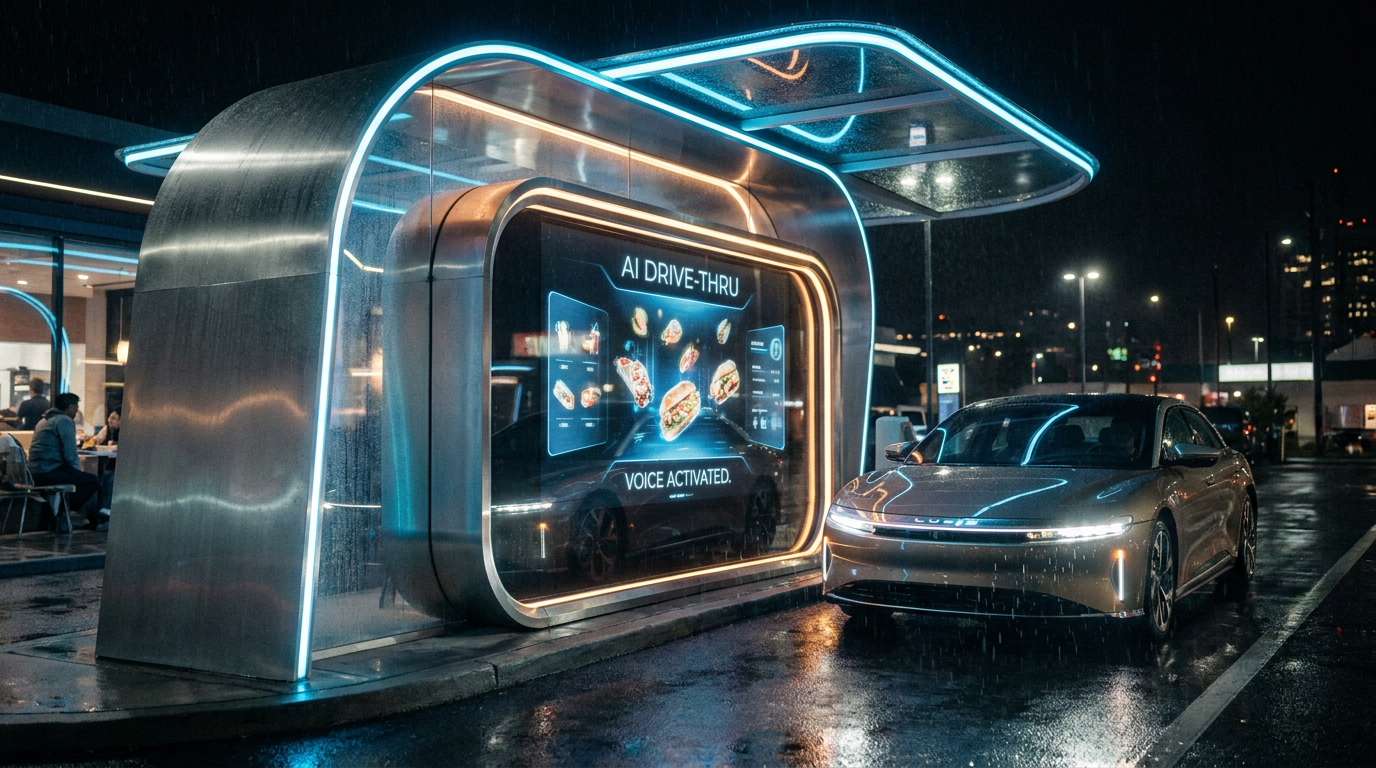
But in 2026, the drive-thru is undergoing its most radical transformation since the invention of the two-way speaker. Driven by advances in conversational artificial intelligence and physical automation, chains are deploying systems that can understand complex orders, handle heavy accents, and physically deliver food via vertical lifts.[4][6]
The shift from experimental pilots to operational necessity has been swift. Just two years ago, early AI ordering tests were plagued by viral failures—most notably a system that mistakenly added hundreds of dollars of chicken nuggets to a single order or offered bacon with ice cream.[2][3]
The technology has since matured dramatically. Modern drive-thru AI relies on advanced large language models (LLMs) specifically trained on menu items, local dialects, and the chaotic acoustic environment of a running car engine. Unlike older rules-based chatbots that required specific phrasing, these generative models understand context and intent.[5]

When a customer pulls up, the AI voice agent instantly transcribes the speech to text. It parses complex, non-linear human speech—such as a customer ordering a burger, changing their mind to a chicken sandwich, and then asking for no pickles—and injects the final structured data directly into the restaurant's Point of Sale (POS) system in milliseconds.[4][7]
McDonald's, the world's largest drive-thru operator, exemplifies this leap. After ending its initial automated order-taker partnership in 2024, the company launched a new system dubbed "ArchIQ," built on Google Cloud infrastructure.[3][5]
Currently operating in over 120 test locations, ArchIQ boasts a 92% accuracy rate in interpreting accented speech. Internal metrics show the system has slashed average ordering times from 78 seconds down to just 52 seconds, a massive efficiency gain during peak rush hours.[3][5]

Currently operating in over 120 test locations, ArchIQ boasts a 92% accuracy rate in interpreting accented speech.
Wendy's has been equally aggressive, deploying its "FreshAI" system to more than 500 locations. The system recognizes conversational shorthand with 90% comprehension and automatically suggests complementary items, which has demonstrably increased the average spend per customer and boosted restaurant margins.[5]
Taco Bell is tackling the drive-thru bottleneck from both digital and physical angles. The chain has expanded its voice AI to hundreds of high-traffic sites, aiming to provide a consistent, friendly experience while improving order accuracy.[1][2]
Physically, Taco Bell's "Defy" concept—a two-story restaurant design with four drive-thru lanes and a proprietary vertical lift—shows how architecture is evolving alongside software. The lift transports food straight from the second-floor kitchen down to the customer's car, aiming to reduce total service time to two minutes or less.[6]

The economic catalyst for this rapid adoption is undeniable. Rising labor costs, punctuated by California's $20 minimum wage for fast-food workers implemented in 2024, have accelerated the business case for automation across the entire sector.[5]
However, industry leaders emphasize that AI is not about replacing human workers, but rather reallocating them. By offloading the repetitive task of order-taking, staff can focus on food preparation, quality control, and hospitality at the payment window.[3][5]
The transition hasn't been entirely frictionless. Chains report instances of customers intentionally testing the AI's limits with bizarre requests or speaking over each other in the car. This necessitates a robust "human-in-the-loop" fallback protocol, where a staff member monitoring the transaction can seamlessly take over the headset if the system detects confusion or frustration.[7]
Beyond the customer interface, AI is quietly revolutionizing back-of-house operations. Predictive inventory systems analyze real-time sales data, weather patterns, and local events to automatically generate supply orders, drastically reducing food waste and ensuring fresh ingredients are always in stock.[4][7]

Looking ahead, the integration of computer vision promises to further personalize the experience. Opt-in loyalty programs linked to license plate recognition allow digital menu boards to dynamically update as a car approaches, greeting the driver by name and instantly suggesting their usual order.[4]
As these systems scale globally, the fast-food drive-thru is evolving from a transactional chore into a highly optimized, frictionless digital experience. By blending conversational AI with physical automation, the industry is proving that the future of convenience is both faster and surprisingly more personalized.[7]
How we got here
2022
Taco Bell opens its 'Defy' concept in Minnesota, featuring four drive-thru lanes and vertical food lifts, signaling a shift in physical automation.
June 2024
McDonald's ends its initial automated order-taker pilot with IBM after viral videos highlight system errors.
2024
California implements a $20 minimum wage for fast-food workers, accelerating the industry's push for operational efficiency.
2025
Wendy's expands its 'FreshAI' voice ordering system to over 500 locations, proving the viability of conversational AI at scale.
Early 2026
McDonald's launches its highly accurate 'ArchIQ' system in partnership with Google Cloud, cutting average order times to 52 seconds.
Viewpoints in depth
Restaurant Operators & Franchises
Operators view AI as a critical tool to protect margins and improve throughput amid rising labor costs.
For franchisees and corporate operators, the drive-thru is a math equation where seconds equal millions of dollars. By shaving 20 seconds off an average order time and automatically upselling items, AI systems directly boost the bottom line. Furthermore, operators argue that automation allows them to reallocate staff to food quality and hospitality, rather than eliminating jobs entirely, helping them navigate a tight labor market and rising minimum wages.
Technology & Automation Providers
Tech companies focus on the rapid maturation of large language models and seamless POS integration.
The engineers behind systems like ArchIQ and FreshAI emphasize that today's voice agents are fundamentally different from the rigid chatbots of the past. By leveraging generative AI, these systems can parse complex, non-linear human speech, filter out background engine noise, and handle diverse accents. Their primary goal is to achieve near-100% accuracy so that the "human-in-the-loop" fallback is rarely needed.
Consumer Experience Advocates
Consumer advocates balance the desire for speed with concerns over accuracy and the loss of human interaction.
While many customers appreciate the speed and reduced wait times of an automated drive-thru, there remains a segment of the public that prefers human interaction. Advocates point out that early AI failures—such as adding hundreds of dollars of unwanted items to an order—damaged consumer trust. They emphasize that for AI to be fully embraced, it must be completely frictionless and transparent, with an immediate option to speak to a human if the system falters.
What we don't know
- How smaller, independent restaurants will afford these enterprise-grade AI systems as consumer expectations for speed increase.
- The long-term impact of complete drive-thru automation on overall fast-food employment numbers over the next decade.
Key terms
- Conversational AI
- Artificial intelligence that uses large language models to understand and respond to natural, unstructured human speech in real-time.
- Point of Sale (POS) System
- The central computer system where a restaurant processes transactions, manages orders, and tracks inventory.
- Human-in-the-loop
- A system design where a human worker monitors the AI's performance and can instantly intervene if the technology makes an error.
- Quick-Service Restaurant (QSR)
- The industry term for fast-food establishments that prioritize speed, convenience, and standardized menus.
Frequently asked
Will AI voice agents replace fast-food workers?
Industry leaders state that AI is designed to reallocate workers, not replace them. By handling order-taking, staff can focus on food preparation, quality control, and customer service at the payment window.
What happens if the AI misunderstands my order?
Modern systems include a 'human-in-the-loop' fallback. If the AI detects confusion or a complex request it cannot handle, a human employee monitoring the system instantly takes over the headset.
Does the AI know who I am when I pull up?
Some advanced systems use computer vision to recognize the license plates of opted-in loyalty members, allowing the menu board to greet them by name and suggest their favorite orders.
Why are restaurants adopting this technology now?
A combination of mature large language models (LLMs) and rising labor costs—such as California's $20 minimum wage for fast-food workers—has made the economic case for automation undeniable in 2026.
Sources
Source coverage
7 outlets
4 viewpoints surfaced







[1]Fast CompanyConsumer Experience Advocates
Taco Bell is expanding its AI drive-thru ordering to hundreds of locations
Read on Fast Company →[2]CBS NewsConsumer Experience Advocates
Taco Bell is expanding AI drive-thru to hundreds of U.S. locations
Read on CBS News →[3]Artificial Intelligence NewsRestaurant Operators & Franchises
McDonald's tests Google-backed AI drive-thru ordering system
Read on Artificial Intelligence News →[4]Kiosk IndustryTechnology & Automation Providers
Self-Service Technology and AI in Restaurants: 2026 Update
Read on Kiosk Industry →[5]AI RationalRestaurant Operators & Franchises
The State of Drive-Thru Automation in 2026
Read on AI Rational →[6]Fox BusinessConsumer Experience Advocates
Taco Bell opens high-tech 'Defy' restaurant with vertical food lifts
Read on Fox Business →[7]Factlen Editorial TeamIndustry Analysts
Synthesis by Factlen editorial team
Read on Factlen Editorial Team →

More in food drink
See all 11 stories →Baking Science
The Chemistry of the Perfect Chocolate Chip Cookie
0 sources
Inclusive Design
The Rise of Sensory-Friendly Dining: How Restaurants Are Redesigning for Neurodiversity
0 sources

Baking Science
The Science of Tangzhong: How a Simple Flour Paste Creates the World's Softest Bread
0 sources

Packaging Tech
How the Fast-Food Industry Finally Eliminated 'Forever Chemicals' From Its Packaging
0 sources
Every angle. Every day.
Get food drink stories with full source coverage and perspective breakdowns delivered to your inbox.