
SpaceX Executes Historic $75 Billion IPO, Shattering Wall Street Records
SpaceX debuted on the Nasdaq in the largest initial public offering in history, raising $75 billion and pushing its valuation past $2 trillion despite billions in operational losses.
By Factlen Editorial Team
- Retail & Growth Bulls
- Argues that SpaceX's unprecedented valuation is justified by its monopoly on space launch and its massive total addressable market in AI and satellite internet.
- Fundamental Skeptics
- Cautions that the stock is highly speculative, trading at extreme revenue multiples while masking multi-billion dollar operational losses.
- Governance & Security Analysts
- Focuses on the geopolitical and regulatory implications of a single individual holding 85% voting control over critical U.S. space and defense infrastructure.
What's not represented
- · Space Industry Competitors
- · Retail Investors holding the stock
Why this matters
This historic public listing opens the commercial space economy to everyday investors for the first time, while fundamentally reshaping how mega-cap technology companies access capital and structure their governance.
Key points
- SpaceX raised $75 billion in its Nasdaq debut, marking the largest IPO in stock market history.
- The company bypassed traditional Wall Street pricing, offering a fixed $135 per share that retail and institutional investors heavily oversubscribed.
- The IPO merges SpaceX's rocket division, Starlink satellite internet, and xAI into a single publicly traded entity.
- Despite a $1.77 trillion initial valuation, SEC filings revealed the company posted a $4.9 billion net loss in 2025.
- The stock's nearly 20% first-day surge officially made CEO Elon Musk the world's first trillionaire.
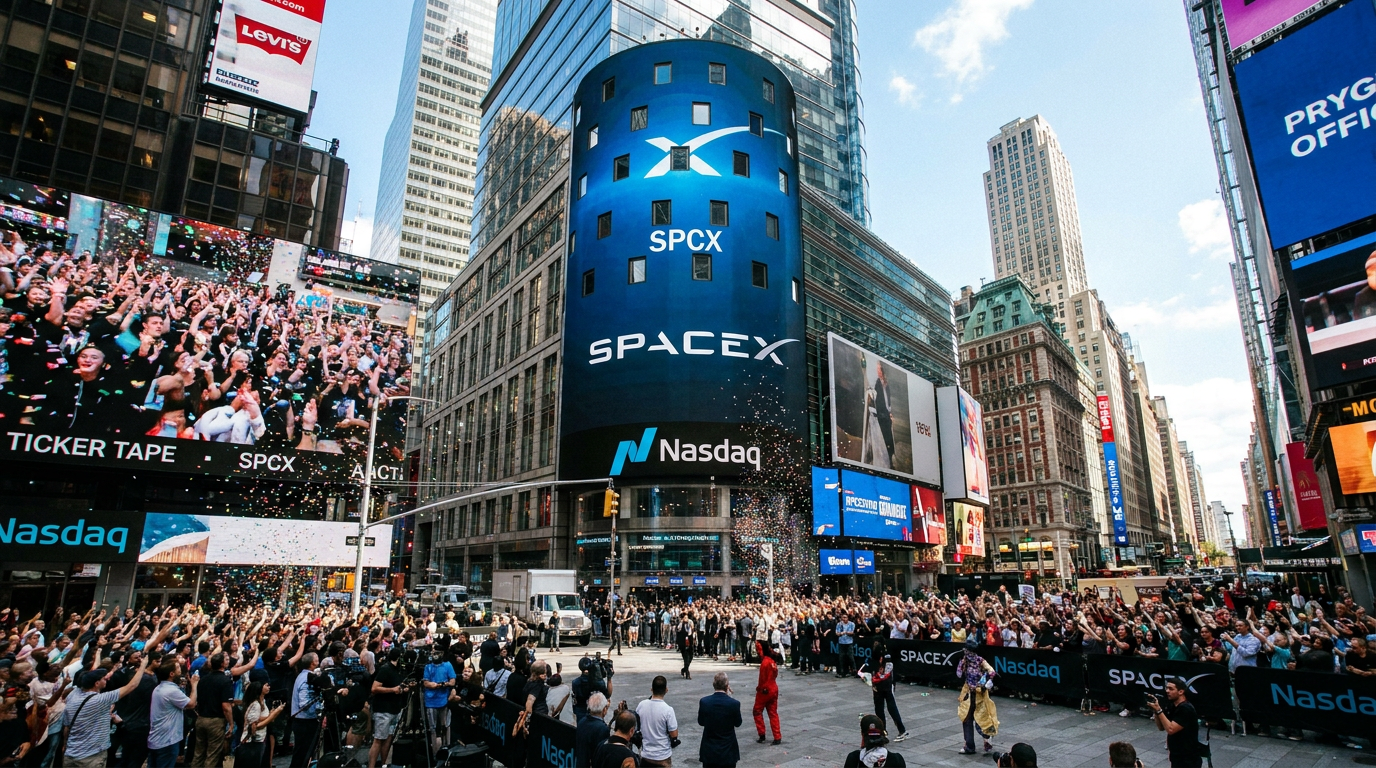
On Friday, June 12, 2026, the financial landscape witnessed a seismic shift as Space Exploration Technologies Corp.—better known as SpaceX—officially debuted on the Nasdaq under the ticker symbol SPCX. The highly anticipated initial public offering raised a staggering $75 billion, instantly valuing the aerospace and technology conglomerate at $1.77 trillion. The sheer magnitude of the debut captivated global markets, drawing immense capital from both institutional heavyweights and everyday retail traders eager to secure a stake in the commercial space economy.[1][2]
The scale of the SpaceX offering completely rewrites the history books for public listings. For seven years, Saudi Aramco held the record for the largest IPO, having raised $29.4 billion in 2019. SpaceX more than doubled that benchmark, executing a capital raise that dwarfed the combined debuts of several major technology firms. The influx of $75 billion provides the company with an unprecedented war chest to fund its most ambitious projects, from lunar bases to advanced artificial intelligence infrastructure.[2][6]
Beyond its record-breaking size, the IPO fundamentally bucked traditional Wall Street mechanics. Standard mega-cap offerings typically announce a wide price range, spending weeks courting institutional investors in a "bookbuilding" process to narrow down the final figure. SpaceX bypassed this entirely. The company handed the market an uncompromising, fixed price of $135 per share before trading began. It was an audacious accept-it-or-leave-it proposition that forced investors to buy in based purely on enthusiasm rather than negotiated demand.[1][2]

The market accepted the terms with a voracious appetite. Investor demand reportedly surpassed $250 billion in the days leading up to the listing, oversubscribing the offering by nearly four times. Retail investors alone placed orders exceeding $100 billion, an extraordinary display of grassroots market participation. Major institutional players were equally aggressive, with asset managers reportedly placing single orders worth upwards of $5 billion just to secure an allocation.[1][6]
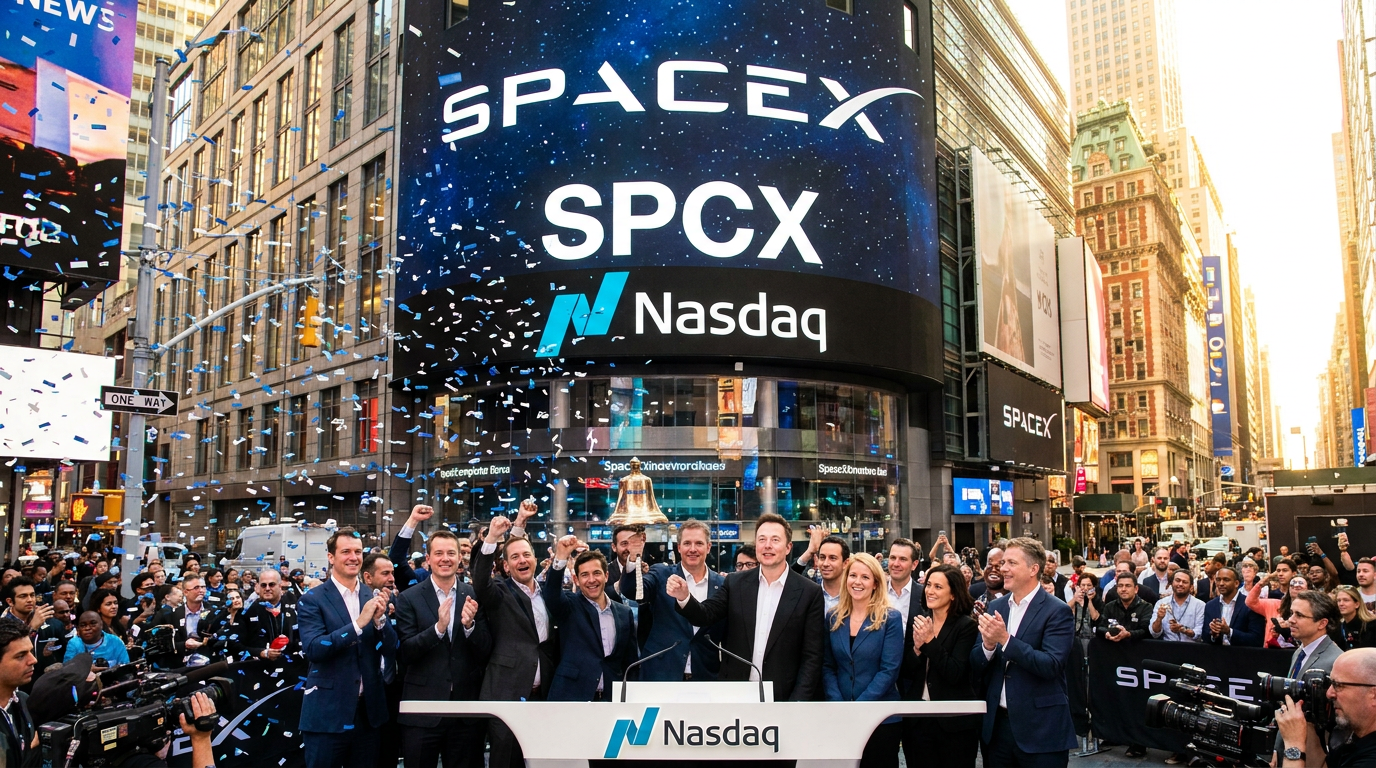
When the opening bell rang—accompanied by Elton John's "Rocket Man" playing on the Nasdaq floor—the stock immediately surged. By the end of its first trading day, SPCX shares had climbed nearly 20% to close above $161. This rapid appreciation pushed the company's market capitalization past the $2 trillion threshold. Because of his massive retained equity stake, the historic closing price officially elevated CEO Elon Musk to a net worth exceeding $1 trillion, making him the world's first trillionaire.[2]
To understand the unprecedented market frenzy, one must look closely at what investors are actually buying. The regulatory filings reveal that this is no longer just a rocket manufacturer. The S-1 prospectus outlines a "Total SpaceX" conglomerate that merges three distinct, high-growth technological pillars into a single publicly traded entity, offering exposure to sectors that are traditionally siloed in the public markets.[3][6]
The first and most visible pillar is the foundational space launch business. Anchored by the workhorse Falcon 9 and the next-generation Starship rocket, this division operates as the undisputed backbone of the U.S. space program. It holds a near-monopoly on domestic orbital delivery, servicing NASA missions, deploying commercial payloads, and acting as a critical logistical asset for national defense and international aerospace security.[3][5]

The first and most visible pillar is the foundational space launch business.
The second pillar, and arguably the most vital for near-term cash flow, is Starlink. Operating a constellation of nearly 10,000 satellites in low Earth orbit, Starlink provides high-speed, low-latency broadband internet to millions of subscribers globally. Unlike the capital-intensive rocket division, Starlink serves as a predictable financial engine, generating recurring subscription revenue that helps offset the massive research and development costs of deep-space exploration.[3][6]
The third, and most recently integrated pillar, is artificial intelligence. Following SpaceX's acquisition of Musk's AI startup xAI earlier in the year, the company has positioned itself at the intersection of orbital infrastructure and machine learning. By combining space-based data transmission with advanced AI models, SpaceX is pitching investors on a future where it serves as a central hub for the next generation of global computing and autonomous systems.[2][3]
In its prospectus, SpaceX executives outlined an astonishing total addressable market of $28.5 trillion across these three sectors. This staggering figure—which includes projections for enterprise applications, digital advertising, and AI infrastructure—was the primary narrative used to justify the $1.77 trillion initial valuation. The company is effectively selling a vision of a multiplanetary economy, where orbital data centers and lunar logistics become standard commercial industries.[3][6]

However, the company's current financial fundamentals paint a starkly different picture from its visionary projections. According to the SEC filings, SpaceX reported a net loss of $4.9 billion in 2025. This massive deficit was driven by aggressive capital expenditures, including the ongoing development of the Starship vehicle, the rapid expansion of the Starlink satellite network, and the heavy infrastructure costs associated with scaling xAI's computing power.[3][4]
This glaring disconnect between current profitability and market valuation has triggered sharp warnings from fundamental financial analysts. Research groups have pointed out that at the $135 IPO price, SpaceX is trading at roughly 94 times its projected revenue. This is a valuation multiple that is virtually unprecedented for a mature company of this size, suggesting that the stock price is entirely dependent on flawless execution over the next decade.[4]
Some market analysts have calculated the company's fundamental intrinsic value to be closer to $63 a share. These skeptics argue that the current premium relies heavily on untested technologies and highly speculative AI growth assumptions rather than near-term cash flow. They caution that retail investors, whose retirement funds may soon be exposed to the stock via index inclusion, are taking on significant risk by buying into a narrative rather than a balance sheet.[4][6]

Corporate governance remains another major friction point for institutional watchdogs. The S-1 filing confirms that Musk will retain approximately 85% of the shareholder voting power post-IPO through a dual-class share structure. This arrangement effectively insulates him from activist investors, hostile takeovers, and standard board pressure—a dynamic that has drawn intense scrutiny from lawmakers who worry about unprecedented economic power concentrated in a single executive.[3][5]
Despite these structural, financial, and regulatory concerns, the market has delivered a definitive verdict. The successful public debut of SpaceX marks a paradigm shift in how mega-cap technology companies access capital. It proves that a critical mass of investors is willing to overlook traditional valuation metrics and governance norms to participate in what they view as the inevitable commercialization of space and the next frontier of artificial intelligence.[1][6]
How we got here
April 2026
SpaceX confidentially submits its draft S-1 registration statement to the SEC.
May 2026
The SEC publicly discloses the IPO paperwork, revealing the integration of xAI and Starlink.
June 3, 2026
SpaceX bypasses traditional bookbuilding and announces a fixed IPO price of $135 per share.
June 11, 2026
Retail and institutional demand reportedly surpasses $250 billion, heavily oversubscribing the offering.
June 12, 2026
SpaceX begins trading on the Nasdaq, closing up nearly 20% and pushing its valuation past $2 trillion.
Viewpoints in depth
Growth Bulls' view
Focuses on the massive addressable market and technological monopoly.
Investors driving the stock's massive surge are primarily focused on the company's long-term potential rather than its current balance sheet. By combining the world's only fully reusable orbital rocket fleet with a global satellite internet monopoly and advanced AI infrastructure, bulls argue SpaceX has no true peers. They view the $1.77 trillion valuation not as a reflection of today's revenue, but as a down payment on a $28.5 trillion addressable market that includes orbital data centers, global telecommunications, and lunar logistics.
Fundamental Skeptics' view
Highlights the extreme valuation multiples and ongoing operational losses.
Financial analysts and fundamental investors warn that the IPO price is entirely divorced from traditional valuation metrics. Trading at nearly 94 times its projected revenue while posting a $4.9 billion net loss in 2025, the company is priced for absolute perfection. Skeptics argue that any delays in the Starship program, regulatory hurdles for Starlink, or failure to monetize xAI could trigger a massive correction, leaving retail investors holding the bag on a highly speculative asset.
Governance Watchdogs' view
Raises alarms over the unprecedented concentration of voting power.
Regulatory experts and national security analysts are focused on the structural implications of the IPO. With Elon Musk retaining 85% of the voting power, public shareholders have virtually no mechanism to influence corporate governance or demand accountability. Given that SpaceX operates as the backbone of the U.S. space program and a critical defense contractor, watchdogs argue this dual-class structure places an uncomfortable amount of geopolitical leverage in the hands of a single executive who is insulated from board oversight.
What we don't know
- How quickly SpaceX will be added to major indices like the S&P 500, given its current lack of GAAP profitability.
- Whether the aggressive capital expenditures on Starship and AI infrastructure will yield positive cash flow before investor patience wanes.
- How regulatory bodies will handle the unprecedented concentration of defense and telecommunications infrastructure under a single publicly traded entity.
Key terms
- Initial Public Offering (IPO)
- The process by which a private company offers shares of its stock to the public for the first time, allowing it to raise capital from public investors.
- Bookbuilding
- The traditional process where investment banks generate, capture, and record investor demand for shares to determine an IPO's final issue price.
- Total Addressable Market (TAM)
- The overall revenue opportunity that is available to a product or service if 100% market share was achieved.
- Dual-class share structure
- A corporate structure where a company issues two different classes of shares, typically giving founders or executives significantly more voting power than public shareholders.
Frequently asked
How much money did SpaceX raise in its IPO?
SpaceX raised $75 billion, making it the largest initial public offering in stock market history, surpassing Saudi Aramco's $29 billion raise in 2019.
What is the ticker symbol for SpaceX?
SpaceX trades on the Nasdaq exchange under the ticker symbol SPCX.
Is SpaceX currently profitable?
No. According to its SEC filings, SpaceX reported a net loss of $4.9 billion in 2025, largely due to heavy investments in its Starship rocket and AI infrastructure.
How much of the company does Elon Musk control?
Following the IPO, Elon Musk retains approximately 85% of the shareholder voting power through a dual-class share structure.
Sources
Source coverage
6 outlets
3 viewpoints surfaced






[1]MarketWatchRetail & Growth Bulls
How Elon Musk nailed the SpaceX IPO: ‘I’m not sure that this could have gone much better’
Read on MarketWatch →[2]The GuardianFundamental Skeptics
SpaceX made the biggest stock market debut in history on Friday
Read on The Guardian →[3]U.S. Securities and Exchange CommissionGovernance & Security Analysts
Form S-1 Registration Statement: Space Exploration Technologies Corp.
Read on U.S. Securities and Exchange Commission →[4]Morningstar ResearchFundamental Skeptics
Initiating Coverage: SpaceX Valuation and Market Fundamentals
Read on Morningstar Research →[5]Center for Strategic and International StudiesGovernance & Security Analysts
U.S. Space Power and the Commercial Market: The SpaceX IPO
Read on Center for Strategic and International Studies →[6]Factlen Editorial TeamGovernance & Security Analysts
Synthesis by Factlen editorial team
Read on Factlen Editorial Team →
More in finance
See all 18 stories →Market Rotation
Why Value Stocks Are Outperforming Growth Equities in 2026
0 sources

SpaceX IPO
SpaceX Completes Historic $75 Billion IPO, Pushing Valuation Past $2 Trillion
0 sources
Wealth Management
Robo-Advisors vs. Human Planners: Comparing Financial Guidance Tools in 2026
0 sources

IPO Mechanics
How SpaceX Bypassed Wall Street Norms to Pull Off the Largest IPO in History
0 sources
Every angle. Every day.
Get finance stories with full source coverage and perspective breakdowns delivered to your inbox.