
Smart Ring vs. Smartwatch: The 2026 Guide to Choosing a Health Tracker
As wearable technology splits into active wrist displays and passive finger sensors, choosing the right health tracker comes down to prioritizing real-time workout data versus continuous sleep comfort.
By Factlen Editorial Team
- Active Fitness Enthusiasts
- Prioritize real-time workout metrics, GPS tracking, and interactive features during exercise.
- Recovery & Sleep Optimizers
- Focus on overnight comfort, continuous biometric data, and holistic readiness scores.
- Minimalist Tech Adopters
- Seek to reduce screen time and notification fatigue while still monitoring long-term health trends.
- Clinical Data Analysts
- Emphasize sensor accuracy, physiological signal quality, and uninterrupted data continuity.
What's not represented
- · Traditional Watch Enthusiasts
- · Budget-Conscious Consumers
Why this matters
With premium wearables costing upwards of $300 and some requiring monthly subscriptions, selecting the wrong form factor often leads to abandoned devices. Understanding the physiological and practical trade-offs between finger and wrist tracking ensures you invest in a tool you will actually wear consistently.
Key points
- The wearable market has split into two distinct categories: active smartwatches and passive smart rings.
- Smartwatches excel at providing real-time workout metrics, GPS tracking, and interactive smartphone features.
- Smart rings offer superior overnight comfort, leading to more consistent and accurate sleep and recovery data.
- Battery life is a major differentiator, with rings lasting up to 10 days compared to 18-36 hours for watches.
- Consumers must weigh the upfront cost of a smartwatch against the lower price but potential subscription fees of a smart ring.
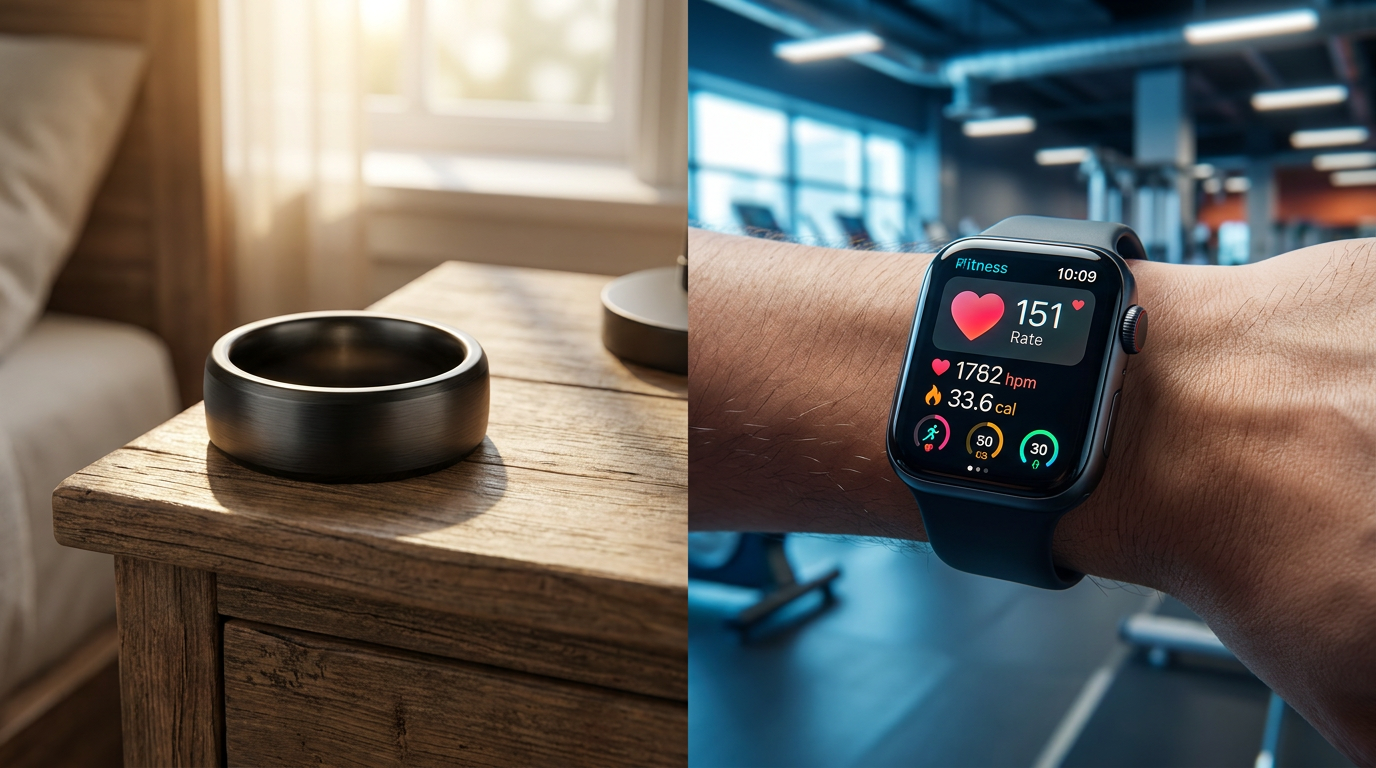
The wearable health technology market has decisively split into two distinct form factors in 2026: the active smartwatch and the passive smart ring. While both categories promise to monitor habits and provide actionable health insights, they represent fundamentally different philosophies of personal data collection. A smartwatch functions as an interactive companion, delivering real-time metrics, notifications, and on-demand applications directly to the wrist. Conversely, a smart ring acts as a quiet observer, gathering biometric data continuously without demanding immediate attention or screen interaction.[6]
Choosing between these two approaches requires a careful evaluation of personal habits, as neither device is objectively superior across all use cases. The decision ultimately hinges on whether a user prioritizes active workout guidance and connectivity, or unobtrusive comfort and long-term recovery tracking. With flagship devices from Apple, Samsung, and Oura dominating the landscape, understanding the physiological and practical trade-offs is essential for selecting a wearable that will actually remain on the body rather than abandoned on a nightstand.[1][6][8]
The case for the smartwatch centers heavily on its versatility and its ability to provide immediate, actionable feedback. For individuals who train regularly, the wrist-worn display is an indispensable tool. Smartwatches excel at delivering real-time heart rate zones, GPS route tracking, pace metrics, and interval timers during active exercise. The processing power and screen real estate allow users to adjust their effort mid-run or mid-ride based on live data, a feature that screenless devices simply cannot replicate.[1][4][6]
The evidence supporting the smartwatch's dominance in active fitness is robust. Devices like the Apple Watch Series 11 offer automatic exercise detection and highly accurate step counting, alongside advanced medical-grade features such as on-demand electrocardiograms (ECG) and fall detection. For users who want a comprehensive lifestyle product that doubles as a phone extension, the smartwatch provides unparalleled utility, allowing them to check messages, set timers, and log workouts instantly.[2][4]

However, the argument against the smartwatch often revolves around comfort and screen fatigue. The very features that make it powerful—a bright display and complex sensors—result in a bulkier device that typically weighs between 40 and 80 grams. This bulk becomes particularly noticeable at night. Many users find wearing a glowing, vibrating computer to bed uncomfortable, which leads to inconsistent nighttime wear and significant gaps in sleep data. Furthermore, the constant barrage of notifications can increase digital distraction, countering the wellness goals the device is meant to support.[3][6][7][8]
The case for the smart ring is built entirely on passive, frictionless data collection. Weighing a mere 4 to 8 grams, a smart ring is designed to disappear into the user's daily life. By eliminating the screen, rings remove the temptation to constantly check metrics, fostering a healthier relationship with health data. This discreet form factor is particularly appealing to those who prefer wearing traditional mechanical watches or who simply want to monitor their well-being without broadcasting their tech adoption to the world.[6][7][8]
The evidence favoring smart rings is strongest in the realm of sleep and recovery tracking. Physiologically, the finger offers a superior location for optical heart rate sensors (photoplethysmography). The arteries in the finger are closer to the skin surface and feature a denser capillary network than the wrist, yielding a cleaner signal with less interference from ambient light or motion. A 2025 validation study demonstrated that top-tier smart rings achieved a 96 to 98 percent correlation with clinical sleep-staging equipment, significantly outperforming the 85 to 90 percent accuracy typically seen in wrist-worn devices prone to positional drift during the night.[5][6][7]

The evidence favoring smart rings is strongest in the realm of sleep and recovery tracking.
The argument against the smart ring highlights its limitations as an active fitness tracker. Because they lack a display, rings cannot provide real-time pacing or heart rate alerts during a workout. Users must wait until after their exercise session to sync the device with their smartphone and review the data. Additionally, some smart rings struggle with immediate workout recognition, occasionally taking several minutes to register that an exercise session has begun, which can frustrate data-driven athletes.[1][4]
Battery life represents one of the starkest operational divides between the two form factors. The robust displays and continuous connectivity of premium smartwatches drain their batteries quickly, typically requiring a charge every 18 to 36 hours. This frequent charging cycle often forces users to choose between tracking their daytime activity or their nighttime sleep, creating inevitable blind spots in their health data.[2][5][6]
In contrast, the minimalist nature of smart rings allows for exceptional energy efficiency. Leading models in 2026 consistently deliver five to ten days of continuous tracking on a single charge. This extended battery life is not merely a convenience; it is a critical factor in data integrity. Because the ring rarely needs to leave the finger, it captures a truly uninterrupted stream of baseline metrics, making its long-term trend analysis for heart rate variability (HRV) and body temperature highly reliable.[5][6]
The financial comparison between the two devices extends beyond the initial retail price. While smartwatches generally cost between $250 and $500 upfront, they rarely require ongoing software fees to access core health metrics. Smart rings, which often retail between $250 and $400, frequently employ a subscription model. For instance, unlocking the full suite of insights on an Oura Ring requires a monthly fee, which can add hundreds of dollars to the total cost of ownership over a few years, though some newer competitors are beginning to offer subscription-free alternatives.[3][4][6]

Interestingly, a growing segment of health enthusiasts has adopted a dual-wearer approach, utilizing both devices to capture the best of both worlds. They rely on a smartwatch during the day for connectivity and workout tracking, and switch to a smart ring at night for comfortable, high-fidelity sleep staging. While this provides the most comprehensive data picture, it requires a significant financial investment and can result in redundant data that most casual users do not need.[2][3]
Ultimately, the choice comes down to aligning the technology with specific lifestyle goals. A smartwatch fits well when the user is an active athlete who relies on real-time pacing, GPS tracking, and immediate heart rate feedback during runs or cycling sessions. It is also the ideal choice for individuals who want to reduce their smartphone usage by triaging notifications directly from their wrist, or those who specifically need advanced medical alerts like fall detection or ECG readings.[1][4][5][6]
Conversely, a smartwatch does not fit well when the user suffers from screen fatigue, finds wrist wearables irritating while typing or sleeping, or struggles to maintain a daily charging routine. If the device spends half the week sitting dead on a nightstand, its advanced sensors provide zero value to the user's health journey.[3][5][8]

A smart ring fits well when the primary objective is optimizing sleep, tracking long-term recovery trends, and monitoring baseline health without adding another screen to daily life. It is perfect for users who want a 'set it and forget it' experience, where the technology quietly gathers high-quality biometric data in the background and presents a holistic readiness score each morning.[2][5][6][8]
A smart ring does not fit well when the user demands immediate feedback during high-intensity interval training, requires built-in GPS for outdoor navigation, or expects their wearable to serve as a communication device. By honestly assessing which of these profiles matches their daily reality, consumers can confidently select the wearable that will best support their health goals in 2026.[1][6]
How we got here
2015
The Apple Watch launches, establishing the wrist as the primary location for mainstream wearable health tracking.
2018
Oura releases its second-generation ring, proving that miniaturized sensors can accurately track sleep from the finger.
2022
Clinical validation studies confirm that finger-based optical sensors match or exceed wrist sensors for resting heart rate accuracy.
2024
Samsung enters the smart ring market with the Galaxy Ring, signaling major tech industry investment in the screenless form factor.
2026
The wearable market fully bifurcates, with consumers actively choosing between active wrist displays and passive finger sensors based on lifestyle needs.
Viewpoints in depth
Active Fitness Enthusiasts
Athletes and runners who rely on real-time data to guide their training.
For this camp, a wearable is primarily a training tool. They argue that health tracking is most valuable when it can be acted upon in the moment—such as adjusting running pace to stay within a specific heart rate zone or using GPS to navigate a new cycling route. From their perspective, the inability of a smart ring to provide immediate, mid-workout feedback makes it a secondary accessory rather than a primary fitness device. They are willing to accept the bulk and daily charging requirements of a smartwatch in exchange for its powerful, interactive capabilities.
Recovery & Sleep Optimizers
Users who prioritize overnight biometric data and holistic wellness over workout metrics.
This group views health tracking through the lens of rest and recovery. They argue that the most critical health data—resting heart rate, heart rate variability, and sleep staging—is gathered at night. Because smart rings are significantly more comfortable to wear to bed and boast multi-day battery life, optimizers believe rings capture a more complete and accurate picture of baseline health. They often view the constant notifications and glowing screens of smartwatches as sources of stress that actively detract from their wellness goals.
Clinical Data Analysts
Experts focused on the accuracy, continuity, and physiological validity of the data.
From a data integrity standpoint, analysts emphasize the importance of sensor placement and user adherence. They point out that the finger's dense capillary network provides a cleaner photoplethysmography (PPG) signal than the wrist, especially during sleep when wrist devices are prone to shifting. Furthermore, they argue that the 5-to-10-day battery life of a smart ring virtually eliminates the 'charging gaps' that plague smartwatch data sets, resulting in a more continuous and reliable longitudinal health record.
What we don't know
- Whether major smartwatch manufacturers will eventually release their own companion rings to create unified, multi-device health ecosystems.
- How long subscription-based pricing models will remain viable as more fee-free smart rings enter the market.
Key terms
- Photoplethysmography (PPG)
- An optical measurement technique used by wearables to detect blood volume changes in the microvascular bed of tissue, primarily used to calculate heart rate.
- Heart Rate Variability (HRV)
- The measure of the specific changes in time between successive heartbeats, used as a key indicator of physical recovery and physiological stress.
- Sleep Staging
- The process of categorizing sleep into distinct phases, such as light, deep, and REM sleep, based on movement, heart rate, and temperature data.
- Positional Drift
- When a wearable device shifts out of its optimal sensor position on the body, often occurring with loose-fitting smartwatches during sleep, leading to inaccurate data.
Frequently asked
Can a smart ring track my runs and workouts?
Yes, most premium smart rings can track heart rate and estimate calorie burn during workouts. However, they lack a screen to show you real-time pacing or heart rate zones, and they do not have built-in GPS for route tracking.
Do I have to pay a monthly subscription for a smart ring?
It depends on the brand. The Oura Ring requires a monthly subscription to access detailed health insights, while others like the Samsung Galaxy Ring and RingConn offer their data without ongoing fees.
Is it redundant to wear both a smartwatch and a smart ring?
For most people, yes. Both devices track baseline metrics like steps, heart rate, and sleep. Wearing both is only beneficial if you specifically want a watch for daytime workout tracking and a ring for more comfortable nighttime sleep tracking.
Which device is more accurate for heart rate?
During active movement and exercise, a tightly fastened smartwatch is generally more accurate. During rest and sleep, a smart ring often provides a cleaner signal because the finger has a denser capillary network and the ring moves less than a watch.
Sources
Source coverage
8 outlets
4 viewpoints surfaced








[1]ForbesActive Fitness Enthusiasts
Oura Ring Vs. Apple Watch: Which Is The Better Health Tracker?
Read on Forbes →[2]ZDNETActive Fitness Enthusiasts
I've worn the Oura Ring and Apple Watch for years: Here's which of two is more essential
Read on ZDNET →[3]BGRRecovery & Sleep Optimizers
Smart Rings Vs. Smartwatches: Which Is Better For Sleep Tracking?
Read on BGR →[4]Garage Gym ReviewsActive Fitness Enthusiasts
Expert Comparison: Oura Ring vs Apple Watch (2026)
Read on Garage Gym Reviews →[5]KnowWave JournalClinical Data Analysts
Smartwatch Vs Ring Health Tracking-what Wins In 2026?
Read on KnowWave Journal →[6]Vora BlogMinimalist Tech Adopters
Smart Ring or Smartwatch? How to Choose the Right Wearable in 2026
Read on Vora Blog →[7]J-StyleRecovery & Sleep Optimizers
Smart Ring vs Fitness Tracker vs Smartwatch: Ultimate Comparison 2026
Read on J-Style →[8]VertuMinimalist Tech Adopters
Fitness Ring vs. Smartwatch: Which is Right for Your 2026 Fitness Goals?
Read on Vertu →

More in shopping
See all 25 stories →Home Appliances
Heat Pump Dryers: The 2026 Buying Guide and Explainer
0 sources
Display Tech
OLED vs. Mini-LED in 2026: The Ultimate Home Theater Trade-Off Analysis
0 sources
TV Tech
OLED vs. Mini-LED: Choosing the Right Premium TV in 2026
0 sources

Home Electrification
The 2026 Guide to Buying a Heat Pump: Ratings, Rebates, and Avoiding Costly Mistakes
0 sources

Every angle. Every day.
Get shopping stories with full source coverage and perspective breakdowns delivered to your inbox.