
OLED vs. Mini-LED: The 2026 TV Buying Guide
As television technology advances in 2026, the choice between OLED's perfect black levels and Mini-LED's extreme brightness comes down to room lighting and viewing habits.
By Factlen Editorial Team
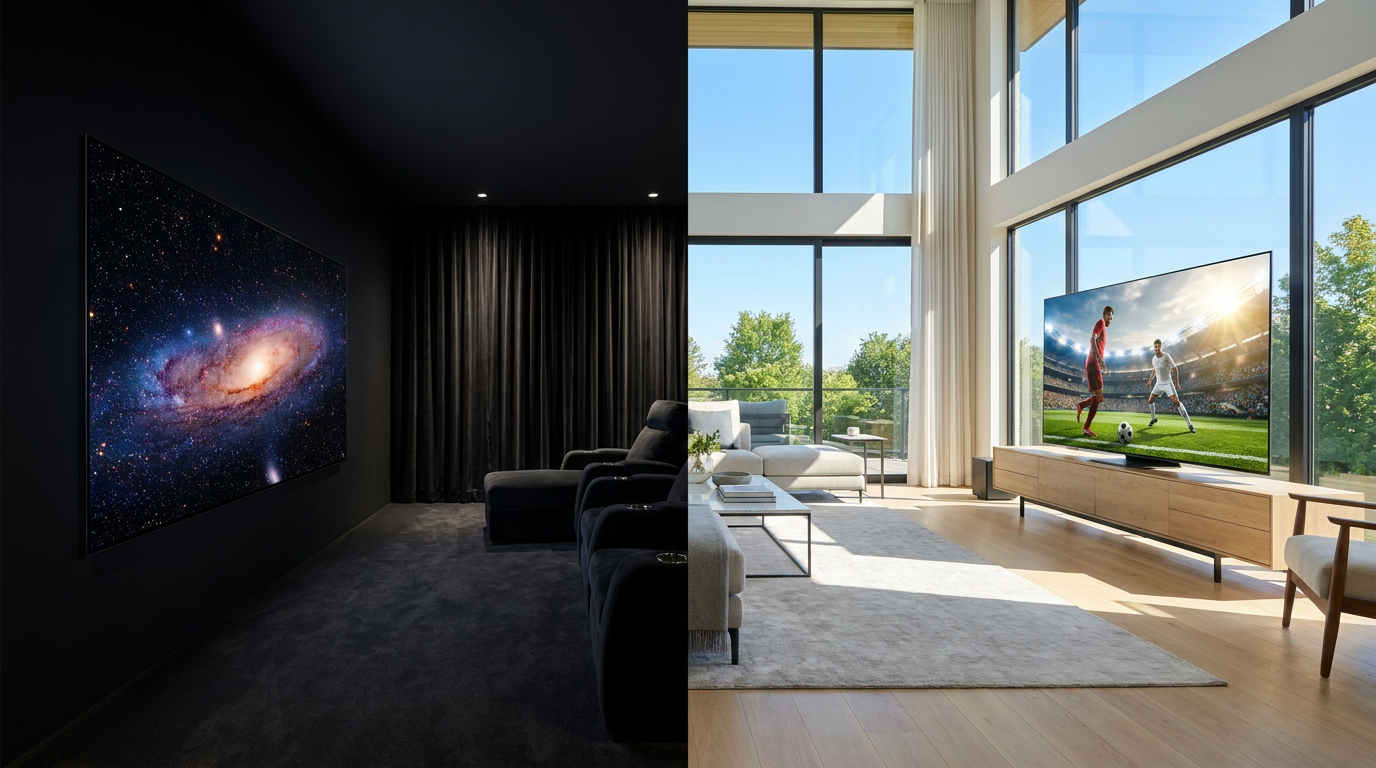
- Cinematic Purists
- Advocates for preserving the director's exact visual intent through perfect contrast.
- Bright-Room Viewers
- Prioritizes sheer light output and durability for everyday, mixed-use living spaces.
- Value & Large-Format Buyers
- Focuses on the cost-per-inch ratio and the growing demand for massive screens.
What's not represented
- · Budget-conscious consumers who prioritize sub-$500 standard LED televisions.
- · Projector enthusiasts who prefer massive, reflected-light cinematic setups over emissive flat panels.
Why this matters
Dropping $1,000 to $3,000 on a premium television is a major household investment. Choosing the wrong panel technology for your specific living room lighting can result in frustrating glare during the day or distracting light-bleed during movie nights.
Key points
- OLED TVs offer perfect black levels and infinite contrast by lighting each pixel individually.
- Mini-LED TVs utilize thousands of microscopic backlights to achieve extreme peak brightness.
- OLED is the definitive choice for dark home theaters and cinematic viewing.
- Mini-LED is superior for sunlit living rooms, daytime sports, and massive screen sizes.
- While OLED carries a slight risk of burn-in over thousands of hours, Mini-LED is immune to permanent image retention.
The 2026 television market has crystallized into a two-horse race for the premium living room: OLED and Mini-LED. While older LCD and standard LED models still populate budget aisles, anyone spending over $800 is inevitably faced with this specific fork in the road. Both technologies promise stunning 4K resolution, vibrant high-dynamic-range (HDR) colors, and advanced gaming features. Yet, they achieve these results through fundamentally different engineering philosophies, forcing buyers to weigh distinct trade-offs based on their room lighting, viewing habits, and budget.[1][2]
To understand the divide, one must look at how each screen generates light. OLED, which stands for Organic Light-Emitting Diode, is a self-emissive technology. This means that every single one of the 8.3 million pixels on a 4K OLED display produces its own light and color. When an image calls for absolute black—such as the vacuum of space in a sci-fi film—the TV simply turns off the power to those specific pixels. This pixel-level precision results in an infinite contrast ratio, a characteristic that reviewers and cinematic purists have championed for over a decade.[2][4]
The primary argument for OLED rests on this flawless contrast and its handling of dark scenes. The evidence is clear in side-by-side testing: because there is no backlight bleeding through the panel, OLED televisions exhibit zero "blooming" or "haloing"—the distracting glow that can surround bright objects, like white subtitles, on a dark background. Furthermore, OLED panels offer exceptionally wide viewing angles. Whether a viewer is sitting dead-center or off to the side in a wide seating arrangement, the color saturation and contrast remain perfectly intact, making it the undisputed king of the dark-room home theater.[1][3]

The primary argument against OLED centers on its brightness limitations and the inherent nature of organic materials. The evidence for this drawback is the Auto Brightness Limiter (ABL). While 2026 innovations like QD-OLED (Quantum Dot OLED) and Tandem OLED have pushed peak highlight brightness to around 2,000 nits, OLEDs still struggle to maintain high brightness across the entire screen. When displaying a bright, full-screen image like a hockey rink or a snow-covered landscape, the ABL engages to protect the panel from overheating, noticeably dimming the picture. Additionally, while the risk has been heavily mitigated by modern pixel-shifting algorithms, OLEDs still carry a slight risk of permanent burn-in if static elements are displayed for thousands of hours.[2][3]
Mini-LED takes the opposite approach, supercharging traditional LCD technology to overcome its historical weaknesses. Instead of relying on a few dozen large backlights, a Mini-LED television utilizes thousands of microscopic light-emitting diodes packed behind the screen. These tiny lights are grouped into hundreds or thousands of "local dimming zones" that can independently brighten or darken based on the scene. While it cannot control light at the individual pixel level like an OLED, a high-end Mini-LED gets remarkably close, offering deep blacks while retaining the raw power of an LED backlight.[4][5]
The strongest argument for Mini-LED is its blinding, sustained brightness. The evidence is found in peak luminance measurements, where premium 2026 Mini-LED models can easily push past 2,500 to 3,000 nits of peak brightness, making them significantly more luminous than their OLED counterparts. For consumers with sun-drenched living rooms, skylights, or large uncurtained windows, this sheer light output is a necessity. A Mini-LED can punch through daytime glare effortlessly, ensuring that sports broadcasts and HDR highlights remain vivid and visible even at high noon. Furthermore, because Mini-LEDs do not use organic compounds, they are entirely immune to permanent burn-in.[1][5]

The strongest argument for Mini-LED is its blinding, sustained brightness.
The argument against Mini-LED is found in the shadows. The evidence of this limitation is "blooming." Despite advanced algorithms controlling thousands of dimming zones, the technology still relies on shining light through an LCD layer. This means that some light inevitably bleeds into adjacent dark zones, creating a faint halo effect around bright objects on black backgrounds. While 2026 models have minimized this blooming to near-imperceptible levels for casual viewers, side-by-side testing in a pitch-black room still reveals Mini-LED's slight disadvantage against OLED. Additionally, Mini-LED panels often suffer from color degradation when viewed from off-center angles.[3][5]
When evaluating the evidence for gaming, the two technologies trade blows depending on the genre. OLED is widely celebrated for its near-instantaneous pixel response time, often measured at 0.1 milliseconds. This results in unparalleled motion clarity, completely eliminating the blurry ghosting effect behind fast-moving objects in competitive shooters or racing games. Mini-LEDs, while offering identical 144Hz refresh rates and HDMI 2.1 features, have slightly slower liquid-crystal response times. However, gamers who play in bright rooms or worry about leaving static maps on the screen for marathon sessions often find Mini-LED's durability and brightness to be the safer long-term investment.[3][6]
The economic reality of manufacturing also plays a massive role in the 2026 buying decision, particularly as consumer demand shifts toward gargantuan screen sizes. Mini-LED technology scales up much more cost-effectively than OLED. While a 65-inch OLED and a 65-inch Mini-LED might sit at similar price points, the gap widens drastically at 85 inches and beyond. For buyers looking to fill a massive wall with a 98-inch or 100-inch display, Mini-LED is often the only financially viable option, offering a cinematic scale that would cost tens of thousands of dollars in an OLED format.[5][6]

Ultimately, the decision requires abandoning the search for a single, objective winner and instead matching the technology to the environment. OLED fits exceptionally well when the television is placed in a light-controlled room, a basement home theater, or a bedroom where nighttime viewing is the priority. It is the definitive choice for cinephiles who demand perfect black levels, gamers who prioritize flawless motion clarity, and viewers with wide seating arrangements where off-axis color accuracy is paramount. If the goal is to replicate the exact mastering monitor used by a Hollywood director, OLED remains the gold standard.[1][2]
Conversely, OLED does not fit well when the television will be subjected to direct, uncontrolled sunlight, or when the household viewing habits involve leaving a single news channel or static video game interface on the screen for eight hours a day. In these scenarios, the panel's protective dimming features will frustrate the viewer, and the lingering anxiety over burn-in can detract from the premium experience.[2][3]
Mini-LED fits perfectly when the television serves as the centerpiece of a bright, open-concept living room. It is the superior choice for daytime sports viewing, casual mixed-media consumption, and households that want a massive 85-inch-plus screen without taking out a second mortgage. Its immunity to burn-in makes it the ultimate stress-free family television, capable of doubling as a giant PC monitor or a background noise generator without any risk of permanent panel damage.[4][5]

However, Mini-LED does not fit well when the primary use case is watching moody, dark-scene prestige dramas in a pitch-black room, as the subtle haloing around bright highlights can break the immersion for sensitive viewers. It is also less ideal for wide, U-shaped seating arrangements where guests on the far ends of the couch might experience washed-out colors. By honestly assessing the room's lighting and the family's viewing habits, buyers can confidently navigate the 2026 TV market and secure a display that perfectly serves their specific needs.[3][6]
How we got here
2013
LG introduces the first mass-market OLED TVs, establishing a new benchmark for perfect black levels.
2019
TCL pioneers the first Mini-LED televisions, bringing thousands of dimming zones to traditional LCD panels.
2022
Samsung launches QD-OLED, combining OLED's perfect blacks with a quantum dot layer for brighter colors.
2024
Mini-LED models break the 3,000-nit brightness barrier, solidifying their dominance in bright-room environments.
2026
Tandem OLED and RGB Mini-LED technologies arrive, further narrowing the performance gap between the two formats.
Viewpoints in depth
Cinematic Purists
Advocates for preserving the director's exact visual intent through perfect contrast.
For home theater enthusiasts and professional colorists, the conversation begins and ends with OLED. This camp argues that peak brightness is a secondary metric compared to absolute black levels and pixel-level light control. They point out that in a dark room, a 1,000-nit OLED highlight against a true black background appears vastly more impactful than a 3,000-nit Mini-LED highlight surrounded by subtle blooming. For this group, the slight risk of burn-in is a worthwhile trade-off for motion clarity and infinite contrast.
Bright-Room Viewers
Prioritizes sheer light output and durability for everyday, mixed-use living spaces.
This perspective argues that perfect black levels are irrelevant if the screen is washed out by afternoon sunlight. Bright-room advocates champion Mini-LED for its brute-force luminance, which can easily overpower glare from large windows and skylights. Furthermore, they value the 'stress-free' nature of Mini-LED; without the organic compounds that cause burn-in, families can leave news channels, sports scoreboards, or video games paused for hours without anxiety.
Value & Large-Format Buyers
Focuses on the cost-per-inch ratio and the growing demand for massive screens.
As the standard living room TV size creeps toward 85 inches and beyond, this camp looks strictly at manufacturing economics. While OLED remains competitive at 55 and 65 inches, the cost to produce flawless organic panels at 98 or 100 inches remains astronomical. Value advocates argue that Mini-LED delivers 90% of OLED's dark-room performance while making truly massive, wall-filling cinematic experiences affordable for the average consumer.
What we don't know
- Whether emerging Micro-LED technology will eventually become affordable enough to replace both OLED and Mini-LED.
- How long the newest Tandem OLED panels will maintain their peak brightness before organic degradation occurs.
Key terms
- OLED (Organic Light-Emitting Diode)
- A display technology where every individual pixel generates its own light and color, allowing it to turn off completely for perfect black levels.
- Mini-LED
- An advanced LCD television that uses thousands of microscopic LED lights grouped into zones behind the screen to control brightness and contrast.
- Nits
- A standard unit of measurement for screen brightness; a higher number indicates a display capable of producing a brighter image.
- Local Dimming Zones
- Specific clusters of backlights in a Mini-LED TV that can independently dim or brighten to improve the contrast of a specific area of the image.
- QD-OLED
- A hybrid panel that combines the perfect black levels of an OLED with a quantum dot color layer to achieve brighter, more vibrant highlights.
- Response Time
- The time it takes for a single pixel to change from one color to another, crucial for reducing motion blur in fast-paced games and sports.
Frequently asked
What is blooming on a Mini-LED TV?
Blooming, or haloing, occurs when the backlight from a bright object bleeds into the surrounding dark areas of the screen. While Mini-LEDs use thousands of dimming zones to minimize this, it can still be visible around elements like white subtitles on a black background.
Do OLED TVs still get burn-in in 2026?
While the risk is vastly lower than in early generations due to advanced pixel-shifting and panel-refresh algorithms, OLEDs can still suffer permanent image retention if static elements—like news tickers or game HUDs—are displayed for thousands of hours.
Which TV is better for a bright room with windows?
Mini-LED is the superior choice for bright rooms. Its ability to output 2,500 to 3,000 nits of peak brightness allows it to easily overpower natural sunlight and reduce distracting screen glare.
Are Mini-LED TVs good for gaming?
Yes. Modern Mini-LEDs support 144Hz refresh rates, VRR, and HDMI 2.1, making them excellent for gaming. However, OLEDs still hold a slight edge in competitive gaming due to their near-instantaneous pixel response times, which eliminate motion blur.
Sources
Source coverage
6 outlets
3 viewpoints surfaced






[1]CNETBright-Room Viewers
OLED vs. Mini-LED: Which TV Tech Is Better?
Read on CNET →[2]Tom's GuideCinematic Purists
OLED vs Mini-LED: What's the difference?
Read on Tom's Guide →[3]RTINGSCinematic Purists
Mini LED vs. OLED: Which Panel Technology Is Better?
Read on RTINGS →[4]SamsungBright-Room Viewers
Mini LED vs. OLED: What is the difference?
Read on Samsung →[5]CurrysValue & Large-Format Buyers
OLED vs Mini LED: Which TV is best for you?
Read on Currys →[6]Data Wire SolutionsValue & Large-Format Buyers
Tandem OLED vs QD-OLED vs Mini-LED
Read on Data Wire Solutions →

More in shopping
See all 25 stories →Home Appliances
Heat Pump Dryers: The 2026 Buying Guide and Explainer
0 sources
Display Tech
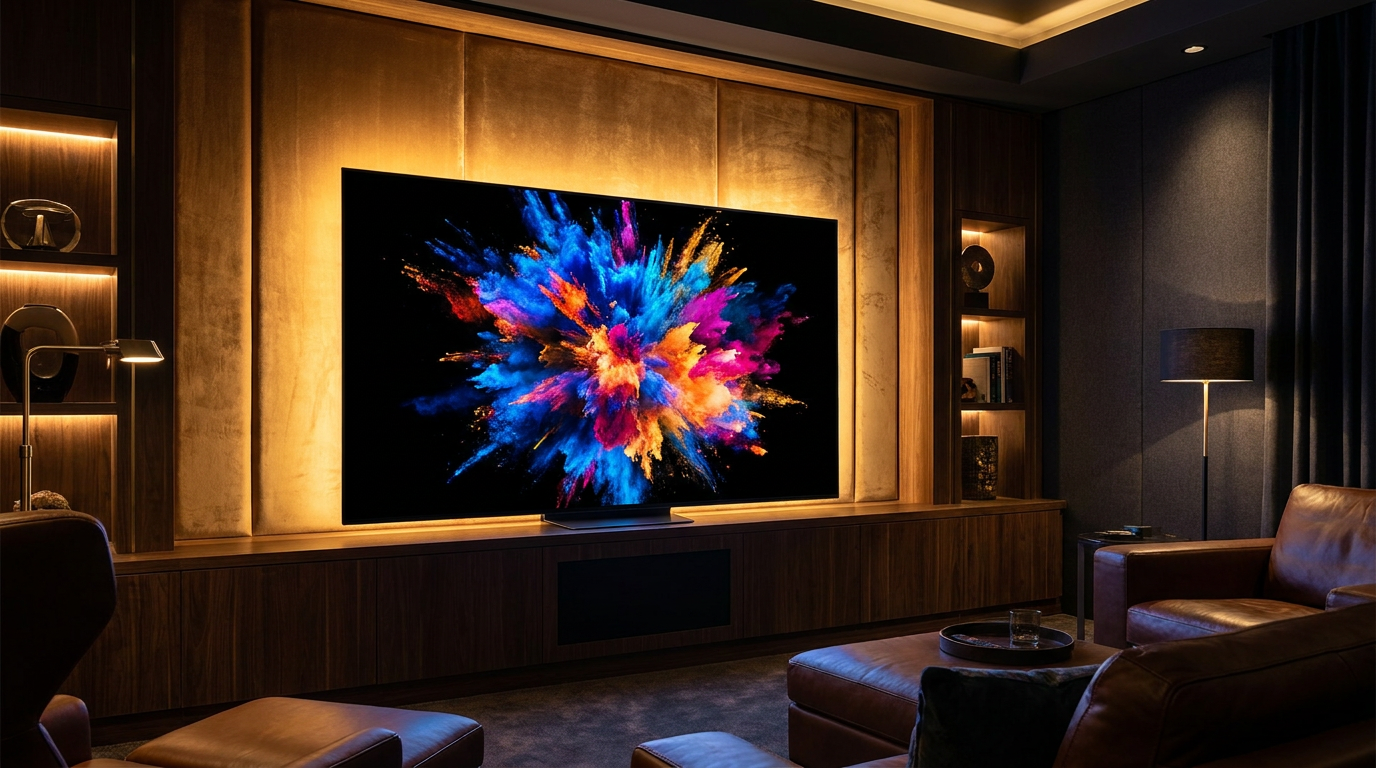
OLED vs. Mini-LED in 2026: The Ultimate Home Theater Trade-Off Analysis
0 sources
TV Tech
OLED vs. Mini-LED: Choosing the Right Premium TV in 2026
0 sources
Home Electrification
The 2026 Guide to Buying a Heat Pump: Ratings, Rebates, and Avoiding Costly Mistakes
0 sources
Every angle. Every day.
Get shopping stories with full source coverage and perspective breakdowns delivered to your inbox.