
OLED vs. Mini-LED in 2026: The Ultimate TV Trade-Off Analysis
As Tandem OLED and RGB Mini-LED technologies reach maturity in 2026, the premium television market has fractured into two distinct engineering paths, requiring buyers to match screen physics to their specific living room environments.
By Factlen Editorial Team
- Cinematic Purists
- Home theater enthusiasts who prioritize perfect contrast and dark-room performance.
- Bright-Room Power Users
- Viewers in sunlit rooms and PC users who demand sustained brightness and durability.
- Competitive Gamers
- Esports players and heavy gamers focused on motion clarity and HUD longevity.
What's not represented
- · Budget-conscious buyers looking for sub-$500 standard LED options
- · Eco-conscious consumers focused strictly on power consumption metrics
Why this matters
Choosing the wrong television technology in 2026 can result in thousands of dollars spent on a screen that constantly dims in your bright living room or suffers burn-in from your daily workflow. Understanding the exact trade-offs between OLED and Mini-LED ensures you buy a display engineered specifically for your lighting environment and viewing habits.
Key points
- OLED delivers perfect black levels and infinite contrast, making it ideal for dark-room cinematic viewing.
- Mini-LED sustains massive full-screen brightness, making it the superior choice for sunlit living rooms.
- OLED panels boast near-instantaneous 0.03ms response times, eliminating motion blur for competitive gamers.
- Mini-LED's inorganic structure makes it virtually immune to burn-in, ideal for PC monitors and static news channels.
- Flagship Mini-LEDs now feature over 20,000 dimming zones, drastically reducing the halo effect known as blooming.
- Mini-LED scales to massive 85-inch and 100-inch sizes much more affordably than OLED technology.
For years, buying a premium television meant defaulting to OLED and accepting its quirks, or settling for an LCD and accepting its compromises. But in 2026, the display landscape has fundamentally fractured into two distinct, flagship-tier engineering paths. The arrival of Tandem OLED and Micro Lens Array (MLA 3.0) technology has pushed organic panels to new heights, while the rapid maturation of RGB Mini-LED has effectively eliminated the traditional drawbacks of backlighting. Consumers are no longer choosing between a good screen and a best screen. Instead, they are choosing between two radically different approaches to manipulating light and color. Making the right choice requires looking past the saturated jellyfish loops playing in showroom aisles and understanding the underlying physics of how these screens operate in real-world living rooms.[2][4]
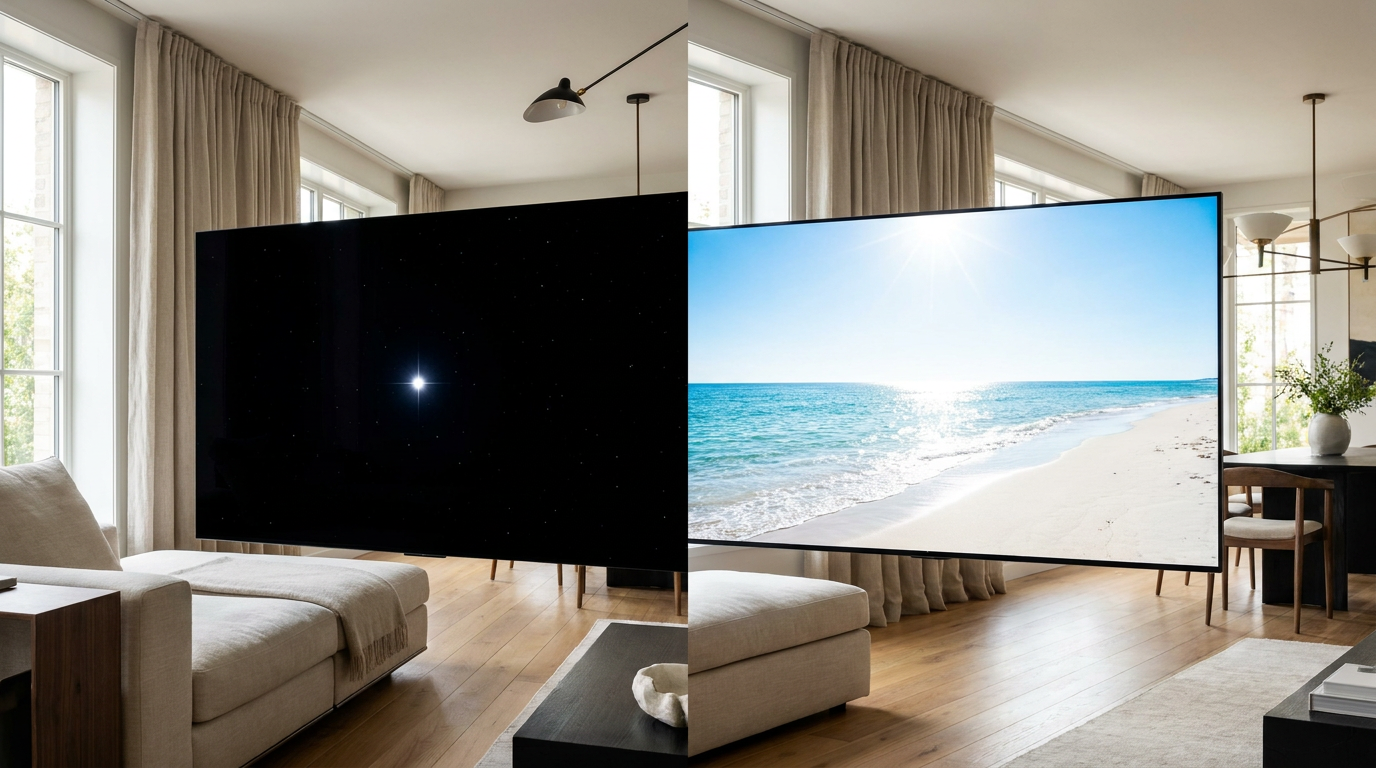
The core structural difference dictates every advantage and flaw. OLED, which stands for Organic Light-Emitting Diode, relies on self-emissive, carbon-based pixels where every single dot generates its own light and color. When an OLED pixel needs to display black, it simply turns off, creating an infinite contrast ratio. Mini-LED, conversely, uses an inorganic Gallium Nitride backlight shining through a liquid crystal layer. In 2026, the industry shifted toward RGB Mini-LED, removing the traditional color filter and using thousands of microscopic red, green, and blue diodes. These are grouped into local dimming zones—often exceeding 20,000 on flagship models—that independently dim or brighten based on the scene.[1][4][5]
When evaluating Mini-LED for bright-room performance, the argument for the technology is its absolute, sustained luminance. Modern living rooms with massive windows or harsh overhead lighting demand a screen that can punch through the glare. The evidence shows that 2026 flagship Mini-LEDs easily sustain 2,000 to 5,000 nits of peak brightness, rendering specular highlights—like the glint of sun on a car windshield—with retina-searing realism. Because the diodes are inorganic and distributed evenly, they can hold a full-field white screen indefinitely without overheating or dimming.[1][3][4]

The argument against Mini-LED in this category is the persistent, albeit minimized, issue of blooming. Even with 20,000 dimming zones, a 4K television contains over 8.2 million pixels. This means a single dimming zone still controls hundreds of pixels. The evidence of this limitation appears when a bright white object, like a cursor or a subtitle, moves across a pitch-black background. A faint halo of light can bleed into the surrounding dark space, a phenomenon that becomes slightly more visible when viewing the television from an off-center angle.[4][5]
Conversely, when evaluating OLED for cinematic dark-room viewing, the argument for the technology is its flawless micro-contrast. Because light is controlled at the individual pixel level, there is zero blooming, zero light bleed, and absolute black depth. The evidence is undeniable in high-contrast sci-fi films or moody thrillers, where a single star can shine brilliantly next to the inky black void of space without washing out the surrounding pixels. For home theater purists who watch movies with the lights off, OLED remains the undisputed reference standard.[1][2][6]
The argument against OLED is its reliance on the Auto Brightness Limiter (ABL), a necessary safeguard that compromises bright-room performance. Because organic compounds degrade when exposed to excessive heat, the television's processor aggressively dims the entire screen if a bright, static image is displayed for too long. The evidence is most obvious during winter sports broadcasts or when watching a hockey game; the expansive white ice will cause the OLED panel to visibly step down its brightness to protect itself, resulting in a dimmer, flatter image compared to a Mini-LED.[2][4][5]
The argument against OLED is its reliance on the Auto Brightness Limiter (ABL), a necessary safeguard that compromises bright-room performance.
For competitive gamers, the trade-off analysis shifts entirely to motion clarity versus hardware longevity. The argument for OLED is its near-instantaneous response time. Because organic pixels change state almost immediately, OLED panels boast response times of roughly 0.03 milliseconds. The evidence shows that this translates to zero ghosting and zero motion blur during fast-paced esports, providing a tangible competitive advantage in tracking fast-moving targets without any visual smearing.[4][6]
However, the argument against OLED for heavy gaming and PC productivity is the lingering risk of differential aging, commonly known as burn-in. While 2026 advancements like Deuterium stabilization and MLA 3.0 have drastically slowed organic wear, the chemical limits remain. The evidence indicates that after 10,000 hours of heavy use, static elements like gaming heads-up displays (HUDs) or PC taskbars can still leave permanent ghost images on an OLED panel.[2][3][4]

This brings up the argument for Mini-LED as the ultimate heavy-duty workhorse. Because it relies on robust, inorganic semiconductors, it is virtually immune to burn-in. The evidence from long-term testing shows that Mini-LED backlights deliver exceptional stability, with under three percent brightness drift even after 10,000 hours of continuous, static light-mode productivity workloads. For users who leave news channels running all day or use their screen as a massive PC monitor, Mini-LED offers total peace of mind.[1][2][3]
Pricing and size scaling also play a critical role in the 2026 decision matrix. Historically, Mini-LED was the budget alternative, but today, a flagship Mini-LED costs exactly as much as a flagship OLED. The evidence of Mini-LED's value emerges at extreme screen sizes. Manufacturing massive sheets of flawless organic material is exponentially expensive, making 97-inch OLEDs prohibitively costly. Mini-LED scales much more efficiently, allowing buyers to secure massive 85-inch to 115-inch panels for a fraction of the cost of an equivalent OLED.[4][6]
Ultimately, neither technology is universally superior; the winner is entirely conditional. OLED fits perfectly when the television is placed in a dedicated, light-controlled home theater or a dimly lit bedroom. It is the definitive choice for cinematic purists who prioritize perfect black levels, accurate skin tones, and flawless off-angle viewing. It also fits well for competitive gamers who demand the absolute lowest response times and zero motion blur, provided they vary their content.[2][5][6]
Conversely, OLED does not fit well when placed in a sun-drenched living room with massive windows, where its Auto Brightness Limiter will constantly throttle the picture. It is also the wrong choice for users who exclusively play a single game with a static HUD for thousands of hours, or for professionals who need a massive monitor for light-mode coding and spreadsheet work.[2][4][5]

Mini-LED fits perfectly when the television serves as the centerpiece of a bright, multi-use family room. It is the undisputed champion for daytime sports viewing, delivering punchy, vibrant highlights that easily overpower ambient glare. It also fits well for PC power users, developers, and casual viewers who want to leave the screen on all day without a second thought about panel degradation.[1][2][4]
However, Mini-LED does not fit well when seating arrangements are wide and horseshoe-shaped, as the liquid crystal layer inherently causes color shift and increased blooming when viewed from extreme side angles. It may also disappoint the most discerning dark-room cinephiles, who might find the slight haloing around subtitles distracting during high-contrast scenes. In 2026, buying a TV is no longer about finding the best screen—it is about finding the screen that best matches your environment.[1][4][5]
How we got here
2013
The first commercial OLED TVs launch, establishing a new standard for perfect black levels but struggling with low brightness.
2019
Mini-LED technology enters the consumer market, offering a brighter alternative to OLED with improved local dimming.
2024
OLED manufacturers introduce Micro Lens Array (MLA) and QD-OLED tech to push peak brightness past the 1,000-nit barrier.
2026
RGB Mini-LED and Tandem OLED panels reach the mainstream, eliminating traditional compromises and creating a true dual-flagship market.
Viewpoints in depth
Cinematic Purists
Home theater enthusiasts who prioritize perfect contrast and dark-room performance.
For this camp, the conversation begins and ends with pixel-level light control. Cinematic purists argue that the infinite contrast ratio of OLED is the only way to experience films as the director intended. They point to the absolute absence of blooming around subtitles and the perfect rendering of starfields in sci-fi movies as evidence that organic panels remain the reference standard. While they acknowledge Mini-LED's brightness, they argue that in a properly light-controlled home theater, anything over 1,000 nits is unnecessary and potentially fatiguing.
Bright-Room Power Users
Viewers in sunlit rooms and PC users who demand sustained brightness and durability.
This perspective prioritizes sheer luminance and panel resilience. Power users argue that a television's primary job is to be visible, and the Auto Brightness Limiter (ABL) on OLEDs fundamentally breaks the viewing experience during daytime sports or bright HDR scenes. They cite the 2,000 to 5,000-nit sustained output of 2026 Mini-LEDs as the definitive solution for modern, window-heavy living rooms. Furthermore, PC users and developers in this camp point to Mini-LED's immunity to burn-in as the deciding factor for static, light-mode workloads.
Competitive Gamers
Esports players and heavy gamers focused on motion clarity and HUD longevity.
Gamers are split between the two technologies based on their specific habits. One faction advocates fiercely for OLED, citing the 0.03ms response time as a tangible competitive advantage that eliminates motion blur during fast-paced shooters. However, the opposing faction within this camp argues that the heavy use of static Heads-Up Displays (HUDs) over thousands of hours makes OLED a liability. They present evidence of cumulative burn-in risk, arguing that Mini-LED's 1ms response time is a negligible trade-off for the peace of mind that comes with an inorganic panel.
What we don't know
- Whether Micro-LED technology will become affordable enough to replace both OLED and Mini-LED before the end of the decade.
- Exactly how long the new Deuterium-stabilized Tandem OLED panels will last before showing any signs of degradation in real-world, non-laboratory conditions.
Key terms
- Tandem OLED
- A panel design that stacks multiple organic light-emitting layers to increase brightness and lifespan.
- MLA 3.0 (Micro Lens Array)
- A microscopic lens layer applied to OLED panels to focus light outward, increasing perceived brightness without driving the pixels harder.
- Local Dimming Zones
- Specific areas of a Mini-LED backlight that can independently dim or turn off to create deeper blacks.
- Auto Brightness Limiter (ABL)
- A software safeguard in OLED TVs that dims the entire screen during prolonged bright scenes to prevent overheating.
- Blooming
- A visual artifact on Mini-LED TVs where light bleeds from a bright object into the surrounding dark areas.
Frequently asked
Does OLED still suffer from burn-in in 2026?
While significantly reduced by MLA 3.0 and Tandem technology, cumulative burn-in risk still exists after 10,000 hours of static content like gaming HUDs or PC taskbars.
What is RGB Mini-LED?
A 2026 advancement that replaces the traditional white backlight and color filter with individual red, green, and blue microscopic LEDs, boosting color purity and efficiency.
Why does my OLED dim during bright scenes?
OLEDs use an Auto Brightness Limiter (ABL) to prevent the organic pixels from overheating during sustained bright scenes, such as watching a hockey game.
Is Mini-LED better for a bright living room?
Yes. Mini-LED can sustain high full-screen brightness indefinitely, easily punching through window glare without dimming.
Sources
Source coverage
6 outlets
3 viewpoints surfaced






[1]PCWorldBright-Room Power Users
It's time to look beyond OLED to Mini-LED
Read on PCWorld →[2]KTC BlogsBright-Room Power Users
Tandem OLED vs. Mini-LED: Choosing the Best HDR Panel in 2026
Read on KTC Blogs →[3]BGRCompetitive Gamers
Here's How Long You Can Expect Your Mini LED TV To Last
Read on BGR →[4]Display MasterCompetitive Gamers
The 2026 Display Dilemma: Which Tech Reigns Supreme?
Read on Display Master →[5]RTINGSCinematic Purists
Best TVs 2026: OLED vs Mini-LED
Read on RTINGS →[6]What Hi-Fi?Cinematic Purists
Best TVs 2026: Flagship OLED and RGB Mini LED compared
Read on What Hi-Fi? →

More in shopping
See all 25 stories →Home Appliances
Heat Pump Dryers: The 2026 Buying Guide and Explainer
0 sources
Display Tech
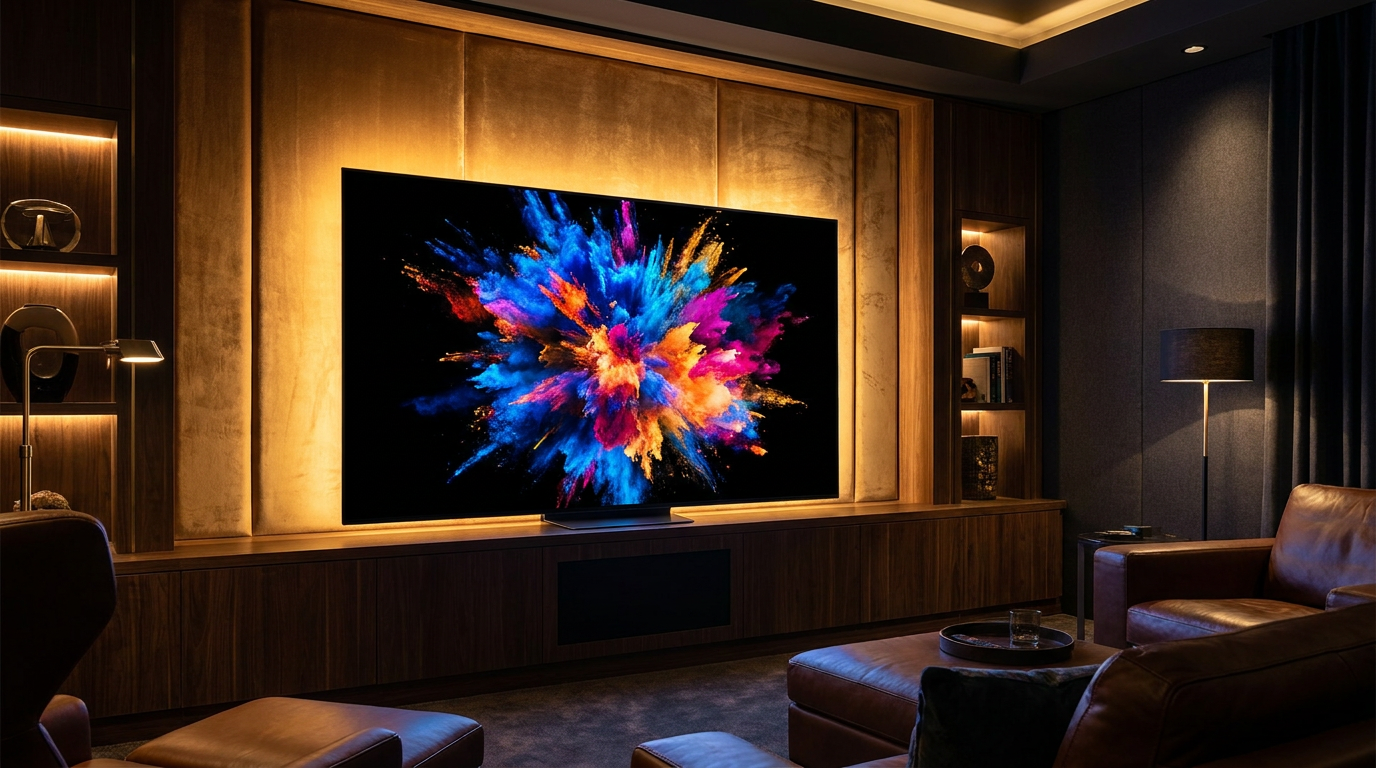
OLED vs. Mini-LED in 2026: The Ultimate Home Theater Trade-Off Analysis
0 sources
TV Tech
OLED vs. Mini-LED: Choosing the Right Premium TV in 2026
0 sources
Home Electrification
The 2026 Guide to Buying a Heat Pump: Ratings, Rebates, and Avoiding Costly Mistakes
0 sources
Every angle. Every day.
Get shopping stories with full source coverage and perspective breakdowns delivered to your inbox.