
OLED vs. Mini-LED in 2026: How to Choose the Right TV Panel Technology
As 2026 display technologies push both OLED and Mini-LED to new performance heights, the choice between perfect contrast and sustained brightness comes down to room lighting and viewing habits.
By Factlen Editorial Team
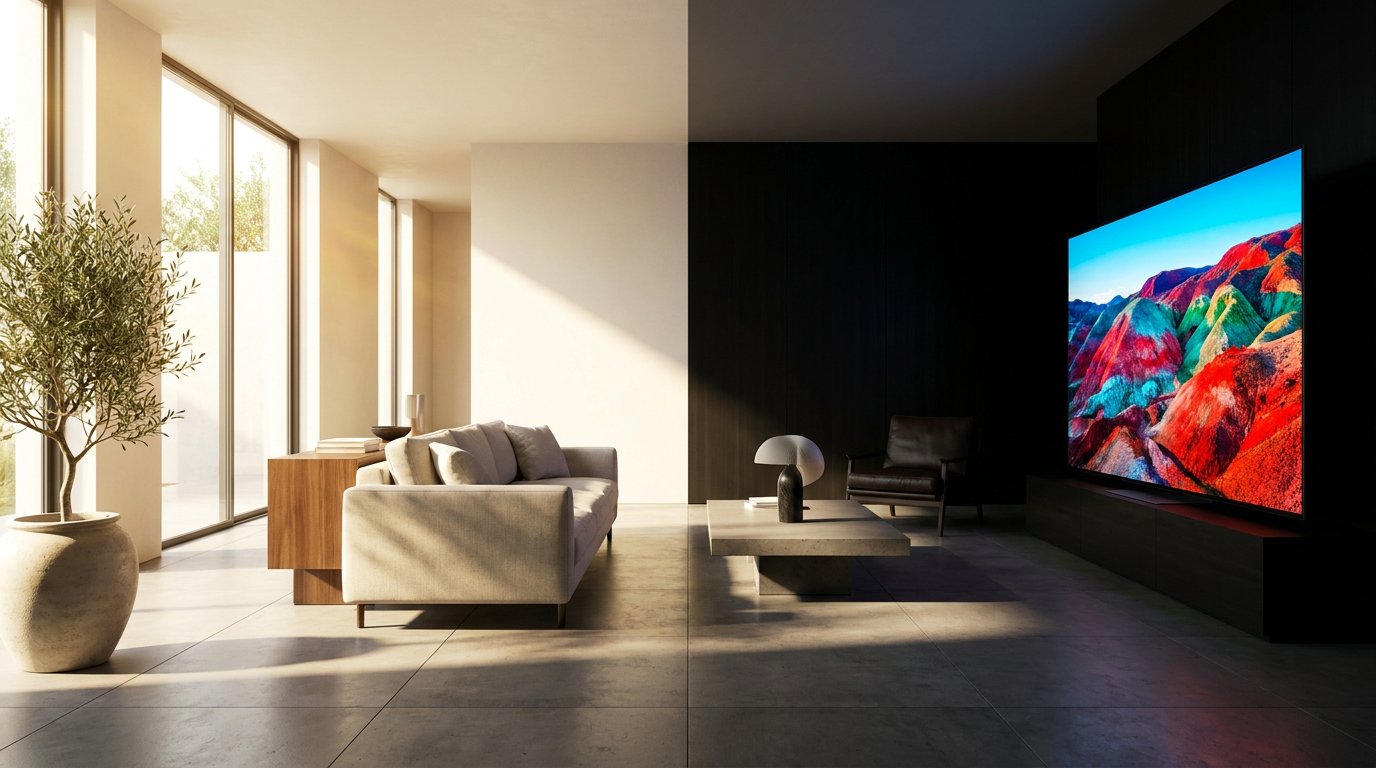
- Cinematic Purists
- Advocates for prioritizing perfect black levels and infinite contrast above all else.
- High-Luminance Enthusiasts
- Advocates for maximizing sustained brightness and eliminating burn-in anxiety.
- Value and Scale Buyers
- Advocates for maximizing screen real estate per dollar spent.
What's not represented
- · Budget-constrained buyers looking at standard LED
- · Projector enthusiasts for 100+ inch screens
Why this matters
A premium TV is a multi-year investment. Understanding the exact trade-offs between 2026's Tandem OLEDs and 5,000-zone Mini-LEDs ensures buyers match their screen to their specific room lighting and viewing habits, avoiding costly buyer's remorse.
Key points
- 2026 OLEDs feature Tandem and QD-OLED technology, reaching 2,000 nits peak brightness while maintaining perfect pixel-level contrast.
- Modern Mini-LEDs utilize up to 5,000 dimming zones to drastically reduce blooming and can sustain full-screen brightness over 1,000 nits.
- OLED remains the definitive choice for dark-room home theaters, cinephiles, and competitive gamers seeking instant response times.
- Mini-LED is the optimal solution for sun-drenched living rooms, static PC productivity, and buyers wanting massive 85-inch screens on a budget.
The 2026 television market represents a golden age for buyers, as the gap between the two dominant premium display technologies has narrowed significantly. For years, the choice was simple: buy OLED for dark rooms and Mini-LED for bright ones. However, 2026 has introduced Tandem OLEDs that push past 2,000 nits of peak brightness, while Mini-LEDs now feature upwards of 5,000 local dimming zones to virtually eliminate light bleed. Deciding between them now requires a nuanced, side-by-side trade-off analysis based on specific use cases.[1][3]
The foundational difference between the two technologies dictates their respective strengths. OLED, or Organic Light-Emitting Diode, is a self-emissive technology where every single pixel produces its own light and color. Mini-LED, conversely, relies on a traditional LCD panel illuminated by thousands of microscopic LED backlights grouped into dimming zones. This architectural divide is the root of every trade-off a buyer must weigh.[1][2]
When evaluating peak and sustained brightness, the argument for Mini-LED is overwhelming luminance. Modern Mini-LED panels can output between 2,500 and 3,600 nits, allowing them to overpower direct sunlight in a bright living room. The argument against OLED in this category is the Auto Brightness Limiter (ABL). While 2026 Tandem OLEDs can hit 2,000 nits in small highlights, the ABL aggressively dims the screen during full-field bright scenes to prevent overheating. The evidence is clear in sustained brightness tests, where Mini-LEDs comfortably hold 1,000 nits across the entire screen, a feat OLED simply cannot replicate.[3][4]

Conversely, when analyzing contrast and shadow detail, the argument for OLED remains undefeated. The ability to turn individual pixels completely off results in an infinite contrast ratio and perfect, inky blacks. The argument against Mini-LED is the persistent halo effect, or blooming. Even with 5,000 dimming zones, a bright object on a dark background will cause some light to bleed into the surrounding zones. Evidence from side-by-side cinematic testing confirms that while 2026 Mini-LEDs have minimized this issue, OLED still provides a superior, three-dimensional depth in dark-room viewing.[1][5]
The longevity and durability debate centers entirely on static content. The argument for Mini-LED is absolute peace of mind; the inorganic backlights are immune to permanent image retention. The argument against OLED is the looming threat of burn-in. If a user watches the same news channel with a static ticker for hours a day, the organic compounds in those specific pixels will degrade faster than the rest of the screen. Evidence from 10,000-hour stress tests shows that while 2026 advancements have drastically reduced burn-in risk for varied content, OLED remains vulnerable under heavy, static workloads.[4][6]
The longevity and durability debate centers entirely on static content.
Color volume and viewing angles introduce another layer of trade-offs. The argument for OLED, particularly QD-OLED models, is flawless color accuracy and wide viewing angles that do not degrade when sitting off-center. The argument against Mini-LED is that many models use VA (Vertical Alignment) panels, which suffer from color washout and reduced contrast when viewed from the side. Evidence from display analysts indicates that while Mini-LEDs use quantum dots for massive color volume at high brightness, OLED ensures that every seat in a wide living room gets the exact same picture quality.[1][2]

For gaming performance, both technologies offer exceptional 4K 144Hz capabilities, but they cater to different priorities. The argument for OLED is near-instantaneous pixel response times, resulting in zero motion blur during fast-paced competitive games. The argument against Mini-LED in gaming is slight ghosting or smearing during rapid camera movements. However, the evidence shows that Mini-LEDs deliver a much punchier HDR experience in bright, vibrant game worlds, making the choice dependent on whether a player values motion clarity or blinding HDR highlights.[1][4]
Pricing and screen size availability heavily favor the backlit technology. The argument for Mini-LED is sheer scale per dollar; buyers can secure an 85-inch or even 100-inch Mini-LED for the same price as a 65-inch or 77-inch premium OLED. The argument against OLED is the exponential cost increase at massive sizes, with 97-inch models remaining prohibitively expensive for most consumers. Evidence from 2026 retail pricing confirms that Mini-LED is the undisputed champion for buyers wanting a massive home theater screen on a realistic budget.[2][3]
Ultimately, there is no single winner without conditions. OLED fits well when the primary viewing environment is a light-controlled or dark room. It is the definitive choice for home theater purists, cinephiles, and competitive gamers who demand perfect black levels, infinite contrast, and instant response times. It also fits well when seating arrangements are wide, ensuring no one suffers from a degraded off-angle picture.[1][5]
However, OLED does not fit when the television is placed in a sun-drenched room with many windows. It is also a poor fit for users who leave the TV on background news channels all day, or for PC users who require a monitor for eight-hour shifts of static productivity software, due to the lingering risk of burn-in and the aggressive dimming of full-white screens.[4][6]

Mini-LED fits well when the television acts as the centerpiece of a bright, open-concept living room. It is the optimal choice for daytime sports viewing, massive 85-inch-plus installations, and users who want absolute peace of mind regarding panel longevity. It also fits well for hybrid users who mix PC productivity with HDR gaming, as the sustained full-screen brightness makes text and bright interfaces pop without triggering dimming algorithms.[2][3]
Conversely, Mini-LED does not fit when the user is highly sensitive to blooming or haloing around subtitles in dark scenes. It is not the best fit for dedicated, pitch-black home theater rooms where its extreme brightness can cause eye strain, nor is it ideal for wide, wrap-around seating arrangements where a VA panel's viewing angles will compromise the experience for those on the edges.[1][4]
How we got here
2013
The first consumer OLED TVs hit the market, establishing a new benchmark for perfect black levels and contrast.
2021
Mini-LED technology enters the mainstream, offering a high-brightness alternative to traditional LCDs.
2023
Micro Lens Array (MLA) and Quantum Dot (QD-OLED) technologies launch, significantly boosting OLED peak brightness.
2026
Tandem OLEDs and 5,000-zone Mini-LEDs narrow the performance gap, making the choice highly dependent on specific room conditions.
Viewpoints in depth
Home Theater Purists
Advocates for prioritizing perfect black levels and infinite contrast above all else.
For cinephiles and home theater enthusiasts, the conversation begins and ends with contrast. This camp argues that the ability to turn a pixel completely off creates a three-dimensional depth that no backlit technology can replicate. They point to the fact that in a light-controlled room, OLED's lower full-screen brightness is actually an advantage, preventing eye strain during bright flashes, while its perfect shadow detail ensures nothing is lost in dark, moody films.
Bright-Room and Hybrid Users
Advocates for maximizing sustained brightness and eliminating burn-in anxiety.
Users with sun-drenched living rooms or those who use their screens for a mix of PC productivity and gaming argue that Mini-LED is the more practical choice. This camp emphasizes that OLED's Auto Brightness Limiter (ABL) makes daytime viewing frustrating, as the screen dims to protect itself. By championing Mini-LED, they prioritize a punchy, vibrant image that cuts through ambient glare, alongside the peace of mind that comes from knowing static UI elements will never cause permanent panel damage.
Value and Scale Buyers
Advocates for maximizing screen real estate per dollar spent.
This perspective focuses on the immersive impact of sheer size. Proponents argue that the slight blooming seen on a Mini-LED is a worthwhile trade-off if it means affording an 85-inch or 98-inch display on a standard budget. They note that while OLED picture quality is technically superior, the exponential cost of manufacturing massive organic panels makes Mini-LED the undisputed champion for buyers wanting a true cinematic scale in their living rooms.
What we don't know
- How the new dual-stack Tandem OLED panels will degrade over a 10-year lifespan compared to traditional single-stack designs.
- Whether future Micro-LED technology will eventually become affordable enough to replace both OLED and Mini-LED entirely.
Key terms
- OLED (Organic Light-Emitting Diode)
- A display technology where each individual pixel generates its own light and color, allowing for perfect black levels.
- Mini-LED
- An LCD display that uses thousands of microscopic LEDs grouped into zones to provide highly controlled backlighting.
- Auto Brightness Limiter (ABL)
- A safety feature in OLED TVs that automatically dims the screen when a large portion of the image is bright white, preventing overheating and burn-in.
- Blooming (Halo Effect)
- A visual artifact on backlit TVs where light bleeds from a bright object into the surrounding dark areas of the screen.
- Local Dimming Zones
- Specific clusters of backlights on a Mini-LED TV that can dim or turn off independently to improve contrast in dark scenes.
Frequently asked
Will an OLED TV get burn-in?
While 2026 advancements like Micro Lens Array (MLA) and pixel-shifting have drastically reduced the risk, OLEDs can still suffer burn-in if exposed to the same static image (like a news ticker or PC taskbar) for thousands of hours.
Is Mini-LED bright enough for a sunny room?
Yes. Mini-LED is currently the best technology for bright rooms, with 2026 models capable of sustaining over 1,000 nits across the entire screen to easily overpower direct sunlight.
Which TV is better for PS5 or Xbox gaming?
Both are excellent, but they serve different needs. OLED offers near-instant response times for blur-free competitive gaming, while Mini-LED provides punchier HDR highlights and zero risk of HUD burn-in for long sessions.
Why are large OLED TVs so expensive?
Manufacturing flawless organic panels at sizes above 77 inches remains highly complex and yields fewer usable screens per production run, keeping prices significantly higher than similarly sized Mini-LEDs.
Sources
Source coverage
6 outlets
3 viewpoints surfaced






[1]RTINGSCinematic Purists
OLED vs LED vs Mini LED: Which TV is better?
Read on RTINGS →[2]What Hi-Fi?Value and Scale Buyers
Mini LED vs OLED: which is the best TV technology?
Read on What Hi-Fi? →[3]Data Wire SolutionsValue and Scale Buyers
Best TVs for 2026: 10 OLED and Mini-LED Picks by Room, Brightness, and Install Reality
Read on Data Wire Solutions →[4]KTC PlayHigh-Luminance Enthusiasts
Tandem OLED vs. Mini-LED: Choosing the Best HDR Panel in 2026
Read on KTC Play →[5]PCWorldCinematic Purists
OLED vs. Mini-LED: The next wave of premium displays
Read on PCWorld →[6]EcoPicksGoHigh-Luminance Enthusiasts
LG G5 OLED vs LG QNED9M Mini LED Comparison (2026 Buyer's Guide)
Read on EcoPicksGo →

More in shopping
See all 24 stories →Home Appliances
Heat Pump Dryers: The 2026 Buying Guide and Explainer
0 sources
Display Tech
OLED vs. Mini-LED in 2026: The Ultimate Home Theater Trade-Off Analysis
0 sources
TV Tech
OLED vs. Mini-LED: Choosing the Right Premium TV in 2026
0 sources
Home Electrification
The 2026 Guide to Buying a Heat Pump: Ratings, Rebates, and Avoiding Costly Mistakes
0 sources
Every angle. Every day.
Get shopping stories with full source coverage and perspective breakdowns delivered to your inbox.