
How NCAA Gymnastics and NIL Transformed the Lifespan of an Elite Gymnast
The average age of an Olympic gymnast has climbed to its highest point in 60 years, driven by a collegiate financial revolution that allows athletes to extend their careers without sacrificing their earning potential.
By Factlen Editorial Team
- Collegiate Athletes & Coaches
- Argue that the NCAA provides a healthier, more sustainable environment that extends careers and protects physical and mental well-being.
- Sports Economists
- Focus on the financial revolution brought by NIL, noting that female gymnasts are among the highest earners in college sports.
- Elite Traditionalists
- Value the extreme difficulty incentivized by the international Code of Points and worry that collegiate scoring inflation dilutes the sport's standards.
What's not represented
- · International gymnastics federations losing talent to the U.S. collegiate system
- · Lower-level collegiate programs struggling to compete with NIL powerhouses
Why this matters
For decades, female gymnasts were forced to peak as teenagers, often retiring with broken bodies before they could legally vote. The new collegiate financial model has fundamentally rewritten the biological and economic clock of the sport, creating healthier, wealthier, and longer-lasting athletes.
Key points
- The average age of Olympic women's gymnastics medalists reached 22.7 in 2024, the highest in 60 years.
- NIL policies allow gymnasts to earn endorsement money while maintaining their collegiate eligibility.
- NCAA scoring caps difficulty at a 10.0, prioritizing execution and protecting athletes from extreme physical wear.
- The collegiate system provides a supportive, team-oriented environment that combats the isolation of elite clubs.
- The influx of elite talent into the NCAA has sparked debates over score inflation and the proliferation of perfect 10s.
The image of the elite gymnast as a fragile, fleeting teenager is officially obsolete. For decades, the sport operated on a brutal biological and economic clock: athletes were expected to peak at 16, win their medals, and retire before their bodies broke down. In 1992, the average age of an Olympic medalist in women's gymnastics plummeted to an all-time low of 16.6 years old. But a quiet revolution has rewritten the rules of human flight. By the 2024 Paris Games, the average age of the podium finishers had surged to 22.7, the highest mark in 60 years.[1]
The United States women's team that took the floor in Paris averaged 22.4 years old, making it the oldest American squad since the Helsinki Games in 1952. This demographic shift is not merely a biological anomaly; it is the direct result of a massive structural change in how the sport is funded and how athletes are allowed to train. The catalyst for this longevity boom was the dismantling of an ultimatum that had haunted American gymnasts for generations.[2]

Historically, top-tier gymnasts faced a devastating financial choice. If they won Olympic gold and wanted to capitalize on their fleeting fame through endorsements or professional tours, they had to forfeit their amateur status. Doing so meant permanently surrendering their eligibility to compete in the NCAA and losing out on a full collegiate athletic scholarship. Conversely, athletes who wanted to experience college gymnastics had to turn down millions of dollars in their prime earning years. Every American Olympic all-around champion from 2004 to 2016 was forced to exchange their college eligibility for the ability to make a living.[3]
That paradigm shattered in July 2021 when the NCAA adopted its interim Name, Image, and Likeness (NIL) policy. Overnight, the firewall between professional endorsements and collegiate eligibility vanished. Gymnasts could suddenly sign lucrative brand deals, monetize their massive social media followings, and still compete for their universities. This regulatory shift transformed NCAA gymnastics from a post-elite retirement home into a highly profitable, sustainable middle chapter of an athlete's career.[3][6]
The financial incentives of NIL kept athletes in the sport longer, but it is the physical environment of NCAA gymnastics that actually allows their bodies to survive. Elite international gymnastics, governed by the International Gymnastics Federation (FIG), uses an open-ended "Code of Points." In this system, there is no maximum score; athletes are rewarded for packing their routines with the most dangerous, boundary-pushing skills imaginable. The relentless pursuit of a higher Difficulty Score (D-Score) takes a catastrophic toll on joints and ligaments.[5][6]
The financial incentives of NIL kept athletes in the sport longer, but it is the physical environment of NCAA gymnastics that actually allows their bodies to survive.
Collegiate gymnastics operates in a completely different biomechanical universe. The NCAA still utilizes a modified version of the traditional 10.0 scoring system. Because the maximum Start Value is capped at 10.0, there is no mathematical incentive to perform a death-defying, body-breaking skill when a safer, perfectly executed element yields the exact same score. The collegiate format prioritizes flawless execution, consistency, and artistry over sheer, terrifying difficulty.[5]

This scoring difference acts as a physical sanctuary for elite athletes. By dropping down to the NCAA level between Olympic cycles, gymnasts can perform slightly downgraded routines every weekend. This keeps them in peak competitive shape, sharpens their mental resilience in front of massive crowds, and drastically reduces the wear and tear on their bodies. When the Olympic year approaches, they can safely ramp their difficulty back up to elite standards, rather than trying to sustain maximum impact for four uninterrupted years.[6]
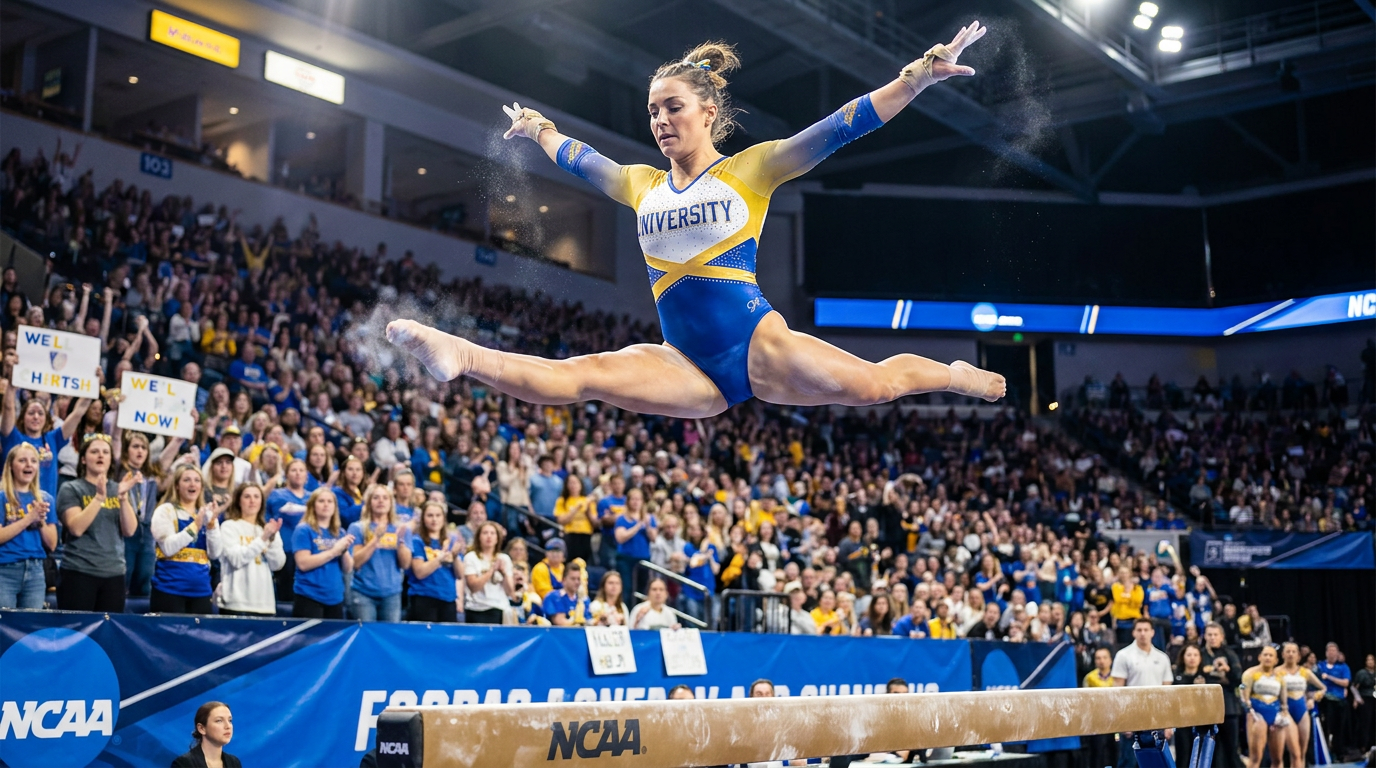
The psychological benefits of the collegiate system are equally transformative. Elite gymnastics has historically been an isolating, high-pressure pursuit, often characterized by grueling hours in private clubs under authoritarian coaching methods. The NCAA introduces a team-first environment where athletes compete for their universities in sold-out arenas, supported by robust athletic departments that provide dedicated sports psychologists, nutritionists, and physical therapists. For many athletes, college gymnastics heals the mental burnout inflicted by their teenage elite years.[3][6]

However, the collision of elite talent and collegiate scoring has created friction. Because the NCAA caps difficulty, the influx of world-class Olympians into college programs has led to a scoring bottleneck. In the 2024 season alone, judges handed out 87 perfect 10s, nearing the all-time highwater mark set in 2004. The proliferation of perfect scores has sparked intense debate within the sport about "overscoring" and whether the NCAA needs to adjust its Code of Points to differentiate between a great college routine and a flawless Olympic-caliber performance.[4]
Some prominent voices in the sport worry that if every routine receives a 9.9 or a 10.0, the audience will lose the ability to appreciate true excellence. A new accountability system for judges has been tested to curb score inflation, resulting in a noticeable downturn in perfect marks during recent seasons. Yet, administrators are cautious about altering a product that is currently enjoying record-breaking television viewership and sold-out arenas.[4][6]
The success of the American model is now reshaping the global landscape. International gymnasts, seeing the financial and physical benefits enjoyed by their U.S. counterparts, are increasingly migrating to the NCAA. Top collegiate programs now regularly recruit national team members from Canada, Great Britain, and beyond, turning American universities into a global training hub for the world's best athletes.[6]
Ultimately, the integration of NIL and NCAA gymnastics has saved the sport from its own attrition rate. By providing a financially viable, physically sustainable, and mentally supportive bridge between Olympic cycles, the system has allowed a generation of women to grow up within their sport. Gymnastics is no longer a sprint that ends at high school graduation; it is a marathon where athletes can finally reap the rewards of their lifelong dedication well into their twenties.[1][3][6]
How we got here
1992
The average age of Olympic medalists in women's gymnastics drops to an all-time low of 16.6 years old.
1997
The International Gymnastics Federation raises the minimum age for Olympic eligibility to 16 to protect young athletes.
2006
The 'Perfect 10' is abolished in elite international competition in favor of the open-ended Code of Points.
July 2021
The NCAA adopts its interim NIL policy, allowing gymnasts to profit from endorsements while competing in college.
Summer 2024
The U.S. women's Olympic team averages 22.4 years old, becoming the oldest American squad since 1952.
Viewpoints in depth
Collegiate Athletes & Coaches
The NCAA system is viewed as a physical and mental sanctuary that saves athletes from early burnout.
For decades, the elite club system was criticized for treating young athletes as disposable commodities. College coaches and current athletes argue that the NCAA model fundamentally changes this dynamic by introducing a supportive, team-first environment. Because the scoring system caps difficulty, athletes are not pressured to perform body-breaking skills every weekend. Instead, they can focus on execution, consistency, and mental health, utilizing university resources like sports psychologists and physical therapists to heal the trauma often accumulated during their teenage elite years.
Sports Economists
NIL has transformed women's gymnastics into one of the most lucrative collegiate sports.
Financial analysts point out that female gymnasts are uniquely positioned to benefit from the NIL era. Because the sport has a massive, highly engaged television and social media audience, top gymnasts command endorsement deals that rival or exceed those of star college quarterbacks. Economists argue that this financial revolution is the primary driver of athlete longevity; by removing the economic penalty of staying amateur, the NCAA has allowed athletes to monetize their peak popularity while earning a free college education.
Elite Traditionalists
There is growing concern that the NCAA's capped scoring system leads to score inflation and dilutes the sport's standards.
While acknowledging the benefits of longevity, gymnastics purists and international judges worry about the competitive integrity of the collegiate scoring model. Because the NCAA caps routines at a 10.0 Start Value, the influx of world-class Olympians has led to a massive bottleneck of perfect scores. Traditionalists argue that handing out dozens of perfect 10s for routines that would be considered mathematically inferior on the international stage confuses the audience and fails to properly reward the extreme difficulty that pushes the sport forward.
What we don't know
- Whether the NCAA will eventually adopt a modified open-ended scoring system to differentiate Olympic-level talent.
- How the influx of international elite athletes into the NCAA will affect scholarship availability for domestic gymnasts.
Key terms
- NIL (Name, Image, and Likeness)
- The collegiate policy allowing athletes to earn money from brand deals and endorsements without forfeiting their NCAA eligibility.
- Code of Points
- The open-ended scoring system used in elite international gymnastics that separates a routine's difficulty score from its execution score.
- Start Value
- The maximum possible score a gymnast can achieve on a routine before any deductions for execution errors are applied.
- Elite Gymnastics
- The highest competitive level of the sport, governed by the International Gymnastics Federation, which qualifies athletes for the Olympics.
Frequently asked
Why did gymnasts used to retire so young?
Historically, the open-ended scoring system incentivized extreme, body-breaking difficulty that caused severe wear and tear. Additionally, athletes had to forfeit college scholarships if they wanted to earn money professionally, forcing early retirements.
What is the NIL policy?
NIL stands for Name, Image, and Likeness. It is an NCAA policy introduced in 2021 that allows college athletes to earn money from endorsements and sponsorships without losing their amateur status.
How does NCAA scoring differ from the Olympics?
The Olympics use an open-ended Code of Points that rewards unlimited difficulty. The NCAA uses a modified system capped at a 10.0 Start Value, which prioritizes flawless execution and consistency over dangerous skills.
What is the average age of an Olympic gymnast today?
At the 2024 Paris Games, the average age of women's gymnastics medalists was 22.7 years old, the highest mark in 60 years.
Sources
Source coverage
6 outlets
3 viewpoints surfaced





[1]The Washington PostCollegiate Athletes & Coaches
Simone Biles and the Olympians defying age
Read on The Washington Post →[2]USA Gymnastics
Artistic Gymnastics Olympic Team Diversity and Average Ages
Read on USA Gymnastics →With NIL flexibility, elite gymnasts no longer have to choose between college and going pro
Read on The Washington Post →[4]The GuardianElite Traditionalists
Livvy Dunne is worried about the future of women's college gymnastics
Read on The Guardian →[5]NBC OlympicsElite Traditionalists
What is a perfect score in gymnastics?
Read on NBC Olympics →[6]Factlen Editorial TeamSports Economists
Synthesis by Factlen editorial team
Read on Factlen Editorial Team →

More in sports
See all 36 stories →Preview
England's 2026 World Cup Outlook: Inside Thomas Tuchel's High-Stakes Group L Campaign
0 sources

College Baseball
Troy Trojans Complete Historic Cinderella Run to Reach First Men's College World Series
0 sources

MLB Preview
San Diego Padres Look to Snap Road Skid Against Baltimore Orioles in Interleague Clash
0 sources

Grassroots Tech
How 'Drop-In' Sports Apps Are Rewiring Urban Communities and Fighting Loneliness
0 sources

Every angle. Every day.
Get sports stories with full source coverage and perspective breakdowns delivered to your inbox.