
How Bidirectional Charging is Turning EVs into Home Power Plants
A new generation of bidirectional chargers allows electric vehicles to power homes during blackouts and stabilize the grid. Here is how V2H and V2G technology actually works in 2026.
By Factlen Editorial Team
- Consumers
- Primarily interested in V2H for blackout resilience and home energy savings, rather than complex grid-export contracts.
- Grid Operators
- View EVs as a massive distributed battery network essential for balancing renewable energy and preventing blackouts.
- Automakers
- Cautious about battery degradation and warranty claims from constant grid cycling, but eager to sell V2H as a premium feature.
What's not represented
- · Renters and Apartment Dwellers
Why this matters
Electric vehicles are no longer just transportation; they are massive mobile batteries. Bidirectional charging allows owners to eliminate home blackouts, lower their electricity bills, and help stabilize the public power grid.
Key points
- Bidirectional charging allows EVs to send power back to a home (V2H) or the public grid (V2G).
- A standard EV battery holds enough energy to power an average home for three to five days.
- The new ISO 15118-20 protocol is bringing two-way charging to the dominant CCS plug standard.
- Hardware costs remain high, with bidirectional home chargers costing between $4,000 and $7,000 installed.
- Utilities are offering drivers up to $1,200 annually to use their cars as virtual power plants.
- Automakers remain cautious about V2G due to concerns over accelerated battery degradation.
For decades, the relationship between a car and its fuel source has been a one-way street. You fill the tank, you drive, and the energy is gone. But the rapid adoption of electric vehicles has fundamentally altered that dynamic. Because the average car sits parked for 90% to 95% of its life, millions of EVs are currently functioning as massive, idle energy silos sitting in residential driveways.[1]
The sheer scale of the energy stored in a modern EV is staggering when compared to traditional home backup systems. A standard residential battery, such as the Tesla Powerwall 3, holds roughly 13.5 kilowatt-hours (kWh) of electricity. In contrast, a standard commuter EV carries a 60 kWh battery, while larger electric trucks like the Ford F-150 Lightning or Tesla Cybertruck boast packs exceeding 120 kWh. That is enough stored energy to run an average household for three to five days without any lifestyle compromises.[3][6]

Unlocking that dormant capacity requires a technology known as bidirectional charging. Instead of electricity only flowing from the grid into the vehicle, bidirectional systems create a two-way highway, allowing the car to discharge its stored power back out. This capability is rapidly moving from niche pilot programs into mainstream consumer hardware, promising to reshape both home energy resilience and national grid stability.[2][3]
The technology is generally categorized into three distinct acronyms, starting with Vehicle-to-Load (V2L). This is the simplest and most common implementation, requiring no special home infrastructure. V2L simply means the vehicle has built-in 120-volt or 240-volt outlets, allowing owners to plug in camping equipment, power tools, or household appliances directly into the car. It is highly practical for off-grid use, but it does not integrate with a building's electrical panel.[1][5]
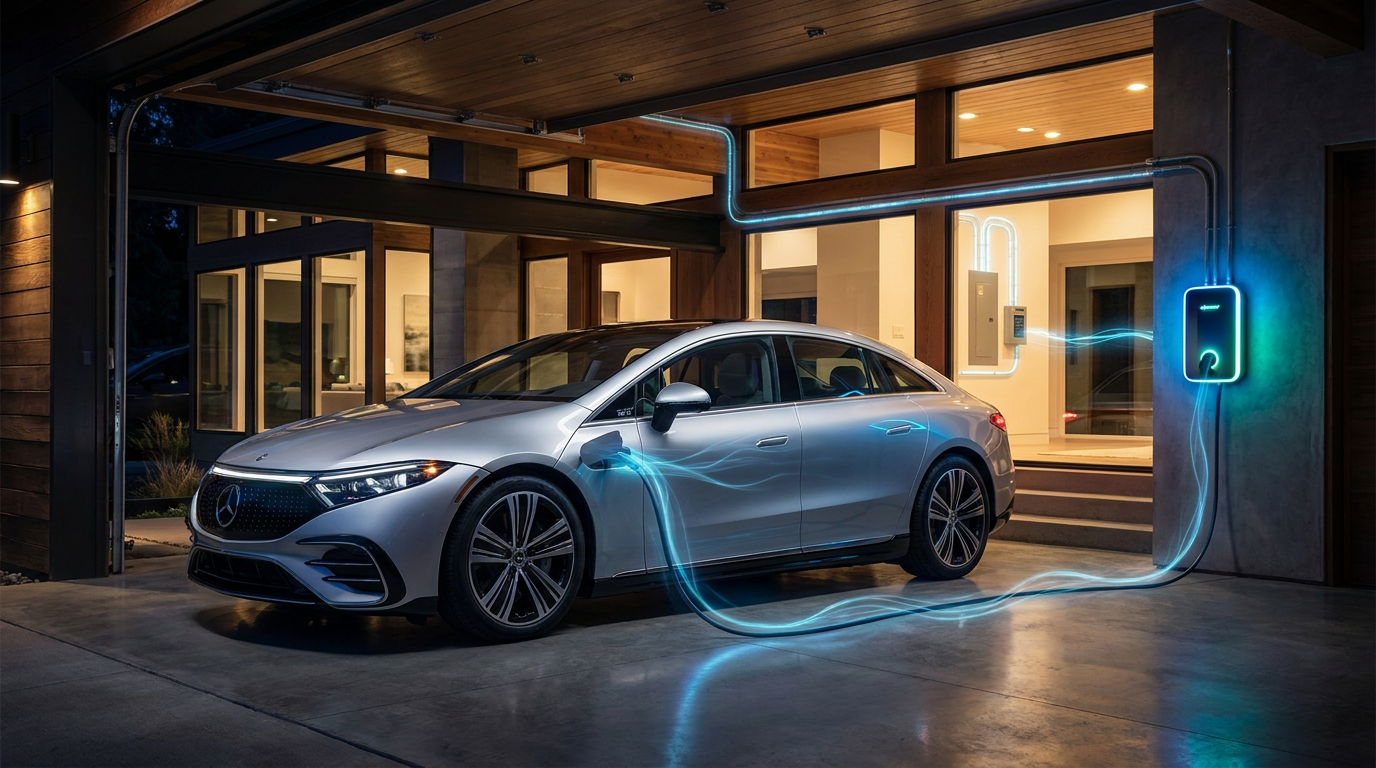
The next step up is Vehicle-to-Home (V2H), which turns the EV into a whole-house backup generator. During a blackout, a V2H system automatically disconnects the house from the dead utility grid—a safety requirement known as islanding—and begins drawing power from the car's battery to keep the lights, refrigerator, and Wi-Fi running. Beyond emergencies, homeowners can use V2H to power their house during expensive peak evening hours, recharging the car later at night when rates plummet.[2][7]
The most ambitious tier is Vehicle-to-Grid (V2G). In this scenario, the EV does not just power the owner's home; it exports surplus energy all the way back into the public electrical grid. Utility companies can tap into thousands of plugged-in EVs simultaneously during a heatwave, using them as a "virtual power plant" to prevent rolling blackouts. In exchange, the vehicle owner is compensated for the energy they provide.[1][2]

While the concept is elegant, the execution is technically complex. EV batteries store energy as Direct Current (DC), but residential homes and the public grid operate on Alternating Current (AC). To push power from the car into the house, the DC power must be inverted into AC. Because most cars lack an onboard inverter large enough to handle whole-home loads, that heavy-duty conversion hardware must be built into the wall charger itself.[3][7]
While the concept is elegant, the execution is technically complex.
This requirement makes bidirectional chargers significantly larger and more expensive than standard home EV chargers. Units like the Wallbox Quasar 2, which is leading the European and UK markets, bypass the car's internal AC charger and communicate directly with the battery. However, the hardware and specialized electrical installation can easily cost between $4,000 and $7,000, representing a steep upfront barrier for early adopters.[7][8]
Another historical bottleneck has been the charging plug itself. For years, the only standard capable of two-way power flow was CHAdeMO, a Japanese connector used primarily by the Nissan Leaf. Because the rest of the automotive industry largely abandoned CHAdeMO in favor of the Combined Charging System (CCS), bidirectional charging remained a niche feature locked to a single aging vehicle model.[2][5]
That bottleneck is finally breaking in 2026. The CCS standard has officially rolled out bidirectional support through a software protocol known as ISO 15118-20. This standard allows the car and the charger to securely negotiate the complex handshake required to reverse power flow, opening the door for the vast majority of modern European and Asian EVs to participate in V2H and V2G ecosystems.[2][5]

Automakers are rapidly updating their fleets to take advantage of the new standard. Vehicles built on Hyundai and Kia's E-GMP platform, such as the Kia EV9 and Hyundai Ioniq 5, are rolling out firmware updates to support full V2H capabilities. Similarly, Volkswagen has partnered with energy providers to enable bidirectional charging across its ID family of vehicles, provided they are paired with compatible DC wallboxes.[7][8]
Tesla, which utilizes its own proprietary connector (now the North American Charging Standard), has taken a slightly different approach. The company introduced its "Powershare" bidirectional technology exclusively on the Cybertruck. The system boasts a massive 11.5 kW of continuous output, allowing the truck to easily run a central air conditioner or heavy machinery during a multi-day outage.[4]
However, integrating these massive mobile batteries with existing home solar and storage systems has proven difficult. Tesla recently notified Cybertruck owners that the highly anticipated feature allowing Powershare to seamlessly sync with existing Tesla Powerwall home batteries has been delayed until mid-2026. The company cited the immense engineering challenge of getting two separate grid-forming devices to negotiate power delivery without relying on an external internet connection.[4]
Beyond hardware delays, the biggest hesitation comes from the automakers' warranty departments. V2G requires "micro-cycling"—constantly discharging and recharging the battery in small increments to balance the grid. Automakers worry this extra wear and tear could accelerate battery degradation, leading to premature warranty claims. As a result, some manufacturers explicitly void the battery warranty if the car is used for V2G grid export, though they generally permit V2H home backup.[1][3]
Despite these hurdles, grid operators view bidirectional charging as an existential necessity. As the world transitions to intermittent renewable energy sources like wind and solar, the grid desperately needs massive amounts of battery storage to smooth out supply and demand. Utilizing the batteries already sitting in consumers' driveways is vastly cheaper and faster than building dedicated utility-scale storage facilities.[2][5]

To incentivize participation, utility companies are launching aggressive pilot programs. In markets like California, the UK, and the Netherlands, energy providers are offering EV owners between $500 and $1,200 annually in bill credits just for the right to tap into their cars during peak demand events. Early participants in Octopus Energy's UK trials have reported earning enough to cover their entire household electricity bill.[1][8]
As hardware costs fall and communication standards unify, bidirectional charging is poised to become a standard feature rather than a luxury add-on. By the end of the decade, the electric vehicle will no longer be viewed simply as a mode of transportation, but as a critical node in a decentralized, resilient global energy network.[1][8]
How we got here
2012
Nissan Leaf launches with CHAdeMO, becoming the first mass-market EV capable of bidirectional charging.
2022
Ford introduces the F-150 Lightning with Intelligent Backup Power, popularizing V2H in North America.
2024
Tesla launches the Cybertruck with Powershare, its first bidirectional vehicle.
2025
The ISO 15118-20 protocol rolls out, bringing two-way charging to the dominant CCS plug standard.
2026
Major utilities launch commercial V2G tariffs, paying drivers to balance the grid.
Viewpoints in depth
The Grid Operator's View
Utilities see bidirectional EVs as the ultimate solution to renewable energy storage.
For utility companies, the transition to wind and solar power presents a massive storage problem: energy is often generated when demand is low and drops off when demand peaks. Grid operators argue that building dedicated, utility-scale battery farms is too slow and expensive. Instead, they view the millions of EVs sitting idle in driveways as a ready-made 'virtual power plant.' By offering financial incentives for V2G access, utilities believe they can eliminate the need for fossil-fuel peaker plants and prevent rolling blackouts during extreme weather events.
The Automaker's View
Car manufacturers are balancing the appeal of home backup features against the risk of premature battery failure.
While automakers are eager to market their vehicles as ultimate off-grid tools, they remain highly cautious about full Vehicle-to-Grid (V2G) integration. Their primary concern is 'micro-cycling'—the constant, shallow discharging and recharging required to balance the public grid. Engineers argue this extra wear could accelerate battery degradation, leading to a surge in expensive warranty replacements. Consequently, many manufacturers are strictly limiting bidirectional capabilities to emergency home backup (V2H), where the battery is only cycled during rare power outages.
The Consumer's View
Drivers prioritize personal energy resilience and cost savings over complex grid-balancing schemes.
For the average EV owner, the appeal of bidirectional charging is deeply personal: keeping the lights on during a storm and lowering the monthly electric bill. Consumer advocates note that while utility companies push for V2G grid export, most drivers are far more interested in Vehicle-to-Home (V2H) setups. The high upfront cost of bidirectional chargers—often exceeding $5,000—means consumers want guaranteed, tangible benefits like blackout protection, rather than relying on fluctuating utility credits that may take years to pay off the hardware investment.
What we don't know
- How quickly bidirectional hardware costs will fall to match standard EV chargers.
- The long-term impact of daily V2G micro-cycling on modern EV battery chemistry.
- Whether automakers will standardize warranty protections for drivers participating in grid-export programs.
Key terms
- Bidirectional Charging
- Technology that allows an electric vehicle to both receive electricity from the grid and send stored electricity back out.
- V2H (Vehicle-to-Home)
- A setup where an electric vehicle acts as a backup battery, supplying power directly to a house during an outage or peak pricing hours.
- V2G (Vehicle-to-Grid)
- A system where an electric vehicle sends its stored energy back into the public electricity grid, often earning the owner money.
- ISO 15118-20
- The international communication standard that allows modern CCS charging plugs to securely negotiate two-way power flow.
- Inverter
- A device that converts the Direct Current (DC) electricity stored in a battery into the Alternating Current (AC) electricity used by home appliances.
Frequently asked
Does bidirectional charging void my EV warranty?
It depends on the manufacturer. Most automakers explicitly cover V2H (home backup) but may have strict limits or void warranties for V2G (grid export) due to the extra wear from micro-cycling.
Can I use my current home EV charger for V2H?
No. Standard home chargers only flow one way. You need a specialized bidirectional DC charger that contains an inverter to convert the car's DC power to AC for your home.
Which cars support bidirectional charging in 2026?
Models include the Nissan Leaf, Ford F-150 Lightning, Tesla Cybertruck, Kia EV9, Hyundai Ioniq 5, and select VW ID models, though capabilities vary by region.
What happens if the grid goes down while I'm plugged in?
With a proper V2H setup and an automatic transfer switch, your home will instantly disconnect from the dead grid and draw power from your car, keeping your lights on.
Sources
Source coverage
8 outlets
3 viewpoints surfaced








[1]Energy Solutions IntelligenceGrid Operators
Bidirectional EV Charging 2026: Which Cars Can Power Your Home and the Grid?
Read on Energy Solutions Intelligence →[2]Octopus ElectroverseConsumers
Vehicle-to-grid, V2H & bidirectional charging: the complete UK guide
Read on Octopus Electroverse →[3]EnergySageConsumers
Bidirectional EV Chargers: Your EV Could be the Ultimate Home Backup Battery
Read on EnergySage →[4]TeslaAutomakers
Powershare - Vehicle to Home/Grid Charging
Read on Tesla →[5]Solar Data AtlasGrid Operators
Vehicle-to-Grid (V2G) — The Future of Mobile Storage
Read on Solar Data Atlas →[6]Apex MechanicalConsumers
Could Your EV Battery Be the Ultimate Home Power Upgrade?
Read on Apex Mechanical →[7]AMP RenewablesConsumers
V2H and V2G in 2026: Using Your EV as a Home Battery
Read on AMP Renewables →[8]TeslaChargerConsumers
V2G and Vehicle-to-Home Charging UK 2026: What's Real
Read on TeslaCharger →

More in automotive
See all 13 stories →Battery Tech
Solid-State Batteries Hit the Road: How the Next Generation of EVs Actually Works
0 sources
EV Market
2026 Rivian R2 vs. Tesla Model Y: Choosing the Right Midsize Electric SUV
0 sources
Motorcycle Tech
How Radar and AI Are Making Motorcycles Safer Than Ever
0 sources

Battery Tech
How Solid-State Batteries Are Rewriting the Rules of Electric Vehicles
0 sources

Every angle. Every day.
Get automotive stories with full source coverage and perspective breakdowns delivered to your inbox.