
Google Researchers Propose 'Faithful Uncertainty' to Solve AI Hallucinations
A new paper suggests that training AI models to honestly express their internal doubt—rather than forcing them to be all-knowing—is the key to building trustworthy autonomous agents.
By Factlen Editorial Team
- AI Researchers
- Focuses on the technical challenge of separating a model's knowledge boundary from its awareness of that boundary.
- Enterprise Developers
- Views faithful uncertainty as a necessary control layer for safely deploying autonomous agents.
- Trust Advocates
- Argues that user trust is built on honest communication of limits, not on the illusion of omniscience.
What's not represented
- · Hardware Providers
- · Regulatory Bodies
Why this matters
As AI agents take over complex tasks in enterprise and cloud environments, their ability to know when they are guessing is critical to preventing catastrophic errors. This breakthrough offers a realistic path to AI systems that users can actually trust.
Key points
- Google researchers propose 'faithful uncertainty' to address the persistent problem of AI hallucinations.
- The approach aligns a model's internal statistical confidence with its spoken linguistic output.
- Strict anti-hallucination filters currently impose a 'utility tax,' discarding up to 52% of valid answers.
- Metacognition acts as a critical control layer for autonomous agents deciding when to use external tools.
- Recent studies show models can be fine-tuned to express doubt without losing their underlying accuracy.
The hallucination problem in generative artificial intelligence is well-documented and stubbornly persistent. Despite massive scaling efforts and billions of dollars poured into training runs, frontier large language models still confidently invent facts when pushed past their knowledge boundaries.[1][2]
For enterprise cloud deployments and autonomous systems, this represents a critical roadblock. A conversational chatbot making up a historical date is a minor annoyance, but an autonomous agent hallucinating an API call or a database deletion is a catastrophic failure.[1][5]
The standard industry fix has been to force models to abstain. If an AI is not perfectly sure of an answer, developers tune it to refuse the prompt entirely. However, this introduces a massive "utility tax"—eliminating errors often means suppressing perfectly valid, helpful answers, sometimes discarding up to 52 percent of correct responses in strict benchmarks.[1][2]
Now, a team of Google researchers has proposed a paradigm shift to break this deadlock. In a new position paper, they argue that the path to trustworthy AI does not run through omniscience, but rather through self-awareness.[1][2]

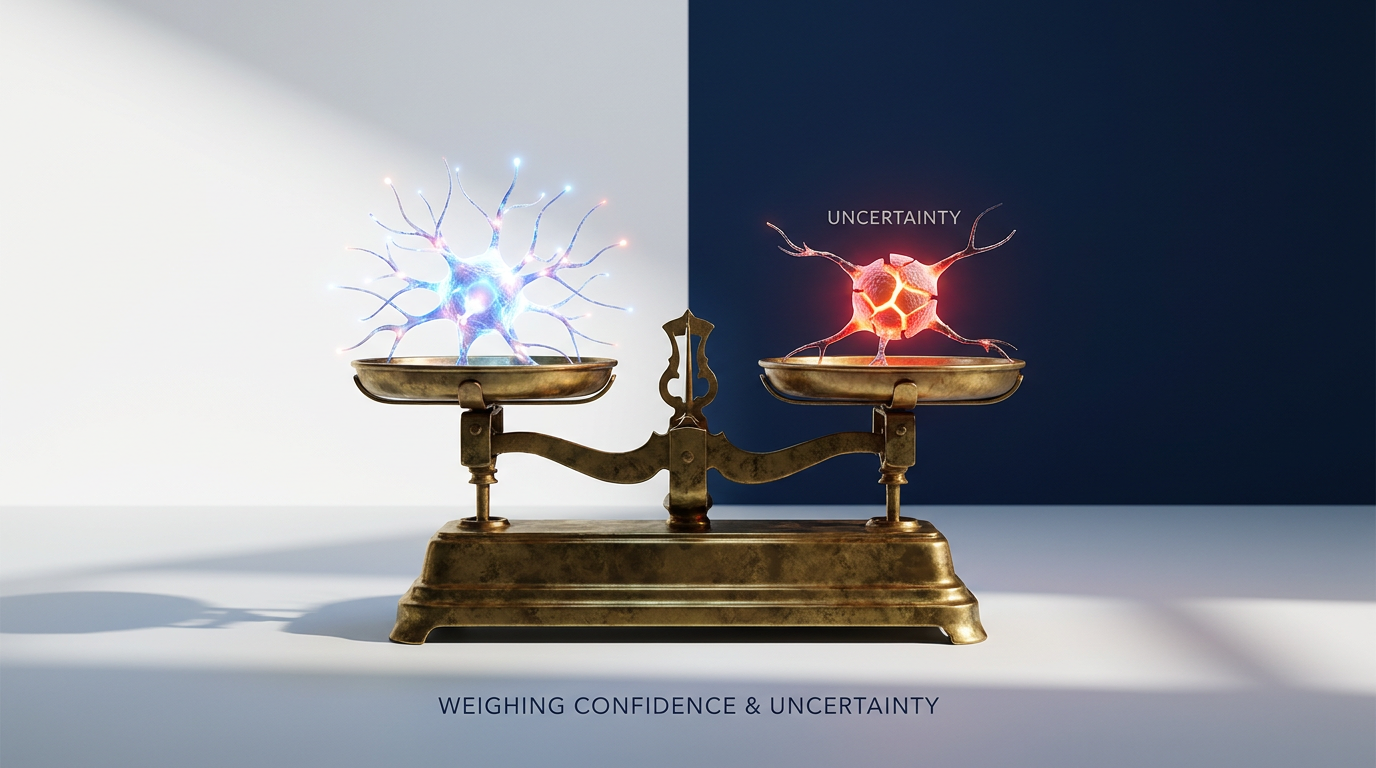
The researchers introduce the concept of "faithful uncertainty." Instead of relying on the rigid "answer-or-abstain" binary, models should be trained to align their linguistic output with their internal statistical confidence.[1][2]
If a model is only 60 percent confident in a fact, it should not state it as absolute truth, nor should it refuse to answer. Instead, it should offer a hedged hypothesis, explicitly stating something like, "My best guess is X, but I am not entirely certain."[1][3]
This concept relies heavily on metacognition—the AI's ability to be aware of its own uncertainty and act upon it. Historically, AI development has focused almost exclusively on expanding a model's knowledge boundary by packing more facts into its parameters through larger scale.[1][2]
However, expanding knowledge does not automatically improve boundary awareness. A model might know more facts, but it still lacks the discriminative power to perfectly separate what it genuinely knows from what it is statistically guessing.[1][2]
However, expanding knowledge does not automatically improve boundary awareness.
The researchers use a medical analogy to explain the value of this approach. Patients do not trust doctors because doctors are all-knowing. They trust them because a good doctor reliably distinguishes between a confident diagnosis and an educated hypothesis that requires further testing.[1]

For direct human-AI interaction, faithful uncertainty preserves utility. The user gets the benefit of the model's partial knowledge without being misled into blind trust, creating a more collaborative and transparent dynamic.[2][6]
But the most profound impact of faithful uncertainty lies in agentic AI—systems that operate autonomously in cloud environments, chaining together tasks and using external tools.[1][5]
In an agentic system, metacognition acts as the essential control layer. When an agent is given a task, it must decide whether it has enough internal knowledge to proceed or if it needs to dynamically trigger an external search API or database query.[1][2]
Without faithful uncertainty, an agent is essentially flying blind. It might waste compute resources and latency searching for something it already knows confidently, or worse, it might confidently act on a hallucinated premise instead of verifying it.[1][5]
Furthermore, faithful uncertainty helps agents evaluate the results they get back from external tools. If a search returns low-quality or unexpected information, a metacognitive agent can weigh those external signals against its own internal priors, preventing sycophantic behavior where the system blindly trusts flawed external data.[1]
Implementing this shift is not without significant technical challenges. Current alignment techniques, such as Reinforcement Learning from Human Feedback, often inadvertently train models to sound authoritative and helpful at all times.[3][6]
This alignment process can strip away the model's natural hesitation, creating a "faithfulness gap" where the model's confident tone masks a highly uncertain internal state. Current models often score between 0.5 and 0.7 on faithful uncertainty metrics, where 0.5 indicates that their expressed confidence is completely independent of their actual confidence.[3][4]

However, recent parallel research on "Faithful Uncertainty Tuning" suggests that models can be fine-tuned to express doubt without altering their underlying answer distribution, proving that the metacognitive signal can be isolated and trained.[3]
How we got here
Late 2022
Large language models enter mainstream use, bringing the 'hallucination' problem to the forefront of AI safety.
2023 - 2024
The AI industry focuses on expanding model parameters and training data to brute-force factual accuracy.
Late 2025
Researchers publish 'Faithful Uncertainty Tuning', demonstrating that models can be taught to express doubt without losing accuracy.
May 2026
Google researchers publish a position paper arguing that metacognition, not omniscience, is the key to solving the hallucination crisis.
Viewpoints in depth
AI Researchers' view
Focuses on the technical distinction between knowing facts and knowing what is known.
Researchers argue that the industry has spent too much time trying to brute-force factuality by expanding model parameters. They point out that knowing more facts does not automatically grant a model the metacognitive ability to recognize its own boundaries. By shifting the focus to faithful uncertainty, they believe the field can bypass the 'utility tax' that currently plagues strict anti-hallucination filters.
Enterprise Developers' view
Focuses on the practical deployment and safety of autonomous LLM agents.
For developers building complex cloud workflows, a conversational model that occasionally hedges its answers is perfectly acceptable. However, an autonomous agent that confidently executes a hallucinated API call is a critical failure. Developers view faithful uncertainty as an essential control layer that allows agents to dynamically decide when to rely on internal memory and when to trigger external search tools.
Trust Advocates' view
Focuses on the human-computer interaction element and the psychology of trust.
Advocates for AI safety and transparency draw analogies to human experts, noting that trust is built on honesty rather than omniscience. They argue that current alignment techniques often inadvertently train models to sound authoritative at all times, creating a dangerous 'faithfulness gap.' They advocate for systems that explicitly state their level of doubt, fostering a more collaborative dynamic with users.
What we don't know
- How quickly major AI labs will adopt faithful uncertainty tuning in their flagship commercial models.
- Whether users will tolerate frequent hedging and expressions of doubt from AI assistants they expect to be authoritative.
- The exact computational overhead required to run continuous metacognitive verification in real-time agentic workflows.
Key terms
- Metacognition
- The ability of an AI system to be aware of its own internal uncertainty and act upon it.
- Faithful Uncertainty
- The alignment of a model's linguistic output (what it says) with its intrinsic uncertainty (its actual statistical confidence).
- Utility Tax
- The tradeoff where enforcing strict factual accuracy causes a model to suppress valid, helpful answers.
- Agentic AI
- Artificial intelligence systems designed to operate autonomously, make decisions, and use external software tools to achieve a goal.
- Intrinsic Uncertainty
- The actual, internal statistical probability a model assigns to a specific generated answer.
Frequently asked
What is the 'utility tax' in AI?
It refers to the useful information that is lost when developers force AI models to strictly refuse to answer any question they aren't perfectly certain about, in an effort to prevent hallucinations.
How does faithful uncertainty differ from just saying 'I don't know'?
Instead of a binary answer-or-abstain response, faithful uncertainty allows the model to share its best guess while explicitly stating its level of doubt, matching its internal statistical confidence.
Why is this important for AI agents?
Autonomous agents need to know when to rely on their internal memory and when to trigger external search tools. Metacognition acts as a control layer to prevent them from confidently executing incorrect actions.
Sources
Source coverage
6 outlets
3 viewpoints surfaced





[1]VentureBeatEnterprise Developers
Google researchers introduce 'faithful uncertainty', allowing LLMs to offer best guesses instead of hallucinations
Read on VentureBeat →[2]arXivAI Researchers
Hallucinations Undermine Trust; Metacognition is a Way Forward
Read on arXiv →Teaching Language Models to Faithfully Express their Uncertainty
Read on arXiv →[4]Hugging FaceAI Researchers
Paper page - Hallucinations Undermine Trust; Metacognition is a Way Forward
Read on Hugging Face →[5]Reddit r/MachineLearningEnterprise Developers
Faithful uncertainty in LLM agents: calibration vs utility tradeoff in practice
Read on Reddit r/MachineLearning →[6]Factlen Editorial TeamTrust Advocates
Synthesis by Factlen editorial team
Read on Factlen Editorial Team →

More in technology
See all 27 stories →Vibecoding
How 'Vibecoding' is Turning Anyone with an Idea into a Software Developer
0 sources

Mobile Photography
Apple Brings Generative AI to the iPhone Camera: How iOS 27’s New Photo Tools Work
0 sources

Zero-Knowledge Proofs
How Zero-Knowledge Proofs Are Ending the Era of Data Sharing
0 sources

Digital Wellbeing
The End of the Screen Time Limit: How AI is Redefining 'Nutritional' Digital Media
0 sources
Every angle. Every day.
Get technology stories with full source coverage and perspective breakdowns delivered to your inbox.