
Do At-Home LED Light Therapy Masks Actually Work? An Evidence-Based Review
Clinical data confirms that red and near-infrared light therapy can improve skin texture and boost collagen, but consumer devices require months of consistent use to deliver modest results.
By Factlen Editorial Team
- Dermatological Consensus
- Medical professionals view LED masks as scientifically valid but modest adjuncts to a comprehensive skincare routine.
- Consumer Tech Reviewers
- Product analysts focus on the usability, comfort, and price-to-performance ratio of the devices.
- Clinical Skeptics
- Some medical purists highlight the lack of standardized protocols and the vast power gap between consumer and clinical devices.
What's not represented
- · Aesthetic Estheticians
- · Budget Skincare Consumers
Why this matters
With premium LED masks costing upwards of $400, understanding the clinical evidence separates proven photobiology from expensive placebos, empowering consumers to make informed investments in their long-term skin health.
Key points
- Red light (630–660 nm) stimulates collagen production, while near-infrared light (830 nm) penetrates deeper to boost cellular energy and reduce inflammation.
- Clinical studies confirm the efficacy of photobiomodulation, but consumer devices are significantly less powerful than in-office dermatological treatments.
- Visible structural improvements, such as reduced fine lines and enhanced elasticity, require a minimum of four to twelve weeks of consistent use.
- Flexible silicone masks generally offer better light distribution than rigid masks by conforming closely to individual facial contours.
- Overusing an LED mask beyond the recommended three to five weekly sessions can lead to skin irritation and diminished returns.
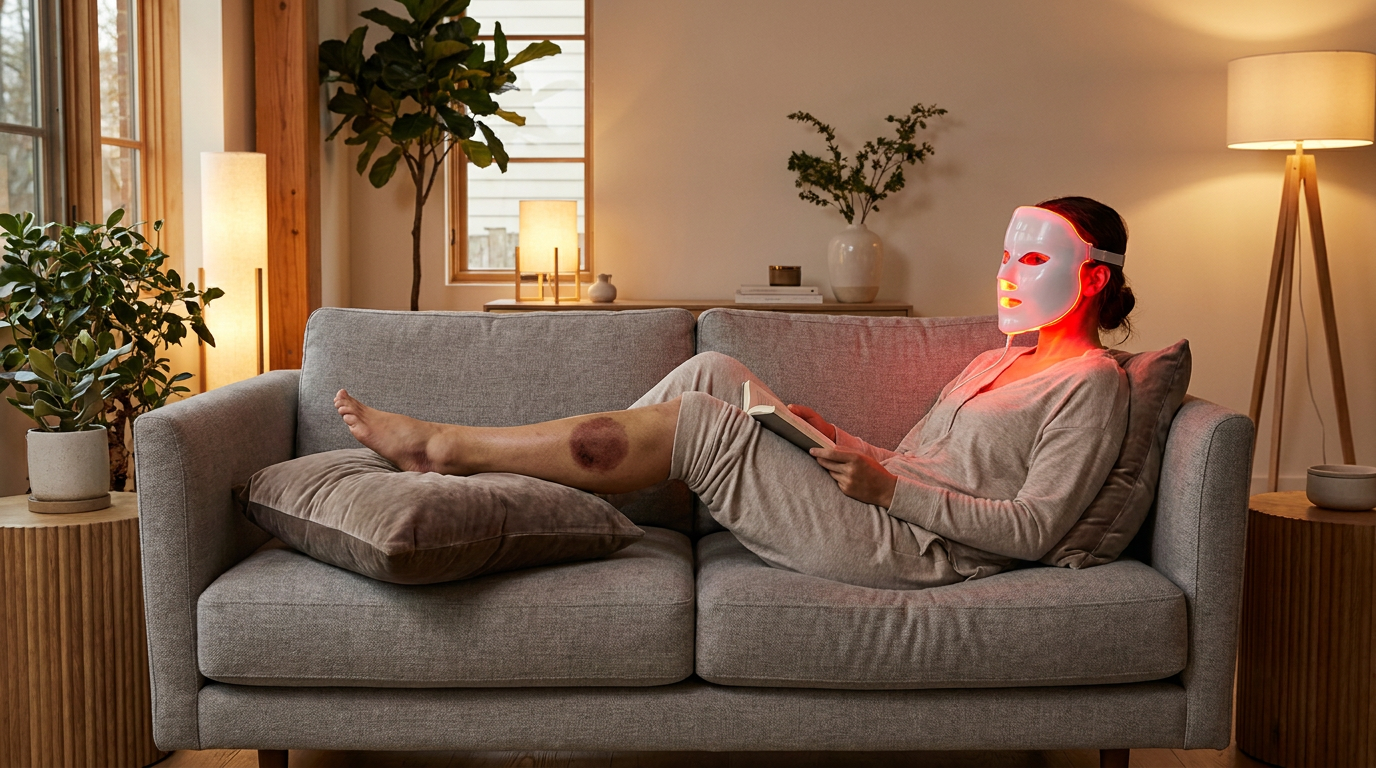
The visual of glowing red masks has moved from specialized dermatology clinics to everyday living rooms, driven by promises of clinic-level skin rejuvenation. With price tags routinely exceeding $400, consumers are left weighing aggressive social media marketing against scientific reality. The central question for buyers is whether these futuristic devices are a legitimate investment in long-term skin health or simply an expensive, vibey placebo. As the market floods with both FDA-cleared medical devices and cheap knockoffs, separating evidence-based photobiology from clever marketing has become essential for anyone looking to upgrade their skincare routine.[1][2][4]
At the core of the debate is a well-documented biological mechanism called photobiomodulation. Unlike ultraviolet light, which damages cellular DNA and accelerates aging, specific wavelengths of visible and near-infrared light are theorized to heal and energize human tissue. This process uses light energy to stimulate the skin's natural regenerative processes without relying on thermal heat or physical trauma.[2][4]
The primary claim driving the consumer market is that red light—specifically calibrated in the 630 to 660 nanometer range—can reverse visible signs of aging by stimulating fibroblasts to produce more collagen. Collagen is the structural protein responsible for skin elasticity, which naturally depletes as humans age.[4][8]
The evidence supporting this anti-aging claim is generally strong, though nuanced. Peer-reviewed studies, including those published in the Archives of Dermatological Research, demonstrate that consistent exposure to these specific red wavelengths improves skin elasticity, reduces fine lines, and enhances overall texture. Participants in these clinical trials consistently report measurable rejuvenation when adhering to strict protocols.[5][6]

However, the strength of the evidence weakens slightly when translating clinical trial data to consumer reality. A Cochrane review of photodynamic therapy highlights that while light therapy unequivocally works, consumer-focused studies often suffer from small sample sizes and a lack of standardized treatment protocols. The profound heterogeneity in how different brands measure irradiance—the power output over a specific area—makes direct comparisons incredibly difficult. Without a universal standard for at-home dosage, consumers are largely forced to trust manufacturer claims regarding how much therapeutic light is actually penetrating their skin during a standard ten-minute session.[3]
A secondary, deeply penetrating wavelength—near-infrared light at 830 nanometers—is frequently paired with red light in premium masks. This invisible spectrum reaches beyond the skin's surface to target the mitochondria, the powerhouse of the cell. The light boosts the production of adenosine triphosphate (ATP), which serves as the fundamental energy currency for cellular function.[4][5]
By increasing ATP production, near-infrared light accelerates cellular repair and significantly reduces inflammation. Dermatologists note that this mechanism is particularly well-supported by clinical data, making it highly effective for post-procedure wound healing and calming inflammatory conditions like rosacea or severe redness.[5][8]
By increasing ATP production, near-infrared light accelerates cellular repair and significantly reduces inflammation.
The third major claim involves blue light, typically operating at 415 nanometers, which is heavily marketed as an at-home acne cure. The evidence here is solid but comes with specific medical caveats. Blue light effectively targets and neutralizes acne-causing bacteria on the absolute surface of the skin, offering a non-chemical alternative to harsh topical treatments.[7][8]

Yet, medical professionals caution against over-relying on blue light for comprehensive acne management. While it clears surface bacteria, it does not penetrate deeply enough to address hormonal or cystic acne. Furthermore, many dermatologists argue that red light's anti-inflammatory properties are actually more universally beneficial for acne recovery, as they soothe the surrounding tissue and prevent scarring.[8]
The most significant point of transparent uncertainty in the evidence pack lies in the sheer power disparity between in-office medical devices and at-home consumer masks. Clinical photodynamic therapy often pairs high-powered light panels with photosensitizing topical agents—like aminolevulinic acid (ALA)—to actively destroy precancerous cells and treat severe photoaging. These medical treatments induce a deliberate chemical reaction that consumer devices simply cannot replicate. The clinical results achieved in a dermatologist's office are fundamentally different from the subtle, gradual improvements offered by a wearable silicone mask.[3]
Consumer masks completely lack these photosensitizing agents and operate at a mere fraction of a clinical laser's irradiance. Consequently, dermatologists emphasize that at-home masks should be viewed as supportive adjuncts rather than direct replacements for medical-grade procedures, prescription retinoids, or daily sunscreen application.[3][7]
Safety is another area where the clinical evidence is remarkably clear, provided users strictly follow manufacturer instructions. LED masks are non-invasive, painless, and do not cause thermal damage to the epidermis. However, prolonged exposure to intensely bright LEDs without proper eye protection can risk ocular strain or damage, prompting experts to recommend built-in shields or goggles.[5][7]
Furthermore, the "more is better" fallacy frequently leads to user error and diminished returns. Clinical guidelines suggest optimal usage is 10 to 20-minute sessions, three to five times a week. Exceeding this frequency can paradoxically trigger skin irritation, inflammation, and a breakdown of the very skin barrier the user is attempting to fortify.[5][8]

Consumer testing by product review outlets reveals that the physical design of the mask heavily dictates user compliance, which is the ultimate key to efficacy. Flexible silicone masks, such as those from Omnilux and CurrentBody, conform closely to facial contours to ensure an optimal, uniform distance between the LED diodes and the skin.[1][2]
Conversely, rigid masks like the Shark CryoGlow offer a more luxurious, spa-like experience but may struggle to deliver uniform light therapy to individuals with varying facial structures. If the mask sits too far from the skin, the irradiance drops exponentially, significantly reducing the biological impact of the light.[1]
The timeline for visible results requires significant patience, a reality often obscured by rapid-fire social media transformations. Clinical consensus indicates that while a temporary, superficial glow may appear immediately due to increased circulation, structural changes like collagen synthesis take a minimum of four to twelve weeks of strict adherence to materialize.[5][8]

Ultimately, the aggregated evidence confirms that at-home LED masks are not a placebo; they are grounded in established, peer-reviewed photobiology. For consumers willing to invest both the upfront financial cost and months of consistent daily use, FDA-cleared devices offer a measurable, albeit modest, improvement in long-term skin health.[4][5]
How we got here
1980s
NASA begins researching LED light therapy to promote wound healing and tissue growth for astronauts in space.
2000s
Dermatologists begin adopting high-powered photodynamic therapy (PDT) for treating precancerous lesions and severe acne.
2010s
The FDA begins clearing the first wave of low-level light therapy devices for consumer at-home use.
2024-2026
Flexible silicone LED masks become a ubiquitous, multi-million dollar consumer tech category driven by social media.
Viewpoints in depth
Dermatological Consensus
Medical professionals view LED masks as scientifically valid but modest adjuncts to a comprehensive skincare routine.
Board-certified dermatologists largely agree that the photobiology behind LED masks is sound. They emphasize that while red and near-infrared light can genuinely stimulate collagen and reduce inflammation, these devices are not magic wands. The medical consensus positions at-home masks as excellent maintenance tools to be used alongside proven topicals like retinoids and daily sunscreen, rather than replacements for in-office lasers or injectables.
Consumer Tech Reviewers
Product analysts focus on the usability, comfort, and price-to-performance ratio of the devices.
For reviewers at outlets like Wirecutter, the clinical science is only half the equation. They argue that the best LED mask is the one a consumer will actually use consistently. Consequently, their evaluations heavily weight factors like the flexibility of the silicone, the comfort of the eye shields, and the battery life of the controller. They often penalize rigid masks that fail to conform to different face shapes, noting that poor fit drastically reduces the device's effective irradiance.
Clinical Skeptics
Some medical purists highlight the lack of standardized protocols and the vast power gap between consumer and clinical devices.
A subset of the medical community remains highly skeptical of the consumer LED boom. They point to Cochrane reviews indicating that while photodynamic therapy works, the evidence supporting low-powered at-home devices is often funded by the manufacturers themselves. These skeptics argue that without the photosensitizing agents used in clinical settings, the biological impact of a $400 consumer mask is too minimal to justify the cost, suggesting patients would be better served investing that money in prescription-grade skincare.
What we don't know
- There is currently no universal industry standard for measuring and reporting the exact irradiance (power output) of consumer LED masks.
- Long-term data comparing the efficacy of daily low-dose at-home therapy versus infrequent high-dose clinical therapy remains limited.
- The exact degree to which consumer devices can replicate the preventative anti-aging effects seen in controlled, clinical photodynamic therapy is still debated.
Key terms
- Photobiomodulation
- The use of specific wavelengths of light to stimulate cellular function and promote tissue healing without causing thermal damage.
- Adenosine Triphosphate (ATP)
- The primary energy carrier in all living organisms, which is boosted by near-infrared light to accelerate cellular repair.
- Fibroblasts
- Cells within the skin's dermis layer that are responsible for producing collagen and maintaining structural integrity.
- Irradiance
- The measure of power output per unit area, determining how much light energy actually reaches and penetrates the skin.
- Near-Infrared Light
- An invisible spectrum of light (typically 830 nm) that penetrates deeper than visible red light to reduce inflammation.
Frequently asked
Do I need to wear eye protection while using an LED mask?
Yes. While many masks are FDA-cleared, prolonged exposure to bright LEDs can cause ocular strain or damage. Dermatologists strongly recommend using built-in eye shields or protective goggles.
Can I use a red light mask every day for faster results?
No. Clinical guidelines suggest using the mask three to five times a week. Overuse can paradoxically cause skin irritation and compromise your skin barrier.
Does red light therapy hurt or burn the skin?
No. Unlike lasers or ultraviolet light, LED therapy is completely non-invasive and does not rely on thermal heat. The mask may feel slightly warm, but it should never burn.
How long does it take to see anti-aging results?
While you may notice a temporary glow immediately, structural changes like increased collagen and reduced fine lines typically require four to twelve weeks of consistent use.
Sources
Source coverage
8 outlets
3 viewpoints surfaced








[1]WirecutterConsumer Tech Reviewers
The Best Red-Light Therapy Device
Read on Wirecutter →[2]The IndependentDermatological Consensus
Do LED face masks actually work? An aesthetic doctor explains the science
Read on The Independent →[3]MedscapeClinical Skeptics
Are Red Light Therapy Masks Actually Doing Anything?
Read on Medscape →[4]Los Angeles TimesConsumer Tech Reviewers
Do red light therapy masks work? What the science says
Read on Los Angeles Times →[5]Boulder Medical CenterDermatological Consensus
At-Home Red Light Masks: What the Science Shows
Read on Boulder Medical Center →[6]Archives of Dermatological ResearchClinical Skeptics
Efficacy of red and near-infrared light therapy for skin rejuvenation
Read on Archives of Dermatological Research →[7]Oak DermatologyClinical Skeptics
Are LED Face Masks Safe? Skincare Specialists Explain
Read on Oak Dermatology →[8]Doctor RogersDermatological Consensus
Red Light Therapy Masks: A Dermatologist's Guide to the Science
Read on Doctor Rogers →

More in shopping
See all 25 stories →Home Appliances
Heat Pump Dryers: The 2026 Buying Guide and Explainer
0 sources
Display Tech
OLED vs. Mini-LED in 2026: The Ultimate Home Theater Trade-Off Analysis
0 sources
TV Tech
OLED vs. Mini-LED: Choosing the Right Premium TV in 2026
0 sources

Home Electrification
The 2026 Guide to Buying a Heat Pump: Ratings, Rebates, and Avoiding Costly Mistakes
0 sources
Every angle. Every day.
Get shopping stories with full source coverage and perspective breakdowns delivered to your inbox.