
2026 Rivian R2 vs. Tesla Model Y: The Defining EV Trade-Off
Rivian’s highly anticipated R2 SUV has arrived to challenge the refreshed Tesla Model Y, forcing buyers to choose between maximum aerodynamic efficiency and rugged off-road utility.
By Factlen Editorial Team
- Utility & Adventure Seekers
- Prioritizes ground clearance, cargo volume, and off-road capability over absolute highway efficiency.
- Efficiency & Value Prioritizers
- Focuses on maximizing range, on-road driving dynamics, and tech integration.
- Budget-Conscious Buyers
- Evaluates the vehicles strictly on near-term affordability and cost-per-mile.
What's not represented
- · Traditional Automakers losing market share to EV-native platforms
- · European and Asian market consumers where the R2's larger footprint may be less practical
Why this matters
For anyone entering the electric vehicle market, this head-to-head defines the current state of the industry. Buyers no longer have to compromise; they can choose between a highly optimized, budget-friendly highway cruiser or a rugged, space-maximizing adventure vehicle.
Key points
- The 2026 Tesla Model Y Juniper starts at $41,630, significantly undercutting the Rivian R2's $57,990 launch price.
- Rivian's R2 offers 90.1 cubic feet of cargo space and 9.6 inches of clearance, beating the Model Y in utility.
- Tesla's Juniper update brings a quieter cabin, ventilated seats, and improved suspension damping.
- The R2 utilizes a native NACS port, granting it seamless access to Tesla's Supercharger network.
- A $45,000 base model of the Rivian R2 is planned, but will not be available until late 2027.
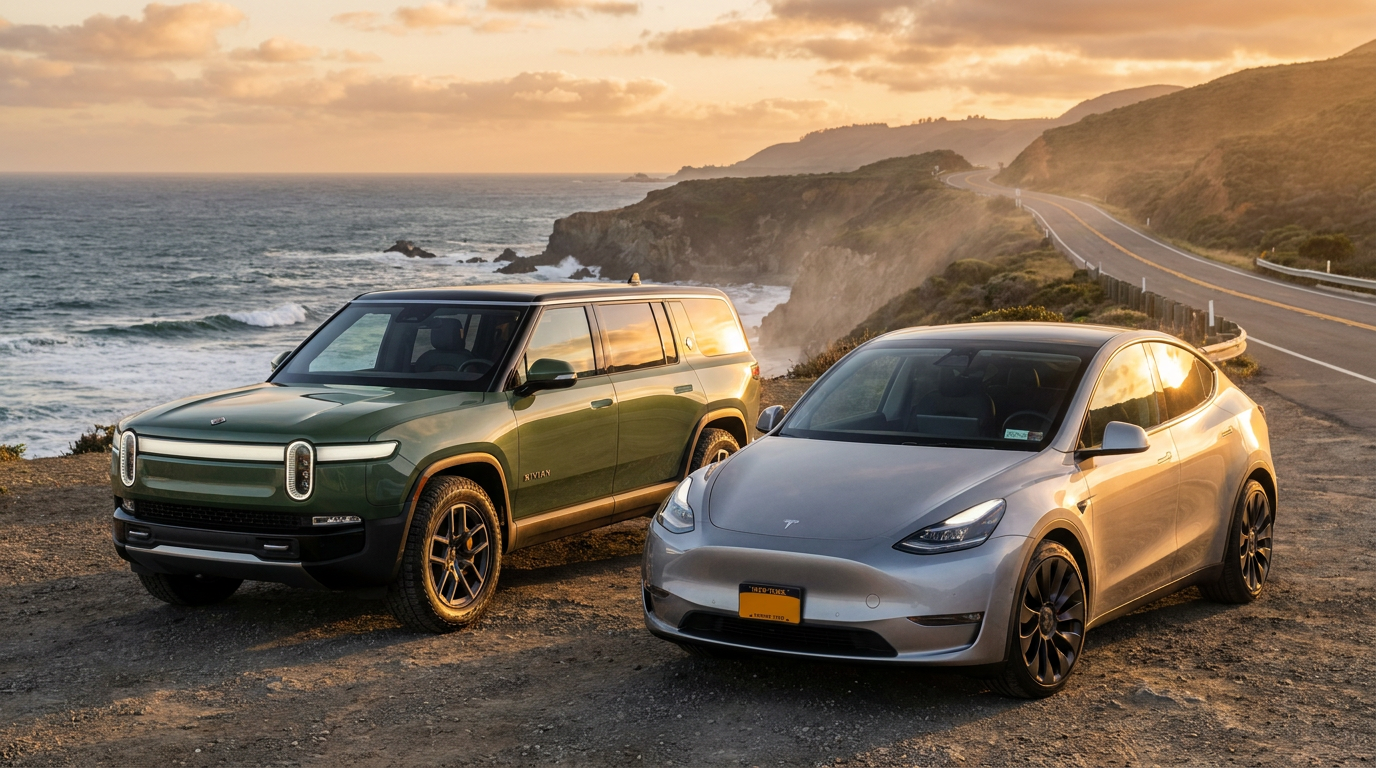
The electric vehicle landscape of 2026 is defined by a single, high-stakes rivalry in the mid-size SUV segment. For years, the Tesla Model Y has dominated global sales, offering a teardrop-shaped blend of efficiency and technology that set the industry standard. Now, Rivian has launched its highly anticipated R2, a vehicle designed specifically to challenge Tesla's supremacy. While both vehicles occupy roughly the same footprint and target the same families, their engineering philosophies could not be more different.[2][3]
The comparison begins at the dealership, where pricing strategies immediately diverge. Tesla's 2026 Model Y, fresh off its comprehensive "Juniper" update, starts at a highly aggressive $41,630 for the base model, scaling up to $61,630 for the Performance trim. Rivian, meanwhile, is leading with its flagship configurations. The R2 Performance Launch Edition hits the streets at $57,990, with a $53,990 Premium trim following closely. While Rivian promises a $45,000 base model, that variant will not arrive until late 2027, giving Tesla a massive near-term advantage for budget-conscious buyers.[1][5][8]
Visually and aerodynamically, the two SUVs represent opposing schools of thought. The Model Y prioritizes aerodynamic slipperiness, utilizing a sloped roofline to maximize highway range and minimize wind resistance. The R2 opts for a traditional, boxy silhouette with an upright rear end. This design sacrifices some aerodynamic efficiency to deliver a rugged, trail-ready aesthetic that has become Rivian's signature, appealing directly to buyers tired of the ubiquitous teardrop shape.[2][3]

That boxy design pays massive dividends in interior volume. Despite the R2 being slightly shorter in overall length than the Model Y, its taller roofline and squared-off greenhouse generate significantly more usable space. With the seats folded, the R2 offers 90.1 cubic feet of total cargo capacity—including a 5.2-cubic-foot front trunk. This represents a 19 percent increase over the Model Y's 76 cubic feet, making the Rivian the clear winner for hauling bulky gear or large pets.[2][6]
The dimensional differences extend to the chassis, dictating exactly where these vehicles can travel. The Model Y sits on a road-biased suspension with 6.0 inches of ground clearance, perfectly suited for suburban commutes, tight parking garages, and highway road trips. The R2 boasts a towering 9.6 inches of ground clearance, paired with 25-degree approach and 26-degree departure angles. This geometry makes the Rivian genuinely capable on rough trails, soft sand, and rocky inclines where the Tesla would quickly bottom out.[2][3]

The dimensional differences extend to the chassis, dictating exactly where these vehicles can travel.
Under the floorboards, both manufacturers are pushing battery technology forward to eliminate range anxiety. The R2 utilizes Rivian's new 4695 cylindrical cells, supplied by LG, which pack six times the energy of their previous batteries. This 88-kilowatt-hour pack delivers an EPA-estimated 330 miles of range in the Performance trim. Tesla counters with its highly optimized powertrain; the Model Y Premium RWD achieves up to 357 miles of range, squeezing every possible mile out of its pack through superior aerodynamics and weight management.[1][6]
In a straight line, the performance metrics are staggering for both family haulers. The dual-motor R2 Performance generates 656 horsepower and 609 pound-feet of torque, rocketing from zero to 60 mph in just 3.6 seconds. Tesla's Model Y Performance edges it out slightly, achieving the same sprint in 3.3 seconds. However, efficiency data reveals a surprise: despite its boxy shape and 370-pound weight penalty, the R2 Performance achieves a 109 MPGe combined rating, edging out the Model Y Performance's 104 MPGe.[1][2][4]
Inside the cabin, Tesla's 2026 Juniper update has dramatically shifted the narrative around its build quality. Reviewers note that the Model Y now features a whisper-quiet interior, double-stitched dash elements, soft-touch materials, and ventilated seats. The suspension has also been overhauled with frequency-selective passive damping, resolving the harsh ride that plagued earlier models. It feels like a genuine luxury vehicle, shedding its previously stark, minimalist reputation in favor of refined comfort.[7][9]

Rivian's interior takes a different approach, blending premium materials with extreme utility. The R2 features fold-flat seating across both rows, transforming the cabin into a flat surface ideal for car camping. It also introduces "Haptic Halo" steering wheel dials for tactile control and retains a rugged, easy-to-clean ethos. While it matches Tesla in material quality, its focus is squarely on adventure readiness rather than sleek, urban minimalism.[4][5]
On the technology front, the playing field is leveling. Rivian has equipped the R2 with 11 cameras, five radars, and its Autonomy+ software, aiming for point-to-point hands-free driving. Tesla continues to refine its vision-only Full Self-Driving suite on Hardware 4, which remains the industry benchmark for widespread semi-autonomous deployment. Crucially, the R2 features a native North American Charging Standard (NACS) port, granting Rivian owners seamless access to Tesla's sprawling Supercharger network without an adapter.[3][6][7]

Ultimately, the choice between the 2026 Rivian R2 and the Tesla Model Y Juniper comes down to lifestyle realities versus aspirations. The Model Y is the pragmatic champion—cheaper, longer-ranged, and dynamically superior on paved roads. The R2 demands a price premium and sacrifices some highway range, but rewards buyers with unmatched cargo space, genuine off-road capability, and a design that breaks free from the teardrop monotony.[1][4][8]
How we got here
2020
Tesla launches the Model Y, which quickly becomes the best-selling electric vehicle globally.
March 2024
Rivian officially unveils the R2, targeting the mid-size SUV segment with a promised $45,000 base price.
Early 2026
Tesla rolls out the comprehensive 'Juniper' refresh for the Model Y, upgrading the interior, suspension, and styling.
Mid 2026
Rivian begins deliveries of the R2 Performance Launch Edition.
Late 2027
The highly anticipated $45,000 base model of the Rivian R2 is scheduled to enter production.
Viewpoints in depth
The Rivian R2 Profile
Prioritizing maximum cargo volume, off-road capability, and rugged aesthetics.
For: Unmatched utility and adventure capability in a mid-size footprint. Against: High initial purchase price and aerodynamic penalties at highway speeds. Evidence: The R2 delivers 90.1 cubic feet of cargo space and 9.6 inches of ground clearance, dwarfing the Model Y's 76 cubic feet and 6.0 inches. However, the $57,990 launch price sits far above Tesla's entry point. Fits well when: The buyer actively navigates rough terrain, frequently hauls bulky outdoor gear, or plans to use the fold-flat seats for car camping. Does not fit when: The primary goal is maximizing daily commuting range per dollar, or the buyer has a strict budget under $50,000 for a 2026 purchase.
The Tesla Model Y Profile
Maximizing aerodynamic efficiency, on-road comfort, and value per mile.
For: Exceptional highway range, aggressive pricing, and a highly refined, quiet cabin. Against: Limited off-road capability and a ubiquitous design that lacks visual distinction. Evidence: The 2026 Juniper update provides up to 357 miles of range and a base price of $41,630, making it highly accessible. The new frequency-selective damping drastically improves ride quality, but the 6.0-inch clearance restricts it to pavement. Fits well when: The buyer commutes long distances, prioritizes highway driver-assistance tech, and wants the absolute best range-to-price ratio on the market. Does not fit when: The driver needs to clear rocky trails, requires maximum vertical cargo space for large items, or desires a traditional, boxy SUV aesthetic.
What we don't know
- Whether Rivian can scale production fast enough to meet demand without suffering the bottleneck issues that plagued the early R1 rollout.
- How the real-world highway range of the boxy R2 will hold up against the aerodynamic Model Y at sustained speeds over 75 mph.
- If Tesla will introduce further price cuts to the Model Y to undercut the R2's eventual $45,000 base model in 2027.
Key terms
- NACS
- The North American Charging Standard, originally developed by Tesla, which has become the universal plug for most new electric vehicles.
- MPGe
- Miles Per Gallon Equivalent, a metric used by the EPA to compare the energy efficiency of electric vehicles to traditional gas-powered cars.
- Frequency-Selective Damping
- A suspension technology that automatically adjusts shock absorber firmness based on road conditions, smoothing out bumps while maintaining cornering stability.
- 4695 Cells
- A new, larger cylindrical battery cell format used by Rivian that packs significantly more energy than previous generation batteries.
Frequently asked
Does the Rivian R2 use the Tesla Supercharger network?
Yes. The 2026 Rivian R2 features a native North American Charging Standard (NACS) port, allowing it to plug directly into Tesla Superchargers without an adapter.
When can I buy the $45,000 Rivian R2?
While the high-end Performance models launch in 2026, the entry-level $45,000 Standard RWD trim is not slated to arrive until late 2027.
Which vehicle has more cargo space?
The Rivian R2 offers significantly more room. With the seats folded, it provides 90.1 cubic feet of total storage compared to the Model Y's 76 cubic feet.
Did Tesla fix the Model Y's harsh ride?
Yes. The 2026 'Juniper' update introduces frequency-selective passive damping and a reinforced suspension, which reviewers note dramatically improves ride comfort.
Sources
Source coverage
9 outlets
3 viewpoints surfaced








[1]Car and DriverEfficiency & Value Prioritizers
2026 Tesla Model Y Review, Pricing, and Specs
Read on Car and Driver →[2]ElectrekUtility & Adventure Seekers
Rivian R2 vs Tesla Model Y spotted side-by-side: Detailed size comparison
Read on Electrek →[3]ForbesUtility & Adventure Seekers
Rivian R2 Is Imminent: How It Stacks Up Against The Tesla Model Y
Read on Forbes →[4]Top GearUtility & Adventure Seekers
Rivian R2 (US) Review 2026
Read on Top Gear →[5]EdmundsBudget-Conscious Buyers
2027 Rivian R2 Prices, Reviews, and Pictures
Read on Edmunds →[6]Design NewsBudget-Conscious Buyers
Rivian R2 Cuts Costs With New Battery Tech
Read on Design News →[7]TESMAGEfficiency & Value Prioritizers
The 2026 Tesla Model Y Juniper Facelift New Styling Interior Refinements
Read on TESMAG →[8]AutonocionBudget-Conscious Buyers
The cheapest Rivian R2 you can buy in 2026 is $57,990 — not the $45,000 everyone expected
Read on Autonocion →[9]carsales.com.auEfficiency & Value Prioritizers
Tesla Model Y Juniper Performance 2026 Review
Read on carsales.com.au →
More in automotive
See all 13 stories →Battery Tech
Solid-State Batteries Hit the Road: How the Next Generation of EVs Actually Works
0 sources
EV Market
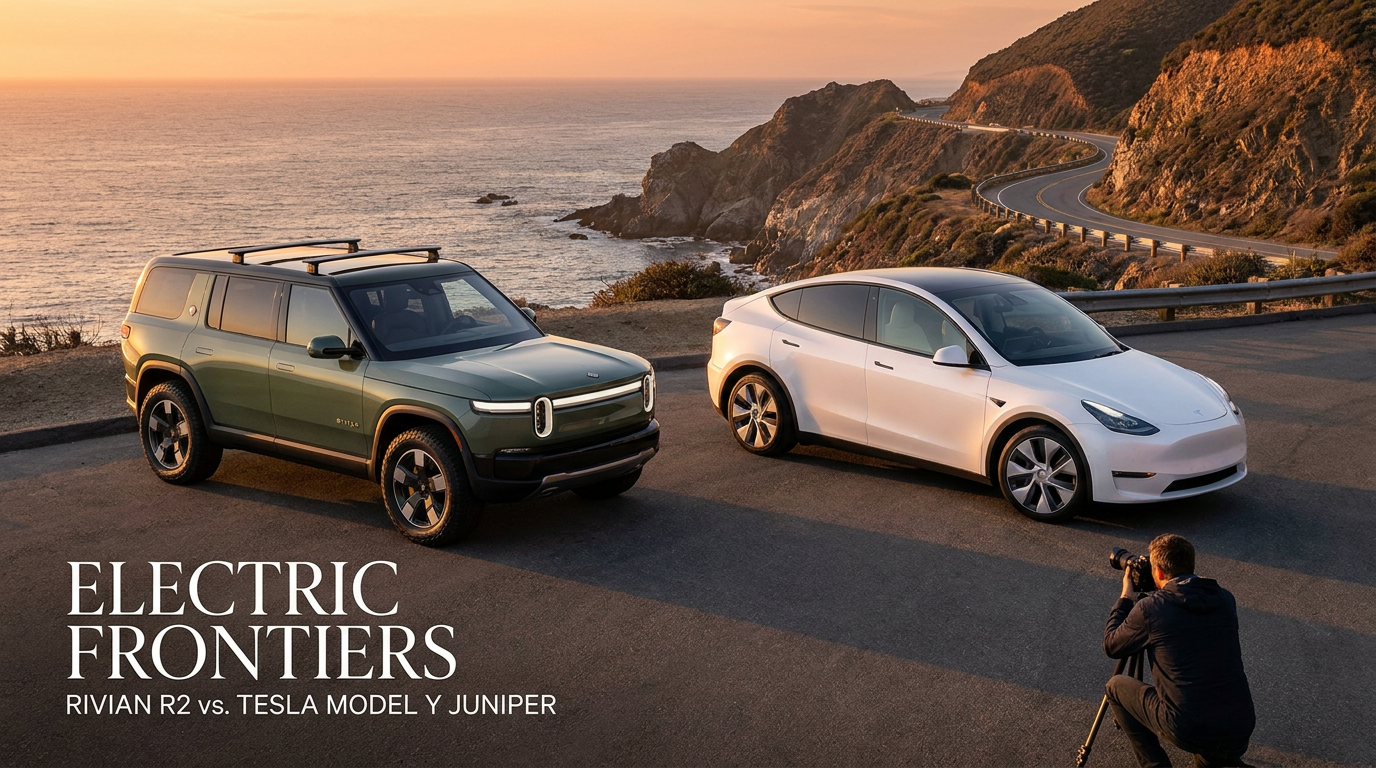
2026 Rivian R2 vs. Tesla Model Y: Choosing the Right Midsize Electric SUV
0 sources
Motorcycle Tech
How Radar and AI Are Making Motorcycles Safer Than Ever
0 sources
Battery Tech
How Solid-State Batteries Are Rewriting the Rules of Electric Vehicles
0 sources

Every angle. Every day.
Get automotive stories with full source coverage and perspective breakdowns delivered to your inbox.