
The Science of Sourdough: How Wild Microbes Transform Flour and Water
Inside every sourdough starter is a complex, symbiotic ecosystem of wild yeast and bacteria. Understanding this microscopic world reveals why naturally leavened bread is more flavorful, digestible, and nutritious.
By Factlen Editorial Team
- Microbiologists & Food Scientists
- Focus on the taxonomy of the starter, the symbiotic relationship between microbes, and the enzymatic breakdown of phytic acid.
- Artisan Bakers
- Focus on the practical manipulation of temperature, hydration, and feeding schedules to control the dough's structural integrity and flavor profile.
- Nutritionists & Dietitians
- Focus on the downstream human health impacts, including the lowered glycemic index, mineral bioavailability, and improved gut tolerability.
What's not represented
- · Commercial Yeast Manufacturers
- · Industrial Bakeries
Why this matters
Sourdough isn't just a culinary trend; it is a return to an ancient biotechnology that fundamentally alters the nutritional profile of grain. By understanding the fermentation process, home bakers can manipulate flavor, improve their gut health, and unlock nutrients that commercial bread leaves trapped.
Key points
- A sourdough starter is a symbiotic ecosystem of wild yeast and lactic acid bacteria.
- Wild yeast produces carbon dioxide to leaven the bread, while bacteria produce acids for flavor.
- The highly acidic environment naturally protects the dough from mold and harmful pathogens.
- Bakers can control the sourness of the bread by adjusting fermentation temperature and hydration.
- Long fermentation breaks down phytic acid, making the grain's minerals easier for the body to absorb.
- Sourdough has a lower glycemic index than commercial bread, preventing sudden blood sugar spikes.
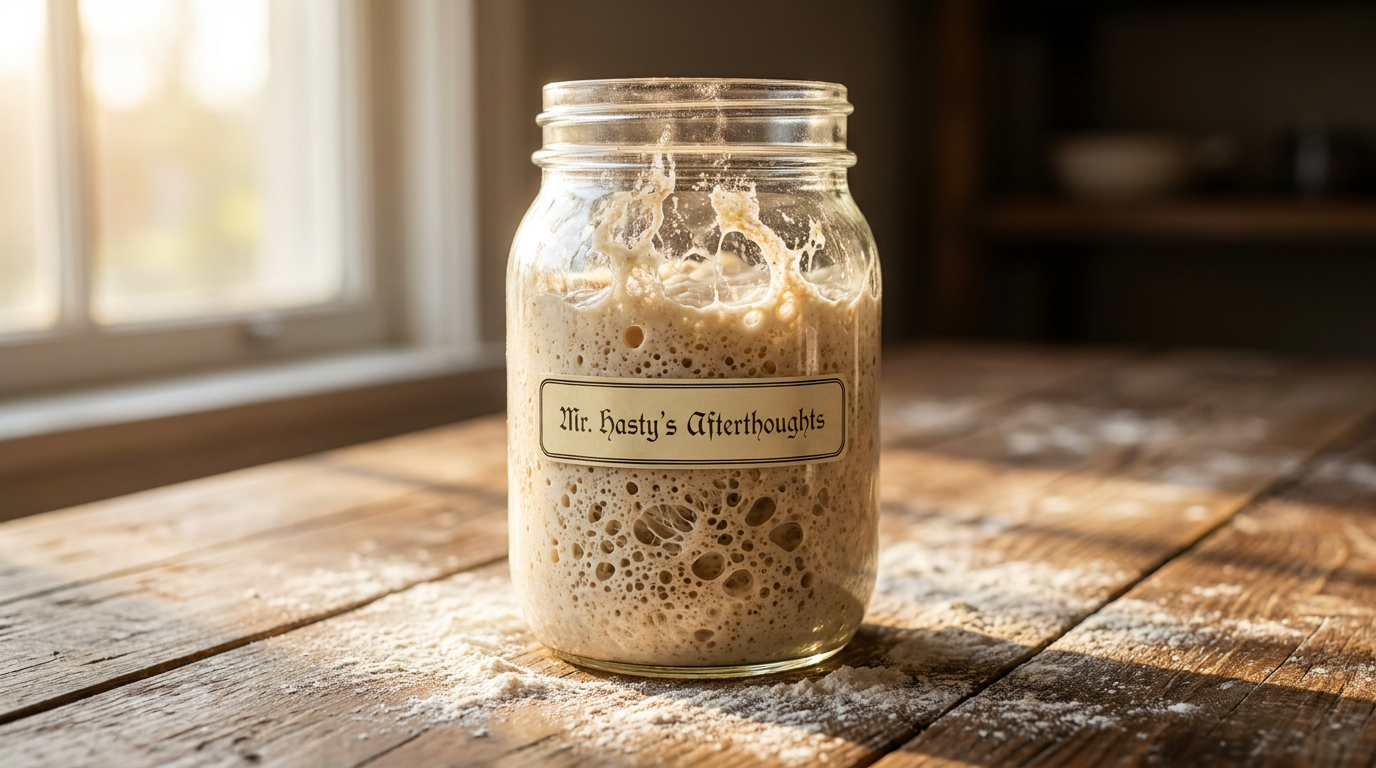
Mix flour and water together, and it looks like a lifeless paste. But leave that mixture on a kitchen counter for a few days, and it transforms into a bubbling, breathing ecosystem. This simple combination is the genesis of a sourdough starter, a living culture that harnesses the invisible microbes floating in the air and resting on the grain.[3][4]
For thousands of years, this was the only way humanity knew how to leaven bread. Archaeological evidence traces the use of naturally fermented dough back to ancient Egypt around 3700 BCE. It was a daily rhythm of survival, with bakers saving a piece of fermented dough from one batch to inoculate the next.[3][4]
That rhythm was interrupted in the mid-1800s when commercial baker's yeast was isolated and mass-produced. The industrialization of bread prioritized speed and consistency, allowing a loaf to rise in two hours rather than two days. But that speed came at a hidden cost to both flavor and human digestion.[4][6]
Today, the global resurgence of sourdough represents a return to a symbiotic culture of bacteria and yeast—often referred to as a SCOBY. This microscopic alliance does much more than just make dough rise; it fundamentally alters the chemical and nutritional structure of the wheat.[5][6]

In a mature sourdough starter, wild yeasts—such as Candida milleri or wild strains of Saccharomyces—are responsible for the heavy lifting. As these yeasts consume simple sugars like glucose and fructose found in the flour, they expel carbon dioxide gas and ethanol as metabolic byproducts.[1][5]
The carbon dioxide gets trapped in the dough's extensible gluten network, inflating it like millions of tiny balloons to create the beautiful, airy pockets that define a rustic loaf. The ethanol, meanwhile, contributes to the dough's complex, sweet aroma during the proofing stage.[4][5]
But while the yeast provides the architectural lift, the bacteria provide the character. In a healthy sourdough starter, lactic acid bacteria (LAB) outnumber yeast cells by a staggering ratio of roughly 100 to 1. It is this bacterial dominance that makes sourdough entirely unique.[1][6]
But while the yeast provides the architectural lift, the bacteria provide the character.
A common question is why the bacteria and yeast don't compete for food and starve each other out. The answer lies in a perfect evolutionary truce. The wild yeasts prefer simple sugars, while the LAB primarily metabolize maltose, a complex sugar that the yeasts cannot easily digest. They share the environment without fighting over the menu.[4][5]

As the lactic acid bacteria feast, they produce organic acids that drop the starter's pH to between 3.5 and 4.5. This highly acidic environment acts as a natural preservative. It creates a hostile barrier that prevents harmful pathogens, mold, and spoilage bacteria from taking root in the dough.[1][5]
The specific tang of a loaf depends entirely on the types of bacteria present. Homofermentative LAB produce only lactic acid, which imparts a soft, milky, yogurt-like flavor. Heterofermentative LAB, on the other hand, produce both lactic acid and acetic acid, the latter providing a sharp, vinegary punch.[3][6]
Bakers can actively manipulate this microbial balance. Warmer fermentation temperatures and highly hydrated, liquid starters favor lactic acid production. Conversely, cooler temperatures—such as retarding the dough in a refrigerator overnight—and stiffer starters encourage acetic acid, resulting in a noticeably sourer loaf.[3][5]

Beyond flavor, this bacterial activity performs a kind of nutritional alchemy. Wheat bran contains phytic acid, an antinutrient that binds to essential minerals like zinc, iron, and magnesium, preventing the human digestive tract from absorbing them.[1][4]
The acidic environment created by the LAB activates an enzyme called phytase, which neutralizes the phytic acid. This process effectively pre-digests the grain, unlocking the trapped minerals and making them highly bioavailable to the consumer. Commercial yeast works too quickly for this enzymatic breakdown to occur.[1][6]
The long, slow fermentation also allows bacterial enzymes to partially break down gluten proteins. While sourdough is absolutely not safe for individuals with celiac disease, many people with mild non-celiac gluten sensitivities find true, long-fermented sourdough much easier to digest than commercially yeasted bread.[2][4]
Furthermore, the organic acids produced during fermentation slow down the rate at which starches are digested and absorbed into the bloodstream. This significantly lowers the bread's glycemic index, providing a steady, sustained release of energy rather than a sudden glucose spike.[2][4]

The science continues all the way into the oven. As the dough hits the intense heat, the residual sugars and amino acids left behind by the microbes undergo the Maillard reaction. This chemical process creates hundreds of new flavor compounds, resulting in a deeply caramelized, blistered, and crunchy crust.[3][6]
How we got here
3700 BCE
Ancient Egyptians utilize the first recorded naturally leavened bread.
Mid-1800s
Commercial baker's yeast is isolated, shifting the industry away from slow fermentation.
1971
Scientists first isolate and identify Lactobacillus sanfranciscensis, the dominant bacteria in many starters.
2020
The COVID-19 pandemic sparks a massive global resurgence in home sourdough baking.
Viewpoints in depth
The Microbiologist's View
Focuses on the self-sterilizing nature of the starter's ecosystem.
From a microbiological standpoint, a sourdough starter is a marvel of self-preservation. When flour and water are first mixed, a chaotic battle of microbes ensues, including potentially harmful bacteria. However, as the lactic acid bacteria begin to dominate and produce acid, the pH plummets. This creates an environment so acidic that pathogens and mold simply cannot survive, effectively sterilizing the culture and allowing only the acid-tolerant wild yeasts and LAB to thrive.
The Artisan Baker's View
Focuses on manipulating the dough's environment to craft specific flavors and textures.
For the baker, the science is a tool for artistic expression. By utilizing 'retardation'—placing the dough in a cold environment like a refrigerator—bakers intentionally stress the yeast, slowing down gas production. This prevents the dough from over-proofing while giving the bacteria ample time to develop complex, sharp acetic acids. The result is a loaf with a deeply developed flavor profile and a blistered crust that cannot be achieved at room temperature.
The Nutritionist's View
Focuses on the difference between true fermentation and commercial 'sour' flavoring.
Nutritionists emphasize that the health benefits of sourdough rely entirely on the long fermentation process. Many commercial breads labeled 'sourdough' in grocery stores are actually made with fast-acting commercial yeast and simply flavored with vinegar to mimic the taste. These shortcut breads do not undergo the enzymatic breakdown of phytic acid or the degradation of gluten, meaning they lack the improved mineral bioavailability and lower glycemic index of a truly fermented loaf.
What we don't know
- Exactly how geographical location and local airborne microbes alter the specific strain composition of a starter over time.
- The precise threshold at which sourdough's degraded gluten becomes tolerable for different levels of non-celiac gluten sensitivity.
Key terms
- SCOBY
- An acronym for Symbiotic Culture of Bacteria and Yeast, referring to the cooperative ecosystem that makes up a sourdough starter.
- Lactic Acid Bacteria (LAB)
- Beneficial bacteria that ferment sugars into organic acids, providing sourdough's signature tang and protecting the dough from spoilage.
- Phytic Acid
- An antinutrient found in wheat bran that binds to minerals; it is broken down and neutralized during the long sourdough fermentation process.
- Maillard Reaction
- A chemical reaction between amino acids and reducing sugars under high heat that gives browned food, like bread crust, its distinctive flavor.
- Retardation
- The process of slowing down dough fermentation by placing it in a cold environment, usually a refrigerator, to develop deeper flavors.
Frequently asked
Can a sourdough starter go bad?
Yes. If neglected or contaminated, harmful mold or bacteria can overpower the culture. This is usually indicated by pink or orange streaks, or a deeply putrid smell, at which point the starter should be discarded.
Why is my sourdough bread dense?
Dense bread usually results from an underactive starter that hasn't produced enough yeast, or from insufficient fermentation time before baking, meaning the dough hasn't trapped enough carbon dioxide.
Is sourdough bread gluten-free?
No. While the long fermentation process breaks down some gluten, making it easier to digest for mildly sensitive individuals, it still contains gluten and is not safe for those with celiac disease.
What is the dark liquid on top of my starter?
This liquid is called 'hooch.' It is a harmless alcohol byproduct that indicates the starter has consumed all its available food and is hungry. It can be poured off or stirred back in before feeding.
Sources
Source coverage
6 outlets
3 viewpoints surfaced






[1]National Center for Biotechnology InformationMicrobiologists & Food Scientists
Sourdough Microbiome Comparison and Benefits
Read on National Center for Biotechnology Information →[2]Frontiers in MicrobiologyMicrobiologists & Food Scientists
Microbiome analysis of sourdough fermentation
Read on Frontiers in Microbiology →[3]Harvard UniversityNutritionists & Dietitians
Knead to Know: Unlock the Secrets of Sourdough
Read on Harvard University →[4]WikipediaArtisan Bakers
Sourdough
Read on Wikipedia →[5]Pantry MamaArtisan Bakers
How Does Sourdough Starter Work? The Science Explained
Read on Pantry Mama →[6]Factlen Editorial TeamNutritionists & Dietitians
Synthesis by Factlen editorial team
Read on Factlen Editorial Team →
Every angle. Every day.
Get food drink stories with full source coverage and perspective breakdowns delivered to your inbox.