
The Complete 2026 E-Bike Buying Guide: Motors, Batteries, and Finding Your Perfect Ride
Navigating the booming e-bike market requires understanding key specs like motor placement, battery capacity, and safety certifications. This comprehensive guide breaks down everything you need to know to find the perfect electric bicycle for your commute, cargo, or weekend rides.
By Factlen Editorial Team
- Local Bike Shop Advocates
- Emphasize the importance of professional assembly, long-term maintenance support, and test rides before purchasing.
- Urban Mobility Planners
- View e-bikes primarily as car replacements and advocate for cargo capabilities and robust safety certifications.
- Direct-to-Consumer Shoppers
- Prioritize value, massive variety, and the democratization of e-bikes through online-only brands.
What's not represented
- · Traditional acoustic cyclists concerned about trail etiquette
- · Apartment landlords managing battery charging policies
Why this matters
E-bikes have transformed urban mobility and recreation, offering a sweat-free commute and a viable replacement for car trips. But with hundreds of models and confusing technical jargon, making the right $1,000 to $4,000 investment requires cutting through the marketing to understand what actually drives performance and safety.
Key points
- Mid-drive motors offer better hill climbing and a natural feel, while hub motors are more affordable and often feature throttles.
- Battery capacity is measured in Watt-hours (Wh); aim for at least 400Wh for a standard commute.
- Always verify that an e-bike's electrical system is UL 2849 certified to prevent battery fire risks.
- US e-bikes are divided into three classes based on top speed and throttle availability, dictating where they can be ridden.
- Purchasing from a local bike shop costs more upfront but guarantees professional assembly and long-term maintenance support.
The electric bicycle has evolved from a niche novelty into a mainstream transportation juggernaut. By 2026, e-bikes are lighter, more integrated, and more reliable than ever before, offering a sweat-free way to commute, haul groceries, or explore local trails. But stepping into the market for the first time can feel like learning a new language, filled with terms like watt-hours, mid-drives, and torque sensors.[1][3]
The core appeal of an e-bike is simple: it flattens hills and eliminates headwinds. By providing a battery-powered boost to your pedaling, it turns a daunting ten-mile commute into a breezy twenty-minute ride. However, the sheer variety of options—from folding commuter bikes to massive cargo haulers—can lead to decision paralysis for new buyers.[1][4]
The first major decision you will face is motor placement. E-bikes generally use either a hub motor or a mid-drive motor. Hub motors are housed inside the center of the rear (or sometimes front) wheel. They are the most common type found on budget and entry-level e-bikes, operating independently of the bicycle's chain and gears.[1][2]
Hub motors offer several advantages: they are generally less expensive to manufacture, require less maintenance since they don't put extra stress on the bike's drivetrain, and can often be paired with a throttle for pedaling-free cruising. However, because the motor pushes the bike from the wheel rather than the pedals, the ride can sometimes feel less like traditional cycling and more like being pushed from behind.[3]
Mid-drive motors, on the other hand, are positioned directly between the pedals at the bike's bottom bracket. This placement keeps the bike's center of gravity low and centered, improving handling. More importantly, a mid-drive motor transfers power through the bike's chain and gears. This means that when you shift into an easier gear for a steep hill, the motor also gets the mechanical advantage of that gear.[4][5]

Because of this mechanical synergy, mid-drive motors are vastly superior for climbing steep hills or hauling heavy cargo. They also provide a much more natural, intuitive riding feel, as they typically use torque sensors that measure exactly how hard you are pushing on the pedals and amplify that exact effort. The trade-off is a higher upfront cost and increased wear and tear on your chain and cassette.[2][5]
Beyond motor placement, power is a crucial metric. Motor power is measured in Watts (W), typically ranging from 250W to 750W. While a higher wattage means a more powerful motor, torque—measured in Newton-meters (Nm)—is arguably more important. Torque measures the rotational force the motor can apply. A 250W motor with 85Nm of torque will feel significantly punchier off the line and better on hills than a 500W motor with only 40Nm of torque.[3][5]
Motor power is measured in Watts (W), typically ranging from 250W to 750W.
The battery is the 'gas tank' of your e-bike, and its capacity is measured in Watt-hours (Wh). You can calculate this by multiplying the battery's voltage (V) by its amp-hours (Ah). A standard e-bike battery today ranges from 400Wh to 700Wh. As a rough rule of thumb, you can expect to consume about 15 to 20 Watt-hours per mile on a moderate assist setting, meaning a 500Wh battery should reliably deliver 25 to 35 miles of real-world range.[1][3]

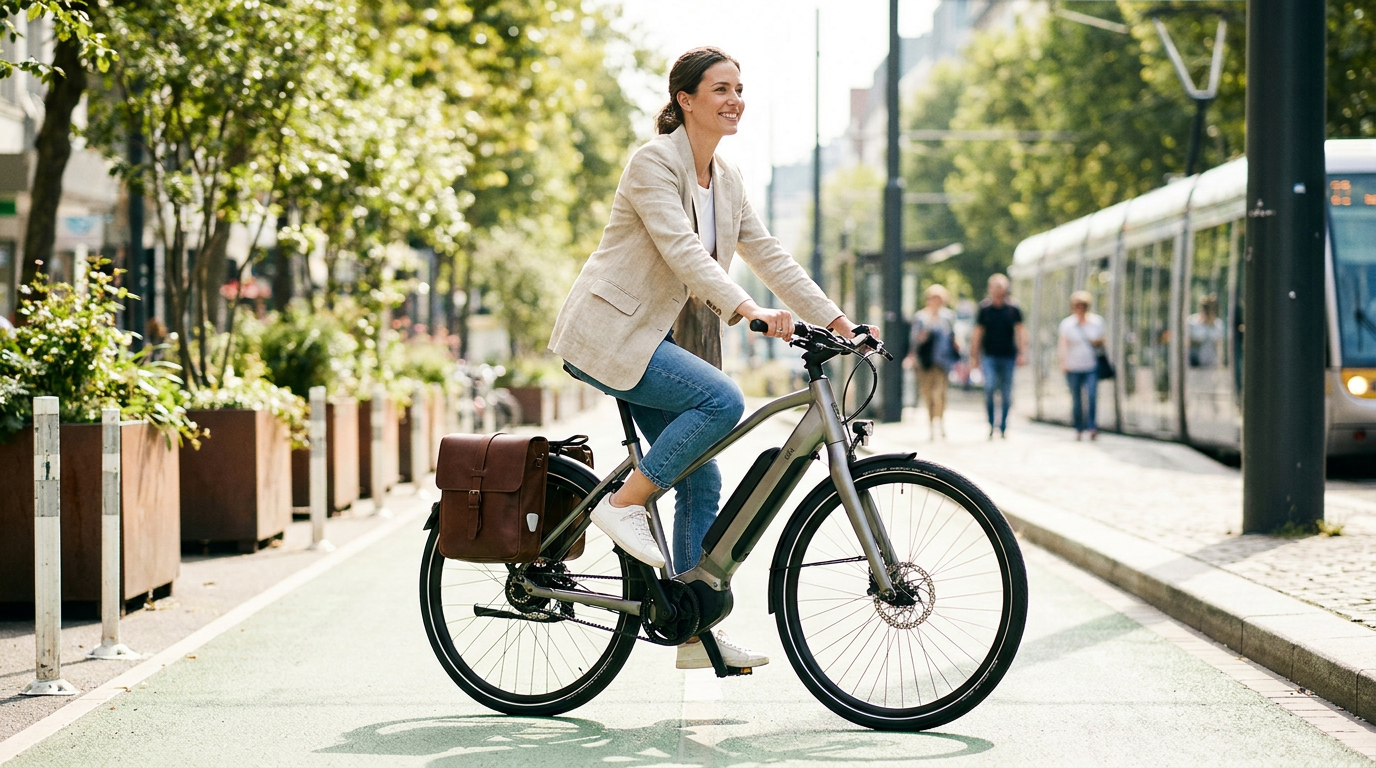
Battery placement and removability are also key lifestyle considerations. Modern e-bikes increasingly integrate the battery directly into the frame's downtube for a sleek look and better weather protection. If you live in an apartment or cannot bring the whole bike inside, ensuring the battery is easily removable with a key so you can charge it at your desk or in your living room is essential.[4]
Safety is paramount when dealing with large lithium-ion batteries. In recent years, the market has seen a push toward strict safety certifications to prevent battery fires caused by cheap, unverified cells. When shopping in 2026, it is absolutely critical to look for a bike whose electrical system is certified to UL 2849 standards. This independent testing ensures the battery, motor, and charger communicate safely and are protected against overcharging and thermal runaway.[1][6]
In the United States, e-bikes are legally categorized into three classes, which dictate where you can ride them. Class 1 e-bikes provide motor assistance only while you are pedaling, and the assist cuts off at 20 mph. These are the most widely accepted on multi-use paths and mountain bike trails. Class 2 e-bikes also cap out at 20 mph but include a throttle, allowing you to ride without pedaling at all.[2][3]
Class 3 e-bikes are for speed. They are pedal-assist only (no throttle) but provide motor support up to 28 mph. These are ideal for commuters looking to keep up with city traffic or cover long distances quickly, but they are often restricted from dedicated bike paths and require the rider to be mindful of local trail regulations.[2][4]

Once you understand the specs, choosing the right style of bike is the final step. Commuter and city bikes prioritize comfort and utility, often coming pre-equipped with fenders, integrated lights, and rear racks for panniers. Cargo bikes—often called 'minivan replacements'—feature elongated frames (longtails) or front buckets (bakfiets) designed to carry multiple children, massive grocery hauls, or heavy equipment.[1][3]
For those with limited space or multi-modal commutes, folding e-bikes offer a brilliant solution. They can be collapsed to fit in the trunk of a car, stored under a desk, or carried onto a commuter train. While they typically have smaller wheels that make for a slightly bumpier ride, their convenience for urban dwellers is unmatched.[2]
Finally, consider where you are buying the bike. Direct-to-consumer (DTC) brands offer incredible value by cutting out the middleman, but you are often responsible for final assembly and finding a local shop willing to service it. Buying from a Local Bike Shop (LBS) costs more upfront, but it guarantees professional assembly, a warranty you can physically walk into a store to claim, and a long-term maintenance partner.[1][4]
Ultimately, the best e-bike is the one that fits seamlessly into your daily routine. By assessing your typical route, choosing the appropriate motor and battery size, verifying safety certifications, and taking a few test rides, you can unlock a healthier, more efficient, and undeniably fun mode of transportation.[1]

How we got here
Early 2010s
E-bikes begin gaining traction in Europe and Asia, primarily using heavy hub motors and external battery packs.
2020
The global pandemic triggers a massive bicycle boom, accelerating e-bike adoption as people seek socially distanced transportation.
2023
Major cities like New York implement strict battery safety laws following a rise in fires caused by uncertified lithium-ion cells.
2026
UL 2849 certification becomes the de facto industry standard, and sleek, frame-integrated batteries dominate the consumer market.
Viewpoints in depth
Direct-to-Consumer Advocates
Focus on value, massive variety, and the democratization of e-bikes through online-only brands.
Proponents of the direct-to-consumer (DTC) model argue that cutting out the middleman has made e-bikes accessible to the masses. Brands operating in this space can offer powerful motors and large batteries for half the price of legacy bicycle brands. They argue that the vast online communities and detailed video tutorials empower riders to learn basic bicycle maintenance themselves, breaking the reliance on expensive local repair shops.
Local Bike Shop Supporters
Emphasize the importance of professional assembly, long-term maintenance support, and test rides before purchasing.
Advocates for buying locally stress that an e-bike is a heavy, high-speed vehicle that requires professional assembly to be safe. They point out that many local shops refuse to service DTC brands due to proprietary parts or liability concerns regarding uncertified electrical systems. For this camp, paying a premium upfront for a bike from a legacy brand guarantees a warranty you can trust and a mechanic who will keep the bike safely on the road for years.
Urban Mobility Planners
View e-bikes primarily as car replacements and advocate for cargo capabilities and robust safety certifications.
City planners and transit advocates view the e-bike not as a recreational toy, but as a critical tool for reducing urban congestion and emissions. This perspective heavily favors cargo e-bikes and robust commuter models that can genuinely replace a second family car. They also strongly advocate for strict battery safety regulations (like UL 2849) to ensure that e-bikes can be safely stored in dense apartment buildings and integrated into public transit networks.
What we don't know
- How rapidly solid-state battery technology will replace current lithium-ion cells in the consumer e-bike market.
- Whether federal tax rebates for e-bike purchases will be expanded or standardized across more regions.
- How local municipalities will adapt multi-use trail speed limits as high-speed Class 3 e-bikes become more common.
Key terms
- Watt-hours (Wh)
- A measure of battery capacity; it acts as the 'gas tank' size of the e-bike, determining how far you can ride on a single charge.
- Torque (Nm)
- The rotational force produced by the motor, measured in Newton-meters. Higher torque means better acceleration and hill-climbing ability.
- Mid-drive motor
- An electric motor positioned at the bike's pedals that powers the chain, allowing it to leverage the bike's gears for better efficiency on hills.
- Hub motor
- An electric motor housed inside the center of the front or rear wheel, operating independently of the bike's gears.
- Torque sensor
- A sensor that measures exactly how hard you are pushing on the pedals and delivers motor power proportionally, creating a natural riding feel.
- Cadence sensor
- A simpler sensor that detects whether the pedals are turning (regardless of how hard you push) and delivers a set amount of motor power.
Frequently asked
How much should I spend on a reliable e-bike?
A reliable, entry-level e-bike from a reputable brand typically starts around $1,000 to $1,500. Mid-drive commuter and cargo bikes with premium components usually range from $2,500 to $4,000.
Can I ride an e-bike in the rain?
Yes, most modern e-bikes are highly water-resistant and designed to be ridden in the rain. However, they are not waterproof, so you should never submerge the motor or battery in deep water or use a high-pressure power washer on the electrical components.
How long does an e-bike battery last before it needs replacing?
A quality lithium-ion e-bike battery typically lasts between 3 to 5 years, or roughly 500 to 1,000 full charge cycles, before its maximum capacity noticeably degrades.
Do I still get a workout on an e-bike?
Absolutely. Because you can adjust the level of motor assistance, you can choose to let the bike do the heavy lifting on your morning commute, and turn the assist down to get a vigorous cardiovascular workout on your way home.
Sources
Source coverage
6 outlets
3 viewpoints surfaced






[1]Factlen Editorial TeamUrban Mobility Planners
Synthesis by Factlen editorial team
Read on Factlen Editorial Team →[2]Consumer ReportsLocal Bike Shop Advocates
Electric Bike Buying Guide
Read on Consumer Reports →[3]ElectrekDirect-to-Consumer Shoppers
E-Bike Guide: Everything you need to know
Read on Electrek →[4]BicyclingLocal Bike Shop Advocates
How to Buy an E-Bike
Read on Bicycling →[5]Bosch eBike Systems
eBike Buying Guide: Find the right eBike
Read on Bosch eBike Systems →[6]UL SolutionsUrban Mobility Planners
E-bikes Certification and Testing to UL 2849
Read on UL Solutions →

Every angle. Every day.
Get shopping stories with full source coverage and perspective breakdowns delivered to your inbox.