
OLED vs. Mini-LED: Which Premium Display Technology Wins in 2026?
As Tandem OLEDs boost brightness and Mini-LEDs refine their dimming zones, the gap between the two premium display technologies has never been narrower. Choosing the right panel in 2026 comes down to room lighting, gaming habits, and burn-in tolerance.
By Factlen Editorial Team
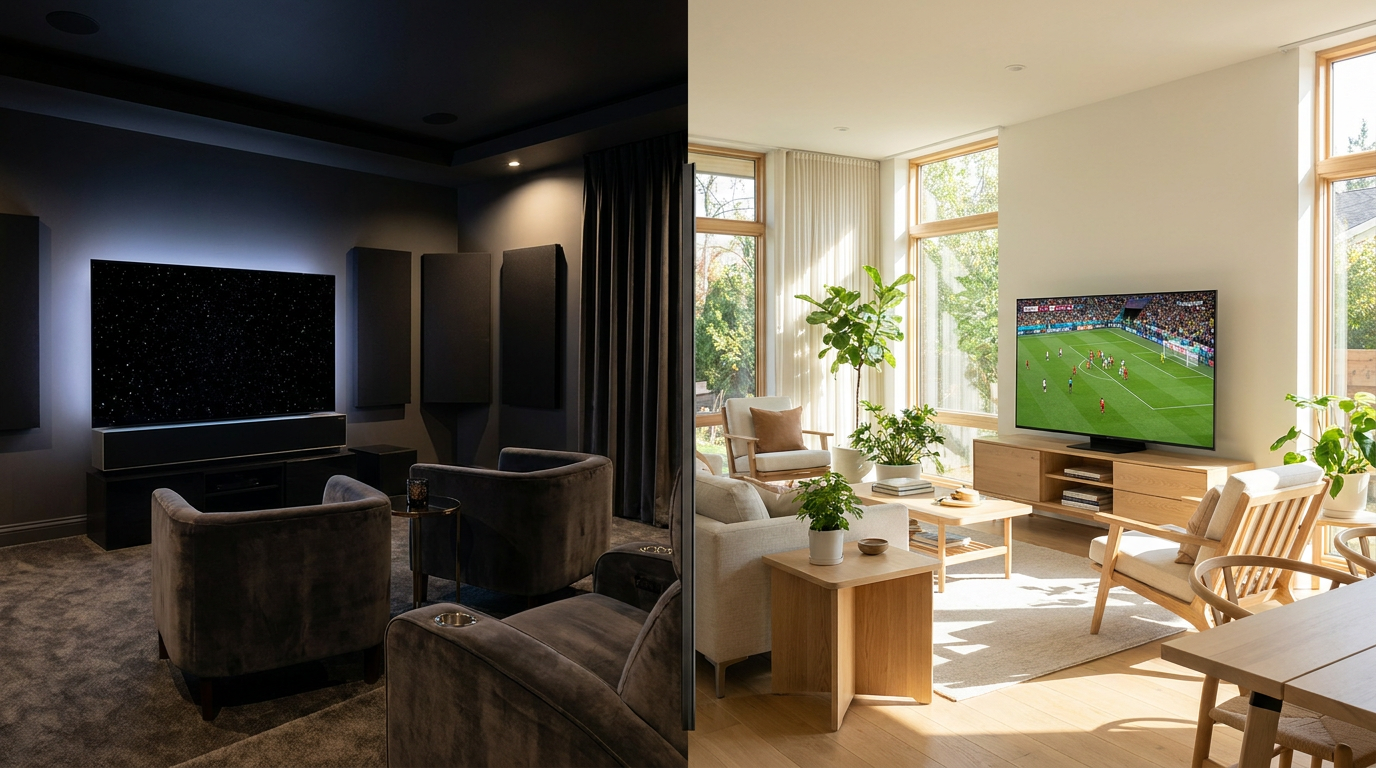
- Cinematic Purists
- Prioritizes perfect black levels, infinite contrast, and pixel-level precision for dark-room viewing.
- Bright-Room Maximizers
- Values sustained full-screen brightness, glare reduction, and zero burn-in risk for daytime viewing.
- Competitive Gamers
- Focuses on motion clarity, sub-millisecond response times, and high refresh rates for fast-paced titles.
- Factlen Editorial
- Provides a neutral, environment-based synthesis of the display market.
What's not represented
- · Budget-conscious buyers looking for entry-level LED TVs
- · Professional color graders requiring reference monitors
Why this matters
A premium TV or monitor is a multi-year investment that dictates your daily entertainment and productivity experience. Understanding the exact trade-offs between OLED and Mini-LED prevents buyers from overpaying for the wrong technology and ensures optimal performance for their specific room lighting.
Key points
- Tandem OLED and QD-OLED panels in 2026 have significantly closed the brightness gap, hitting up to 2,000 nits in small highlights.
- Mini-LED remains the undisputed champion for bright rooms, sustaining massive full-screen brightness without aggressive auto-dimming.
- OLED delivers superior motion clarity and infinite contrast, making it the top choice for dark-room cinema and competitive gaming.
- Mini-LED carries zero burn-in risk, offering total peace of mind for heavy PC productivity and static-heavy viewing.
- The choice in 2026 relies entirely on room lighting conditions and specific usage habits rather than one technology being universally superior.
The 2026 television and monitor market is defined by a fierce, narrowing rivalry between two premium display technologies: OLED and Mini-LED. For years, the buying advice was simple and binary. OLED was reserved for dark rooms and perfect blacks, while LCD-based displays were the default for bright rooms and budget-conscious buyers.[1][6]
That historical binary has completely shattered. The latest Tandem OLED and QD-OLED panels have drastically increased their peak brightness, closing the gap from the bottom up. Simultaneously, premium Mini-LED displays now feature upwards of 5,000 local dimming zones, allowing them to rival OLED's contrast from the top down.[1][3]
To understand the trade-offs, one must understand the underlying mechanics. OLED (Organic Light-Emitting Diode) relies on self-emissive pixels. Every single pixel on the screen generates its own light and color, operating entirely independently of the pixels surrounding it.[6]
Mini-LED, conversely, is a highly advanced evolution of traditional LCD technology. It utilizes a backlight composed of thousands of microscopic light-emitting diodes grouped into specific "dimming zones." These zones shine light through an LCD layer that creates the colors and images you see on the screen.[4][6]

When evaluating display luminance, the argument for Mini-LED is overwhelming. Because it relies on a dedicated, massive backlight, it can generate extraordinary amounts of light. The evidence supporting this approach is highly quantifiable: flagship 2026 Mini-LED panels, such as the LG QNED9M and TCL X11L, can push peak highlight brightness to 2,500 nits.[4][5]
More importantly, Mini-LED can sustain full-screen brightness levels well above 1,000 nits without triggering any protective dimming mechanisms. This makes them absolute "light cannons" capable of punching through the harshest daytime window glare, ensuring the picture never looks washed out in a sunlit living room.[3][4]
However, the argument against Mini-LED centers on its inability to control light at the individual pixel level. Even with 5,000 or more local dimming zones, a single zone still illuminates thousands of pixels simultaneously. The evidence of this limitation manifests as "blooming"—a faint halo of light that bleeds into the dark areas surrounding a bright object, such as white subtitles on a black cinematic letterbox.[2][4]
Conversely, the argument for OLED rests entirely on perfect micro-contrast. Because OLED panels lack a backlight entirely, every single pixel can turn off completely. The evidence for this superiority is an infinite contrast ratio. When a starfield is displayed on an OLED screen, the stars are piercingly bright while the surrounding space is pitch black, with zero light bleed or blooming.[1][6]
Conversely, the argument for OLED rests entirely on perfect micro-contrast.
For cinematic purists watching movies in a dark room, this pixel-level precision creates an unmatched sense of three-dimensional depth. The per-pixel lighting eliminates the halos that can appear around bright UI elements or explosions, delivering a pristine, reference-quality image that filmmakers intend.[3][6]
The primary argument against OLED has historically been its lack of sustained brightness. To protect the organic compounds from overheating and degrading, OLED panels employ an Automatic Brightness Limiter (ABL). The evidence of this limitation is clear during full-screen bright scenes—such as a hockey game or a snowy landscape—where the TV will aggressively dim the entire image, sometimes dropping to 250 to 400 nits.[3][4]
In 2026, the display industry introduced Tandem OLED and refined QD-OLED architectures to directly counter this weakness. By stacking multiple emissive layers, manufacturers have effectively doubled the brightness efficiency of the panels. Evidence from recent testing shows models like the LG G5 and Samsung S95F hitting 1,500 to 2,000 nits in small highlight windows, drastically improving their bright-room viability.[1][3]

When evaluating gaming performance, the argument for OLED centers on motion clarity. OLED panels boast near-instantaneous pixel response times—often under 0.1 milliseconds. This virtually eliminates ghosting and motion blur, making it the definitive choice for fast-paced, competitive shooters where visual clarity during rapid camera pans is essential.[2][3]
The argument for Mini-LED in gaming focuses on sustained HDR impact and longevity. High-end 2026 Mini-LEDs offer 144Hz to 240Hz refresh rates with brilliant HDR highlights that do not dim over long sessions. Furthermore, Mini-LED carries absolutely zero risk of permanent image retention, or "burn-in," which remains a lingering concern for OLED users who leave static HUDs on screen for hours.[4][7]
Cost and value at scale also heavily favor Mini-LED. While manufacturing massive OLED panels remains prohibitively expensive, an 85-inch or 98-inch Mini-LED delivers flagship-tier HDR impact at a fraction of the cost of a similarly sized OLED, making it the practical choice for large home theaters.[1][6]
Synthesizing these trade-offs leads to clear purchasing guidance. OLED fits exceptionally well when the display is placed in a light-controlled or dim room, when the primary use case is watching cinematic movies or prestige television, and when the user demands the absolute best motion clarity for competitive gaming.[2][8]
Conversely, OLED does not fit well when the display will be placed in a sun-drenched room with heavy window glare. It is also a poor fit for users who watch news channels with static tickers all day, or for heavy PC productivity users who leave static taskbars on the screen for eight hours a day, due to the non-zero risk of burn-in.[3][7]

On the other side of the aisle, Mini-LED fits perfectly when the TV or monitor is destined for a bright, open-concept living room or a sunlit home office. It is the superior choice for daytime sports viewing, mixed-use family rooms, and heavy productivity setups where static images are the norm and sustained brightness is required.[4][8]
Mini-LED does not fit well when the buyer is a home theater purist who watches content exclusively in pitch-black rooms and is highly sensitive to backlight blooming around subtitles. It is also slightly less optimal for the most demanding esports competitors who require the absolute fastest sub-millisecond pixel response times.[2][3]
Ultimately, the 2026 display landscape offers no wrong answers—only different tools for different environments. The gap between the two technologies has never been narrower, ensuring that whichever panel technology consumers choose, the resulting visual experience is a massive leap forward from previous generations.[1][8]
How we got here
2013
First commercial OLED TVs launch, offering perfect blacks but low brightness and high burn-in risk.
2019
Mini-LED technology enters the consumer market, shrinking backlight LEDs to dramatically increase dimming zones.
2022
QD-OLED (Quantum Dot OLED) is introduced, boosting color volume and peak brightness for self-emissive panels.
2026
Tandem OLED and 5,000+ zone Mini-LEDs hit the mainstream, narrowing the performance gap between the two technologies to its tightest margin yet.
Viewpoints in depth
The Cinematic Purist's View
Prioritizing perfect black levels and pixel-level contrast for dark-room viewing.
For home theater enthusiasts, OLED remains the undisputed champion. Because each pixel is self-emissive and can turn off completely, OLED panels deliver an infinite contrast ratio that Mini-LED cannot replicate, even with thousands of dimming zones. This eliminates the 'blooming' or halo effect around bright objects on dark backgrounds—such as starfields or subtitles. In 2026, the introduction of Tandem OLED and refined QD-OLED panels has pushed highlight brightness to nearly 2,000 nits, closing the historical brightness gap while maintaining the micro-contrast that gives 4K HDR movies their three-dimensional depth.
The Bright-Room Maximizer's View
Focusing on sustained brightness, glare resistance, and zero burn-in risk for daytime use.
In sunlit living rooms or bright office environments, Mini-LED is the superior technology. While OLEDs can hit high peak brightness in small windows, their Automatic Brightness Limiter (ABL) aggressively dims the screen when displaying full-screen bright content like hockey games, snowy landscapes, or desktop applications. Mini-LEDs, acting as 'light cannons' capable of sustaining 2,500 nits across the entire panel, punch through ambient glare effortlessly. Furthermore, the complete absence of burn-in risk makes Mini-LED the safer long-term investment for users who watch news channels with static tickers or use their displays for heavy PC productivity.
The Competitive Gamer's View
Balancing motion clarity, input lag, and HDR impact for next-generation consoles and PCs.
Gamers are split based on their environment, but OLED generally holds the edge for competitive play due to its near-instantaneous sub-millisecond pixel response time, which virtually eliminates motion blur in fast-paced shooters. However, 2026's high-zone Mini-LEDs have introduced 144Hz to 240Hz refresh rates with significantly improved local dimming algorithms that keep up with rapid camera pans. For mixed-use gamers who leave static HUDs on screen for eight hours a day, Mini-LED offers peace of mind. For those playing in controlled lighting who demand the absolute cleanest motion clarity, Tandem OLED is the definitive choice.
What we don't know
- How the long-term degradation curve of 2026's dual-stack Tandem OLEDs will compare to traditional single-layer OLEDs over a 10-year lifespan.
- Whether upcoming micro-LED technology will become affordable enough to replace both OLED and Mini-LED before the end of the decade.
Key terms
- Tandem OLED
- A 2026 display architecture that stacks multiple organic light-emitting layers to increase brightness and panel lifespan.
- Local Dimming Zones
- Specific areas of a Mini-LED backlight that can dim or turn off independently to improve black levels and contrast.
- Automatic Brightness Limiter (ABL)
- A software feature in OLED TVs that dims the entire screen during bright scenes to prevent overheating and burn-in.
- Nits
- A unit of measurement for display brightness; one nit is roughly equal to the light of one candle per square meter.
- Blooming
- A visual artifact where light bleeds from a bright object into surrounding dark areas on an LCD or Mini-LED screen.
Frequently asked
Does OLED burn-in still happen in 2026?
While significantly reduced by Tandem OLED structures and software mitigations, burn-in remains a slight risk for users who display static content (like news tickers or PC taskbars) for hours daily.
What is blooming on a Mini-LED TV?
Blooming is a faint halo of light that appears around bright objects on dark backgrounds, caused by the backlight zones being larger than individual pixels.
Which TV is better for a bright living room?
Mini-LED is the clear winner for bright rooms, as it can sustain much higher full-screen brightness to overpower window glare without dimming itself.
Are Mini-LED TVs good for gaming?
Yes. High-end 2026 Mini-LEDs offer 144Hz+ refresh rates and excellent HDR brightness, though OLED still holds a slight edge in motion clarity due to faster pixel response times.
Sources
Source coverage
8 outlets
4 viewpoints surfaced








[1]Data Wire SolutionsCinematic Purists
Best TVs for 2026: 10 OLED and Mini-LED Picks
Read on Data Wire Solutions →[2]RTINGSCinematic Purists
OLED vs Mini LED monitors 2026
Read on RTINGS →[3]KTC DisplaysCompetitive Gamers
Tandem OLED vs. 5000-Zone Mini-LED: A 2026 Deep Dive
Read on KTC Displays →[4]EcoPicksGoBright-Room Maximizers
LG G5 OLED vs LG QNED9M Mini LED Comparison
Read on EcoPicksGo →[5]NextGen PicksBright-Room Maximizers
2026 TV Buyer's Guide: OLED vs Mini LED
Read on NextGen Picks →[6]Embrapa TechBright-Room Maximizers
OLED vs Mini-LED vs QLED (The Real Difference)
Read on Embrapa Tech →[7]Reddit CommunityCompetitive Gamers
OLED vs mini-LED for study and gaming
Read on Reddit Community →[8]Factlen Editorial TeamFactlen Editorial
Synthesis by Factlen editorial team
Read on Factlen Editorial Team →


Every angle. Every day.
Get shopping stories with full source coverage and perspective breakdowns delivered to your inbox.