
How AI and X-Ray Mapping Are Revealing Hidden Paintings and Catching Master Forgers
Conservation scientists are combining macro-X-ray fluorescence with neural networks to digitally peel back the layers of classical masterpieces. The non-destructive technique is authenticating disputed works and uncovering lost art hidden beneath the canvas.
By Factlen Editorial Team
- Conservation Scientists
- Advocates for non-invasive chemical analysis to preserve historical integrity.
- AI Researchers
- Focused on the statistical power of computer vision to detect microscopic patterns.
- Art Historians
- Defenders of human connoisseurship and historical context.
What's not represented
- · Art Forgers
- · Private Art Collectors
- · Auction House Appraisers
Why this matters
The integration of artificial intelligence and nuclear imaging is solving centuries-old art mysteries without risking damage to priceless artifacts. By definitively identifying forgeries and recovering lost compositions, this technology is rewriting art history and protecting the integrity of global museum collections.
Key points
- Macro-XRF scanning allows scientists to map the chemical elements of a painting without touching it.
- The technology reveals hidden paintings by detecting heavy metals like lead beneath the surface layer.
- AI neural networks process the massive X-ray datasets to digitally reconstruct lost artworks in full color.
- Vision Transformers can authenticate paintings by analyzing brushstrokes at the pixel level.
- AI models achieved over 85% accuracy in distinguishing authentic Van Gogh works from high-quality forgeries.
- Experts emphasize that AI must be used alongside traditional historical provenance, not as a replacement.
The art world has long been plagued by the limits of human perception. For centuries, discovering a hidden painting or proving a forgery required invasive, physically destructive techniques—such as scraping away layers of paint or extracting microscopic core samples from a priceless canvas. Today, a quiet revolution in museum laboratories is rendering those destructive methods obsolete.[5][6]
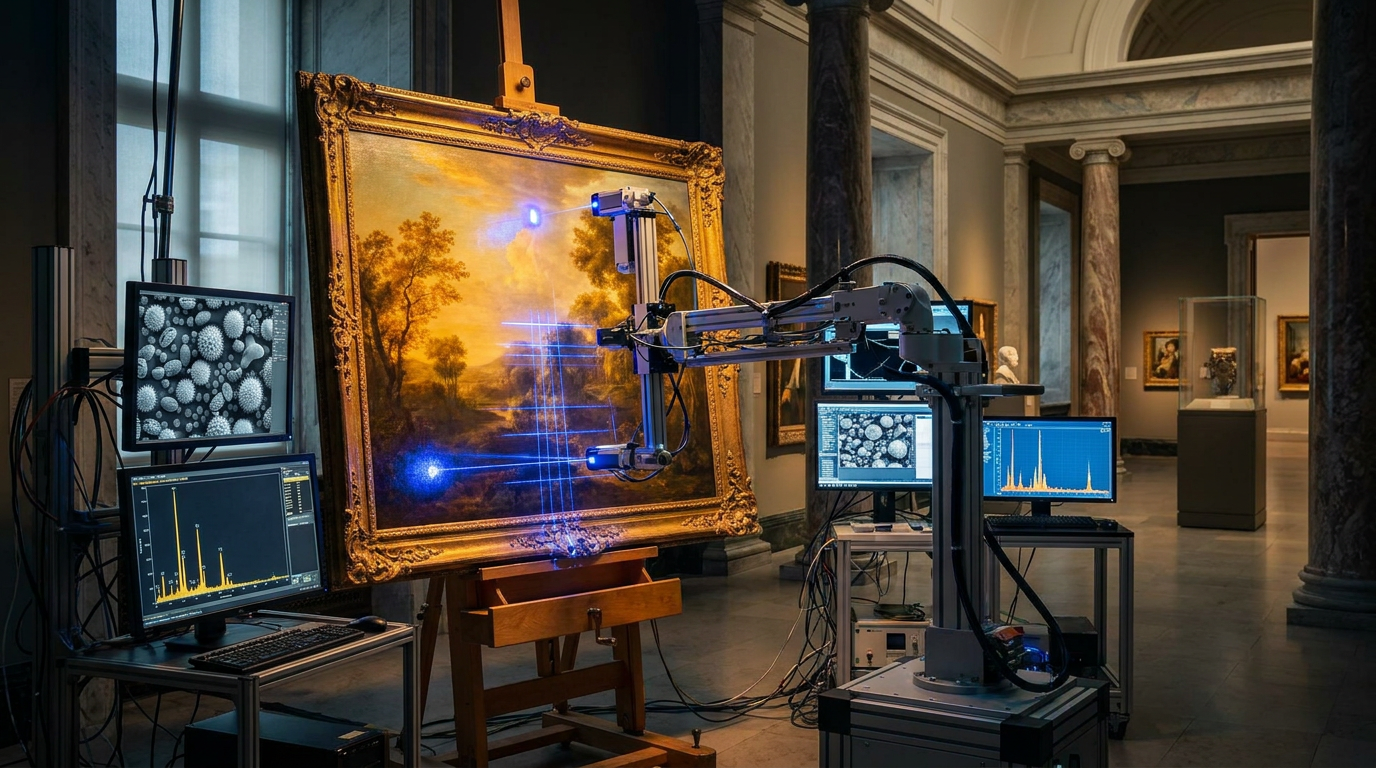
The paradigm shift arrived with the refinement of Macro-X-ray Fluorescence, commonly known as MA-XRF. This non-destructive scanning technique allows conservators to look straight through a finished painting without ever touching its surface. The mechanism relies on high-energy physics applied to classical art.[1][4]
During an MA-XRF scan, an instrument fires a focused beam of X-rays at the canvas. This energy excites the atoms within the paint's pigments. As those atoms return to their resting state, they emit fluorescent energy signatures that are entirely unique to specific chemical elements, such as lead, iron, cobalt, or zinc.[1][6]
By moving the scanner across the painting millimeter by millimeter, scientists generate two-dimensional elemental maps. If a map isolates the distribution of lead white, and that lead white forms the distinct shape of a face beneath a painted landscape, a hidden composition is instantly revealed. Artists frequently reused expensive canvases, meaning many masterpieces conceal abandoned drafts or entirely different works beneath their visible surface.[1][4]

However, the sheer volume of information generated by MA-XRF presents a massive logistical hurdle. A single scan of a large painting can produce millions of data points across dozens of elemental channels. Interpreting this data manually is an agonizingly slow process that can take research teams months or even years.[2][6]
This is where artificial intelligence enters the conservation laboratory. Researchers are now deploying multidimensional neural networks to process these massive datasets in a fraction of the time. Algorithms are trained to recognize the complex correlations between different chemical elements and the visual colors they produce.[2]
Projects like AIRES-CH have built cloud-native applications that translate raw XRF data directly into RGB color images. This allows the AI to perform digital restoration, effectively peeling back the overpainting to reconstruct the exact colors and brushstrokes of the hidden layer, all without a single physical intervention.[2]
Beyond the thrill of discovery, this technological marriage is fundamentally revolutionizing art authentication. Forgers have historically fooled experts by meticulously mimicking an artist's visual style, but they cannot easily fake the chemical timeline of the materials they use.[5][6]
Beyond the thrill of discovery, this technological marriage is fundamentally revolutionizing art authentication.
If an AI-assisted XRF scan detects the presence of synthetic organic pigments in a painting attributed to a 17th-century master, the anachronism instantly exposes the forgery. Many of these synthetic pigments were not invented or commercially available until after 1945, providing an undeniable chemical timestamp.[6]

AI is also analyzing the surface level of paintings through advanced models known as Vision Transformers. Initially developed for complex language processing, these models split high-resolution images of paintings into gridded patches to analyze brushwork at the microscopic pixel level.[3][5]
In recent academic studies, Vision Transformers achieved over 85 percent accuracy in distinguishing authentic Vincent van Gogh paintings from high-quality imitations. The models detect subtle variations in brushstroke pressure, directional vectors, and texture that are entirely invisible to the human eye.[3]
The AI produces detailed heat maps that highlight specific areas of a canvas where the brushwork deviates from the artist's established mathematical pattern. This provides authenticators with quantitative, objective data to support their visual assessments.[5]
Despite these incredible breakthroughs, the technology carries inherent uncertainties and limitations. Machine learning models require vast amounts of training data, meaning they perform best on prolific artists with well-documented, consistent styles.[3][5]
The algorithms struggle significantly when an artist's style evolved dramatically over their lifetime, or when analyzing abstract art that lacks gestural, signatory mark-making. A model trained on classical portraiture cannot easily authenticate a minimalist color-field painting.[5][6]

Furthermore, art historians caution that AI cannot replace the nuanced discipline of connoisseurship. Authentication is not merely a math problem; it requires deep historical context, an understanding of an artist's biography, and rigorous provenance research tracing the documented history of ownership.[5][6]
If a painting's chemical makeup is period-accurate and the brushstrokes match the algorithm's expectations, but there is no historical record of the painting ever existing before last year, human experts must still make the final, critical judgment.[5]
How we got here
1978
Early X-radiography reveals the basic outlines of hidden figures beneath classical paintings, but lacks detail.
2013
Macro-X-ray fluorescence (MA-XRF) scanning is successfully used to create complete elemental distribution maps of historical artworks.
2022
AI startups begin marketing computer vision models specifically trained to authenticate brushstrokes and detect forgeries.
2023
Researchers demonstrate that Vision Transformers can achieve over 85% accuracy in distinguishing authentic Van Gogh paintings from imitations.
2024
Portable MA-XRF scanners and cloud-native AI applications allow museums to conduct real-time, in-situ analysis of their collections.
Viewpoints in depth
Conservation Scientists
Advocates for non-invasive chemical analysis to preserve historical integrity.
For conservation scientists, the primary victory of MA-XRF is its non-destructive nature. Historically, determining the layer structure of a painting required taking microscopic core samples—physically damaging the artwork. By mapping elements like lead, iron, and zinc via X-ray, scientists can now understand the chemical makeup of both the surface and the hidden layers without ever touching the canvas. They view AI as a necessary processing engine to handle the millions of data points generated by these scans.
AI Researchers
Focused on the statistical power of computer vision to detect microscopic patterns.
Computer scientists emphasize the mathematical precision of Vision Transformers and Convolutional Neural Networks. To an AI, a painting is not an emotional artifact but a dataset of brushstroke pressure, directional vectors, and color gradients. Researchers argue that these models can detect forgeries that fool human experts because the algorithms operate at a sub-pixel level, identifying statistical anomalies in how paint was applied that no human eye could ever perceive.
Art Historians
Defenders of human connoisseurship and historical context.
While welcoming new diagnostic tools, art historians caution against treating AI as an infallible oracle. They point out that algorithms struggle with artists who frequently changed their styles or experimented with new mediums. Furthermore, authentication is not just about chemical makeup or brushstroke math; it requires provenance—the documented history of ownership. Historians argue that AI should serve as a powerful supporting tool, but the final certification of authenticity must remain a human, scholarly judgment.
What we don't know
- How reliably AI can authenticate abstract art that lacks distinct, repetitive brushstrokes.
- Whether forgers will eventually use generative AI to perfectly mimic the mathematical brushstroke patterns expected by authentication models.
Key terms
- Macro-X-ray Fluorescence (MA-XRF)
- A non-destructive scanning technique that uses X-rays to identify and map the chemical elements present in a painting.
- Vision Transformer (ViT)
- An artificial intelligence model that splits images into a grid of patches to analyze visual data, highly effective in pattern recognition.
- Provenance
- The documented history of an artwork's ownership, used as a primary tool for establishing authenticity.
- Overpainting
- The act of painting over an existing artwork, either by the original artist reusing a canvas or by a later restorer altering the image.
- Synthetic Organic Pigments
- Modern, chemically manufactured paint colors that did not exist before the 20th century, often used to expose historical forgeries.
Frequently asked
Does X-ray scanning damage the paintings?
No. Macro-XRF is a completely non-destructive technique. It analyzes the chemical composition of the artwork without requiring physical samples or touching the canvas.
Why did classical artists paint over their own work?
Canvases were expensive. Artists frequently reused them to save money, painting new compositions directly over abandoned drafts or unsold works.
Can AI definitively prove a painting is fake?
AI can identify anachronistic materials or brushstroke anomalies with high accuracy, but experts agree it is best used alongside human historical research rather than as a standalone judge.
Sources
Source coverage
6 outlets
3 viewpoints surfaced






[1]MDPIConservation Scientists
Development of a Macro X-ray Fluorescence Scanner System for In Situ Analysis of Paintings
Read on MDPI →[2]Rendiconti LinceiConservation Scientists
A cloud-native application for digital restoration of Cultural Heritage using nuclear imaging: THESPIAN-XRF
Read on Rendiconti Lincei →[3]arXivAI Researchers
Art Authentication with Vision Transformers
Read on arXiv →[4]The Analytical ScientistConservation Scientists
Macro-XRF and the Ghent Altarpiece
Read on The Analytical Scientist →[5]Art and ObjectArt Historians
Can AI Detect Forged Art?
Read on Art and Object →[6]Factlen Editorial TeamArt Historians
Synthesis by Factlen editorial team
Read on Factlen Editorial Team →
Every angle. Every day.
Get culture stories with full source coverage and perspective breakdowns delivered to your inbox.