
The Science of Tangzhong and Yudane: How Pre-Gelatinized Starches Transform Home Baking
Two Asian bread-making techniques are revolutionizing home baking by using heat and hydration to fundamentally alter starch chemistry, resulting in ultra-soft loaves that resist staling.
By Factlen Editorial Team
- Baking Educators & Practitioners
- Bakers focused on recipe development, dough handling, and achieving the best texture.
- Food Scientists & Chemists
- Researchers analyzing the molecular mechanisms of starch gelatinization and staling.
- Editorial Analysts
- Synthesizing the culinary and scientific consensus into actionable insights.
What's not represented
- · Commercial Bakery Manufacturers
- · Gluten-Free Bakers
Why this matters
Understanding the chemistry of bread staling and starch gelatinization allows home cooks to adapt almost any recipe—from sandwich loaves to cinnamon rolls—yielding bakery-quality softness and extending shelf life without artificial preservatives.
Key points
- Bread staling is caused by starch retrogradation—the recrystallization of starch molecules—not simply moisture loss.
- Tangzhong and Yudane are Asian techniques that pre-cook a portion of the dough's flour to pre-gelatinize the starches.
- Gelatinized starches absorb up to twice as much water, allowing for highly hydrated doughs that remain easy to knead.
- The heat alters the starch structure, preventing it from recrystallizing and thereby keeping the bread soft for days.
- Yudane leverages boiling water and a resting period to allow natural amylase enzymes to break starches into simple sugars.
- Home bakers can adapt standard recipes by converting 5% to 10% of the total flour into a pre-cooked roux.
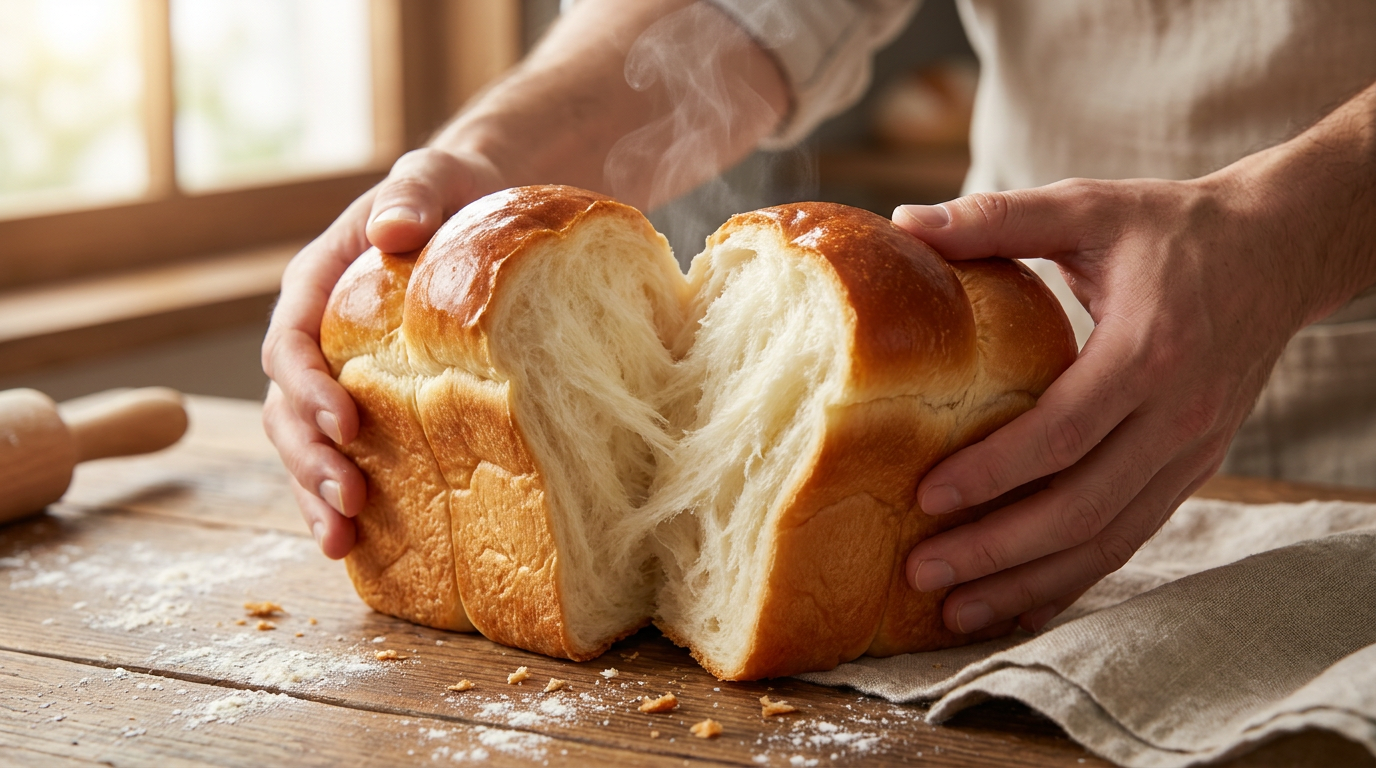
The universal disappointment of bread staling is familiar to any home baker. You pull a perfect, fragrant loaf from the oven, only to find it has transformed into a crumbly, dry brick just two days later. Most people assume the bread has simply lost its moisture to the surrounding air, but the reality is a much more complex chemical process happening at the molecular level.[3][8]
For over a century, food scientists have known that staling is not primarily driven by dehydration. According to BAKERpedia and food chemists, the true culprit is a phenomenon called starch retrogradation. When bread comes out of the oven and begins to cool, the starch molecules that swelled and absorbed water during baking begin to realign and recrystallize. As they form these rigid crystalline structures, they physically expel the water they previously held, hardening the crumb from the inside out.[3][6][8]

Enter two Asian bread-making techniques that have quietly revolutionized the global baking community: Tangzhong and Yudane. By pre-cooking a small portion of the recipe's flour and liquid before the main dough is even mixed, bakers can fundamentally alter the starch chemistry of the wheat. As noted by King Arthur Baking, these methods lock in moisture and dramatically delay the staling process, yielding loaves that remain bakery-fresh for days.[1][4]
The Tangzhong method, popularized across Asia by Taiwanese cookbook author Yvonne Chen in her seminal book '65°C Bread Doctor,' involves whisking flour and water or milk over a stovetop. The standard ratio is one part flour to five parts liquid by weight. The mixture is gently heated until it reaches exactly 65°C (150°F), transforming it into a thick, pudding-like paste.[1][3]
At this specific temperature threshold, a critical transformation called starch gelatinization occurs. The heat causes the hard starch granules in the flour to swell, absorbing up to twice as much liquid as they could when cold. This traps the water inside a viscous gel, preventing it from migrating through the dough later. The American Chemical Society explains that this gelatinization is the foundational science behind the world's fluffiest white breads.[1][2][4]
Yudane, a technique originating in Japan, achieves a similar result through a slightly different mechanism. Instead of stovetop cooking, boiling water is poured directly over the flour at a one-to-one ratio by weight. The mixture is stirred into a thick, stubborn dough and left to rest, often overnight. While Tangzhong creates a smooth emulsion, Yudane leverages the extreme heat of boiling water to scald the flour instantly.[1][4]

While both methods pre-gelatinize starches, they interact with the flour's natural biology in distinct ways. Tangzhong relies heavily on creating a stable, moisture-rich emulsion. Yudane, however, uses its resting period to allow endogenous enzymes—specifically alpha-amylase and beta-amylase—to go to work on the heat-damaged starches, breaking them down over several hours.[2][7]
While both methods pre-gelatinize starches, they interact with the flour's natural biology in distinct ways.
Amylase is the unsung hero of the bread world. As the American Chemical Society details, these enzymes act like microscopic scissors, chopping up the long, complex polysaccharide chains of the gelatinized starch into simpler sugars, such as maltose. Because the boiling water in the Yudane method damages the starch granules so thoroughly, the amylase has unprecedented access to break these molecules apart.[2]

This enzymatic breakdown has two profound effects on the final loaf. First, the resulting simple sugars provide an absolute feast for the yeast during the main dough fermentation, leading to a more vigorous rise and a lighter, airier crumb. Second, the increased sugar content enhances the bread's natural sweetness and promotes beautiful, even browning on the crust through the Maillard reaction.[2]
But the most significant benefit of both Tangzhong and Yudane is their impact on the inevitable staling process. Because the pre-gelatinized starches have already been structurally altered and saturated with water, they strongly resist the thermodynamic urge to recrystallize as the bread ages. Research published by the National Center for Biotechnology Information confirms that altering amylopectin characteristics is the key to preventing increased bread hardness during room-temperature storage.[2][6]
The shorter carbohydrate chains produced by the amylase activity in the Yudane method are particularly resistant to retrogradation. Because the chains have been physically snipped into smaller fragments, they struggle to realign into the rigid, organized crystalline structures that make day-old bread feel hard and dry. The moisture remains trapped in the amorphous regions of the crumb.[2]

Furthermore, the massive amount of water trapped in the pre-cooked roux allows bakers to create highly hydrated doughs that remain remarkably easy to handle. A standard bread dough might turn into an unworkable, sticky mess at 75% hydration. However, because the gelatinized paste holds the water captive, the dough feels stronger and more cohesive, allowing for easier kneading and shaping.[4][7]
This structural integrity means home bakers can achieve the feathery, cloud-like texture of a Japanese milk bread or a rich brioche without relying on massive quantities of butter, eggs, or commercial dough conditioners. As experiments at the Institute of Culinary Education have shown, the water itself, bound by the altered starches, mimics the tenderizing and lubricating effects of fat, making these methods highly economical for both home cooks and commercial bakeries.[7]

When adapting a standard recipe to use these techniques, experts generally recommend taking 5% to 10% of the total flour weight to create the starter. For Tangzhong, this flour is mixed with five times its weight in liquid pulled from the recipe; for Yudane, an equal weight of boiling liquid is used. The resulting paste is then cooled and added to the main mixing bowl along with the remaining ingredients.[1][4]
The choice between the two methods often comes down to desired texture and baker convenience. Tangzhong yields a supremely fluffy, delicate crumb that is ideal for dinner rolls, cinnamon buns, and classic sandwich loaves. Yudane, on the other hand, tends to produce a slightly chewier, mochi-like resilience that works beautifully in artisanal loaves and flatbreads, while requiring less active stovetop monitoring.[1][4]
Ultimately, these techniques represent a perfect marriage of culinary tradition and modern food chemistry. By understanding how heat and hydration manipulate the microscopic architecture of wheat, bakers can outsmart the inevitable march of retrogradation. The result is a fundamental upgrade to the home kitchen: the ability to produce loaves that are softer, taller, and fresher than anything found on a supermarket shelf.[5]
How we got here
Pre-2000s
Japanese bakers develop the Yudane method to create ultra-soft, long-lasting milk breads.
2007
Taiwanese author Yvonne Chen publishes '65°C Bread Doctor', popularizing the Tangzhong method across Asia.
2010s
The techniques begin spreading to Western baking blogs and communities, revolutionizing home bread-making.
2020s
Food scientists publish detailed NMR and FTIR analyses explaining the exact molecular mechanisms behind the techniques.
Viewpoints in depth
Baking Educators
Focus on the practical handling and textural benefits of pre-gelatinized doughs.
For culinary instructors and recipe developers, the primary appeal of Tangzhong and Yudane lies in dough rheology—how the dough behaves in the hands. By locking a significant portion of the recipe's water inside a starch gel, bakers can push overall hydration levels to 75% or higher without the dough becoming a sticky, unmanageable mess. This allows home bakers to achieve professional-level oven spring and feathery textures without needing commercial dough conditioners or industrial mixers.
Food Chemists
Focus on the molecular mechanisms of retrogradation and enzymatic activity.
From a biochemical perspective, these techniques are elegant manipulations of polymer science. Food chemists emphasize that staling is not dehydration, but rather the thermodynamic drive of amylopectin molecules to return to a crystalline state. By pre-gelatinizing the starches and allowing endogenous amylase to cleave the carbohydrate chains, the resulting molecular fragments are physically too short and disorganized to effectively recrystallize, thereby fundamentally short-circuiting the staling mechanism.
What we don't know
- While the macroscopic effects of amylase in Yudane are well-documented, the exact optimal resting time for maximum enzymatic breakdown without risking unwanted fermentation remains debated among bakers.
- The precise interaction between pre-gelatinized starches and different types of fats (like butter versus olive oil) in complex enriched doughs is still an active area of food science research.
- It is not entirely clear why certain low-protein flours respond dramatically better to Tangzhong than others, though variations in natural enzyme levels are suspected.
Key terms
- Starch Gelatinization
- The process where starch granules swell and absorb water when heated, creating a viscous, gel-like structure.
- Starch Retrogradation
- The chemical process where gelatinized starches cool and recrystallize, expelling water and causing bread to stale.
- Amylase
- An enzyme naturally present in flour that breaks down complex starches into simpler sugars like maltose.
- Tangzhong
- A Chinese bread-making technique involving cooking a portion of flour and liquid into a paste to pre-gelatinize starches.
- Yudane
- A Japanese technique where boiling water is poured over flour to scald it, creating a dough-like starter that improves bread texture.
Frequently asked
Can I use whole wheat flour for Tangzhong?
Yes. Any flour with sufficient starch, including whole wheat or rye, can be gelatinized, though white bread flour yields the fluffiest and lightest results.
Do I need a thermometer to make Tangzhong?
No. While 65°C (150°F) is the exact gelatinization point, you can simply watch for the mixture to thicken into a pudding-like paste that leaves visible lines when stirred.
Can bread staling be reversed?
Partially and temporarily. Reheating stale bread re-gelatinizes the starches, making it soft again, but it will stale even faster once it cools a second time.
Why do I need to let Yudane rest overnight?
The resting period allows endogenous enzymes like amylase to break down the heat-damaged starches into simpler sugars, maximizing the dough's sweetness and softness.
Sources
Source coverage
8 outlets
3 viewpoints surfaced








[1]King Arthur BakingBaking Educators & Practitioners
A closer look at tangzhong
Read on King Arthur Baking →[2]American Chemical SocietyFood Scientists & Chemists
Starch gelatinization, retrogradation, and the world's fluffiest white bread
Read on American Chemical Society →[3]BAKERpediaFood Scientists & Chemists
Tangzhong Method | Baking Process
Read on BAKERpedia →[4]The Perfect LoafBaking Educators & Practitioners
How To Make and Use Tangzhong and Yudane
Read on The Perfect Loaf →[5]Factlen Editorial TeamEditorial Analysts
Synthesis by Factlen editorial team
Read on Factlen Editorial Team →[6]National Center for Biotechnology InformationFood Scientists & Chemists
The Mechanism Underlying the Increase in Bread Hardness in Association with Alterations in Protein and Starch Characteristics
Read on National Center for Biotechnology Information →[7]Institute of Culinary EducationBaking Educators & Practitioners
Tangzhong Bread Method Unveiled: A Scientific Exploration
Read on Institute of Culinary Education →[8]The KitchnFood Scientists & Chemists
Food Science: Why Bread Stales
Read on The Kitchn →
Every angle. Every day.
Get food drink stories with full source coverage and perspective breakdowns delivered to your inbox.