
How 'Solarpunk' Literature is Rewriting the Future of Climate Fiction
Rejecting the dystopian doom of traditional sci-fi, a growing literary movement is imagining a sustainable, post-carbon future powered by renewable energy and community cooperation.
By Factlen Editorial Team
- Literary Optimists
- Argue that dystopian fiction induces apathy, and that we need positive, actionable visions of the future to inspire real-world climate solutions.
- Genre Historians
- Focus on the grassroots, internet-native origins of the movement, tracing its evolution from a Tumblr aesthetic to a formalized literary genre.
- Speculative Realists
- Emphasize that Solarpunk is not a frictionless utopia, focusing instead on the difficult, messy political work required to transition away from fossil fuels.
What's not represented
- · Traditional Hard Sci-Fi Authors
- · Climate Doomerism Advocates
Why this matters
As climate anxiety reaches all-time highs, the stories we tell about the future shape our ability to survive it. Solarpunk provides a crucial imaginative roadmap, proving that a sustainable, post-carbon world is not only possible, but worth fighting for.
Key points
- Solarpunk is a sci-fi subgenre that rejects climate doomerism in favor of sustainable, community-driven futures.
- The movement contrasts sharply with cyberpunk, replacing 'high-tech, low-life' with 'high-tech, high-harmony.'
- Originating as an internet aesthetic in the late 2000s, it has evolved into a formalized literary movement.
- Solarpunk stories are not frictionless utopias; they focus on the difficult political work of transitioning away from fossil fuels.
- The genre emphasizes that the technology needed to save the planet already exists, focusing instead on social change.
For decades, science fiction has been dominated by the apocalypse. From the neon-drenched corporate dystopias of cyberpunk to the scorched-earth wastelands of post-apocalyptic survival stories, the future has consistently been framed as a nightmare. This relentless pessimism, often categorized under the umbrella of "climate doomerism," has left readers and writers alike exhausted.[4]
Emerging as a direct counter-narrative to the grimdark trends of modern speculative fiction, "solarpunk" asks a radically different question: What if we actually get it right? It is a literary, artistic, and social movement that envisions a sustainable future where humanity has successfully harmonized with nature through the use of renewable energy and community cooperation.[5][8]
The "solar" in solarpunk represents both the literal use of renewable energy—solar, wind, and hydro power—and a broader, bright optimism about the days to come. The "punk," meanwhile, signifies the movement's countercultural edge. In a world where extractive capitalism and environmental degradation are the status quo, imagining a post-capitalist, ecologically balanced society is an inherently rebellious act.[3][7]
To understand solarpunk, it helps to contrast it with its most famous predecessor: cyberpunk. Cyberpunk, popularized in the 1980s, operates on the ethos of "high-tech, low-life"—a world where technological advancement only deepens inequality, corporate power is absolute, and the environment is irreparably decayed. Solarpunk flips this script entirely. It envisions "high-tech, high-harmony," where technology is decentralized, open-source, and used to regenerate the biosphere rather than exploit it.[3][7]

The origins of this optimistic movement are surprisingly humble. The term was first coined in a 2008 blog post titled "From Steampunk to Solarpunk," which celebrated the maiden voyage of a hybrid cargo ship that used a massive kite to reduce fuel consumption. The anonymous author suggested that older technologies like wind and solar could be combined with modern engineering to create a new, sustainable aesthetic.[1]
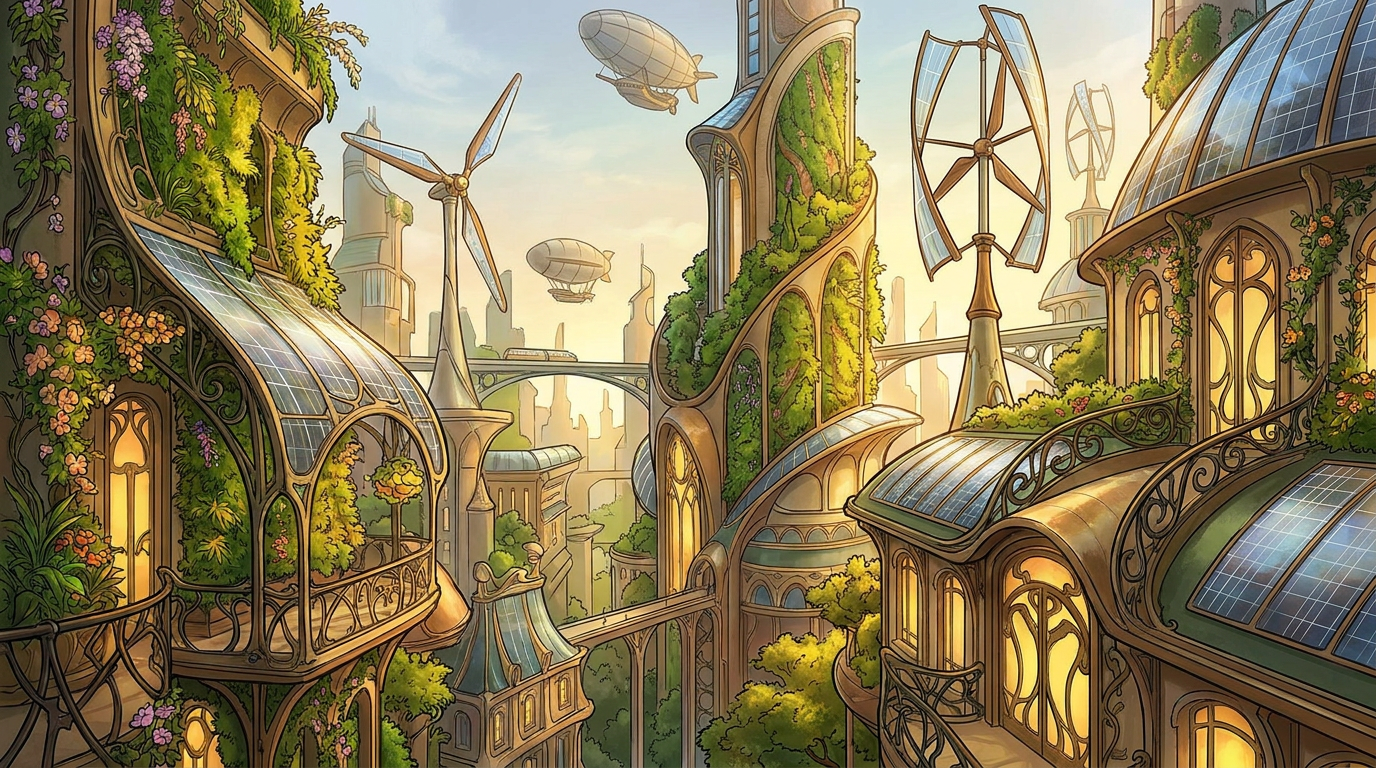
From there, the concept took root internationally. In 2012, a Brazilian publisher released the first dedicated anthology, *Solarpunk: Histórias Ecológicas e Fantásticas em um Mundo Sustenável*. By 2014, the movement had exploded across social media platforms like Tumblr, where artists began sharing mood boards that blended the elegant, organic curves of Art Nouveau architecture with vertical farming, stained-glass solar panels, and diverse, community-driven societies.[4][6][7]
As solarpunk transitioned from an internet aesthetic into a formalized literary genre, it began to attract serious science fiction authors who wanted to move past climate anxiety. Sarena Ulibarri, an author and editor who has curated multiple solarpunk anthologies, notes that traditional climate fiction often focuses on the disastrous outcomes of ecological collapse. Solarpunk, by contrast, focuses on adaptation. "Rather than saying, 'If this goes on, here's the worst that can happen,' solarpunk asks, 'If we change direction, what's a better version that could happen?'" Ulibarri explains.[5]
A common critique leveled at utopian fiction is that a perfect world lacks the friction necessary for a compelling story. If the climate crisis is solved and everyone lives in harmony, where is the narrative conflict? Solarpunk writers are quick to point out that their worlds are not frictionless utopias. The genre frequently focuses on the messy, difficult transition period between our current fossil-fuel dependency and a green future.[3][5][8]

A common critique leveled at utopian fiction is that a perfect world lacks the friction necessary for a compelling story.
Conflict in solarpunk literature often arises from the sheer difficulty of maintaining these sustainable systems. Characters grapple with political disagreements over land use, the logistical challenges of decentralized infrastructure, and the lingering impacts of past environmental damage. Disasters still happen, and human nature remains flawed, but the methods used to resolve these conflicts rely on mutual aid, ingenuity, and democratic consensus rather than violence or authoritarian control.[3][6][8]
Several landmark works have helped define the genre's literary boundaries. Cory Doctorow's novel *The Lost Cause* provides a realistic, politically nuanced depiction of a green future, detailing the intense community organizing required to build an ecological utopia in the face of reactionary pushback. Other foundational texts, like Ruthanna Emrys's *A Half-Built Garden*, explore the diplomatic and sociological hurdles of convincing humanity to prioritize the watershed over corporate profit.[2][5]
On the cozier end of the spectrum is Becky Chambers' beloved *Monk & Robot* series, which began with *A Psalm for the Wild-Built*. Set in a post-transition world where humanity voluntarily gave up half the planet to rewilding, the series follows a tea monk and a robot exploring the philosophical nuances of a society that has already solved its existential crises. It serves as a quintessential comfort read, proving that stories can be driven by internal growth and gentle exploration rather than life-or-death stakes.[8]
Solarpunk is also closely related to another emerging narrative concept: "hopepunk." Coined in 2017 by author Alexandra Rowland, hopepunk is described as "weaponized optimism." It argues that in a world that profits from despair and division, choosing to practice radical compassion and communalism is a fierce, combative stance. If hopepunk is the overarching philosophy of fighting for a better world through kindness, solarpunk is its specific, eco-conscious cousin, providing the architectural and technological blueprints for that world.[4][8]

The visual language of solarpunk is just as important as its prose. The genre heavily emphasizes "speculative design"—creating tangible, visual prototypes of a carbon-free future to help the public imagine what is possible. This approach harkens back to the mid-century World's Fairs, which used grand exhibitions to build broad-based excitement about scientific progress. Today, solarpunk artists use digital renderings to show how existing technologies, like urban agriculture and microgrids, can be remixed to produce beautiful, livable cities.[6][7]
This focus on actionable, existing technology is a crucial pillar of the movement. Solarpunk does not rely on magical "unobtainium" or faster-than-light travel to save humanity. It insists that the tools required for a sustainable future—solar panels, wind turbines, permaculture, and public transit—already exist. The barrier is not technological, but social and political. By normalizing these technologies in fiction, solarpunk aims to lower the psychological barrier to implementing them in reality.[1][2][6][8]

Ultimately, the rise of solarpunk literature reflects a deep, societal yearning for a roadmap out of the climate crisis. As the genre continues to grow, moving from niche internet forums to the shelves of major bookstores, it carries a vital message: politics and policy are often downstream of culture. If we cannot even imagine a future where humanity survives and thrives, we cannot build it. Solarpunk dares to do the hard work of imagining that survival, offering a vibrant, sunlit path forward.[2][5][8]
How we got here
2008
An anonymous blog post titled 'From Steampunk to Solarpunk' coins the term while discussing a hybrid cargo ship.
2012
The first dedicated anthology, 'Solarpunk: Histórias Ecológicas e Fantásticas em um Mundo Sustenável,' is published in Brazil.
2014
The Solarpunk aesthetic explodes on Tumblr, blending Art Nouveau, permaculture, and green technology.
2017
Author Alexandra Rowland coins the term 'Hopepunk' to describe the broader narrative of weaponized optimism.
2021
Mainstream science fiction embraces the genre, highlighted by the success of Becky Chambers' 'A Psalm for the Wild-Built.'
Viewpoints in depth
Literary Optimists
Advocates who believe that positive fiction is a prerequisite for real-world survival.
This camp argues that the relentless barrage of dystopian and post-apocalyptic fiction has created a culture of 'climate doomerism'—a paralyzing belief that the end of the world is inevitable. By explicitly rejecting this narrative, literary optimists view solarpunk as a form of activism. They argue that 'politics is downstream of culture,' meaning that society cannot build a sustainable, equitable future unless artists and writers first provide the imaginative blueprints for what that future looks like.
Speculative Realists
Readers and writers who focus on the messy mechanics of the climate transition.
Realists push back against the idea that solarpunk is merely a cozy, conflict-free utopia. They emphasize the 'punk' aspect of the genre, highlighting stories that deal with the brutal political fights, zoning disputes, and infrastructural challenges required to dismantle fossil-fuel capitalism. For this camp, the value of solarpunk lies not in imagining a perfect world, but in depicting the realistic, community-level struggles necessary to achieve a slightly better one.
What we don't know
- Whether the genre will achieve the mainstream cinematic success of Cyberpunk.
- How the aesthetic will evolve as real-world climate technology advances.
Key terms
- Solarpunk
- A speculative fiction genre and art movement envisioning a sustainable future powered by renewable energy and community cooperation.
- Cyberpunk
- A dystopian sci-fi subgenre characterized by advanced technology, corporate dominance, and societal decay.
- Hopepunk
- A narrative concept coined in 2017 describing 'weaponized optimism'—choosing radical compassion and cooperation as an act of rebellion.
- Permaculture
- An approach to land management and agricultural design that mimics the arrangements observed in flourishing natural ecosystems.
- Climate Fiction (Cli-Fi)
- Literature that deals with climate change and global warming, traditionally leaning toward apocalyptic or dystopian outcomes.
Frequently asked
Is Solarpunk just a utopian fantasy without any conflict?
No. While optimistic, Solarpunk stories feature conflict driven by political struggles, natural disasters, and the difficult work of maintaining a sustainable society.
How is Solarpunk different from Cyberpunk?
Cyberpunk focuses on a dystopian 'high-tech, low-life' future controlled by corporations. Solarpunk envisions a 'high-tech, high-harmony' future driven by communities and renewable energy.
What are some good books to start reading Solarpunk?
Becky Chambers' 'Monk & Robot' series offers a cozy entry point, while Kim Stanley Robinson's 'Pacific Edge' and Cory Doctorow's 'The Lost Cause' provide deeper political explorations.
Sources
Source coverage
8 outlets
3 viewpoints surfaced








[1]The Indian ExpressGenre Historians
What to know about Solarpunk, the literary movement that seeks a sustainable way forward
Read on The Indian Express →[2]Mother JonesLiterary Optimists
Tired of Dystopian Sci-Fi? You Might Like Solarpunk.
Read on Mother Jones →[3]WikipediaGenre Historians
Solarpunk
Read on Wikipedia →[4]Literary HubSpeculative Realists
Hopepunk and Solarpunk: On Climate Narratives That Go Beyond the Apocalypse
Read on Literary Hub →[5]Five BooksLiterary Optimists
The Best Solarpunk Books
Read on Five Books →[6]Ecología PolíticaSpeculative Realists
Putting the Brakes on Dystopia: Speculative Design, Solarpunk, and Visual Tools for Positing Positive Futures
Read on Ecología Política →[7]Built InGenre Historians
What Is Solarpunk? History, Themes, Criticism & Real-World Examples
Read on Built In →[8]Factlen Editorial TeamLiterary Optimists
Synthesis by Factlen editorial team
Read on Factlen Editorial Team →
Every angle. Every day.
Get culture stories with full source coverage and perspective breakdowns delivered to your inbox.