
The Amazon Can Survive Global Warming—If Deforestation Stops Now
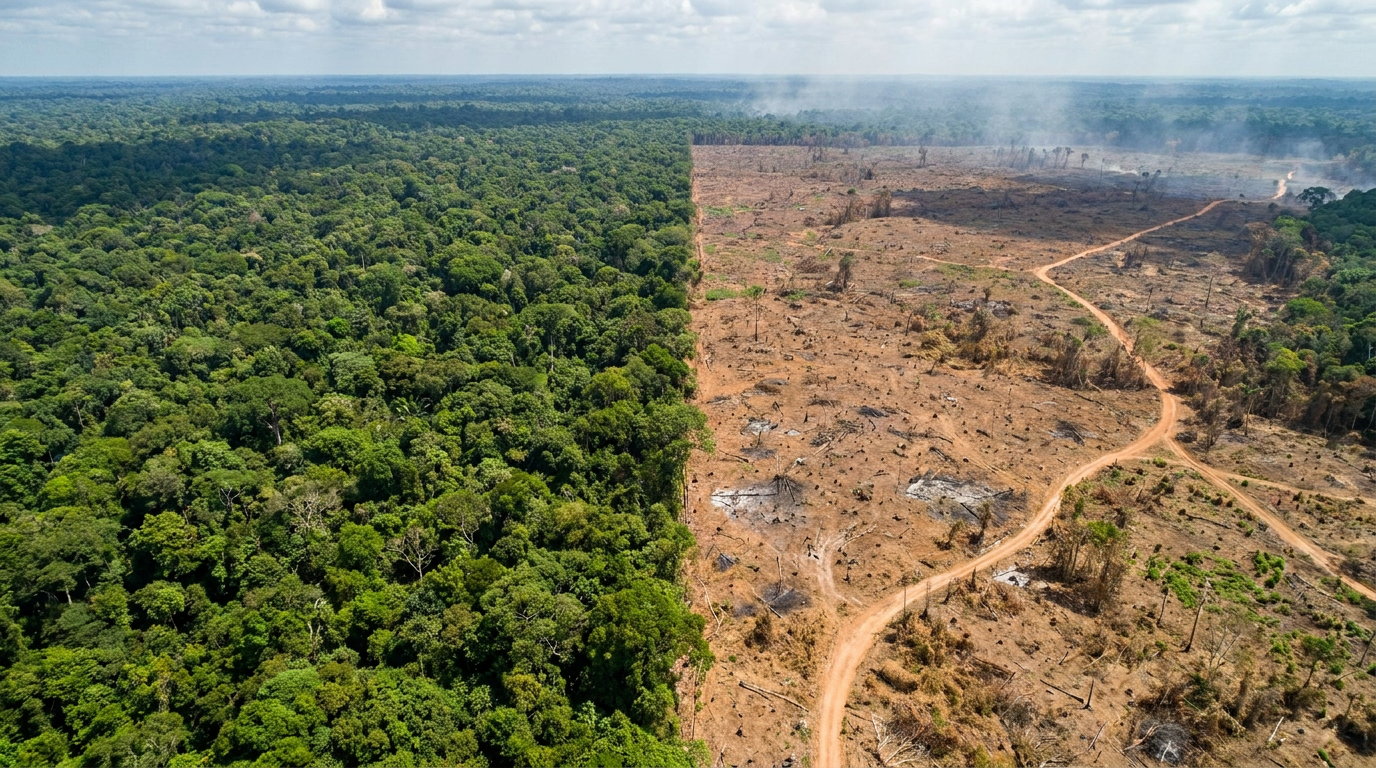
New climate modeling reveals that the Amazon rainforest is highly resilient to rising temperatures alone, but the combination of warming and continued deforestation could trigger a rapid ecological collapse.
By Factlen Editorial Team
- Earth System Scientists
- Focus on the physical mechanisms—moisture recycling, carbon storage, and temperature thresholds—that govern the biome's stability.
- Conservation Organizations
- Focus on the urgent need to halt deforestation, restore degraded lands, and protect the biodiversity that relies on the intact forest.
- Climate Policy Analysts
- Focus on the intersection of local land-use policies and global climate targets, emphasizing that saving the Amazon is a prerequisite for meeting the Paris Agreement.
What's not represented
- · Indigenous communities living within the Amazon
- · South American agricultural industry representatives
- · Local policymakers balancing economic growth with conservation
Why this matters
The Amazon regulates global weather patterns and stores up to 300 billion tonnes of carbon. If it crosses a tipping point into a degraded savanna, the resulting carbon release would make international climate goals impossible to reach, fundamentally altering the trajectory of global warming.
Key points
- New modeling shows the Amazon can withstand up to 4.0°C of global warming if deforestation is completely halted.
- Combined with 1.5°C of warming, clearing just 22% to 28% of the forest could trigger a systemic ecological collapse.
- Approximately 17% to 18% of the Amazon has already been deforested, pushing the biome dangerously close to the tipping point.
- Deforestation disrupts the forest's ability to recycle moisture, creating a cascading drought effect that starves downwind regions of rainfall.
- A large-scale collapse would transform the Amazon from a vital carbon sink into a massive source of greenhouse gas emissions.
The Amazon rainforest is approaching a critical ecological juncture. For decades, scientists have warned of a looming "tipping point"—a threshold beyond which the lush, biodiverse biome would irreversibly degrade into a dry, open savanna. Understanding exactly where this threshold lies has been one of the most urgent questions in climate science, as the fate of the Amazon is inextricably linked to the stability of the global climate. Now, a comprehensive evidence pack has emerged, offering a high-resolution map of the forest's vulnerabilities and its surprising capacity for survival.[6]
A landmark study published in the journal Nature, led by researchers at the Potsdam Institute for Climate Impact Research (PIK), has quantified the precise interplay between rising global temperatures and local land clearing. The core finding presents a paradox of resilience and fragility: the Amazon is remarkably robust against heat alone, but highly vulnerable when warming is combined with deforestation. This dual-threat analysis provides the most detailed quantification to date of how these two forces simultaneously impact the stability of the world's largest rainforest.[1][2]
The evidence points to a perilous, near-term threshold if current trends continue. According to the modeling, if deforestation reaches between 22 percent and 28 percent of the Amazon basin, combined with a relatively modest global warming of 1.5°C to 1.9°C, it would trigger systemic ecological breakdown. Under this scenario, up to two-thirds of the rainforest could transition into degraded forest or savanna-like ecosystems. This is a significantly lower temperature threshold than previous Earth system models had projected, highlighting the catalytic danger of land clearing.[2][4]

Humanity is currently standing dangerously close to this precipice. Satellite data and historical tracking indicate that approximately 17 to 18 percent of the original Amazon forest has already been lost, primarily driven by industrial-scale cattle ranching, agriculture, and infrastructure development. With global temperatures expected to consistently breach the 1.5°C mark above pre-industrial levels in the coming years, the margin for error has effectively vanished. The system is already exhibiting signs of ecological stress, including more frequent droughts and declining recovery rates from extreme weather events.[2][3]
However, the data also reveals a powerful counter-narrative of biological resilience. The researchers found that if deforestation is halted entirely, the forest's natural buffering capacity is vastly superior to previous estimates. Under a zero-deforestation scenario, the intact Amazon biome could withstand global warming of up to 3.7°C to 4.0°C before facing large-scale systemic collapse. This finding fundamentally reframes the crisis, demonstrating that the existing rainforest system possesses the inherent biological tools to survive a significantly hotter world—provided its canopy is left intact.[2][3]
To understand why deforestation acts as such a potent catalyst for collapse, one must look at how the Amazon generates its own climate. The rainforest functions as a colossal biological water pump through a process known as transpiration. Trees draw water from the deep soil and release it as vapor through their leaves into the atmosphere. This moisture gathers into massive "flying rivers" of clouds that travel westward, eventually falling as rain further inland to sustain the rest of the forest and vast agricultural regions in South America.[5]
To understand why deforestation acts as such a potent catalyst for collapse, one must look at how the Amazon generates its own climate.
When large swaths of trees are removed, this intricate moisture recycling engine begins to stutter, creating a devastating domino effect. Less forest cover means less transpiration, which directly translates to reduced rainfall downwind. As conditions become drier, the remaining trees become thermally stressed and shed their leaves to conserve water, further reducing the amount of moisture they pump into the air. This vicious cycle leaves the forest increasingly susceptible to catastrophic fires, which historically were rare in the damp, old-growth Amazon.[5]

This phenomenon, known as cascading moisture loss, is now recognized by climate modelers as the dominant driver of transition risk under future climate scenarios. Because the ecosystem is deeply interconnected, forest decline in the eastern Amazon directly starves the western and southwestern regions of the rainfall they depend upon. The models project the highest risks of collapse in these downwind areas, illustrating that local deforestation has continental consequences that cannot be mitigated by isolated conservation efforts.[2][4]
The physical evidence of this cascade is already visible on the ground today. In the heavily deforested southern Amazon, researchers have documented severe disruptions to the historical climate baseline. The dry season in this region has already lengthened by four to five weeks annually, and overall rainfall volumes have measurably declined. These localized shifts serve as a real-time preview of what a basin-wide tipping point would look like, providing empirical backing to the computational models warning of an impending shift toward a drier, less hospitable ecosystem.[3]
If the tipping point is crossed and the Amazon transitions into a degraded savanna, the global consequences would be catastrophic. The forest currently acts as a massive carbon sink, storing between 250 and 300 billion tonnes of carbon in its biomass and soils—an amount roughly equivalent to 15 to 20 years of all human-caused global greenhouse gas emissions. A large-scale dieback would transform the Amazon from a vital carbon sink into a major carbon source, releasing billions of tonnes of CO2 into the atmosphere.[3][5]

Releasing even a fraction of this stored carbon would create an unstoppable feedback loop, accelerating global warming and making it virtually impossible to meet the targets set by the Paris Agreement. This would, in turn, push other critical planetary systems—such as polar ice sheets, coral reefs, and global ocean currents—closer to their own respective tipping points. The loss of the Amazon would not be an isolated regional tragedy, but a structural shift in the Earth's climate operating system that affects every nation.[6]
Despite the clarity of the thresholds, transparent uncertainty remains regarding the exact timeline of a potential collapse. Earth system scientists debate whether the physical transition from dense rainforest to open savanna would unfold rapidly over a few decades, or play out gradually over several centuries once the tipping point is breached. Additionally, researchers are still investigating the recovery potential of degraded forest edges, noting that while some secondary forests show surprising regrowth, they often recover with only half the biodiversity of the original old-growth ecosystems.[3][6]
The policy implications of this evidence pack are stark and immediate. Because global temperatures are already locked into a warming trajectory that flirts with the 1.5°C threshold, the only viable lever humanity has to prevent an Amazon collapse is to aggressively and permanently halt deforestation. The scientific consensus underscores that protecting the remaining forest and actively restoring degraded areas are not merely regional conservation goals, but absolute prerequisites for maintaining global climate stability. Without these interventions, the resilience of the biome will be structurally undermined.[1][2]

Ultimately, the latest findings reframe the Amazon's future from a narrative of inevitable doom to one of conditional hope. The data proves that the rainforest is not inherently fragile; it is an incredibly robust system capable of weathering the storms of climate change. However, its survival is entirely contingent on a coordinated, worldwide effort to stop cutting it down. The window to secure the forest's resilience remains open, but the margin for continued destruction has officially closed.[1][6]
How we got here
1970s–2000s
Industrial-scale logging, agriculture, and infrastructure projects begin clearing vast tracts of the Amazon basin.
2016
Early climate models suggest a tipping point could occur if 20% to 25% of the forest is lost alongside 2°C of warming.
2023–2024
The Amazon experiences record-breaking droughts and fires, exacerbated by El Niño, highlighting the biome's growing vulnerability.
May 2026
The Potsdam Institute publishes new modeling in Nature, refining the tipping point thresholds and proving the forest's resilience if deforestation is halted.
Viewpoints in depth
Earth System Scientists
Focus on the physical mechanisms and precise thresholds that govern the biome's stability.
Researchers in this camp prioritize data-driven modeling to understand how the Amazon functions as a massive, interconnected biological machine. They emphasize that the forest's survival is not just about counting trees, but about maintaining the complex 'flying rivers' of moisture that the canopy generates. By quantifying the exact tipping points—such as the 22 to 28 percent deforestation threshold—they aim to provide policymakers with hard, undeniable metrics. Their primary concern is the cascading nature of the threat, where localized land clearing triggers continental-scale drying that eventually leads to systemic collapse.
Conservation Organizations
Focus on the urgent need to halt deforestation and protect the communities and biodiversity that rely on the intact forest.
For conservationists, the abstract models of climate science translate into immediate, on-the-ground emergencies. This camp argues that the focus must remain on the human and biological cost of deforestation, highlighting the millions of indigenous people and countless species whose survival is tied to the old-growth canopy. They advocate for strict enforcement of environmental protections, the expansion of indigenous land rights, and aggressive reforestation efforts. From their perspective, the fact that the Amazon can survive a hotter world is a mandate to stop the bulldozers and chainsaws immediately, rather than an excuse to delay action.
Climate Policy Analysts
Focus on the intersection of local land-use policies and global climate targets.
Policy analysts view the Amazon through the lens of global carbon accounting and international diplomacy. They argue that saving the rainforest is not merely a regional environmental issue, but the linchpin of the entire Paris Agreement. If the Amazon shifts from a carbon sink to a carbon source, the resulting emissions would overwhelm any progress made in transitioning to renewable energy elsewhere in the world. This camp focuses on creating economic incentives for South American nations to keep the forest standing, arguing that the global north must financially support conservation if they expect the Amazon to continue regulating the Earth's climate.
What we don't know
- Whether the physical transition from dense rainforest to open savanna would take a few decades or play out over several centuries.
- The exact capacity of secondary, regrown forests to restore the original moisture-recycling functions of old-growth canopy.
- How localized micro-climates within the western Amazon might resist the broader drying trends projected by basin-wide models.
Key terms
- Tipping Point
- A critical threshold where a small change pushes a system into a completely new, often irreversible state.
- Transpiration
- The process by which plants release water vapor through their leaves, which in the Amazon helps generate regional rainfall.
- Cascading Moisture Loss
- A domino effect where deforestation in one area reduces the rainfall needed to sustain forests further downwind.
- Carbon Sink
- A natural environment that absorbs more carbon dioxide from the atmosphere than it releases.
- Savannization
- The ecological process where a dense tropical rainforest degrades into an open, drier, grassy landscape with fewer trees.
Frequently asked
How much of the Amazon has already been deforested?
Approximately 17% to 18% of the original Amazon rainforest has been cleared, primarily for cattle ranching and agriculture.
Can the Amazon survive global warming?
Yes. New research shows that if deforestation is completely halted, the intact rainforest can withstand up to 3.7°C to 4.0°C of global warming.
What happens if the tipping point is crossed?
Large portions of the rainforest would degrade into dry savanna, releasing billions of tonnes of stored carbon and disrupting weather patterns across South America.
Why does deforestation cause droughts?
Trees in the Amazon act as a biological water pump, recycling moisture into the air. Cutting them down breaks this cycle, leading to less rainfall downwind.
Sources
Source coverage
6 outlets
3 viewpoints surfaced






[1]NatureEarth System Scientists
The Amazon can be saved — with concerted action inside and outside Brazil
Read on Nature →[2]Potsdam Institute for Climate Impact ResearchEarth System Scientists
Deforestation lowers threshold for Amazon degradation to below 2°C warming
Read on Potsdam Institute for Climate Impact Research →[3]MongabayConservation Organizations
Deforestation coupled with climate change is rapidly pushing the Amazon Rainforest toward a perilous tipping point
Read on Mongabay →[4]Down To EarthClimate Policy Analysts
As warming and deforestation intensify, the Amazon could begin driving its own collapse, study warns
Read on Down To Earth →[5]World Wildlife FundConservation Organizations
The Amazon domino effect
Read on World Wildlife Fund →[6]Factlen Editorial TeamClimate Policy Analysts
Synthesis by Factlen editorial team
Read on Factlen Editorial Team →

Every angle. Every day.
Get science stories with full source coverage and perspective breakdowns delivered to your inbox.