
PHEV vs. BEV: Which Electrified Vehicle is Right for You in 2026?
As automakers recalibrate their 2026 lineups, choosing between a plug-in hybrid and a fully electric vehicle comes down to your daily charging access and long-distance driving habits.
By Factlen Editorial Team
- Pragmatic Transition Advocates
- Value PHEVs as a necessary bridge technology that solves immediate range anxiety and infrastructure gaps for mainstream consumers.
- Zero-Emission Purists
- Argue that BEVs are the only genuine path to decarbonization and that dual-powertrain vehicles delay necessary infrastructure shifts.
- Real-World Data Analysts
- Focus on actual usage telemetry and total cost of ownership, highlighting that PHEVs only make financial and environmental sense if plugged in daily.
What's not represented
- · Used-car buyers who inherit older PHEVs with degraded batteries and out-of-warranty combustion engines.
- · Apartment renters who face systemic barriers to installing the daily overnight charging required to make a PHEV viable.
Why this matters
With over 100 new electric and hybrid models hitting the market in 2026, making the wrong powertrain choice can cost thousands in unexpected fuel bills, maintenance, and tax penalties, or leave you stranded with a vehicle that doesn't fit your lifestyle.
Key points
- Automakers are pivoting to offer more hybrid options in 2026 as pure-electric demand softens in some markets.
- BEVs offer the lowest running costs and zero tailpipe emissions, but require reliable charging access.
- PHEVs provide electric driving for short commutes with a gas engine backup for long road trips.
- Real-world data shows PHEVs emit 2 to 4 times more CO2 than lab tests because drivers frequently fail to plug them in.
- A BEV fits best for drivers with home charging; a PHEV fits best for a one-car household taking frequent long trips.
The global automotive industry is executing a fascinating strategic retreat in 2026. After years of championing an aggressive, all-electric future, major automakers are recalibrating their production lines to offer a wider array of hybrid options. Confronted with slowing pure-electric demand in some markets and a consumer base wary of infrastructure gaps, the industry has embraced the hybrid as a necessary bridge. For consumers standing on the showroom floor, this pivot means the choice between a Battery Electric Vehicle (BEV) and a Plug-in Hybrid Electric Vehicle (PHEV) has never been more abundant—or more consequential. Making the right choice requires looking past the dealership brochures and understanding how these two fundamentally different powertrains interact with your daily life.[1][5]
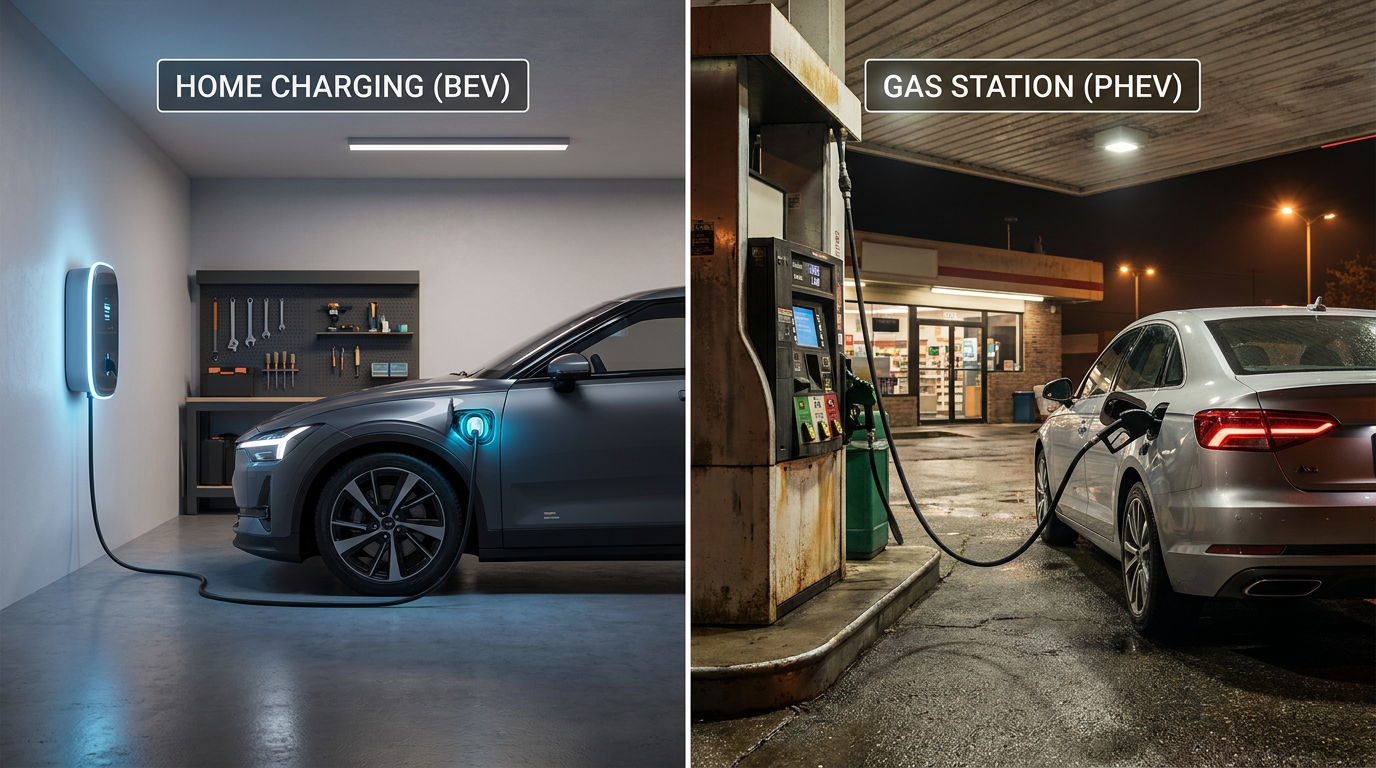
Understanding the mechanical divide is the first step. A Battery Electric Vehicle relies entirely on a massive lithium-ion or lithium-iron-phosphate battery pack and electric motors. It produces zero tailpipe emissions, requires no gasoline, and offers ranges that now routinely span 300 to 600 kilometers on a single charge. A Plug-in Hybrid Electric Vehicle, by contrast, attempts to offer the best of both worlds. It features a much smaller battery capable of 40 to 80 kilometers of pure electric driving, paired with a traditional internal combustion engine and a gas tank. When the battery depletes, the gas engine seamlessly takes over, transforming the car into a conventional hybrid for longer journeys.[6][9]
The case for the Battery Electric Vehicle centers on absolute efficiency, mechanical simplicity, and long-term cost savings. The evidence is compelling: without oil changes, spark plugs, catalytic converters, or complex multi-gear transmissions, BEVs cost roughly 40 to 50 percent less to maintain annually than vehicles with combustion engines. Furthermore, running on electricity is fundamentally cheaper than burning gasoline. Drivers who charge at home during off-peak hours pay a fraction of the equivalent petrol expense per mile. Over a five-year ownership period, these operational savings frequently offset the higher initial purchase price of the vehicle.[4][6]

Conversely, the argument against the BEV remains anchored in infrastructure and behavioral adaptation. While public fast-charging networks have expanded significantly by 2026, drivers without reliable access to dedicated home or workplace charging still face logistical hurdles. Relying solely on public chargers negates much of the cost savings and introduces the inconvenience of waiting 20 to 40 minutes for a battery top-up. Additionally, road trips require deliberate route planning around charger availability, and extreme cold weather can temporarily reduce battery range, making the pure electric option less viable for those living in charging deserts or rural areas.[1][5]
Conversely, the argument against the BEV remains anchored in infrastructure and behavioral adaptation.
For the Plug-in Hybrid, the primary advantage is unparalleled flexibility. The evidence supporting PHEVs highlights their ability to handle the average daily commute entirely on cheap electric power, while completely eliminating "range anxiety" during weekend road trips thanks to the backup gasoline engine. For drivers who want to dip their toes into electrification without altering their travel habits or worrying about broken public chargers, the PHEV presents a frictionless transition. It offers the quiet, smooth acceleration of an EV around town, with the five-minute refueling convenience of a gas car on the highway.[5][6]
However, the case against PHEVs is increasingly backed by damning real-world emissions and efficiency data. Because a PHEV carries the heavy weight of two complete powertrains, it operates inefficiently when the battery is depleted. Studies from environmental watchdogs reveal that PHEVs emit two to four times more carbon dioxide on the road than in laboratory tests. The reason is behavioral: a significant percentage of owners simply do not plug them in regularly. When driven primarily on gasoline, a PHEV is essentially a heavy, inefficient conventional car, failing to deliver on both its climate promises and its advertised fuel savings.[2][3]

Financial incentives and tax structures in 2026 are also forcing buyers to look closely at the math. In markets like the United Kingdom, Benefit-in-Kind tax rates heavily favor pure electrics, with BEVs attracting a 3 percent rate compared to 8 to 12 percent for most PHEVs. Over a multi-year ownership period, this translates to thousands in tax differences, making the BEV the undisputed financial winner for corporate fleets. Similarly, in Australia, the expiration of fringe benefits tax exemptions for PHEVs has shifted the economic calculus entirely toward pure electric models for business buyers.[4]
Ultimately, the decision requires an honest audit of daily driving habits and charging access. A Battery Electric Vehicle fits well when a driver has guaranteed overnight charging at home, predictable daily commutes, and a desire to maximize long-term savings while eliminating tailpipe emissions. It is the superior choice for multi-car households where the EV can serve as the primary daily driver. It does not fit well when a driver relies solely on public infrastructure, regularly tows heavy loads over long distances, or frequently travels through remote areas where charging stations remain sparse.[4][9]

A Plug-in Hybrid Electric Vehicle fits well when a driver has a short daily commute that falls within the 40-to-80-kilometer electric range, can charge reliably at home every night, but regularly takes long, unpredictable road trips into areas with poor infrastructure. It serves perfectly as a household's sole vehicle that must do everything. It does not fit well when the driver lacks home charging access, as running a PHEV strictly on gasoline negates its environmental benefits, accelerates engine wear, and results in higher fuel costs than purchasing a standard, lighter hybrid vehicle.[3][9]
How we got here
2010–2015
Early modern EVs and PHEVs, like the Nissan Leaf and Chevy Volt, enter the market with limited ranges, establishing the two distinct electrification paths.
2020–2022
BEV ranges routinely cross the 300-mile mark, leading many analysts to predict the imminent death of the plug-in hybrid.
2024–2025
Consumer demand for pure EVs softens due to high interest rates and infrastructure concerns, prompting automakers to pivot back to hybrid production.
2026
PHEVs see a resurgence in market share as a 'bridge technology,' though regulators increasingly scrutinize their real-world emissions.
Viewpoints in depth
Zero-Emission Purists
Advocates pushing for an immediate transition to fully electric vehicles.
This camp argues that plug-in hybrids are a compromised stopgap that ultimately delays the transition to a zero-emission future. By maintaining a combustion engine, PHEVs keep consumers tethered to fossil fuel infrastructure and require the extraction of both battery minerals and petroleum. They point to the rapidly expanding fast-charging networks and increasing BEV ranges as proof that the 'range anxiety' justifying PHEVs is an outdated concern.
Pragmatic Transition Advocates
Industry voices who see hybrids as a necessary bridge for mainstream adoption.
Proponents of this view, including several major legacy automakers, argue that the market cannot force consumers into pure electrics faster than the infrastructure allows. They view PHEVs as the perfect compromise, allowing drivers to complete 80% of their routine trips on electricity while retaining the freedom to travel anywhere without route-planning a charge. They also note that a single long-range BEV battery uses enough raw materials to build several PHEVs, making hybrids a more efficient use of scarce battery minerals.
Real-World Data Analysts
Researchers focused on actual telemetry, emissions, and total cost of ownership.
This group looks past the brochure promises and focuses on how the vehicles are actually used. Their data reveals a stark reality: many PHEV owners treat their cars like traditional hybrids, rarely plugging them in. Because PHEVs lug around the dead weight of an uncharged battery and an electric motor, their real-world fuel economy plummets, often resulting in higher emissions than a standard gas car. They argue that PHEVs only make sense for a highly disciplined driver who charges every single night.
What we don't know
- Whether the resale value of PHEVs will collapse as public fast-charging infrastructure becomes ubiquitous later in the decade.
- How upcoming regulatory changes in Europe and North America might penalize PHEVs if real-world emissions data continues to show drivers aren't plugging them in.
- Whether solid-state batteries, expected in the late 2020s, will make the dual-powertrain complexity of PHEVs entirely obsolete.
Key terms
- BEV (Battery Electric Vehicle)
- A vehicle powered entirely by a large battery pack and electric motors, producing zero tailpipe emissions and requiring external plug-in charging.
- PHEV (Plug-in Hybrid Electric Vehicle)
- A vehicle with both a rechargeable battery for short electric trips and a traditional gasoline engine that takes over for longer distances.
- Regenerative Braking
- A system that captures the kinetic energy normally lost during braking and converts it into electricity to recharge the vehicle's battery.
- Range Anxiety
- The fear that an electric vehicle will run out of battery power before reaching a destination or a suitable charging station.
- Benefit-in-Kind (BIK)
- A tax levied on employees who receive perks, such as a company car, which heavily influences fleet purchasing decisions in regions like the UK.
Frequently asked
Is a PHEV cheaper to maintain than a gas car?
Yes, but not as cheap as a BEV. Because the electric motor handles much of the daily driving, the gas engine experiences less wear and tear, and regenerative braking extends brake life. However, you still have to pay for oil changes and engine servicing.
What happens if I never plug in my PHEV?
The vehicle will operate using its gasoline engine, but it will get worse fuel economy than a standard car because it has to carry the heavy, unused battery. You also lose all the environmental and cost-saving benefits.
Do BEVs really cost 40% less to maintain?
Yes. Battery electric vehicles lack internal combustion engines, meaning they do not require oil changes, spark plug replacements, or transmission fluid flushes, drastically reducing annual maintenance bills.
Are there still tax incentives for buying these vehicles in 2026?
Incentives vary heavily by region. In the UK, BEVs enjoy massive Benefit-in-Kind tax advantages over PHEVs. In the US, federal tax credits still exist for both, but eligibility depends strictly on battery sourcing and vehicle price caps.
Sources
Source coverage
9 outlets
3 viewpoints surfaced









[1]International Energy AgencyPragmatic Transition Advocates
Global EV Outlook 2026: Market Trends
Read on International Energy Agency →[2]ForbesReal-World Data Analysts
Plug-In Hybrids Are Failing To Reduce Emissions As Claimed
Read on Forbes →[3]Climate CouncilReal-World Data Analysts
Hybrid Fuel Costs and Tailpipe Emissions Are Higher Than You Think
Read on Climate Council →[4]OrbisioReal-World Data Analysts
PHEV vs BEV: The 2026 Fleet Decision Guide
Read on Orbisio →[5]Edmunds Industry InsightsPragmatic Transition Advocates
Automakers Pivot to Hybrids as BEV Growth Slows
Read on Edmunds Industry Insights →[6]DriveLinePragmatic Transition Advocates
Hybrid vs Plug-in Hybrid vs Electric: Understanding the 3 Technologies
Read on DriveLine →[7]Autovista GroupZero-Emission Purists
Global electric vehicle sales see early 2026 shifts
Read on Autovista Group →[8]European CommissionZero-Emission Purists
European passenger plug-in vehicle market report
Read on European Commission →[9]Factlen Editorial TeamReal-World Data Analysts
Synthesis by Factlen editorial team
Read on Factlen Editorial Team →

Every angle. Every day.
Get guides stories with full source coverage and perspective breakdowns delivered to your inbox.