
The Science of Cloud-Like Bread: How the Tangzhong Method Transforms Flour and Water
By pre-cooking a small portion of flour and water, the tangzhong and yudane methods trigger starch gelatinization—a chemical reaction that allows bread to retain massive amounts of moisture, resulting in a remarkably fluffy, long-lasting crumb.
By Factlen Editorial Team
- Culinary Scientists
- Focuses on the chemical mechanics of starch gelatinization, amylase enzyme activity, and the delay of retrogradation.
- Home Bakers & Artisans
- Embraces the technique for its ability to create incredibly soft, easy-to-handle doughs and adapt enriched breads for vegan diets.
- Commercial Bakers
- Values the methods for extending shelf life naturally and reducing reliance on expensive fats, often preferring the scalable yudane technique.
What's not represented
- · Gluten-free bakers
- · Traditional European crusty-bread purists
Why this matters
Understanding starch gelatinization allows anyone to bake bakery-quality, preservative-free bread at home that stays fresh for days. It also offers a powerful technique for vegan baking, achieving brioche-like richness without relying on butter or eggs.
Key points
- Tangzhong and yudane are Asian baking techniques that pre-cook a portion of a recipe's flour and liquid.
- Heating the flour triggers starch gelatinization, allowing the dough to trap and hold significantly more water.
- The trapped moisture creates immense oven spring, resulting in a feathery, cloud-like crumb.
- Gelatinized starches are easily broken down into sugars by enzymes, which delays the staling process by several days.
- Tangzhong uses stovetop cooking for a fluffy crumb, while yudane uses boiling water for a chewier texture.
- The methods allow bakers to achieve brioche-like softness without relying heavily on butter or eggs.
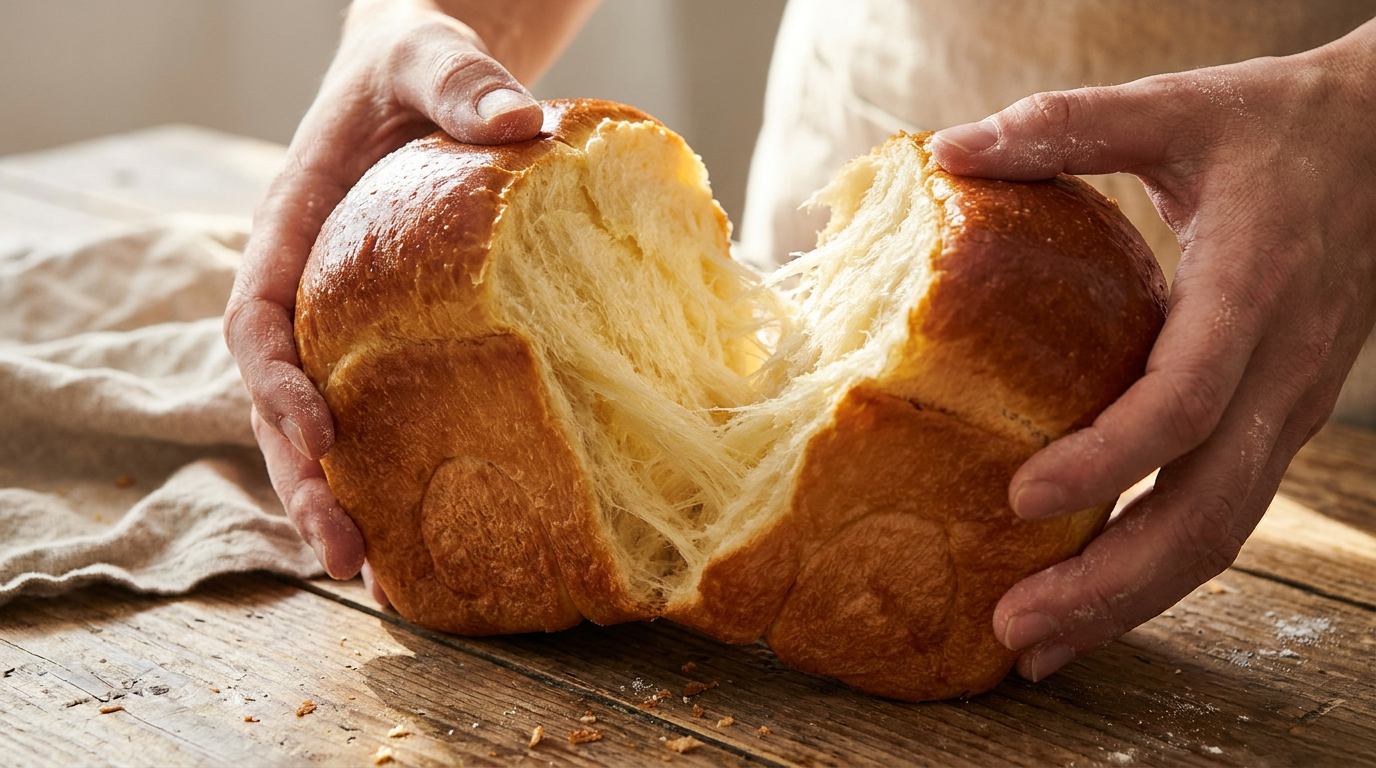
The pursuit of the perfect loaf of bread often leads bakers down two diverging paths. On one side is the European tradition, celebrated for its crackling, blistered crusts and chewy, open interiors. On the other side is the Asian bakery tradition, defined by Hokkaido milk bread—loaves so impossibly soft and feathery that they pull apart in delicate, cotton-like shreds.[1][3]
For decades, achieving that cloud-like texture at home seemed to require industrial dough conditioners or an excessive amount of butter and eggs. But the secret to this pillowy crumb is actually a simple, elegant piece of kitchen chemistry known as the "water roux" method.[1][2]
Known predominantly by two names—tangzhong and yudane—this technique involves pre-cooking a small portion of the recipe's flour and liquid before incorporating it into the main dough. The result is a bread that rises higher, stays softer for days longer, and handles beautifully on the kitchen counter.[5][6]
To understand why a simple flour paste transforms a loaf of bread, it helps to look at the history of its development. Following World War II, rice was heavily rationed in Japan, prompting a dramatic 50 percent drop in consumption. Wheat was introduced as a caloric replacement, but traditional crusty European breads did not appeal to local palates.[3]
Japanese bakers needed a bread that was softer, slightly sweeter, and capable of lasting longer on the shelf without going stale, especially in homes that lacked conventional ovens. Necessity became the mother of invention, and bakers began experimenting with pre-cooking starches, a technique that eventually evolved into the yudane and tangzhong methods used across Asia today.[2][3]
The magic of the water roux method comes down to a chemical process called starch gelatinization. Wheat flour is packed with microscopic starch granules. Under normal, room-temperature conditions, these granules absorb only a limited amount of water.[4][6]
However, when flour and water are heated to approximately 65 degrees Celsius (150 degrees Fahrenheit), the architecture of the starch begins to break down. The heat causes the starch granules to swell, absorb massive amounts of liquid, and eventually burst, creating a highly viscous, pudding-like gel.[2][4][6]

This gelatinization fundamentally changes the dough's hydration dynamics. In traditional bread making, adding more water to a recipe yields a softer crumb, but it also creates a sticky, unmanageable dough that is notoriously difficult to knead and shape.[5]
By pre-cooking a portion of the flour, bakers can force the starch to trap up to five times its weight in water. Because this water is locked inside the gelatinized starch matrix rather than floating freely, the final dough feels firm, smooth, and easy to handle, even though its overall water content is exceptionally high.[2][5][6]
By pre-cooking a portion of the flour, bakers can force the starch to trap up to five times its weight in water.
When the bread finally goes into the oven, all that trapped water turns into steam. This internal steam pushes against the gluten network, creating immense "oven spring" and forming the large, delicate bubbles that give milk bread its signature feathery texture.[4][5]
But the benefits of gelatinization extend far beyond the initial bake. The most frustrating aspect of homemade bread is its incredibly short shelf life. Within 24 hours, traditional loaves begin to stale—a process scientists call retrogradation, where starches recrystallize and harden.[4]
Tangzhong and yudane effectively short-circuit the staling process. Because the starches were pre-swollen and burst during the roux stage, they are far more accessible to amylase, a naturally occurring enzyme present in wheat flour.[4]
As the dough ferments and bakes, the amylase breaks down the gelatinized starches into smaller sugar molecules. These sugars not only add a subtle, natural sweetness to the crumb but also physically interfere with the starch's ability to recrystallize, keeping the bread soft and fresh for days longer than a standard loaf.[3][4]
While tangzhong and yudane rely on the exact same scientific principle, their preparation methods differ. Tangzhong, a technique popularized in Chinese baking, involves whisking flour and liquid—usually at a 1-to-5 ratio—in a saucepan over medium heat until it thickens into a paste.[5][6]
Yudane, which originated in Japan, is even simpler. It uses a 1-to-1 ratio of flour to boiling water. Instead of cooking the mixture on the stove, the baker simply pours the boiling water directly over the flour, stirs it into a thick, dough-like mass, and lets it cool.[6][7]

The two methods produce slightly different textural results. Tangzhong tends to yield a lighter, more delicate fluffiness, making it ideal for dinner rolls and brioche. Yudane, on the other hand, creates a crumb with a chewy, almost mochi-like resilience that is highly prized in Japanese sandwich loaves.[7]
For commercial bakeries, yudane is often the preferred choice. It requires less active cooking time, eliminates the variable of water evaporation on the stovetop, and is vastly easier to scale up in massive production facilities where pouring boiling water is simpler than cooking a slurry.[3][6]
Beyond texture and shelf life, these water roux methods offer a powerful tool for dietary adaptations. Because the gelatinized starch provides so much tenderness and structural support, bakers can achieve brioche-like softness without relying heavily on eggs, butter, or dairy.[5][6]

This makes tangzhong an invaluable technique for vegan baking, allowing plant-based milks and water to produce rich, tender breads that rival their heavily enriched, animal-product-based counterparts.[5]
Ultimately, the science of starch gelatinization democratizes bakery-level perfection. By simply taking five minutes to cook a few tablespoons of flour and water, any home baker can transform a standard recipe into a loaf of extraordinary, cloud-like softness.[1][5]

How we got here
Post-WWII
Rice rationing in Japan leads to a 50% drop in consumption, forcing a shift toward wheat-based diets.
Mid-20th Century
Japanese bakers adapt European bread techniques, developing starch-scalding methods to create softer, longer-lasting loaves for local palates.
Late 20th Century
The tangzhong method is formalized and popularized in Chinese baking, notably in the creation of Hokkaido milk bread.
2000s
Asian milk bread techniques gain global popularity through the internet, introducing Western home bakers to water roux methods.
Viewpoints in depth
Culinary Scientists
Focuses on the chemical mechanics of starch gelatinization, amylase enzyme activity, and the delay of retrogradation.
Food scientists view the tangzhong and yudane methods as elegant examples of applied chemistry. By forcing starch granules to swell and burst at 65°C, the technique fundamentally alters the dough's architecture. The resulting gel matrix not only holds up to five times its weight in water, but it also leaves the starches highly vulnerable to amylase enzymes. This enzymatic breakdown into simple sugars physically interrupts the recrystallization process known as retrogradation, explaining why these breads resist staling for days longer than standard loaves.
Commercial Bakers
Values the methods for extending shelf life naturally and reducing reliance on expensive fats, often preferring the scalable yudane technique.
For large-scale bakeries, the primary appeal of water roux methods is economic and logistical. Extending a product's shelf life by two to three days without artificial preservatives is a massive commercial advantage. Furthermore, the gelatinized starch provides so much inherent softness that manufacturers can reduce the amount of expensive butter and eggs in their formulas. At scale, commercial operations heavily favor the Japanese yudane method; pouring boiling water over flour in a mixer is vastly more efficient and consistent than cooking a tangzhong slurry on a stovetop.
Home Bakers & Artisans
Embraces the technique for its ability to create incredibly soft, easy-to-handle doughs and adapt enriched breads for vegan diets.
In the artisan and home-baking community, tangzhong is celebrated as a "magic trick" that solves the hydration paradox. Normally, adding enough water to achieve a fluffy crumb results in a sticky, frustrating dough. Because the water in a tangzhong is locked inside a gel, the dough remains smooth and workable. Additionally, plant-based bakers have championed the technique as the ultimate egg and dairy replacer, using it to bake rich, tender vegan brioche and cinnamon rolls that rival traditional recipes.
What we don't know
- The exact mathematical formula to calculate stovetop water evaporation during tangzhong preparation, which varies by kitchen environment.
- The precise historical moment when European flour-scalding techniques first merged with Asian baking traditions.
Key terms
- Starch Gelatinization
- The process where starch granules absorb water and swell when heated, eventually bursting to form a thick, moisture-trapping gel.
- Retrogradation
- The chemical process of bread staling, where starches slowly recrystallize and harden after baking.
- Tangzhong
- A Chinese baking technique that involves cooking a 1-to-5 ratio of flour and liquid into a paste to soften bread dough.
- Yudane
- A Japanese baking technique that involves pouring boiling water over flour in a 1-to-1 ratio to gelatinize the starches.
- Amylase
- An enzyme naturally present in flour that breaks down complex starches into simpler sugars.
- Hydration
- The ratio of liquid to flour in a bread dough, which dictates how soft the crumb will be and how sticky the dough is to handle.
Frequently asked
Can I add tangzhong to any bread recipe?
Yes, you can adapt most recipes by taking 5% to 10% of the recipe's total flour weight and mixing it with five times that amount of liquid from the recipe to create the roux.
Does the tangzhong method make bread taste sweet?
It adds a very subtle, natural sweetness. The gelatinized starches are broken down by enzymes in the flour into smaller sugar molecules during fermentation.
Can I make tangzhong or yudane ahead of time?
Yes. Both can be made a day in advance and stored in the refrigerator. In fact, using a chilled roux can help keep the final dough temperature down during mixing.
Which method is better: tangzhong or yudane?
Neither is strictly better; they serve different goals. Tangzhong yields a lighter, fluffier crumb, while yudane produces a chewier, more resilient texture and is slightly easier to prepare.
Sources
Source coverage
7 outlets
3 viewpoints surfaced







[1]Factlen Editorial TeamHome Bakers & Artisans
Synthesis by Factlen editorial team
Read on Factlen Editorial Team →[2]American Society of BakingCommercial Bakers
What is the tangzhong method?
Read on American Society of Baking →[3]Institute of Culinary EducationCulinary Scientists
Tangzhong Method: A Revolutionary Baking Technique
Read on Institute of Culinary Education →[4]American Chemical SocietyCulinary Scientists
Starch gelatinization, retrogradation, and the world's fluffiest white bread
Read on American Chemical Society →[5]The Perfect LoafHome Bakers & Artisans
What is Yudane (and How is it Different From Tangzhong)?
Read on The Perfect Loaf →[6]ChainBakerHome Bakers & Artisans
Tangzhong vs Yudane: Dough Improvers Explained
Read on ChainBaker →[7]Risen FlourHome Bakers & Artisans
Tangzhong vs Yudane: A Comprehensive Guide
Read on Risen Flour →
Every angle. Every day.
Get lifestyle stories with full source coverage and perspective breakdowns delivered to your inbox.