
The Neurobiology of Martial Arts: How Combat Sports Rewire the Brain for Resilience
New research reveals that martial arts training acts as a powerful neurophysiological intervention, elevating brain-boosting proteins and building profound emotional resilience.
By Aylin Aksoy

In short
- Martial arts training drives the brain into a 'quasicritical state,' optimizing adaptability and information processing.
- Complex cross-body movements elevate BDNF, a crucial protein for neuronal survival and memory.
- Non-contact boxing has emerged as a highly effective therapy for easing both motor and non-motor Parkinson's symptoms.
For decades, martial arts have been viewed through the narrow lens of physical combat and self-defense. But a quiet revolution in neuroscience is reframing the dojo as a laboratory for cognitive optimization. Researchers are moving beyond muscular endurance and cardiovascular metrics to study how striking and grappling physically rewire the human brain. The findings suggest that combat sports offer one of the most comprehensive neurophysiological interventions available, simultaneously developing multiple neural systems to build resilience, focus, and longevity.[4]
The foundation of this shift lies in the brain's capacity for neuroplasticity—its ability to form new neural connections in response to experience. A recent framework known as the Integrative Theory of Martial Arts (ITMA) posits that the unique combination of sensorimotor, cognitive, and social-emotional demands in martial arts drives the brain toward a "quasicritical state." This dynamic regime of neural activity balances order and chaos, optimizing the brain's ability to process information, adapt to stress, and maintain long-term health.[3]
At the molecular level, martial arts practice acts as a powerful catalyst for Brain-Derived Neurotrophic Factor (BDNF). Often described as "fertilizer" for the brain, BDNF is essential for neuronal survival and synaptic growth. While natural BDNF levels decline with age, contributing to memory loss and cognitive decline, the complex, cross-body movements required in martial arts consistently elevate peripheral BDNF levels. This neurobiological adaptation forms the basis for improved executive function, attention, and self-regulation across the lifespan.[3]
This neuroprotective effect has profound clinical implications, particularly for the estimated 10 million people worldwide living with Parkinson's disease. Boxing, once associated primarily with head trauma, has paradoxically emerged as a frontline defense against neurodegenerative decline. Non-contact boxing programs have gained widespread medical endorsement for their ability to target the specific motor deficits caused by Parkinson's.
A pilot study conducted by RUSH University demonstrated that a three-month community-based boxing program significantly eased both motor and non-motor symptoms in adults with early-stage Parkinson's. Researchers noted improvements not only in balance and gait but also in depression, anxiety, and sleep quality. The Perron Institute's FIGHT-PD study in Australia echoed these findings, with participants reporting enhanced overall well-being and, in some cases, the regained ability to run.[1]
The mechanism behind boxing's efficacy lies in its intense cognitive demands. Unlike walking on a treadmill, boxing requires rapid hand-eye coordination, multidirectional footwork, and the memorization of complex punch sequences. This forces the brain to build new neural pathways to bypass the damaged basal ganglia circuits characteristic of Parkinson's. By constantly challenging balance and spatial awareness, the brain is essentially tricked into repairing its own motor control networks.
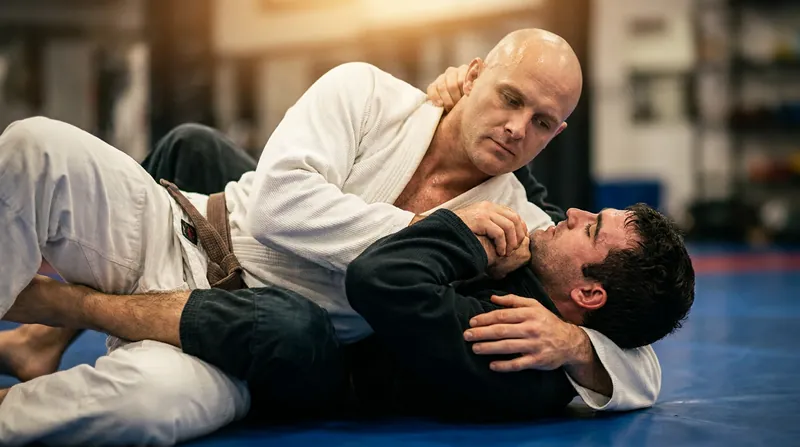
While striking arts excel at improving motor control, grappling disciplines like Brazilian Jiu-Jitsu (BJJ) are proving uniquely effective for emotional regulation and trauma recovery. BJJ is a close-contact martial art focused on ground fighting and submissions. It is physically exhausting and inherently claustrophobic, yet it is increasingly prescribed as an adjunctive therapy for veterans and first responders suffering from post-traumatic stress disorder (PTSD).[2]
Research from the University of Bath and Grand Canyon University has highlighted BJJ's impact on psychological well-being. A recent study found that 87.5% of adult BJJ practitioners reported reduced anxiety, while nearly 97% experienced an overall improvement in mood. The data revealed a positive correlation between BJJ participation and a reduction in clinical depression and PTSD symptoms, with participants successfully transferring the emotional discipline learned on the mats to real-world stressors.[2]
The therapeutic mechanism of BJJ can be described as "mindfulness under pressure." When a practitioner is pinned under a heavier opponent, the brain's natural amygdala response triggers panic and a surge of cortisol. BJJ forces the student to override this evolutionary alarm system. They must consciously regulate their breathing, relax their muscles, and logically problem-solve their way out of the hold.
Through repeated exposure to this controlled adversity, the brain learns to separate physical discomfort from psychological panic. This somatic processing builds profound emotional resilience. When practitioners encounter high-stress situations in their daily lives—a demanding presentation, a traffic incident, or an interpersonal conflict—their nervous systems are already conditioned to remain calm, assess the threat logically, and execute a measured response.
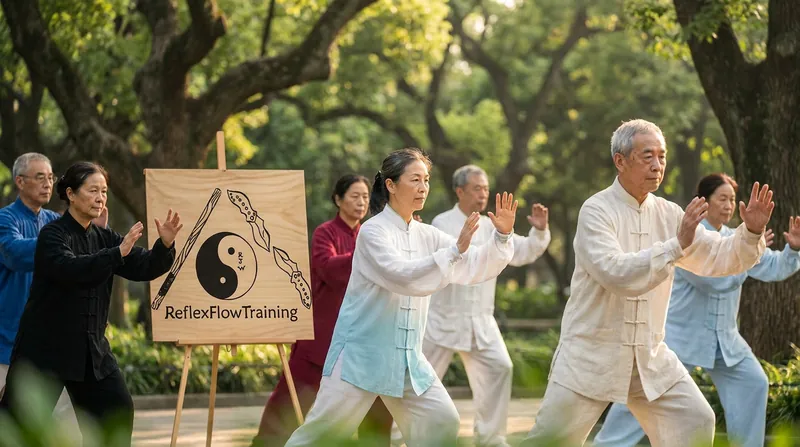
On the softer end of the martial arts spectrum, practices like Tai Chi offer powerful cognitive benefits through moving meditation. A recent study examined young adults who practiced Tai Chi for 45 minutes, three days a week. After just 12 weeks, researchers observed measurable changes in the participants' resting electroencephalographic (EEG) power bands.
Specifically, the Tai Chi practitioners showed a significant increase in alpha-band power (8-12 Hz). Alpha waves are associated with relaxed awareness, creativity, and the "flow state"—a state of optimal performance characterized by deep focus and effortless action. This increase in alpha activity provides a natural, neurological counterbalance to the chronic stress and beta-wave dominance that characterizes modern, screen-heavy lifestyles.
Beyond the individual neurobiology, the communal aspect of martial arts plays a critical role in mental health. The modern epidemic of loneliness is a recognized public health crisis, carrying mortality risks comparable to smoking. Martial arts academies offer a structured, egalitarian social environment where individuals from diverse backgrounds bond over shared physical struggle and mutual respect.[4]
In BJJ, for example, the necessity of physical touch and the absolute trust required to practice submission holds safely create deep interpersonal connections. Studies indicate that this group-based training significantly enhances social well-being, providing a sense of belonging that buffers against isolation and depressive symptoms.[2]
Despite these promising findings, researchers acknowledge several areas of uncertainty. Methodological inconsistencies, such as varying sample sizes and intervention designs, complicate the ability to issue standardized clinical guidelines. The optimal "dosing" of martial arts therapy—how many days a week, at what intensity, and for how long—remains an active area of investigation. Furthermore, longitudinal studies are needed to determine if these neuroplastic changes persist years after training ceases.[3]
Nevertheless, the convergence of ancient physical traditions and modern neuroimaging has established a clear paradigm shift. Martial arts are no longer just about learning how to fight; they are about learning how to live better. By engaging the body in complex, challenging movements, practitioners are actively sculpting more resilient, adaptable, and healthier brains.[4]
Key terms
- Neuroplasticity
- The brain's ability to reorganize itself by forming new neural connections throughout life in response to learning or experience.
- Brain-Derived Neurotrophic Factor (BDNF)
- A protein that acts like fertilizer for the brain, promoting the survival, growth, and maintenance of neurons.
- Alpha Brainwaves
- Neural oscillations in the 8 to 12 Hz range that are associated with relaxed alertness, meditation, and flow states.
- Executive Function
- A set of mental skills managed by the prefrontal cortex that include working memory, flexible thinking, and self-control.
- Somatic Processing
- A therapeutic approach that focuses on the physical connection between the mind and body to release trauma and regulate the nervous system.
Frequently asked
Is it safe for older adults to start martial arts?
Yes. Programs like non-contact boxing and modified Tai Chi are specifically designed for seniors and those with movement disorders, emphasizing balance and safety without the risk of impact.
Do I need to spar to get the brain benefits?
No. Studies show that drilling techniques, hitting pads, and practicing forms provide significant cognitive and neuroplastic benefits without the risk of head trauma.
How does grappling help with anxiety?
Grappling forces practitioners to regulate their breathing and stay calm in physically uncomfortable positions, training the brain to override panic responses in everyday stressful situations.
Viewpoints in depth
Neurobiological Lens
Viewing martial arts as a mechanism for physical brain repair and neurogenesis.
From a purely neurological standpoint, the complex movements of martial arts are a stress test for the brain's motor and spatial networks. Researchers in this camp focus on measurable biomarkers, such as the elevation of Brain-Derived Neurotrophic Factor (BDNF) and the strengthening of the cerebellum and prefrontal cortex. They argue that the cognitive load of memorizing combinations and reacting to an opponent forces the brain into a 'quasicritical state,' optimizing its ability to rewire damaged circuits, which is particularly vital for combating neurodegenerative diseases like Parkinson's.
Somatic Psychology Lens
Viewing martial arts as a tool for emotional regulation and trauma processing.
Psychologists and clinical therapists emphasize the mind-body connection forged on the mats. For individuals suffering from anxiety or PTSD, traditional talk therapy can sometimes fall short. This camp argues that martial arts—particularly grappling disciplines like Brazilian Jiu-Jitsu—provide a safe environment to experience and process physical stress. By repeatedly triggering and then consciously overriding the body's fight-or-flight response, practitioners build a somatic resilience that fundamentally alters how their nervous system reacts to everyday psychological stressors.
Public Health Lens
Viewing martial arts as a community-based intervention for social isolation and aging.
Public health advocates look beyond the individual brain to the social environment of the dojo. They highlight that martial arts academies naturally foster intergenerational socialization, mutual respect, and shared physical struggle. In an era marked by an epidemic of loneliness, this camp argues that the community aspect of training is just as therapeutic as the physical exertion, providing a crucial support network that buffers against depression and encourages long-term adherence to healthy habits.
- Neuroscientists & Researchers
- Focuses on the measurable neurobiological changes, such as BDNF elevation and neural pathway reconstruction, to treat cognitive decline.
- Clinical Therapists
- Views martial arts as an active form of somatic therapy that builds emotional regulation and resilience for trauma and anxiety.
- Public Health Advocates
- Emphasizes the accessibility, social connection, and holistic lifestyle benefits of community-based martial arts programs.
Perspectives this story doesn't cover
- Traditional martial arts purists who argue against medicalizing ancient practices
- Neurologists concerned about the inherent risks of head trauma in full-contact sparring
Sources
Source coverage
4 outlets
3 viewpoints surfaced




- [1]Perron InstituteNeuroscientists & Researchers
Boxing for Parkinson's study in full swing
Read on Perron Institute → - [2]University of BathClinical Therapists
Brazilian Jiu Jitsu's links to mental health explored in new research study
Read on University of Bath → - [3]PubMed CentralNeuroscientists & Researchers
Martial arts induce quasicritical brain states: a unified, multiscale, and mechanistic theory of brain health optimization
Read on PubMed Central → - [4]Factlen Editorial TeamPublic Health Advocates
Synthesis by Factlen editorial team
Read on Factlen Editorial Team →
More in Fitness
See all →Brain Health
The Neurological and Physical Case for Martial Arts in Aging
6 sources
Brain Health
How Brazilian Jiu-Jitsu Rewires the Brain for Resilience and Focus
4 sources
Boxing Reform
Senate Advances Bill to End Boxing's Sanctioning Body System, Allowing Unified League Structure
7 sources

Neuroscience
New Integrative Theory Proposes Martial Arts Induce 'Quasicritical Brain States' to Optimize Brain Function
4 sources
Comments
Every angle. Every day.
Get Fitness stories with full source coverage and perspective breakdowns, free every day.