
How Solid-State Batteries Work—and Why 2026 is Their Breakout Year
After decades of laboratory research, solid-state batteries are finally entering pilot production, promising to double EV ranges and eliminate fire risks.
By Factlen Editorial Team
- Solid-State Pioneers
- Legacy automakers and battery startups betting their future on the solid-state transition.
- Composite & Semi-Solid Adopters
- Manufacturers pushing for immediate, hybrid solutions rather than waiting for pure solid-state perfection.
- Lithium-Ion Pragmatists
- Industry leaders focused on scaling and cheapening existing battery tech over chasing new chemistry.
What's not represented
- · Raw Material Miners
- · Grid Infrastructure Operators
- · Fire and Rescue Services
Why this matters
Solid-state batteries promise to double the range of electric vehicles, cut charging times to 15 minutes, and eliminate the risk of battery fires. As this technology moves from the lab to the factory floor in 2026, it represents the final breakthrough needed to make EVs superior to gas-powered cars in every metric.
Key points
- Solid-state batteries replace flammable liquid electrolytes with a solid ceramic or polymer material.
- The technology eliminates the risk of thermal runaway and battery fires.
- Energy density is expected to double, enabling 600 to 800 miles of range on a single charge.
- QuantumScape and Greater Bay Technology are launching pilot production lines in 2026.
- High manufacturing costs and technical hurdles mean mass-market adoption will likely wait until 2028.
The electric vehicle industry is standing at a technological precipice in 2026. For decades, the "solid-state battery" has been the automotive sector's white whale—a theoretical holy grail of chemistry promising to double driving ranges, slash charging times to mere minutes, and completely eliminate the risk of fiery crashes. Now, after billions of dollars in research, countless missed deadlines, and years of skepticism, the technology is finally migrating from laboratory benches to factory floors. This transition marks one of the most significant leaps in energy storage since the commercialization of the lithium-ion battery in the early 1990s, promising to reshape not just cars, but the entire global energy grid.[6]
The shift is being driven by a sudden convergence of manufacturing breakthroughs across the globe. In California, Volkswagen-backed QuantumScape has officially inaugurated its "Eagle Line" for pilot production, preparing to test its cells in real-world vehicles this year. Simultaneously in China, Greater Bay Technology—backed by automaker GAC—claims it will achieve gigawatt-hour-scale mass production of a composite solid-state battery by the end of 2026. Meanwhile, legacy giants are proving the tech on the tarmac; Mercedes-Benz recently drove an EQS test vehicle over 740 miles on a single solid-state charge, and Toyota is aggressively preparing its own production lines for a commercial launch.[1][2][3]
To understand why this transition is so monumental, one must look inside the conventional lithium-ion batteries that currently power everything from smartphones to the Tesla Model Y. Traditional batteries rely on three primary components: a positive electrode known as the cathode, a negative electrode called the anode, and a liquid electrolyte. This liquid acts as a chemical swimming pool, allowing lithium ions to flow back and forth between the two electrodes during the charging and discharging process. It is a proven, highly efficient system that has enabled the modern portable electronics revolution.[4]
However, that liquid electrolyte is also the fundamental Achilles' heel of modern energy storage. It is composed of volatile, highly flammable organic solvents. If a lithium-ion cell is punctured in a severe car crash, or if it overheats due to an internal manufacturing defect, the liquid can quickly ignite. This triggers a catastrophic, self-sustaining chain reaction known as thermal runaway, which burns at extreme temperatures and is notoriously difficult for firefighters to extinguish. Managing this risk requires automakers to wrap battery packs in heavy armor and install complex, liquid-cooled thermal management systems.[4][5]

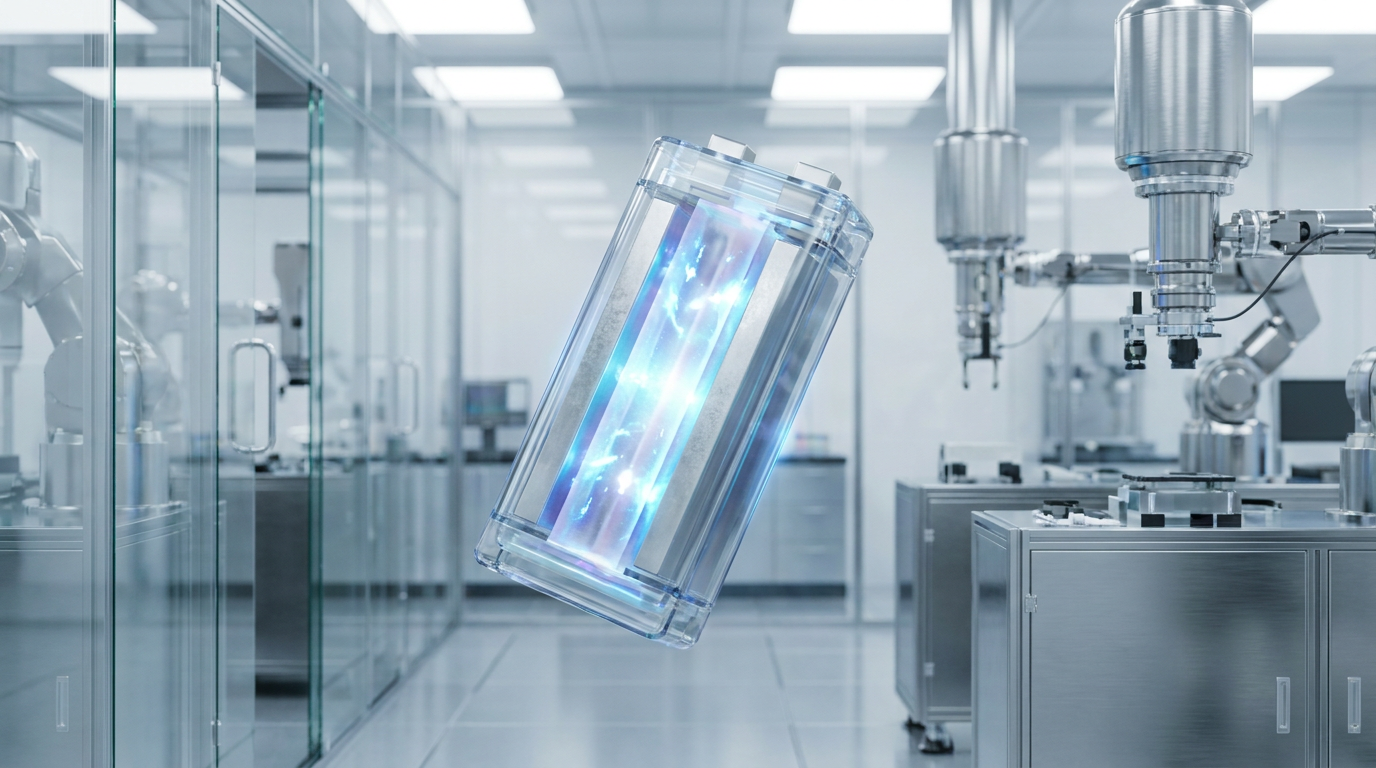
Solid-state batteries fundamentally rewrite this internal architecture. As the name implies, they replace the flammable liquid "juice" with a rigid, solid material—typically an advanced ceramic, a sulfide-based glass, or a specialized polymer. This solid separator takes on a dual role: it acts as an impenetrable physical barrier keeping the positive and negative electrodes apart, while still serving as the microscopic highway that allows lithium ions to pass through. It is a simple conceptual swap that requires unimaginably complex material science to execute.[4][5]
The most immediate and profound benefit of this solid architecture is absolute safety. Comparative laboratory testing demonstrates that thermal events in solid-state systems do not even begin until internal temperatures reach approximately 247 degrees Celsius. By contrast, conventional lithium-ion cells can begin to fail and vent dangerous gases at just 90 degrees Celsius. Without the flammable liquid solvent present, the risk of explosive thermal runaway is virtually eliminated. This inherent stability allows automakers to strip out the heavy, expensive cooling systems that currently weigh down modern electric vehicles.[5]
But safety is only half the story; the true prize driving billions in investment is energy density. Because the solid electrolyte is physically rigid and robust, it unlocks the use of a "lithium metal" anode. In traditional batteries, the anode is made of bulky graphite, which acts like a heavy sponge to hold lithium ions. A solid-state system discards the graphite entirely, allowing pure, metallic lithium to plate directly onto the anode during charging. This eliminates a massive amount of dead weight and wasted space inside the battery cell.[4][5]
But safety is only half the story; the true prize driving billions in investment is energy density.
This single material swap yields a staggering leap in overall performance. Pure lithium metal provides roughly ten times the specific capacity of traditional graphite. As a result, solid-state batteries entering production in 2026 are targeting energy densities of 400 to 500 watt-hours per kilogram (Wh/kg). By comparison, the absolute best lithium-ion cells on the market today hover between 200 and 260 Wh/kg. In practical terms, this means a solid-state battery can store twice as much energy in the exact same physical footprint.[5]

For the average consumer, this mathematical leap translates directly into total freedom from "range anxiety," which remains the primary barrier to EV adoption. A vehicle equipped with a next-generation solid-state pack could comfortably exceed 600 to 800 miles on a single charge without increasing the physical size or weight of the car. Alternatively, automakers could offer standard 300-mile ranges using battery packs that are half the size and half the weight, dramatically improving the vehicle's handling, braking distance, tire wear, and overall energy efficiency.[3][6]
Charging speeds are also poised for a radical revolution. Because solid electrolytes can withstand significantly higher voltages and temperatures without degrading or catching fire, these next-generation cells can accept massive influxes of electrical current. Leading developers project that solid-state EVs will soon be able to charge from 10 percent to 80 percent capacity in under 15 minutes. This effectively mirrors the convenience of a traditional gas station visit, eliminating the agonizing 40-minute highway charging stops that currently frustrate electric vehicle owners on long road trips.[3][4]
Despite these utopian specifications, the road to mass commercialization remains littered with microscopic, highly technical roadblocks. The most persistent challenge facing engineers is "interfacial impedance"—the electrical resistance that occurs exactly where the solid electrode meets the solid electrolyte. Unlike a liquid, which perfectly coats every microscopic crevice of an electrode like water filling a sponge, mashing two solid materials together often leaves microscopic air gaps. These tiny imperfections act like traffic jams, slowing down the transfer of ions and reducing the battery's overall power output.[4]
Another formidable hurdle is taming the very lithium metal anode that gives the battery its incredible power. During repeated charging and discharging cycles, lithium metal has a tendency to form microscopic, needle-like structures known as dendrites. If these sharp dendrites grow long enough to pierce the solid electrolyte, they can short-circuit the cell entirely. Companies like QuantumScape claim their proprietary ceramic separators are dense enough to physically block dendrite penetration, but proving this durability over a 100,000-mile vehicle lifespan under harsh real-world conditions is a grueling, multi-year process.[5]
Then there is the brutal, unforgiving reality of automotive manufacturing at scale. Building solid-state batteries requires entirely new assembly lines, pristine dry-room conditions, and immense mechanical pressure application during the manufacturing process. Sulfide-based electrolytes, which are highly favored by Toyota for their excellent conductivity, react violently with ambient moisture in the air to produce toxic hydrogen sulfide gas. This makes them a logistical nightmare to produce at the gigawatt-hour scale required to supply millions of consumer vehicles, driving up initial production costs astronomically.[2][4]

Because of these steep manufacturing hurdles, the industry is currently adopting a pragmatic, stepping-stone approach. "Semi-solid" batteries—which use a hybrid architecture of solid materials combined with a tiny amount of liquid electrolyte to bridge the microscopic gaps—are already hitting the market. Chinese automaker NIO, for instance, recently introduced a 150-kilowatt-hour semi-solid pack capable of pushing its flagship sedans past the 550-mile mark. These hybrid cells offer a middle ground, delivering increased energy density while remaining compatible with existing lithium-ion manufacturing equipment.[3]
True, all-solid-state batteries, however, are adhering to a strict, multi-year rollout timeline. The consensus among industry analysts is that 2026 and 2027 will see the initial introduction of small-batch, premium electric vehicles equipped with the technology, likely carrying a hefty price premium for early adopters. Toyota, which holds over 1,000 patents in the solid-state space, has publicly committed to integrating these advanced cells into production vehicles by 2028, signaling the moment the technology will truly reach the global mass market and begin trickling down to affordable commuter cars.[1][3]

Meanwhile, the current undisputed king of the electric vehicle market, Tesla, has remained conspicuously quiet on the solid-state front. Tesla's overarching strategy has been to ruthlessly optimize existing lithium-ion technology—specifically its proprietary 4680 cylindrical cells and cheaper, highly durable lithium iron phosphate (LFP) chemistries. For pragmatists and cost analysts, the argument is simple: until solid-state batteries can match the rock-bottom production costs and proven reliability of LFP cells, they will remain a luxury niche rather than a true market standard.[6]
Ultimately, 2026 marks the definitive end of the theoretical era for solid-state batteries and the undeniable beginning of their industrial reality. The underlying chemistry has been proven in the lab, and the physics are fundamentally sound. The remaining battle is purely one of engineering and economics—scaling a microscopic miracle into millions of vehicles affordably. When that threshold is finally crossed, it will not just improve the electric car; it will fundamentally alter the geometry of global transportation, leaving the internal combustion engine in the rearview mirror for good.[6]
How we got here
1990s-2010s
Solid-state technology remains largely confined to laboratory research and small electronics.
2020
QuantumScape goes public, injecting massive capital into solid-state automotive research.
2024
Chinese automakers begin deploying 'semi-solid' batteries with hybrid liquid-solid electrolytes.
2026
QuantumScape inaugurates pilot production lines; Greater Bay Technology targets GWh-scale manufacturing.
2027-2028
Toyota and other legacy automakers plan to launch their first small-batch EVs featuring true solid-state cells.
Viewpoints in depth
Solid-State Pioneers
Legacy automakers and battery startups betting their future on the solid-state transition.
Companies like Toyota, Mercedes, and QuantumScape view solid-state chemistry as the ultimate endgame for electric mobility. They argue that the massive investments required to build new dry-room manufacturing facilities will pay off by unlocking 800-mile ranges and 15-minute charge times. From their perspective, the current limitations of lithium-ion batteries—namely weight and fire risk—create a hard ceiling on EV adoption that only solid-state technology can shatter.
Composite & Semi-Solid Adopters
Manufacturers pushing for immediate, hybrid solutions rather than waiting for pure solid-state perfection.
Chinese battery giants and automakers like NIO and GAC are taking a more pragmatic, incremental approach. Rather than waiting for pure solid-state technology to overcome its manufacturing hurdles, they are aggressively rolling out 'semi-solid' batteries. By blending solid electrolytes with a small amount of liquid, they argue they can deliver 80% of the benefits of solid-state—including higher energy density and improved safety—while still utilizing existing lithium-ion manufacturing equipment to keep costs down today.
Lithium-Ion Pragmatists
Industry leaders focused on scaling and cheapening existing battery tech over chasing new chemistry.
Market leaders like Tesla and various cost analysts maintain a skeptical stance on the immediate impact of solid-state batteries. They argue that while the laboratory specs are impressive, the technology cannot currently compete with the sheer scale and plummeting costs of Lithium Iron Phosphate (LFP) cells. From this viewpoint, the EV revolution will be won by making reliable 300-mile batteries incredibly cheap, rather than making 800-mile solid-state batteries that only luxury buyers can afford.
What we don't know
- Exactly how much a solid-state battery replacement will cost once the vehicles hit the secondary market.
- Whether solid-state cells can truly maintain their performance over a 15-year, 150,000-mile lifespan in extreme real-world climates.
- If the supply chain for specialized solid electrolytes can scale fast enough to meet global automotive demand by 2030.
Key terms
- Electrolyte
- The medium inside a battery that allows ions to flow between the positive and negative sides during charging and discharging.
- Energy Density
- The amount of energy a battery can store relative to its weight or volume, typically measured in watt-hours per kilogram (Wh/kg).
- Thermal Runaway
- A dangerous chain reaction in traditional batteries where overheating causes the liquid electrolyte to catch fire or explode.
- Dendrites
- Microscopic, needle-like structures of lithium metal that can grow inside a battery and cause short circuits.
- Anode
- The negative electrode of a battery, which in solid-state designs can be made of pure lithium metal instead of bulky graphite.
Frequently asked
What makes a solid-state battery different?
It replaces the flammable liquid electrolyte found in traditional lithium-ion batteries with a solid material, like ceramic or glass, making it safer and more energy-dense.
Will solid-state batteries catch fire?
Because they lack flammable liquid solvents, solid-state batteries are highly resistant to thermal runaway and are virtually fire-proof under normal crash conditions.
When can I buy a car with a solid-state battery?
Semi-solid batteries are already entering the market in 2026. Fully solid-state vehicles are expected in small batches by 2027, with mass production scaling around 2028 to 2030.
Why are they taking so long to develop?
Manufacturing them requires entirely new assembly techniques, and engineers have had to solve microscopic issues like dendrite growth and electrical resistance between solid layers.
Sources
Source coverage
6 outlets
3 viewpoints surfaced






[1]CleanTechnicaSolid-State Pioneers
Solid-State Battery Milestones Appear Encouraging For Near Future
Read on CleanTechnica →[2]AutoblogComposite & Semi-Solid Adopters
Is 2026 the year EVs get fire-proof batteries?
Read on Autoblog →[3]EV Infrastructure NewsSolid-State Pioneers
Toyota solid-state Battery timeline: production plans and lifespan projections
Read on EV Infrastructure News →[4]SolarTech OnlineLithium-Ion Pragmatists
What Are Solid State Batteries? A Comprehensive Guide
Read on SolarTech Online →[5]To7 MotorLithium-Ion Pragmatists
Solid-State Batteries 2026: The Complete Guide
Read on To7 Motor →[6]Factlen Editorial TeamLithium-Ion Pragmatists
Synthesis by Factlen editorial team
Read on Factlen Editorial Team →

More in guides
See all 5 stories →Auto Tech
EV vs. PHEV in 2026: How to Choose the Right Electric Vehicle for Your Lifestyle
0 sources
Metabolic Health
The Science of Zone 2 Cardio: Why the 'Conversational Pace' is Revolutionizing Longevity
0 sources

Personalized Oncology
How mRNA Cancer Vaccines Work: The Science Behind the New Era of Personalized Oncology
0 sources

Every angle. Every day.
Get guides stories with full source coverage and perspective breakdowns delivered to your inbox.