
How Biophilic Design and Neuroaesthetics Are Rewiring the Modern Home
Architects and neuroscientists are utilizing biophilic design to create interior spaces that actively lower stress and improve cognitive function. By aligning our built environments with our evolutionary biology, homes are being transformed into restorative sanctuaries.
By Factlen Editorial Team
- Neuroarchitects & Researchers
- Focus on the empirical data linking spatial design to brain function and physiological health.
- Interior Designers & Architects
- Focus on the practical integration of natural patterns into modern living and working spaces.
- Wellness Advocates
- Focus on the holistic mental health benefits and the restoration of the human-nature connection.
What's not represented
- · Affordable Housing Developers
- · Commercial Facilities Managers
Why this matters
Americans spend roughly 90% of their time indoors, often in spaces that unconsciously elevate stress and deplete mental energy. Understanding how to incorporate natural patterns and materials into your home provides a scientifically backed, non-pharmacological way to improve your daily mental health and cognitive focus.
Key points
- Biophilic design goes beyond adding plants; it uses evolutionary biology to create spaces that lower cortisol and improve cognitive function.
- Neuroaesthetics reveals that natural patterns, like fractals and curved lines, activate the brain's pleasure centers and reduce mental fatigue.
- Direct nature (sunlight, water) and indirect nature (wood grain, earth tones) both successfully trigger the brain's innate safety cues.
- The shift toward 'salutogenic architecture' aims to make health-promoting interior design a standard, rather than a luxury.
Humans spent 99 percent of their evolutionary history outdoors, navigating forests, savannas, and coastlines where survival depended on reading the natural environment. Yet, modern living confines us inside for roughly 90 percent of our days. This profound shift has left our nervous systems navigating gray, enclosed spaces—concrete boxes, artificial lighting, and synthetic materials—that they were never biologically adapted to understand. The modern built environment is, in many ways, an alien landscape to the ancient human brain, creating a subtle friction between our biology and our architecture.[5]
The result of this evolutionary disconnect is a subtle but chronic baseline of environmental stress. When our surroundings lack the sensory inputs of nature—the shifting of natural light, the texture of organic materials, the sound of moving water—our bodies remain in a state of low-level alertness, draining our mental energy. However, a quiet revolution is taking place at the intersection of neuroscience and interior architecture, aiming to reverse this architectural anxiety and turn our homes into active participants in our mental health.[5][7]
It is called biophilic design—a framework that goes far beyond simply placing a potted plant in a corner or painting a living room wall green. It is a rigorous, evidence-based approach to building environments that actively lower cortisol, regulate heart rates, and improve cognitive function. By speaking the visual and tactile language our brains evolved to recognize and trust, biophilic design attempts to bridge the gap between modern indoor living and our innate biological need for the natural world.[1][6]
To understand how a living room or an office can act as preventative medicine, researchers look to the emerging field of 'neuroaesthetics.' This discipline studies how the human brain processes, interprets, and responds to beauty, art, and spatial design on a neurological level. It provides the empirical data explaining why certain rooms make us feel instantly at ease, while others leave us feeling drained, anxious, or claustrophobic without us consciously understanding why. By mapping brain activity in different architectural settings, neuroaesthetics proves that our reaction to a room is not just a matter of personal taste, but a hardwired biological response.[4]

Functional MRI (fMRI) studies reveal the profound impact of these environments. When humans are exposed to natural elements or nature-inspired architecture, the brain's orbitofrontal cortex—a region deeply linked to emotional regulation, decision-making, and pleasure—lights up. The space itself triggers the same neurological rewards as listening to a favorite piece of music or sharing a meaningful social connection. This positive neural activation helps to actively suppress the amygdala, the brain's fear and stress center, fostering an immediate sense of calm.[4]
Conversely, rigid geometry, harsh artificial lighting, and synthetic materials force the brain to work harder to process its surroundings. This constant, low-level visual friction depletes cognitive resources, increasing mental fatigue and making it harder to concentrate or relax at the end of the day. When a space lacks the fractal complexity and organic flow of nature, the brain searches for safety cues that aren't there, leading to a subtle but persistent cognitive drain that impacts everything from our mood to our immune system.[6]
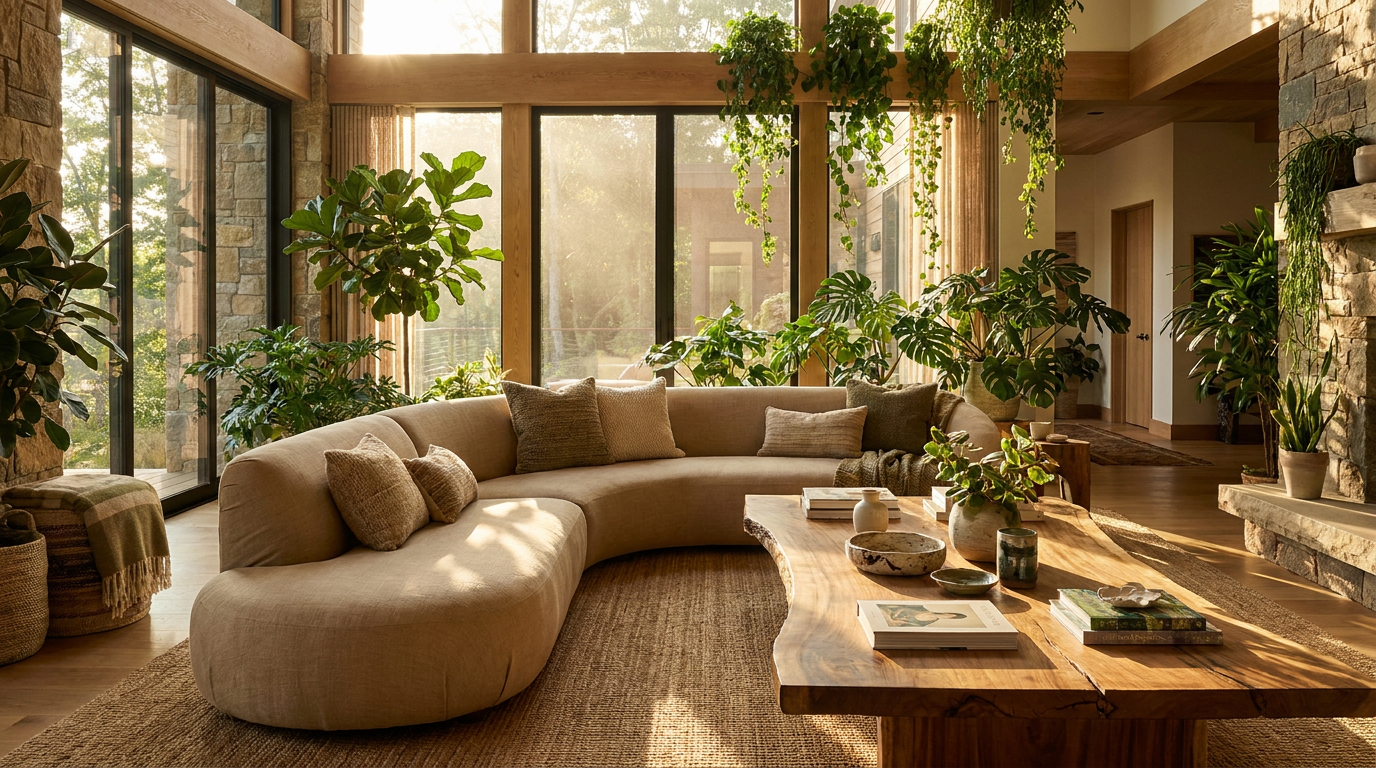
Biophilic design counters this cognitive drain through two primary avenues: direct and indirect experiences of nature. Direct experiences are exactly what they sound like—the literal, living elements of the outdoors brought inside the building envelope. These are the most immediate ways to trigger our evolutionary safety cues, signaling to the brain that we are in an environment capable of sustaining life. By integrating these raw elements into our daily habitats, designers can immediately lower the physiological markers of stress and create spaces that feel vibrant and alive.[5]
These direct interventions include maximizing natural sunlight to regulate our circadian rhythms, ensuring that our bodies know when to be alert and when to prepare for rest. They also incorporate moving water for acoustic masking and stress relief, and integrate living greenery to improve indoor air quality. Beyond just filtering the air, the visual presence of plants provides essential 'micro-breaks' for tired eyes, allowing the nervous system to momentarily reset during a busy day. Even the simple act of ensuring a clear, unobstructed view of the sky or a nearby tree canopy from a desk or reading chair constitutes a vital direct biophilic experience.[3][5]
They also incorporate moving water for acoustic masking and stress relief, and integrate living greenery to improve indoor air quality.
But indirect experiences are where neuroarchitecture truly shines, proving that you don't need a literal indoor jungle to reap the benefits of biophilia. The human brain does not necessarily need a living tree to feel safe; it responds powerfully to the patterns, textures, and representations of nature. Indirect biophilia is about mimicking the essence of the outdoors, using design psychology to trick the brain into experiencing the restorative effects of a natural landscape even in the heart of a dense urban metropolis.[4]

This involves the deliberate use of natural materials like unvarnished wood, textured stone, and raw clay. These materials offer tactile engagement and subtle olfactory cues that synthetic plastics and laminates simply cannot replicate. When we run our hands over the grain of a wooden table or walk across a natural stone floor, we are grounded in the physical world, satisfying a primal sensory hunger that sterile, mass-produced modern interiors often starve. The authenticity of these materials—their imperfections, their warmth, and the way they age over time—communicates a sense of permanence and organic reality to our subconscious.[5]
Indirect biophilia also includes the integration of 'fractals'—complex, repeating geometric patterns found abundantly in leaves, snowflakes, and coastlines. Exposure to fractal-rich environments has been shown to induce a mild meditative state, allowing the mind to wander and recover from directed attention fatigue. Whether incorporated through wallpaper motifs, the arrangement of floor tiles, or the structural design of a ceiling, these natural geometries provide the exact level of visual complexity that the human brain evolved to process effortlessly. This effortless processing is the core of Attention Restoration Theory, which posits that nature-inspired patterns give our active, focused minds a much-needed opportunity to rest and recharge.[4][6]
The cognitive benefits of these interventions are highly measurable. A 2025 study highlighted by the National Institutes of Health demonstrated that indoor environments utilizing biophilic elements significantly improved working memory and cognitive performance. Remarkably, these benefits were observed even in patients who had no direct access to the outdoors, proving that simulated nature and indoor biophilic design can serve as a highly effective, non-pharmacological intervention for cognitive health and stress management. The researchers concluded that optimizing a room's spatial arrangement and material palette could actively enhance a patient's psychological resilience and speed up their overall recovery process.[1]
The Global Wellness Institute similarly points to recent research indicating that nature-inspired design can positively influence brain plasticity. The data suggests that environments rich in biophilic cues help stimulate areas of the brain critical for emotional regulation and memory retention. By consistently exposing the brain to environments that signal safety and abundance, biophilic interiors may actually help rewire our neural pathways to be more resilient against the daily anxieties of modern life. This intersection of architecture and neuroplasticity suggests that our homes are not just static backdrops, but active participants in shaping our long-term mental health.[2]

In residential design, these principles translate to spaces that mimic the evolutionary concept of 'refuge and prospect.' Humans instinctively prefer environments where they feel sheltered and safe from behind—the refuge—while maintaining a clear, expansive view of their surroundings—the prospect. A reading nook tucked into a corner with a view out a large window perfectly encapsulates this biological preference, providing the deep psychological comfort of a safe vantage point. Designers are increasingly prioritizing these layouts, ensuring that living spaces offer both cozy, enclosed areas for retreat and open, airy sightlines that prevent feelings of claustrophobia.[6]
To achieve this sense of organic comfort, architects are increasingly replacing rigid, right-angled floor plans with curvilinear spaces and organic asymmetry. Studies show that curved forms activate the brain's comfort centers, signaling safety and reducing the unconscious anxiety triggered by sharp, enclosed corners. Just as there are very few perfect right angles in a forest or a riverbed, introducing sweeping curves and soft edges into a home helps the space feel more intuitive and welcoming to the human nervous system. This departure from the harsh, boxy aesthetics of traditional modernism represents a return to forms that feel inherently more human.[4][5]
The benefits extend far beyond the psychological realm. The Stress Reduction Theory (SRT) posits that because we have a natural affinity for the living world, environments that simulate nature physically lower blood pressure, slow the heart rate, and expedite physical healing. Hospitals that have integrated biophilic principles—such as providing patients with views of nature or incorporating natural wood finishes—consistently report shorter postoperative stays and a reduced need for potent pain medication among their patients. These physiological metrics provide undeniable proof that our bodies react to our architectural surroundings just as strongly as they react to diet or exercise.[6]
Prominent designers note that these physiological reactions are spontaneous and universal. When a space is calibrated to human biological parameters, it induces the production of compensatory hormones that support collaboration, interconnectedness, and a profound sense of calm. It shifts the design paradigm from asking 'how does this space look?' to 'how does this space make the occupant feel on a cellular level?' By prioritizing the nervous system over pure aesthetics, designers can craft environments that actively buffer against the chronic stress of contemporary life, turning the home into a true sanctuary.[3]

Ultimately, the shift toward biophilic interiors represents a broader move toward 'salutogenic architecture'—buildings designed not just to shelter us from the elements, but to actively promote human health, resilience, and flourishing. It is an acknowledgment that we cannot separate human well-being from the habitats we construct for ourselves. As the science of neuroaesthetics continues to evolve, biophilic design will likely transition from a luxury amenity to a fundamental standard in residential and commercial building codes. The realization that our walls, floors, and windows can function as tools for preventative healthcare is fundamentally changing the future of the construction industry.[1]
As our lives become increasingly digital and urbanized, our homes must serve as restorative sanctuaries. We can no longer afford to live in spaces that fight against our biology. By aligning our interior spaces with our evolutionary wiring—embracing natural light, organic textures, and the complex patterns of the living world—we can transform the built environment from a source of invisible stress into a powerful, daily foundation for our physical and mental well-being. The quiet revolution of biophilic design proves that the ultimate sophistication in architecture is not found in conquering nature, but in welcoming it back indoors.[5][7]
How we got here
1984
Biologist E.O. Wilson popularizes the 'Biophilia Hypothesis,' suggesting humans possess an innate tendency to seek connections with nature.
1984
Roger Ulrich publishes a landmark study showing hospital patients with views of nature recover faster and need less pain medication.
2014
The '14 Patterns of Biophilic Design' framework is published, providing architects with a standardized way to integrate nature into the built environment.
2025
New fMRI studies and neuroaesthetic research explicitly link indoor biophilic environments to improved brain plasticity and working memory.
Viewpoints in depth
Neuroarchitects & Researchers
Focus on the empirical data linking spatial design to brain function and physiological health.
This camp relies on fMRI scans, cortisol tracking, and cognitive testing to prove that our built environments physically alter our nervous systems. They argue that humans are biologically maladapted to rigid, synthetic spaces, and view biophilic design not as an aesthetic choice, but as a necessary public health intervention to combat chronic environmental stress.
Interior Designers & Architects
Focus on the practical integration of natural patterns into modern living and working spaces.
For practitioners, the challenge lies in translating evolutionary biology into functional, beautiful spaces. They emphasize the 14 patterns of biophilic design, utilizing tools like circadian lighting, acoustic dampening, and tactile materials (like unvarnished wood and stone) to create sensory-rich environments that satisfy the brain's craving for nature without requiring a literal indoor jungle.
Wellness Advocates
Focus on the holistic mental health benefits and the restoration of the human-nature connection.
This perspective champions biophilic design as an antidote to the burnout and anxiety of the digital age. Drawing on Attention Restoration Theory, they highlight how spaces that mimic nature provide the mind with essential 'micro-breaks,' allowing directed attention to rest and fostering a deeper sense of emotional grounding and vitality.
What we don't know
- The exact dosage of biophilic exposure required to achieve specific cognitive benefits remains ambiguous, making it difficult to standardize therapeutic design guidelines.
- How different demographics and neurodivergent individuals respond to specific biophilic patterns compared to the neurotypical baseline.
Key terms
- Biophilia
- The innate human instinct to connect with nature and other living systems.
- Neuroaesthetics
- The scientific study of the neural bases for the contemplation and creation of a work of art or design.
- Salutogenic Architecture
- An approach to design that focuses on factors that support human health and well-being, rather than on factors that cause disease.
- Attention Restoration Theory (ART)
- A psychological theory asserting that people can concentrate better after spending time in nature or looking at scenes of nature.
- Fractals
- Complex, repeating geometric patterns found in nature that have been shown to reduce stress when incorporated into visual design.
Frequently asked
Do I need a lot of plants for biophilic design to work?
No. While living plants are a great direct experience of nature, biophilic design also relies heavily on indirect elements like natural light, wood textures, earth tones, and curved architectural lines.
Can biophilic design actually improve my health?
Yes. Studies show that incorporating natural elements into indoor spaces can lower cortisol levels, reduce blood pressure, and improve cognitive function and working memory.
What is the difference between biophilic design and regular interior design?
Traditional interior design often prioritizes aesthetics or trends, whereas biophilic design is an evidence-based approach rooted in evolutionary biology and neuroscience, aimed specifically at optimizing human well-being.
Sources
Source coverage
7 outlets
3 viewpoints surfaced







[1]National Institutes of HealthNeuroarchitects & Researchers
Effects of indoor biophilic environments on cognition
Read on National Institutes of Health →[2]Global Wellness InstituteNeuroarchitects & Researchers
Biophilic Design: Healthy Buildings, Healthy Brain
Read on Global Wellness Institute →[3]Interni MagazineInterior Designers & Architects
Oliver Heath on the power of biophilic design
Read on Interni Magazine →[4]Pearl AcademyNeuroarchitects & Researchers
The Brain, Beauty, and Built Environments
Read on Pearl Academy →[5]IntexcoreInterior Designers & Architects
How Biophilic Design Works in Practice
Read on Intexcore →[6]BiofilicoWellness Advocates
The Science-Backed Benefits of Biophilic Design
Read on Biofilico →[7]Factlen Editorial TeamWellness Advocates
Synthesis by Factlen editorial team
Read on Factlen Editorial Team →
Every angle. Every day.
Get home stories with full source coverage and perspective breakdowns delivered to your inbox.