
How Cryptographic Provenance and Invisible Watermarks Are Securing the 2026 Elections
A new multi-layered infrastructure of digital credentials and neural forensics is successfully empowering voters to detect AI deepfakes ahead of the midterms.
By Factlen Editorial Team
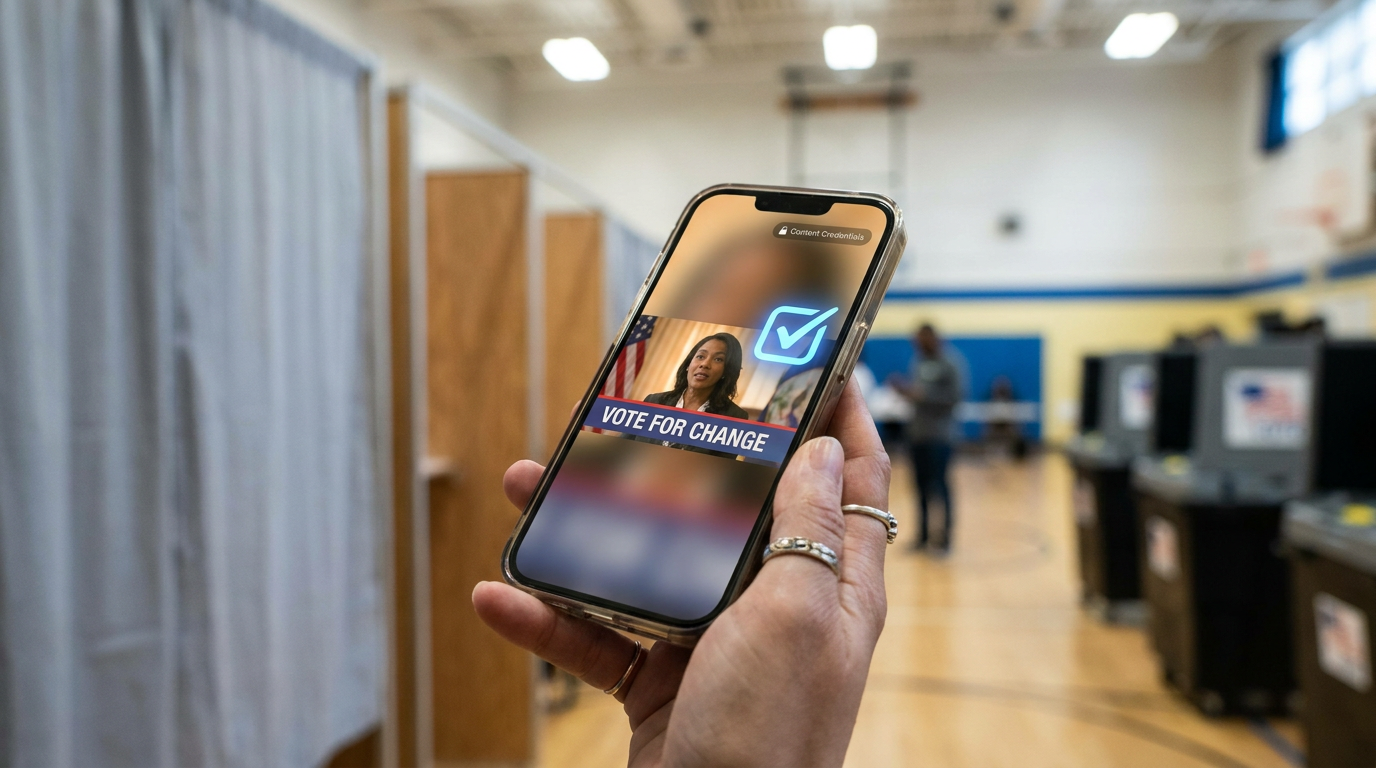
- Provenance Advocates
- Argue that cryptographic metadata and watermarking are the only scalable way to rebuild trust by labeling authentic content at the source.
- Threat Intelligence & Security
- Argue that metadata will inevitably be stripped by bad actors, requiring active forensic detection and real-time analysis to catch deepfakes.
- Policymakers & Regulators
- Argue that voluntary tech standards are insufficient and demand legal mandates and liability for platforms that distribute unmarked synthetic media.
- Voters & Civil Society
- Require transparent, easy-to-use verification tools that do not demand technical expertise to understand what they are seeing.
What's not represented
- · Independent creators concerned about the financial cost of implementing cryptographic signatures.
- · Voters in rural or low-bandwidth areas who may lack access to real-time verification tools.
Why this matters
As generative AI makes it impossible to trust our own eyes and ears, a new multi-layered verification infrastructure is empowering voters to definitively check the authenticity of political media. This shift from reactive fact-checking to proactive cryptographic proof ensures that deceptive deepfakes can be exposed before they influence the 2026 elections.
Key points
- The technology industry has deployed a three-layered defense against deepfakes: cryptographic metadata, invisible watermarking, and neural forensics.
- The C2PA standard acts as a digital nutrition label, embedding a tamper-evident history directly into media files.
- Google's SynthID watermark survives cropping and compression, ensuring AI-generated content remains detectable even if metadata is stripped.
- Major platforms like Google, OpenAI, and Meta have natively integrated these verification tools ahead of the 2026 midterms.
- Advanced forensic models now analyze biological signals, such as simulated blood flow, to catch deepfakes that bypass standard credentials.
The 2026 election cycle was widely predicted to be the "deepfake election," a chaotic environment where synthetic media would overwhelm voters and fact-checkers alike. With generative artificial intelligence tools crossing the threshold of human perception—capable of producing photorealistic video and cloning voices from mere seconds of audio—the threat of synthetic October surprises loomed large over the democratic process. Early indicators were troubling, with dozens of AI-generated campaign ads airing in the months leading up to the midterms, and identity fraud attack rates surging globally.[1][6]
But instead of succumbing to a purely reactive panic, the technology and fact-checking industries have mounted an unprecedented, coordinated defense. A multi-layered infrastructure of cryptographic provenance, invisible watermarking, and advanced forensic detection is now actively shielding the information ecosystem across major platforms. This collaborative effort has transformed deepfake detection from a niche research curiosity into a robust, scalable utility that empowers voters, journalists, and civil society organizations to verify the media they consume with absolute cryptographic certainty. The shift represents a rare moment where defensive technology has successfully outpaced offensive capabilities just in time for a major election.[4][7]
This shift represents a fundamental change in how digital truth is established online. Rather than playing an endless game of "whack-a-mole" by attempting to detect and debunk fakes only after they go viral, the new paradigm relies on establishing a verifiable chain of custody at the source. The industry has rallied around the concept of a digital nutrition label—a transparent, tamper-evident record that travels alongside the media, allowing anyone to see exactly how and when a piece of content was created.[5]
The backbone of this transparency effort is the Coalition for Content Provenance and Authenticity, universally known as C2PA. In May 2026, this open technical standard reached a critical mass of adoption when OpenAI officially joined the steering committee. Simultaneously, Google announced that native C2PA verification would be built directly into the Chrome browser and Google Search, ensuring that billions of users would have immediate access to provenance data without needing specialized software.[2][4]

The mechanism behind C2PA relies on secure, cryptographic signatures rather than easily manipulated text fields. When an image or video is created—whether generated by an AI model or captured by a physical camera from participating manufacturers like Sony and Nikon—a secure manifest is embedded directly into the file. This manifest records the hardware or software used, the exact timestamp, and any subsequent edits applied to the media.[5]
Because this provenance data is secured by cryptography, any attempt to maliciously alter the file or tamper with the metadata immediately invalidates the digital signature. When a user or a social media platform inspects the file, the broken signature serves as an immediate red flag that the media's history has been compromised, alerting fact-checkers to potential deception. This binary verification—either the signature is mathematically valid or it is not—removes the ambiguity that previously plagued digital forensics, providing a definitive answer regarding a file's origins.[4][5]
However, security researchers quickly identified that metadata alone is a fragile defense against dedicated adversaries. Bad actors can easily circumvent C2PA credentials by taking a simple screenshot of an AI-generated image or running a video through a basic format converter that strips out the embedded manifest. Once the metadata is removed, the file appears as an untraceable orphan, leaving traditional provenance systems blind and forcing platforms to rely on secondary detection methods to determine authenticity. This vulnerability necessitated a more resilient approach that could survive aggressive digital laundering.[4]
However, security researchers quickly identified that metadata alone is a fragile defense against dedicated adversaries.
To close this critical loophole, the technology sector has widely adopted invisible watermarking as a mandatory second layer of defense. The most prominent of these systems is Google DeepMind's SynthID, which has become a de facto industry standard for securing synthetic media. Unlike metadata, which lives in the file container, SynthID embeds a digital signal directly into the pixels of an image or the waveform of an audio track.[4]
This invisible watermark is entirely imperceptible to the human eye or ear, but it can be reliably detected by specialized verification algorithms. Crucially, the SynthID signal is designed to be highly resilient; it survives aggressive cropping, heavy file compression, color filtering, and even screenshot capture with a reported reliability rate of 98 percent, ensuring the AI origin remains detectable even if the C2PA metadata is stripped.[4]

The integration of these two technologies was cemented during the May 2026 announcements, when OpenAI confirmed it would begin embedding SynthID watermarks alongside C2PA credentials in all content generated by ChatGPT and the DALL-E API. By combining the rich, contextual history of cryptographic metadata with the durable, tamper-resistant nature of invisible watermarks, the industry has created a formidable dual-layer defense system.[2][4]
For sophisticated threat actors who attempt to bypass both metadata and watermarks—often by using open-source AI models hosted in jurisdictions that ignore these standards—a third layer of defense has rapidly matured: advanced neural forensics. Threat intelligence firms and identity verification platforms have deployed specialized AI models designed specifically to hunt other AI models, creating an automated immune system that constantly scans for the subtle imperfections left behind by synthetic generation. These forensic networks operate continuously in the background, analyzing millions of media files to identify anomalies that human moderators could never spot.[6]
These forensic tools analyze subtle statistical artifacts and biological signals that generative models struggle to replicate perfectly. For example, some real-time video detection systems now use photoplethysmography, a technique that analyzes microscopic changes in pixel color corresponding to human blood flow. By detecting the absence of a genuine human pulse in a video, these systems can identify synthetic faces in milliseconds.[6]
Rather than existing solely in academic labs, these forensic tools are now integrated directly into the moderation pipelines of major social media networks and the onboarding workflows of financial institutions. They serve as an active monitoring layer, scanning millions of uploads daily and flagging deepfakes that attempt to bypass standard liveness checks or masquerade as authentic political evidence. This real-time integration ensures that synthetic media is often quarantined before it can achieve viral distribution among the electorate. The speed of this automated detection is critical for stopping misinformation in its tracks.[6]

The deployment of this technology has been significantly accelerated by a hardening regulatory landscape. Following intense pressure from lawmakers, including stark warnings from the Senate Intelligence Committee regarding the vulnerability of the 2026 midterms, technology platforms are facing unprecedented scrutiny to enforce these authenticity standards proactively rather than waiting for public outcry. Regulators have made it clear that voluntary compliance is no longer sufficient, prompting a massive wave of mandatory security upgrades across the tech sector. This political pressure has effectively forced the industry to prioritize election integrity over frictionless content sharing.[3]
State and federal legislation in 2026 has expanded significantly beyond merely punishing the individual creators of malicious deepfakes. New regulatory frameworks are increasingly placing liability on the platforms, payment processors, and hosting services that facilitate the distribution of unmarked synthetic media, forcing the entire digital supply chain to adopt C2PA and watermarking standards. By targeting the financial and infrastructural incentives of deepfake distribution, lawmakers have created a powerful deterrent against the weaponization of generative artificial intelligence. This holistic approach ensures that bad actors have fewer avenues to monetize or broadcast their deceptive content.[8]
The result of this massive technological and regulatory mobilization is a radically different information environment than the one voters navigated in 2024. When a deceptive political ad or a sensational audio clip surfaces today, journalists and fact-checkers no longer have to rely on subjective visual analysis; they can instantly inspect the cryptographic signature, scan for SynthID, or run court-ready forensic analysis.[1][7]
While the arms race between generative AI capabilities and detection technologies will undoubtedly continue indefinitely, the 2026 midterms are proving to be a watershed moment for digital trust. By building a transparent, multi-layered infrastructure for digital provenance, democratic institutions and technology consortiums are successfully protecting the shared baseline of reality. This comprehensive defense strategy not only mitigates the immediate threat of election interference but also establishes a permanent, empowering framework that allows voters to navigate the digital world with renewed confidence.[7]
How we got here
2023
Google DeepMind launches SynthID for imperceptible watermarking.
Jan 2024
AI-generated voice clone of President Biden used in New Hampshire primary robocalls.
2025
Federal Take It Down Act passes, targeting AI-generated non-consensual content.
May 2026
OpenAI joins C2PA steering committee and Google announces native Chrome/Search verification.
Viewpoints in depth
Provenance Advocates
Argue that cryptographic metadata and watermarking are the only scalable way to rebuild trust.
Technology platforms and the C2PA consortium argue that attempting to detect every deepfake after it has been created is a losing battle. Instead, they advocate for a proactive approach: labeling authentic content at the source. By embedding cryptographic signatures into media at the moment of capture or generation, they believe the industry can create a transparent ecosystem where voters can instantly verify the origin of any image or video, shifting the burden of proof away from fact-checkers.
Threat Intelligence & Security
Argue that metadata will inevitably be stripped, requiring active forensic detection.
Cybersecurity vendors and threat intelligence firms caution against over-relying on C2PA credentials. They point out that sophisticated bad actors will always find ways to strip metadata or bypass watermarks, often by using open-source AI models hosted in unregulated jurisdictions. This camp emphasizes the critical need for active forensic detection, threat monitoring, and real-time analysis of biological signals to catch the deepfakes that successfully evade standard credentialing systems.
Policymakers & Regulators
Argue that voluntary tech standards are insufficient and demand legal mandates.
Lawmakers at both the state and federal levels argue that the technology industry cannot be trusted to self-regulate when democratic institutions are at stake. They demand strict legal mandates requiring the use of watermarks and provenance tags, coupled with severe liability for platforms, payment processors, and hosting services that distribute unmarked synthetic media. This camp believes that only the threat of significant financial penalties will force the entire digital supply chain to adopt necessary security measures.
What we don't know
- Whether open-source AI models hosted overseas will ever comply with C2PA or watermarking standards.
- How quickly adversarial AI networks will develop techniques to successfully scrub SynthID watermarks without degrading the image.
Key terms
- C2PA
- An open technical standard that securely attaches information about the origin and edit history of digital media.
- SynthID
- A technology developed by Google DeepMind that embeds imperceptible digital watermarks into AI-generated images, audio, and video.
- Cryptographic Provenance
- The use of digital signatures to create a tamper-evident record of a file's history, ensuring that any unauthorized changes invalidate the record.
- Neural Forensics
- Advanced detection techniques that use AI to analyze subtle statistical artifacts or biological signals to identify synthetic media.
Frequently asked
What is C2PA?
The Coalition for Content Provenance and Authenticity is an open standard that acts like a digital nutrition label, embedding a cryptographically signed history into media files.
Can deepfake creators just delete the C2PA metadata?
Yes, metadata can be stripped by taking a screenshot or converting the file format. This is why platforms now pair C2PA with invisible watermarks like SynthID that survive tampering.
How do invisible watermarks work?
Systems like SynthID embed a signal directly into the pixels or audio waveform. It is imperceptible to the human eye but can be reliably detected by verification algorithms even if the image is cropped or compressed.
Are social media platforms using these tools?
Yes. Major platforms like Meta, YouTube, and TikTok have begun reading C2PA credentials and automatically applying AI labels to uploaded content.
Sources
Source coverage
8 outlets
4 viewpoints surfaced








[1]AxiosPolicymakers & Regulators
An explosion of AI deepfakes is redefining American elections
Read on Axios →[2]OpenAIProvenance Advocates
How we are preparing for the 2026 global elections
Read on OpenAI →[3]Biometric UpdatePolicymakers & Regulators
Senate Intelligence Committee presses tech firms on 2026 deepfake defenses
Read on Biometric Update →[4]C2PA ViewerProvenance Advocates
OpenAI and Google announce simultaneous C2PA and SynthID rollouts
Read on C2PA Viewer →[5]The Traceability HubProvenance Advocates
Digital Provenance: Why Content Authentication Matters in 2026
Read on The Traceability Hub →[6]SumsubThreat Intelligence & Security
2025–2026 Identity Fraud Report: AI fraud potential in elections
Read on Sumsub →[7]Factlen Editorial TeamVoters & Civil Society
Synthesis by Factlen editorial team
Read on Factlen Editorial Team →[8]MultiStatePolicymakers & Regulators
Future Regulatory Approaches for Deepfakes in 2026
Read on MultiState →

More in news politics
See all 5 stories →US-Iran Deal
The US and Iran Are Closing In on a Peace Deal. Here Is Why Israel Is Sidelined.
0 sources

Energy Infrastructure
Ukraine Strikes Moscow Oil Refinery as G7 Leaders Meet to Discuss Ceasefire
0 sources

Middle East Peace
How Israel's Sidelining Could Complicate the U.S.-Iran Peace Agreement
0 sources

Every angle. Every day.
Get news politics stories with full source coverage and perspective breakdowns delivered to your inbox.