
The Amazon Can Survive Global Warming—If Deforestation Stops
New modeling reveals the Amazon rainforest is highly resilient to rising temperatures, but only if land-clearing is halted before it disrupts the biome's self-sustaining rainfall.
By Factlen Editorial Team
- Climate Scientists & Ecologists
- Focus on the intertwined nature of warming and moisture recycling.
- Conservation Policymakers
- View the findings as an actionable mandate for immediate forest protection.
- Agricultural & Economic Interests
- Highlight the economic drivers of land clearing and the need for sustainable livelihoods.
What's not represented
- · Indigenous Amazonian Communities
- · Global Supply Chain Executives
Why this matters
The Amazon is Earth's largest terrestrial carbon sink and a critical regulator of global weather. Understanding that its survival depends more on local conservation than just global emissions targets gives policymakers a direct, actionable lever to prevent ecological collapse.
Key points
- New modeling shows the Amazon can withstand up to 4.0°C of global warming if deforestation is completely halted.
- If deforestation reaches 22–28%, a warming of just 1.5–1.9°C could trigger large-scale forest collapse.
- Currently, 17–18% of the Amazon has already been cleared, placing the biome near the critical danger zone.
- The forest's resilience comes from its ability to generate up to 50% of its own rainfall through tree transpiration.
- Clearing trees disrupts this moisture recycling, causing cascading droughts hundreds of miles downwind.
- Scientists emphasize that saving the Amazon requires both global emissions cuts and strict local land-use protections.
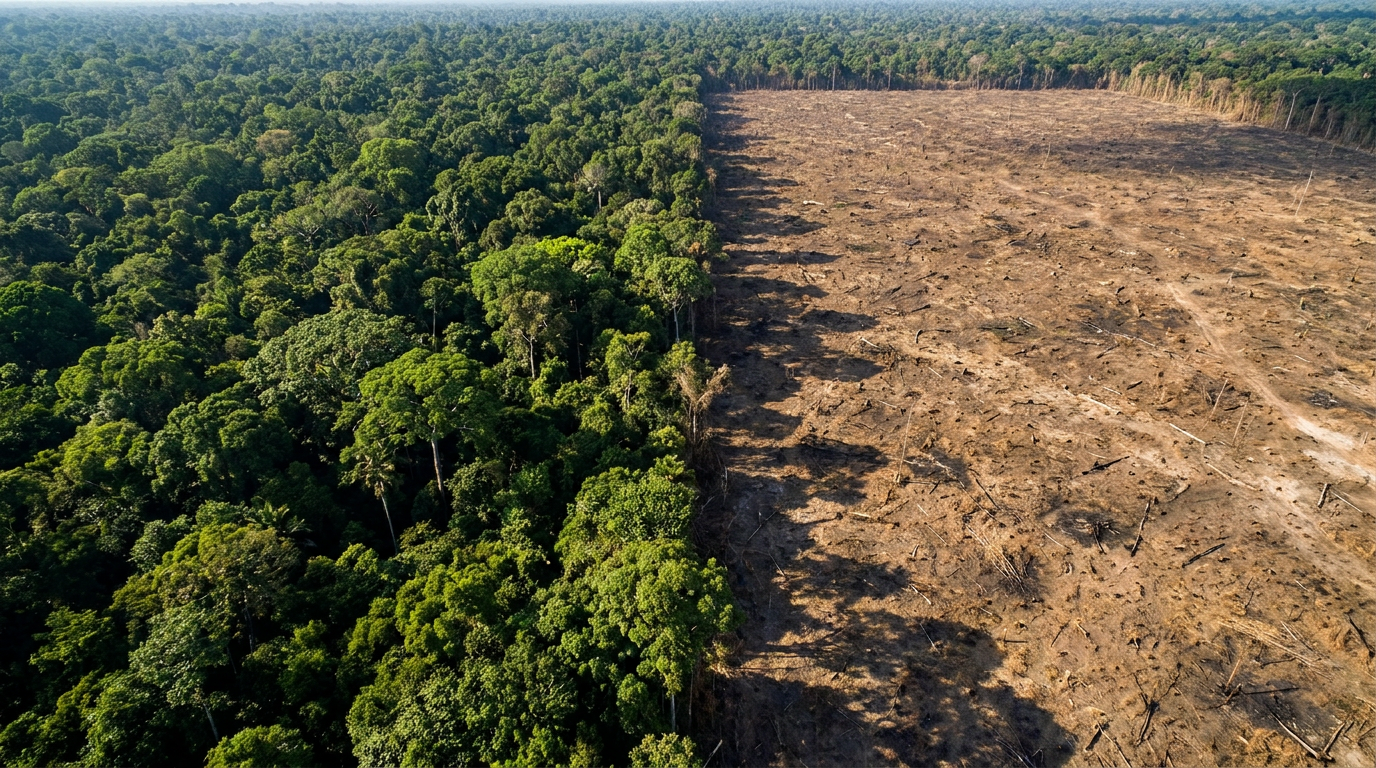
For years, climate models have painted a grim picture of the Amazon rainforest's future, suggesting that rising global temperatures alone could inevitably push the biome into a dry, degraded savanna. However, a newly consolidated body of evidence reveals a far more empowering reality: the Amazon is remarkably resilient to heat, provided humanity stops cutting it down.[1][6]
A June 2026 editorial in the journal Nature declared unequivocally that the Amazon "can be saved." Pointing to falling deforestation rates under Brazil's current administration, the publication highlighted fresh ecological data showing that the rainforest can withstand significant global warming—but only if there is a worldwide, concerted effort to halt land clearing.[1]
The core of this scientific pivot is the understanding that the Amazon's fate is not locked in by global greenhouse gas emissions alone. Instead, the biome's tipping point is a combined function of temperature and local land use, transforming the forest from a passive victim of global warming into an actionable conservation target.[2][6]
A landmark study led by the Potsdam Institute for Climate Impact Research (PIK) quantified this dual threat with unprecedented precision. By combining climate projections, hydrological modeling, and atmospheric moisture tracking, researchers mapped exactly how warming and deforestation interact to stress the ecosystem.[2]

The numbers outline a stark boundary. If deforestation reaches 22 to 28 percent of the Amazon basin, a mere 1.5 to 1.9°C of global warming could trigger a massive ecological transition. Under those conditions, up to two-thirds of the rainforest would degrade into savanna-like ecosystems.[2][3]
The world is uncomfortably close to that danger zone. Roughly 17 to 18 percent of the Amazon has already been cleared, primarily for cattle ranching and agriculture. Simultaneously, global temperatures are currently hovering near the 1.5°C threshold, placing the system on the edge of the critical range identified by the models.[3][4]
However, the PIK study contains a massive scientific silver lining. If deforestation is halted completely, the Amazon's thermal tolerance skyrockets. Without the compounding stress of land clearing, the researchers found that large-scale biome collapse would likely not occur until global warming reached a staggering 3.7 to 4.0°C.[2][4]
However, the PIK study contains a massive scientific silver lining.
“Deforestation makes the Amazon far less resilient than we previously anticipated,” explained Nico Wunderling, a PIK scientist and lead author of the study. He noted that while moderate warming can trigger cascading impacts in a heavily logged forest, an intact canopy possesses deep, structural defenses against extreme heat.[2]
To understand why deforestation dictates temperature resilience, one must look at the Amazon's self-sustaining weather engine. The rainforest does not just receive rain; it actively creates it. Up to 50 percent of the precipitation in the basin comes from water that is recycled by the trees themselves.[2][5]
Through a process called transpiration, deep-rooted Amazonian trees pull water from the soil and release it into the atmosphere as vapor. This moisture gathers into massive "flying rivers" that travel on wind currents, delivering rainfall to regions hundreds or even thousands of kilometers downwind.[2][6]

When large swaths of forest are removed, this delicate moisture transport system is interrupted. Arie Staal, a co-author of the PIK study, explained that clearing trees in the eastern Amazon can cause severe, cascading drought effects deep in the western interior, effectively starving intact forests of their necessary rainfall.[2]
This creates a dangerous feedback loop. Less forest means less rain, which dries out the atmosphere and the remaining canopy. The drier forest then becomes highly susceptible to wildfires and drought-induced dieback, further reducing the number of trees available to recycle moisture.[3][4]
Conversely, keeping the canopy intact maintains the moisture recycling engine, allowing the forest to cool itself and generate rain even as global ambient temperatures rise. This hydrological buffer is what provides the Amazon with its 4.0°C thermal shield.[2][6]

The policy implications of this evidence are profound. It means that South American nations, particularly Brazil, hold the primary lever for saving the biome. The Nature editorial emphasized that initial evidence suggests leadership at the national level is already succeeding in driving deforestation rates down.[1]
But researchers stress that the burden cannot fall on Brazil alone. The international community must support these efforts through robust conservation funding and strict supply chain regulations. Global markets must reject commodities linked to Amazonian clearing, ensuring that the economic incentives for deforestation are dismantled.[1][5]
While the modeling is robust, scientists acknowledge some remaining uncertainties. The exact fertilizing effect of increased atmospheric carbon dioxide on tree growth remains debated, and it is unclear if it could partially offset drought stress in the long term. Additionally, the localized impacts of extreme, multi-year droughts like the one seen in 2023–2024 are still being quantified.[4][6]
Despite these variables, the scientific consensus has crystallized around a singular, actionable truth. The Amazon's tipping point is not an unavoidable temperature on a thermometer; it is a choice about land use. Halting deforestation is the ultimate, most effective climate adaptation strategy for the world's largest rainforest.[1][2][6]
How we got here
Early 2000s
Climate models first suggest the Amazon could suffer massive dieback due to global warming alone.
2018
Scientists identify that the Amazon generates a massive portion of its own rainfall, highlighting the danger of disrupted moisture cycles.
2023–2024
The Amazon experiences unprecedented, severe drought, raising fears that a tipping point is imminent.
May 2026
The Potsdam Institute publishes modeling showing the tipping point is a combined function of warming and deforestation.
June 2026
Nature publishes an editorial confirming the Amazon can be saved if global efforts to halt deforestation succeed.
Viewpoints in depth
Climate Scientists & Ecologists
Focus on the intertwined nature of warming and moisture recycling.
Earth system scientists emphasize that the Amazon cannot be modeled simply as a passive recipient of global climate change. Because the forest generates up to half of its own rainfall through transpiration, its health is highly dependent on its physical size and continuity. Researchers argue that removing trees breaks the 'flying rivers' that carry moisture inland, meaning deforestation in the east directly causes drought in the west. For this camp, the data proves that local land-use policy is just as critical as global emissions reductions.
Conservation Policymakers
View the findings as an actionable mandate for immediate forest protection.
For policymakers and environmental advocates, the revelation that the Amazon can survive up to 4.0°C of warming if left intact is a massive message of hope. It shifts the narrative from inevitable doom to actionable policy. This camp argues that international funding mechanisms, carbon credits, and strict supply-chain bans on deforestation-linked beef and soy are the most effective climate interventions available today. They point to recent declines in Brazilian deforestation as proof that political will can actively prevent biome collapse.
Agricultural & Economic Interests
Highlight the economic drivers of land clearing and the need for sustainable livelihoods.
Stakeholders representing the agricultural sector and local Amazonian communities note that deforestation is primarily driven by economic necessity, including cattle ranching, soy farming, and mining. While acknowledging the ecological risks, this camp argues that simply banning deforestation is insufficient without providing alternative economic models for the millions of people living in the Amazon basin. They advocate for 'bioeconomy' investments that make the standing forest more economically valuable than cleared land.
What we don't know
- How increased atmospheric CO2 might act as a fertilizer to offset some drought stress in the long term.
- The exact recovery timeline for degraded forest areas if aggressive reforestation efforts are implemented.
- How the unprecedented multi-year droughts of 2023–2024 have permanently altered the baseline resilience of specific sub-regions.
Key terms
- Tipping Point
- A critical threshold where a small change pushes a system into a completely new state, such as a rainforest permanently becoming a dry savanna.
- Transpiration
- The process by which plants absorb water through their roots and release it as vapor through their leaves into the atmosphere.
- Flying Rivers
- Massive airborne currents of water vapor generated by the Amazon's trees that carry moisture and create rainfall across South America.
- Biome
- A large naturally occurring community of flora and fauna occupying a major habitat, like the Amazon rainforest.
- Carbon Sink
- A natural environment that absorbs and stores more carbon dioxide from the atmosphere than it releases.
Frequently asked
Is the Amazon rainforest doomed by climate change?
No. Recent studies show the Amazon is highly resilient to temperature increases and can survive up to 4.0°C of warming, provided that deforestation is completely halted.
Why does deforestation make global warming worse for the forest?
The Amazon generates up to half of its own rain. Cutting down trees breaks this moisture recycling system, causing the remaining forest to dry out and become vulnerable to heat and fire.
How close is the Amazon to the tipping point?
Currently, 17-18% of the forest has been cleared. Models suggest that if deforestation reaches 22-28% alongside current warming levels, large parts of the forest could collapse.
Can planting new trees reverse the damage?
While reforestation helps, scientists emphasize that protecting the existing, ancient canopy is far more effective at maintaining the complex moisture recycling system than planting new trees.
Sources
Source coverage
6 outlets
3 viewpoints surfaced






[1]NatureConservation Policymakers
The Amazon can be saved — with concerted action inside and outside Brazil
Read on Nature →[2]Potsdam Institute for Climate Impact ResearchClimate Scientists & Ecologists
Climate change and deforestation interact to cascade impacts across the Amazon
Read on Potsdam Institute for Climate Impact Research →[3]MongabayAgricultural & Economic Interests
Deforestation coupled with climate change is rapidly pushing the Amazon Rainforest toward a perilous tipping point
Read on Mongabay →[4]Down To EarthAgricultural & Economic Interests
As warming and deforestation intensify, the Amazon could begin driving its own collapse, study warns
Read on Down To Earth →[5]Carbon BriefConservation Policymakers
The Amazon can be saved – with concerted action inside and outside Brazil
Read on Carbon Brief →[6]Factlen Editorial TeamClimate Scientists & Ecologists
Synthesis by Factlen editorial team
Read on Factlen Editorial Team →

Every angle. Every day.
Get science stories with full source coverage and perspective breakdowns delivered to your inbox.