
US and Iran to Sign Interim Peace Deal as Trump Warns 'All Hell Will Rain Down' Over Nuclear Ambitions
President Donald Trump and Iranian officials are set to sign a memorandum of understanding in Switzerland to end months of hostilities, featuring a proposed $300 billion private investment fund contingent on Tehran abandoning its nuclear weapons program.
By Factlen Editorial Team
- US Administration
- Argues the deal definitively blocks Iran's path to a nuclear weapon through strict compliance measures and private investment incentives, rather than government payouts.
- Iranian Leadership
- Views the agreement and the proposed international investment fund as necessary reconstruction compensation for war damages and a pathway to sanctions relief.
- Israeli Government
- Deeply skeptical of the arrangement, viewing the financial relief as a dangerous concession that prioritizes temporary quiet over permanently eliminating the Iranian threat.
- Global Investors
- Eager for the stabilization of the Strait of Hormuz and the potential to enter Iran's lucrative energy and infrastructure markets if sanctions are lifted.
What's not represented
- · European Union Negotiators
- · Gulf Arab States
Why this matters
The agreement aims to halt a devastating multi-month military conflict and reopen the critical Strait of Hormuz, potentially stabilizing global energy markets while fundamentally reshaping the Middle East's security architecture.
Key points
- The US and Iran will sign a 14-point memorandum of understanding in Switzerland to end recent hostilities.
- President Trump warned that 'all hell will rain down' if Iran attempts to acquire a nuclear weapon.
- A proposed $300 billion international investment fund would aid Iran's reconstruction using private capital.
- Access to the fund and sanctions relief is strictly contingent on Iran's verifiable nuclear compliance.
- The agreement mandates the reopening of the Strait of Hormuz to stabilize global shipping.
- Israeli officials remain deeply skeptical, fearing the financial relief will embolden Tehran.
The United States and Iran are preparing to sign a historic 14-point memorandum of understanding (MoU) in Switzerland this Friday, aiming to end more than 100 days of direct military conflict. The interim agreement establishes a 60-day window for complex technical negotiations regarding the dismantling of Iran's highly enriched uranium stockpiles, the phased lifting of economic sanctions, and the reopening of the Strait of Hormuz to international shipping.[1][5][6]
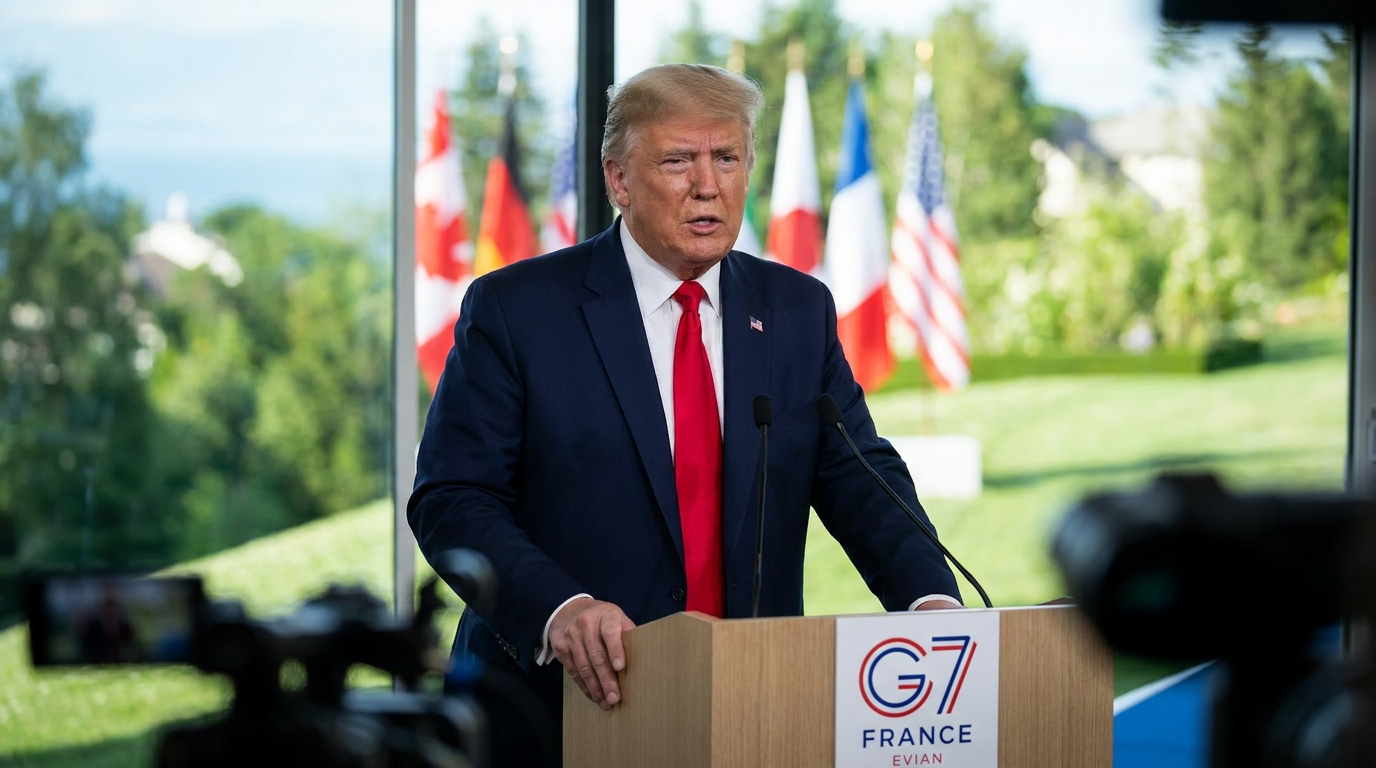
Speaking on the sidelines of the G7 summit in Evian-les-Bains, France, President Donald Trump delivered a stark ultimatum regarding Tehran's nuclear ambitions. Defending the unreleased text of the MoU after a bilateral meeting with the Emir of Qatar, Trump stated that the agreement makes it "loud and clear" that Iran will never be permitted to develop or acquire a nuclear weapon.[2][6]
"The only thing that really matters to me is Iran will never have a nuclear weapon," Trump told reporters. He warned that if the Iranian government attempted to purchase or build one, "all hell will rain down on them." The president characterized the new framework as a definitive "wall" against nuclear proliferation, contrasting it sharply with the 2015 Obama-era accord, which he claimed was merely a "road" to a weapon.[2][3][6]
A central and highly scrutinized pillar of the emerging deal is the proposed creation of a $300 billion international investment fund designed to aid in Iran's post-war reconstruction. The Financial Times reported that the Trump administration is prepared to allow the establishment of this massive capital pool, provided Tehran strictly adheres to the final settlement's terms.[1]

The scale of the financial incentives has sparked immediate political blowback in Washington. Trump forcefully pushed back against characterizations that the U.S. government was writing a check to Tehran, taking to Truth Social to label reports of a $300 billion American payout as "Fake News." U.S. officials clarified that the fund would not consist of direct government payments, but rather private capital pooled from European, Asian, and American corporations eager to enter Iran's energy and infrastructure markets once sanctions are lifted.[1][4]
The scale of the financial incentives has sparked immediate political blowback in Washington.
Vice President JD Vance reinforced this distinction, noting that the $300 billion reconstruction fund represents the type of capital Iran could access "so long as they honor their end of the obligation." Any sanctions relief, including the unfreezing of Iranian assets held overseas, would be released in strict phases tied directly to verifiable progress in nuclear compliance and the maintenance of the ceasefire.[1][4][7]
For the Iranian leadership, the investment fund is viewed as essential compensation for the extensive damages sustained during the recent U.S.-led "Operation Mighty Wrath" bombing campaign. Iranian Deputy Foreign Minister Abbas Araghchi confirmed that top negotiator Mohammad Bagher Ghalibaf will attend the signing ceremony in Switzerland, with formal talks on the final nuclear agreement slated to begin immediately after.[5]
A critical immediate priority for global markets is the Strait of Hormuz. The MoU reportedly mandates the reopening of the vital waterway, though the exact timeline remains a point of friction. Washington is demanding an immediate resumption of transit alongside mine clearance operations, while Tehran has sought the authority to levy future transit fees on shipping traffic.[1][4]

The diplomatic breakthrough has been met with deep skepticism in Israel. Prime Minister Benjamin Netanyahu's government views the financial relief as a dangerous concession that prioritizes temporary quiet over the permanent elimination of the Iranian threat. Israeli officials have expressed concern that an influx of foreign capital could ultimately embolden Tehran's regional proxy networks, despite the strict nuclear guardrails.[2][3]
As the Friday signing approaches, the focus shifts to the technical implementation of the nuclear rollback. Negotiators have reportedly agreed that the baseline requirement involves the on-site dilution of all highly enriched uranium under the direct supervision of the International Atomic Energy Agency (IAEA), setting the stage for one of the most heavily monitored disarmament processes in modern history.[1][6]
How we got here
Spring 2026
Direct military conflict escalates between the U.S. and Iran, severely disrupting global shipping.
Late May 2026
A draft memorandum of understanding emerges, introducing the concept of a massive post-war investment fund.
June 15, 2026
The Financial Times reports the Trump administration is prepared to allow a $300 billion private capital fund for Iran.
June 16, 2026
President Trump speaks at the G7 summit, denying direct U.S. payouts while warning Iran against nuclear proliferation.
June 19, 2026
Scheduled formal signing of the interim peace agreement in Switzerland, initiating a 60-day technical negotiation window.
Viewpoints in depth
US Administration's view
The White House views the deal as a definitive block against Iranian nuclear proliferation achieved without taxpayer dollars.
U.S. officials emphasize that the proposed $300 billion fund is a mechanism to leverage private international capital rather than American government funds. By tying phased sanctions relief and corporate investment directly to verifiable IAEA compliance, the administration argues it has created a structure where Iran is heavily incentivized to abandon its nuclear ambitions. President Trump and Vice President Vance have framed this as a far more robust safeguard than previous diplomatic efforts, backed by the credible threat of overwhelming military force if the terms are breached.
Iranian Leadership's view
Tehran sees the agreement as a necessary step to rebuild its war-torn infrastructure and escape crippling economic isolation.
For Iran, the $300 billion investment fund is framed domestically as a form of reconstruction compensation following the extensive damage caused by recent U.S. military operations. Iranian negotiators have prioritized immediate sanctions relief and the unfreezing of overseas assets to stabilize their domestic economy. While agreeing to the on-site dilution of highly enriched uranium, Tehran is also seeking to assert its sovereignty by attempting to negotiate future transit fees for vessels passing through the newly reopened Strait of Hormuz.
Israeli Government's view
Israel views the financial incentives as a dangerous lifeline to a regime that remains an existential threat.
Prime Minister Benjamin Netanyahu and the broader Israeli security establishment are deeply alarmed by the prospect of a $300 billion capital injection into Iran. They argue that even if the funds are technically earmarked for civilian reconstruction, the massive economic relief will inevitably free up domestic resources for Tehran to rearm and fund its network of regional proxy militias. Israeli officials fear the agreement repeats the mistakes of the 2015 JCPOA by prioritizing a temporary cessation of hostilities over the permanent dismantling of Iran's military capabilities.
What we don't know
- The exact timeline and operational mechanics for clearing mines and reopening the Strait of Hormuz.
- Which specific European and Asian corporations have committed to the $300 billion investment fund.
- How the IAEA will physically secure and monitor the on-site dilution of Iran's highly enriched uranium.
Key terms
- Memorandum of Understanding (MoU)
- A preliminary formal agreement outlining the broad terms of a diplomatic deal before a final, binding treaty is signed.
- Highly Enriched Uranium (HEU)
- Uranium that has been processed to contain a high percentage of the U-235 isotope, making it capable of being used in nuclear weapons.
- Strait of Hormuz
- A critical shipping chokepoint between the Persian Gulf and the Gulf of Oman, through which a significant portion of the world's oil supply passes.
- IAEA
- The International Atomic Energy Agency, the United Nations watchdog responsible for monitoring and verifying civilian nuclear programs.
Frequently asked
Is the US government paying Iran $300 billion?
No. The proposed $300 billion is an international investment fund financed by private companies from Europe, Asia, and the U.S., not direct government payouts.
What happens to Iran's enriched uranium?
Under the reported framework, Iran's highly enriched uranium must be diluted on-site under the direct supervision of the International Atomic Energy Agency (IAEA).
Will the Strait of Hormuz reopen?
Yes, reopening the critical shipping waterway is a central condition of the memorandum of understanding, though the exact timeline for mine clearance is still being negotiated.
When will the final deal be signed?
A preliminary memorandum of understanding is scheduled to be signed in Switzerland on Friday, kicking off a 60-day window to negotiate the final technical details.
Sources
Source coverage
7 outlets
4 viewpoints surfaced







[1]Financial TimesUS Administration
Trump administration considers $300bn fund for Iran if deal is upheld
Read on Financial Times →[2]The Times of IsraelIsraeli Government
Trump: 'All hell will rain down' on Iran if it tries to obtain nuclear weapons
Read on The Times of Israel →[3]Al JazeeraIranian Leadership
Trump warns 'all hell will rain down' if Iran tries to get a nuclear weapon
Read on Al Jazeera →[4]The Economic TimesGlobal Investors
US President Donald Trump rejects report suggesting Washington would pay Tehran a whopping sum
Read on The Economic Times →[5]The HinduIranian Leadership
Iran deal says 'loud and clear' that Tehran won't have a nuclear weapon, says Donald Trump
Read on The Hindu →[6]ReutersUS Administration
Trump says Iran deal makes nuclear weapon ban 'loud and clear'
Read on Reuters →[7]Fox NewsUS Administration
Vance: Trump's Iran policy ensures Tehran 'will never have a nuclear weapon'
Read on Fox News →

More in news politics
See all 7 stories →US-Iran Relations
US and Iran to Sign Ceasefire Memorandum in Geneva as 60-Day Nuclear Deadline Looms
0 sources
Iran Nuclear Deal
U.S. Issues 60-Day Deadline to Iran: Inside the Proposed Nuclear and Sanctions Deal
0 sources
AI Regulation
US Government Classifies Anthropic's Fable 5 AI as a Munition, Forcing Global Shutdown
0 sources
AI Regulation
U.S. Government Forces Anthropic to Disable Advanced AI Models Under Export Control Order
0 sources

Every angle. Every day.
Get news politics stories with full source coverage and perspective breakdowns delivered to your inbox.