
The Solar Singularity: Why Cheap Energy is About to Change Everything by 2030
Driven by plummeting costs and breakthroughs in perovskite technology, global solar capacity is projected to quadruple by the end of the decade, fundamentally rewriting the economics of global power.
By Factlen Editorial Team
- Energy Economists
- Focus on the deflationary economics of solar and its disruption of wholesale power markets.
- Grid Operators
- Prioritize grid stability, battery storage integration, and the challenge of the "last 10%" of decarbonization.
- Materials Scientists
- Focus on breaking the silicon efficiency ceiling with perovskites and solving the looming recycling challenge.
- Climate Optimists
- View the exponential deployment of solar as the definitive, market-driven solution to global emissions.
What's not represented
- · Fossil fuel industry workers facing displacement
- · Local communities living near massive utility-scale solar installations
Why this matters
The transition to near-free daytime electricity will lower manufacturing costs, accelerate the adoption of electric vehicles, and decouple global economic growth from fossil fuel volatility. It represents a fundamental shift from energy as a scarce resource to energy as a scalable technology.
Key points
- Global solar capacity is projected to exceed 5,000 gigawatts by 2030, providing nearly 30% of global electricity.
- Utility-scale solar is now the cheapest form of electricity generation in human history.
- Next-generation perovskite tandem cells are breaking the physical efficiency limits of traditional silicon panels.
- Battery storage costs are falling even faster than solar, enabling grids to use daytime solar power at night.
- The industry faces looming challenges regarding panel recycling and the geopolitics of the supply chain.
For decades, energy forecasters treated solar power as a boutique environmental luxury—a heavily subsidized alternative to coal and gas. But over the last few years, the narrative has quietly inverted. We have entered what energy analysts call the "solar singularity," a threshold where the compounding math of exponential growth makes solar and battery deployment an unstoppable economic force. It is no longer a transition driven by climate altruism; it is a revolution driven by brutal, inescapable economics.[5][7]
The core mechanism driving this shift is the learning curve. Every time the global deployment of solar panels doubles, the cost drops by a predictable percentage. Over the last two decades, solar capacity has doubled more than ten times, driving the cost per kilowatt-hour down by nearly 90 percent. Today, utility-scale solar is definitively the cheapest form of electricity generation in human history, fundamentally altering wholesale electricity markets worldwide.[4][5]
The scale of the coming decade is difficult to overstate. According to projections from the International Energy Agency and industry analysts, global solar capacity is on track to exceed 5,000 gigawatts by 2030—up from roughly 1,200 gigawatts in 2023. At this trajectory, solar will provide nearly a third of all global electricity by the end of the decade, representing a $5 trillion investment opportunity that is reshaping global capital flows.[1][4]
The financial reality is stark when viewed through the Levelized Cost of Energy (LCOE). In optimal locations, utility-scale solar can now generate power for $10 to $20 per megawatt-hour. By comparison, existing gas combined-cycle plants operate at $77 to $106 per megawatt-hour, and gas peaker plants can cost upwards of $200. As the "green premium" disappears, the adoption of solar is increasingly tied to hard economic logic rather than government policy mandates.[3][4]

This price collapse is fueled by an unprecedented expansion in global manufacturing. By 2025, the world's solar silicon refining and module production capacity exceeded 1.1 terawatts annually. To put that in perspective, the industry can now produce as many solar panels in a single year as were installed over the entirety of the previous two decades. While this massive oversupply has strained manufacturer profit margins, it has been a massive boon for developers and consumers.[2][6]
Yet, the traditional silicon solar panel is rapidly approaching its physical limits. Standard crystalline silicon cells have a theoretical maximum efficiency of about 29 percent, meaning they can only convert that fraction of incoming sunlight into electricity. Most commercial panels today hover around 22 to 24 percent. To keep the cost-reduction curve moving downward, the industry needs a fundamental leap in materials science.[4][6]
That leap has arrived in the form of perovskite tandem cells. By layering a highly efficient, light-absorbing crystal structure called a perovskite directly on top of a traditional silicon base, engineers can capture different spectrums of sunlight simultaneously. Laboratory efficiencies have already breached 33.9 percent, and commercial modules targeting 30 percent or higher are rolling off production lines. This represents a massive increase in power output from the exact same surface area.[4][6]

That leap has arrived in the form of perovskite tandem cells.
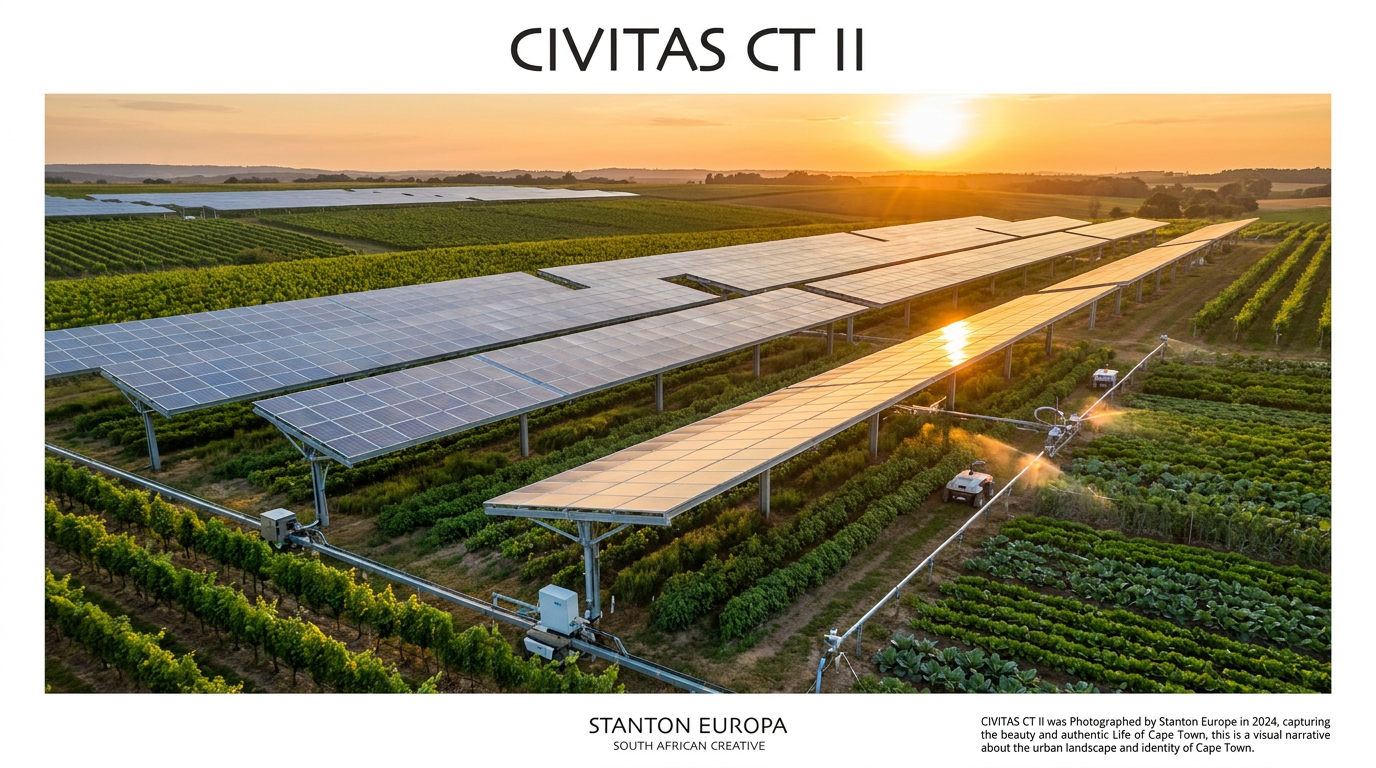
As panels become hyper-efficient and dirt cheap, the deployment model is shifting from passive rooftops and remote deserts to active, integrated surfaces. The industry is seeing explosive growth in Building Integrated Photovoltaics (BIPV), where solar glass replaces traditional windows, and Vehicle Integrated Photovoltaics (VIPV), where electric cars charge themselves while parked. Agrivoltaics—the co-location of solar panels and agriculture—is also proving that land can simultaneously yield crops and clean electrons.[4]
However, generating cheap daytime power is only half the equation. The solar singularity faces a structural asymmetry: the sun sets precisely when evening electricity demand peaks. This creates the infamous "duck curve," where grid operators are flooded with excess power at noon but scramble for dispatchable generation at dusk. Without massive energy storage, the solar revolution hits a hard ceiling.[5][6]
Fortunately, the battery industry is moving down an even steeper learning curve than solar did. Lithium-ion and emerging sodium-ion battery packs have gone through five doublings in cumulative experience in just eight years. The cost of utility-scale battery energy storage systems has plummeted, making hybrid solar-plus-storage plants directly competitive with fossil fuel peaker plants for evening dispatch.[5][6]
Beyond simply storing energy, these batteries are solving a critical physics problem for the grid. Traditional power grids rely on the heavy, spinning metal turbines of coal and gas plants to provide "inertia"—the physical momentum that keeps the grid's frequency stable. As those plants retire, advanced "grid-forming inverters" attached to solar and battery farms are stepping in, using sophisticated power electronics to digitally synthesize that same stability.[6]

Despite these advances, energy economists caution against the assumption that reaching 100 percent clean energy will be easy. The first 90 percent of grid decarbonization is highly profitable, driven by cheap wind, solar, and short-duration batteries. But the "last 10 percent"—maintaining grid resilience during multi-day weather events or seasonal lulls—requires entirely different, and currently more expensive, technologies like long-duration storage, advanced geothermal, or next-generation nuclear power.[5]
The transition also carries significant environmental and circular-economy challenges. While solar is a low-carbon generation option, manufacturing crystalline silicon requires massive amounts of energy, often sourced from coal-heavy grids. Furthermore, the global solar waste stream is projected to reach millions of tonnes by the early 2030s. The industry is racing to develop advanced recycling technologies to recover valuable silver, copper, and high-purity silicon from decommissioned panels.[6]
Finally, the geopolitics of the solar singularity are growing increasingly complex. Currently, the vast majority of the global solar supply chain—from polysilicon refining to wafer manufacturing—is concentrated in China. In response, the United States, the European Union, and India are deploying massive industrial policies to build domestic manufacturing capacity and secure their energy independence.[2][6]
Ultimately, the solar singularity represents one of the most profound economic transformations of the twenty-first century. The transition has shifted from a cost-driven expansion model to a complex ecosystem where efficiency, grid intelligence, and circularity will determine the winners. But the fundamental trajectory is set: energy is becoming a technology, not a fuel, and its cost is trending toward zero.[7]
How we got here
2014–2024
Solar costs undergo a massive decade-long descent, dropping by nearly 89 percent.
2022
The global energy crisis accelerates clean energy investments and industrial policies worldwide.
2024
Global solar manufacturing capacity crosses the unprecedented 1-terawatt annual threshold.
2026
Commercial perovskite tandem cells begin hitting the market, breaking the traditional silicon efficiency ceiling.
Viewpoints in depth
The Economic View
Focuses on the deflationary nature of solar and its disruption of traditional power markets.
Energy economists emphasize that the transition is no longer reliant on government subsidies or carbon taxes. Because solar is a manufactured technology rather than an extracted fuel, it benefits from Wright's Law: every doubling of cumulative production drives costs down by a fixed percentage. This deflationary cycle means that in many global markets, it is now cheaper to build a brand new solar farm than to simply operate an existing, fully paid-off coal or gas plant.
The Grid Operator's View
Prioritizes grid stability, the duck curve, and the challenge of the 'last 10%'.
For grid operators, cheap daytime electricity is a double-edged sword. The massive influx of midday solar creates the 'duck curve,' forcing operators to rapidly ramp up other power sources as the sun sets and evening demand peaks. While battery storage is deploying rapidly to smooth this curve, operators warn that reaching 100 percent decarbonization will require massive investments in long-duration storage and grid-forming inverters to maintain resilience during multi-day weather events.
The Materials Science View
Focuses on breaking the silicon efficiency ceiling and solving the recycling challenge.
Materials scientists view the current silicon-dominated era as merely the first chapter. Because standard silicon cells are nearing their theoretical efficiency limit of 29 percent, researchers are heavily focused on commercializing perovskite tandem cells, which can push efficiencies past 35 percent. Simultaneously, these scientists are sounding the alarm on the need for a circular economy, urging the industry to design panels that can be easily disassembled and recycled to prevent millions of tonnes of toxic e-waste by the 2030s.
What we don't know
- Whether Western nations can successfully build domestic solar supply chains to compete with China's massive manufacturing scale.
- How quickly long-duration energy storage technologies can commercialize to solve the grid's 'last 10 percent' problem.
- Whether the industry can scale up recycling infrastructure fast enough to handle the coming wave of decommissioned panels.
Key terms
- Solar Singularity
- The point at which solar power and battery storage become so cheap and ubiquitous that they irreversibly dominate global energy markets.
- Levelized Cost of Energy (LCOE)
- A financial metric used to compare the lifetime costs of generating electricity across different technologies, factoring in construction, operation, and fuel.
- Perovskite Tandem Cells
- Next-generation solar panels that layer advanced perovskite materials over traditional silicon to capture a broader spectrum of sunlight and increase power output.
- Grid-Forming Inverters
- Advanced power electronics that allow solar and battery plants to digitally stabilize the electrical grid, a job traditionally done by the spinning physical mass of fossil-fuel turbines.
- Agrivoltaics
- The co-development of the same area of land for both solar photovoltaic power generation and agriculture.
Frequently asked
What is driving the massive drop in solar prices?
The cost reduction is driven by the 'learning curve'—massive scaling of global manufacturing, primarily in China, combined with continuous incremental improvements in silicon cell efficiency.
Can the power grid handle this much solar energy?
Yes, but it requires significant upgrades. Grids need massive utility-scale battery storage to shift daytime power to the evening, as well as 'grid-forming inverters' to maintain electrical stability.
What happens to old solar panels?
Recycling is a growing challenge, with millions of tonnes of waste projected by the 2030s. The industry is currently developing circular economy frameworks to recover valuable materials like silver, copper, and silicon.
Will solar completely replace fossil fuels?
Solar and wind will likely dominate the bulk of electricity generation, but the 'last 10 percent' of grid reliability during extreme weather will require dispatchable sources like advanced geothermal, nuclear, or long-duration storage.
Sources
Source coverage
7 outlets
4 viewpoints surfaced







[1]International Energy AgencyClimate Optimists
Renewables 2024: Analysis and forecast to 2030
Read on International Energy Agency →[2]BloombergNEFEnergy Economists
The Great Clean Energy Acceleration
Read on BloombergNEF →[3]LazardEnergy Economists
Levelized Cost of Energy Analysis 2025
Read on Lazard →[4]Energy Solutions JournalMaterials Scientists
The 2030 Vision: The Solar Singularity Has Arrived
Read on Energy Solutions Journal →[5]Volts PodcastGrid Operators
The Solar Singularity and Exponential Growth with Michael Liebreich
Read on Volts Podcast →[6]ResearchGateMaterials Scientists
The Solar Singularity: Economic Asymmetries, Technological Convergence, and the Grid-Forming Horizon
Read on ResearchGate →[7]Factlen Editorial TeamClimate Optimists
Synthesis by Factlen editorial team
Read on Factlen Editorial Team →
Every angle. Every day.
Get opinion stories with full source coverage and perspective breakdowns delivered to your inbox.