
How SpaceX Reached a $2.1 Trillion Valuation and Became America's Fifth-Largest Company
Following a record-shattering $85.7 billion IPO, SpaceX's market capitalization has surged past $2.1 trillion to overtake Amazon. The rapid ascent is driven by a combination of retail enthusiasm, a historically low free float, and impending forced buying by passive index funds.
By Factlen Editorial Team
- Retail & Growth Bulls
- Investors who believe SpaceX's dominance in launch and satellite internet, combined with its AI potential, justifies a premium valuation.
- Market Mechanics Analysts
- Quants and strategists focused on how the low free float and forced passive index buying are artificially inflating the stock price.
- Fundamental Skeptics
- Value investors who argue the 112x price-to-sales ratio is unsustainable and the AI revenue projections are unproven.
What's not represented
- · Traditional aerospace competitors (Boeing, Lockheed Martin)
- · Retail investors who were priced out of the IPO allocations
Why this matters
SpaceX's record-breaking IPO is reshaping the global stock market, forcing billions of dollars from passive retirement accounts into a single space-and-AI conglomerate. Understanding the mechanics behind its $2.1 trillion valuation is crucial for any investor navigating this new era of mega-cap tech dominance.
Key points
- SpaceX's $85.7 billion IPO is the largest in stock-market history, surpassing Saudi Aramco.
- The stock surged 19% on its first day, pushing the company's valuation past $2.1 trillion.
- Only 4.3% of shares are available to trade, creating a massive supply bottleneck.
- Passive index funds will be forced to buy up to $150 billion of the stock in July.
- The valuation relies heavily on unproven AI infrastructure revenues, alongside Starlink and launch services.
The long-awaited public debut of Space Exploration Technologies Corp. finally arrived on June 12, 2026, and it immediately rewrote the record books. Trading under the Nasdaq ticker SPCX, the company priced its initial public offering at $135 per share. Driven by insatiable institutional and retail demand, underwriters fully exercised their over-allotment options, bringing the total capital raised to a staggering $85.7 billion. That figure easily eclipses the previous high-water marks set by Saudi Aramco and Alibaba, cementing SpaceX as the largest stock-market launch in global financial history.[4][7]
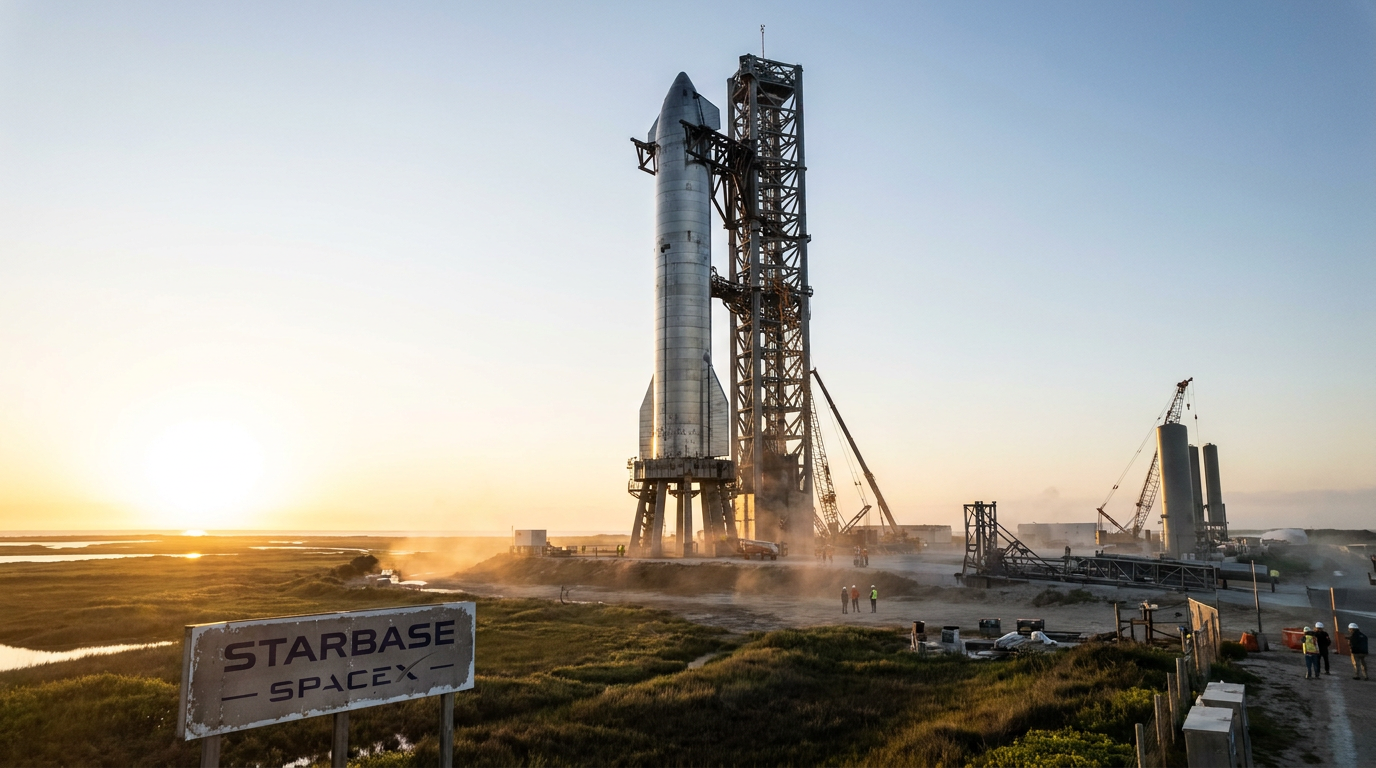
The sheer scale of the offering did little to quench the market's appetite. When the opening bell rang at the company's Starbase headquarters in Texas, retail buying outpaced even the most aggressive tech debuts of the last decade. Shares surged 19% on their first day to close at $160.95, and continued their climb to near $172 in subsequent trading sessions. This overnight price spike propelled SpaceX's total market capitalization past the $2.1 trillion mark, allowing it to overtake Amazon as the fifth-largest company in the United States.[1][3][4]
The wealth creation generated by the listing has been unprecedented. Alphabet's 2015 investment of $900 million has ballooned to a book value exceeding $100 billion, while the offering minted an estimated 4,400 new millionaires among current and former SpaceX employees. At the top of the cap table, the soaring valuation officially pushed CEO Elon Musk's net worth past the thirteen-digit threshold, making him the world's first trillionaire. Yet, behind the euphoria, financial analysts are grappling with how a company generating roughly $18.7 billion in annual revenue commands a valuation north of two trillion dollars.[3][4]

To justify a price-to-revenue multiple of 112, bullish investors are pointing to a sprawling prospectus that frames SpaceX not just as a rocket manufacturer, but as a foundational pillar of the future economy. The company estimates its Total Addressable Market (TAM) at an astronomical $28.5 trillion annually. This valuation rests on three distinct revenue engines: the legacy launch business, the rapidly scaling Starlink satellite internet service, and a newly unveiled artificial intelligence compute division.[4][5][7]
Starlink is currently the company's most proven economic engine. The satellite constellation generated over $11 billion in revenue last year with an operating profit of $4.4 billion, functioning much like a high-growth, high-margin global telecommunications utility. Meanwhile, the traditional launch segment, powered by the reusable Falcon rockets and the developing Starship platform, maintains a near-monopoly on orbital access. SpaceX currently lifts more than 80% of the world's orbital mass, providing an indispensable technological moat that competitors have yet to breach.[3][4][5]
Starlink is currently the company's most proven economic engine.
However, the largest and most controversial component of SpaceX's $28.5 trillion TAM projection is tied to artificial intelligence. The company has aggressively positioned its orbital and terrestrial infrastructure to support AI data centers, recently signing multi-billion-dollar compute capacity deals with tech giants like Anthropic and Google. Skeptics argue that this narrative leans too heavily on a sector where SpaceX currently trails established cloud providers, suggesting the "Space + AI" framing is a strategic maneuver to capture peak market multiples.[3][5]

Beyond the fundamental business case, the stock's meteoric rise is being heavily distorted by unique market mechanics—specifically, a severe supply-and-demand imbalance. When SpaceX went public, it floated only 4.3% of its total equity to the open market. This historically low "free float" means that the vast majority of the company's shares remain locked up by insiders, early venture capitalists, and corporate partners who are legally prohibited from selling for months.[6]
When a massive wave of retail and institutional demand collides with a tiny pool of available shares, the resulting supply vacuum forces the stock price upward. Market analysts note that this dynamic is creating an artificial premium, as buyers are forced to bid higher and higher to convince the few unconstrained shareholders to part with their equity. This "bottleneck trade" is a known phenomenon in mega-cap IPOs, but it has rarely occurred on a multi-trillion-dollar scale.[2][6]
The supply squeeze is about to face its ultimate test due to the rigid rules of passive investing. Because of its massive market capitalization, SpaceX is fast-tracked for inclusion in major stock indices, including the Nasdaq 100, FTSE Russell, and MSCI. When a stock is added to these benchmarks, passive index funds and exchange-traded funds (ETFs) are contractually obligated to buy the shares to match the index weighting, regardless of the current price or underlying fundamentals.[6]

Financial modeling firms project that this passive buying wave will formally begin in early July, forcing index funds to unconditionally acquire between $80 billion and $150 billion worth of SPCX stock on the open market. Because the insider lock-up periods will not have expired by this inclusion date, these funds will be forced to source their shares entirely from the tiny 4.3% free float. Analysts warn that this impending collision between mandatory institutional buying and historically low supply could trigger unprecedented volatility.[6]
The pressure valve for this market structure will eventually release when the first tranche of insider lock-ups expires later in the summer. Once early investors and employees are permitted to sell, the sudden influx of new share supply could rapidly cool the stock's momentum. Until then, the market is treating SpaceX less like a traditional aerospace manufacturer and more like a scarce digital asset, driven by a combination of retail fervor and algorithmic necessity.[6][7]
For now, the market has decided that the "Musk Premium" is worth paying. Just as Tesla experienced a massive re-rating in the early 2020s when it proved the viability of electric vehicles, investors are betting that SpaceX will successfully execute its transition from a launch provider to the backbone of global communications and AI infrastructure. Whether the underlying cash flows can eventually catch up to the $2.1 trillion price tag remains the defining question for Wall Street's newest mega-cap giant.[2][5][8]
How we got here
2002
Elon Musk founds Space Exploration Technologies Corp. with the goal of reducing space transportation costs.
2015
Alphabet invests $900 million in SpaceX, providing crucial capital for early development.
2020
SpaceX successfully launches its first crewed mission to the International Space Station, cementing its launch dominance.
June 12, 2026
SpaceX officially lists on the Nasdaq under the ticker SPCX, pricing at $135 per share.
June 15, 2026
SPCX shares surge past $170, pushing the company's valuation to $2.1 trillion.
July 2026
Major stock indices will formally include SpaceX, triggering mandatory passive buying.
Viewpoints in depth
Retail & Growth Bulls
Investors who believe SpaceX's dominance in launch and satellite internet, combined with its AI potential, justifies a premium valuation.
Bullish investors argue that traditional valuation metrics like price-to-sales are irrelevant for a company building the infrastructure of the future economy. They point to Starlink's $4.4 billion operating profit as proof that SpaceX can monetize its technological moats. For this camp, the $2.1 trillion valuation is simply the 'Musk Premium'—a willingness to pay upfront for the execution of a $28.5 trillion Total Addressable Market that spans global connectivity, orbital logistics, and next-generation AI data centers.
Market Mechanics Analysts
Quants and strategists focused on how the low free float and forced passive index buying are artificially inflating the stock price.
Market structure experts view the current $2.1 trillion valuation as a mechanical distortion rather than a reflection of fundamental value. Because only 4.3% of the company's shares are actively trading, any significant buying pressure creates an immediate supply vacuum. This camp warns that the impending inclusion of SpaceX into the Nasdaq 100 and other major indices will force passive funds to blindly buy billions of dollars of stock, exacerbating the squeeze until insider lock-up periods expire and flood the market with new supply.
Fundamental Skeptics
Value investors who argue the 112x price-to-sales ratio is unsustainable and the AI revenue projections are unproven.
Skeptics emphasize that paying 112 times revenue for a capital-intensive aerospace company is historically unprecedented. They argue that while the launch and Starlink businesses are impressive, they are not large enough to support a $2.1 trillion market cap. This camp is particularly critical of the $26.5 trillion AI TAM projection, viewing it as a buzzword-heavy narrative designed to capture tech multiples, especially since SpaceX currently trails established cloud giants in the AI compute space.
What we don't know
- Whether the AI compute division can actually capture a meaningful share of the cloud market against entrenched incumbents.
- How severely the stock price will correct once the insider lock-up period expires and millions of new shares flood the market.
- If regulators will scrutinize the governance structure that leaves public shareholders with minimal voting power.
Key terms
- Free Float
- The percentage of a company's total shares that are actively available to be traded by the public on the open market.
- Passive Buying
- When index funds and ETFs automatically purchase a stock to match its weight in a financial benchmark, regardless of the stock's current price.
- Over-allotment (Greenshoe Option)
- A provision that allows underwriters to sell more shares than originally planned in an IPO if public demand is exceptionally high.
- Lock-up Period
- A legally binding timeframe after an IPO during which company insiders, employees, and early investors are prohibited from selling their shares.
- Total Addressable Market (TAM)
- An estimate of the total revenue opportunity available for a product or service if it achieved 100% market share.
Frequently asked
Why did SpaceX go public now?
SpaceX went public to fund the capital-intensive development of its Starship rocket, build out its new AI infrastructure, and provide liquidity to early employees and investors.
What is a 'free float' squeeze?
A squeeze occurs when high market demand hits a stock where very few shares are actually available to trade, forcing buyers to bid the price up artificially.
When can SpaceX insiders sell their shares?
Insiders are subject to a legally binding lock-up period, with the first major tranche of shares expected to become available for sale later this summer.
How does SpaceX actually make money?
Currently, the bulk of its revenue comes from its Starlink satellite internet subscriptions and its commercial and government rocket launch contracts.
Sources
Source coverage
8 outlets
3 viewpoints surfaced







[1]MarketWatchMarket Mechanics Analysts
Overnight price spike sees SpaceX overtake Amazon as America’s fifth-largest company
Read on MarketWatch →SpaceX’s massive $2.1 trillion valuation may soon become its own worst enemy
Read on MarketWatch →[3]TradingKeyRetail & Growth Bulls
Musk's SpaceX Creates World's Largest IPO: Historic Leap From 10% Success Rate to 2.1 Trillion Giant
Read on TradingKey →[4]PhemexRetail & Growth Bulls
What Happened in the SpaceX IPO and Which Records It Broke
Read on Phemex →[5]Seeking AlphaFundamental Skeptics
SpaceX's 2.1 trillion valuation reflects the growth opportunity of the business
Read on Seeking Alpha →[6]HTX ResearchMarket Mechanics Analysts
July 7th Nasdaq Inclusion Day: Passive fund building positions across the US will collide head-on with the historically lowest free float
Read on HTX Research →[7]The ProbeFundamental Skeptics
SpaceX IPO Made Elon Musk Richer, Investors Powerless
Read on The Probe →[8]Factlen Editorial Team
Synthesis by Factlen editorial team
Read on Factlen Editorial Team →

More in finance
See all 8 stories →Retirement Savings
How American 401(k) Balances Reached Record Highs in 2026
0 sources

Retirement Savings
Why American 401(k) Balances Just Hit Record Highs (And How the System is Quietly Changing)
0 sources

Retirement Wealth
Why American 401(k) Balances Are Hitting Record Highs
0 sources

Retirement Wealth
The Quiet Revolution: How Automation Drove 401(k) Balances to Record Highs in 2026
0 sources

Every angle. Every day.
Get finance stories with full source coverage and perspective breakdowns delivered to your inbox.