
How At-Home Brain Implants Are Restoring Digital Independence for Paralysis Patients
A new generation of brain-computer interfaces is moving out of the laboratory and into patients' living rooms, allowing individuals with severe motor neuron disease to control computers and communicate seamlessly.
By Factlen Editorial Team
- Neurotechnology Researchers
- Focus on improving signal stability, advancing machine learning decoders, and expanding the bandwidth of neural data.
- Patient Advocacy Groups
- Prioritize quality of life, daily autonomy, and ensuring these devices transition from expensive lab experiments to accessible medical tools.
- Regulatory & Public Health Agencies
- Emphasize the need for rigorous long-term safety data, standardized surgical procedures, and ethical frameworks for neural data privacy.
What's not represented
- · Health Insurance Providers
- · Bioethicists specializing in neural privacy
Why this matters
For decades, severe paralysis meant a total loss of autonomy. The transition of brain-computer interfaces from highly supervised lab experiments to reliable, everyday tools marks a turning point in medical technology, promising to give millions of patients their voices and independence back.
Key points
- A patient with severe motor neuron disease has successfully used a brain implant at home for nearly two years.
- The system allows the user to control a computer, send emails, and operate smart devices independently.
- Advancements in flexible materials have overcome previous issues with scar tissue degrading the implant's signal.
- Machine learning algorithms now translate neural intentions into digital actions in real-time without constant recalibration.
- The technology is transitioning from a highly supervised laboratory experiment to a viable, commercial medical device.
For individuals diagnosed with severe motor neuron disease (MND) or amyotrophic lateral sclerosis (ALS), the progression of the illness often leads to a devastating endpoint: a fully intact, active mind locked inside a paralyzed body. The loss of the ability to speak, type, or even gesture strips away fundamental human autonomy. For decades, neuroscientists have promised that brain-computer interfaces (BCIs) would eventually bridge this gap, translating neural intentions directly into digital actions. Yet, until recently, these systems were largely confined to highly controlled laboratory environments, requiring a team of post-doctoral researchers to calibrate the equipment, untangle wires, and monitor signal quality for a few hours of use a week. That paradigm is now definitively shifting.[1][7]
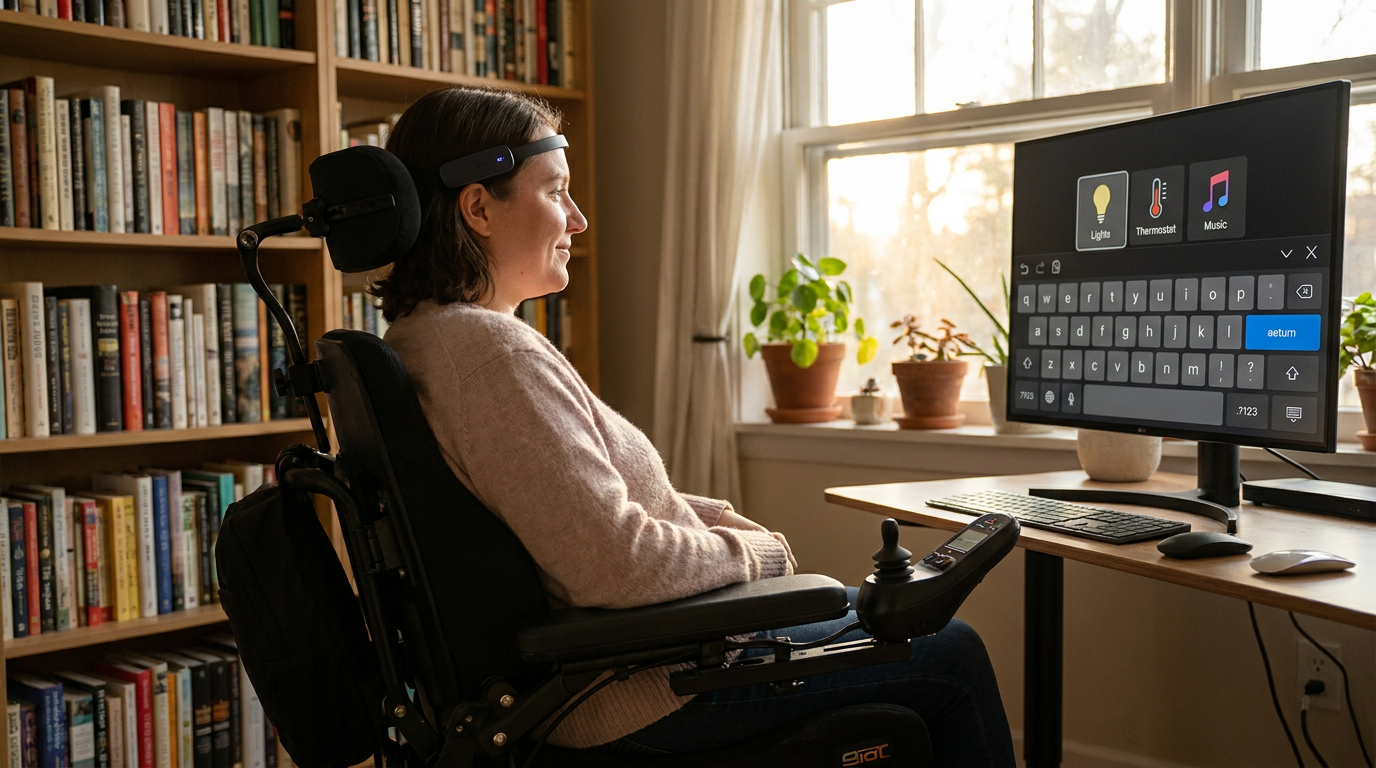
A landmark report published this week details the experience of a man with advanced MND who has successfully used an implanted brain-computer interface in his own home, without daily researcher supervision, for nearly two years. This achievement represents a monumental leap in neurotechnology. It is the difference between a fascinating scientific proof-of-concept and a viable, life-altering medical device. By demonstrating that a BCI can function reliably in a messy, real-world environment—allowing the user to send emails, browse the internet, and control smart home devices independently—researchers have crossed one of the most daunting valleys of death in medical engineering.[1][5]
The mechanics of the system rely on a profound biological truth: even when the spinal cord or motor neurons fail to transmit signals to the muscles, the brain's motor cortex continues to fire. When a paralyzed patient imagines moving their hand to click a mouse, the neurons associated with that specific movement still generate a distinct electrical pattern. The challenge has always been capturing that pattern with enough fidelity to decode it. In this recent case, a microelectrode array implanted on the surface of the brain detects these microscopic voltage changes and transmits them to a small receiver embedded in the skull, which then sends the data wirelessly to a nearby computer.[1][2]

Capturing the signal is only half the battle; interpreting it is where the most rapid advancements have occurred. Early BCIs struggled because the brain's electrical signals are incredibly noisy, and the exact neurons firing can shift slightly from day to day. Today, adaptive machine learning algorithms act as real-time translators. These AI decoders are trained on the patient's specific neural patterns. When the patient thinks 'move cursor left,' the algorithm recognizes the corresponding spike train and executes the command on the screen. Crucially, the latest generation of decoders can automatically recalibrate themselves in the background, adjusting to minor shifts in signal quality without requiring the patient to pause and run tedious calibration exercises.[5][6]
The stability of the implant over a two-year period is perhaps the most scientifically significant aspect of this milestone. Historically, the brain's immune system has been the greatest enemy of invasive BCIs. When a foreign object like an electrode array is introduced to cortical tissue, the body naturally responds by forming a glial scar—a layer of protective tissue that gradually insulates the electrodes, dampening the electrical signals until the device becomes useless. Overcoming this has required breakthroughs in materials science, utilizing flexible, biocompatible polymers that move with the brain rather than cutting into it, significantly reducing the inflammatory response.[2][7]
For the patient at the center of the recent study, the impact of this stability cannot be overstated. Before the implant, communication was restricted to slow, exhausting eye-tracking systems that often failed in bright sunlight or when the patient's eye muscles fatigued. With the BCI, communication is direct and effortless. The system operates at a speed that allows for real-time conversation, enabling the patient to participate in family decisions, manage personal finances, and maintain a degree of privacy that is often lost when relying entirely on caregivers for digital interaction.[1][4]
For the patient at the center of the recent study, the impact of this stability cannot be overstated.
This success does not exist in a vacuum; it is the culmination of billions of dollars in funding and decades of incremental progress across a global ecosystem of research. Initiatives like the US National Institutes of Health's BRAIN Initiative have provided the foundational funding necessary to map neural circuits and develop high-density recording tools. Meanwhile, academic consortiums like BrainGate have spent the last twenty years running the grueling, early-stage clinical trials that proved the fundamental safety of placing arrays in human brains.[3][7]
The landscape is now rapidly commercializing, bringing both vast capital and accelerated development timelines. Companies have pioneered endovascular BCIs—stent-like devices delivered through the jugular vein rather than requiring open brain surgery—while others have pushed the boundaries of electrode density and robotic surgical insertion. This influx of private investment is driving a Moore's Law-like progression in neural decoding, pushing typing speeds from a handful of words per minute a decade ago to over 60 words per minute in recent trials, approaching the speed of conversational speech.[5][7]

Despite the immense promise, the path to universal accessibility remains steep. The current generation of highly capable BCIs still requires neurosurgery, carrying inherent risks of infection or hemorrhage. The hardware itself is bespoke and astronomically expensive, currently funded entirely through research grants and clinical trial budgets. For this technology to reach the estimated hundreds of thousands of individuals worldwide living with severe motor impairments, manufacturing must scale, and surgical procedures must become as standardized as cardiac pacemaker implantations.[4][5]
Patient advocacy groups emphasize that the ultimate measure of success for neurotechnology is not just bandwidth or typing speed, but actual quality of life and autonomy. A device that requires constant technical support or fails unexpectedly can cause immense psychological distress to a patient who has come to rely on it for their only connection to the outside world. Therefore, the transition to 'at-home' use is the critical metric. It proves that the technology is maturing from a scientific experiment into a robust, dependable appliance.[4][7]
Looking ahead, the regulatory environment will play a pivotal role in how quickly these devices reach the broader public. Agencies like the FDA have begun granting 'Breakthrough Device' designations to several BCI platforms, expediting their review processes. However, regulators are navigating uncharted territory. They must establish new frameworks for evaluating the long-term safety of chronic brain implants, as well as the cybersecurity and data privacy standards required when a device is literally reading a patient's neural intentions.[3][7]

The next five years will likely see a bifurcation in the BCI market. Non-invasive systems, using advanced EEG caps or functional near-infrared spectroscopy, will continue to improve for gaming and basic accessibility, though they will likely never match the precision of implanted devices. Meanwhile, invasive BCIs will undergo larger, multi-center clinical trials aimed at securing full regulatory approval as standard-of-care medical devices for ALS, spinal cord injuries, and severe stroke survivors.[5][6]
The ethical implications of this technology are also beginning to surface, though they are currently overshadowed by the immediate medical benefits. As decoders become more sophisticated, the line between intended motor commands and internal, private thoughts may blur. Ensuring that patients retain absolute control over what neural data is translated and broadcasted is a primary concern for bioethicists working alongside these engineering teams.[3][7]

Ultimately, the story of the at-home BCI is one of profound human resilience matched by relentless scientific optimism. It represents a refusal to accept the biological finality of paralysis. By successfully bridging the gap between the human mind and the digital world in a patient's living room, researchers have not just restored a single individual's independence; they have illuminated a clear, viable path toward eradicating the isolation of locked-in syndrome forever.[1][4][7]
How we got here
2004
The BrainGate consortium implants the first microelectrode array into a human patient, proving BCIs can control a computer cursor.
2017
Researchers achieve typing speeds of 8 words per minute using implanted electrode arrays.
2021
The first endovascular BCI (Stentrode) is implanted in a US patient, avoiding the need for open brain surgery.
2024
Neuralink implants its first human patient, demonstrating wireless, high-density neural recording.
June 2026
A major study confirms a patient has successfully used an implanted BCI independently at home for nearly two years.
Viewpoints in depth
Neurotechnology Researchers
Engineers and scientists focused on the technical hurdles of signal stability and bandwidth.
For the engineering community, the primary victory here is material and algorithmic. Historically, the brain's immune response would encapsulate rigid electrodes in scar tissue, rendering them blind within months. By utilizing flexible polymers and adaptive machine learning decoders that can recalibrate on the fly, researchers have solved the 'chronic stability' problem. Their next frontier is increasing the bandwidth—moving from 64 or 256 channels to thousands—to enable not just typing, but the fluid control of robotic prosthetics and the restoration of sensory feedback.
Patient Advocacy Groups
Organizations representing individuals with ALS and severe paralysis.
Advocates view this breakthrough through the lens of human dignity. For a patient with locked-in syndrome, the ability to independently send a text message or turn off a light is a profound restoration of autonomy. However, these groups are acutely focused on the transition from lab to clinic. They argue that the technology must become affordable, covered by insurance, and supported by robust at-home technical infrastructure so that it doesn't remain an exclusive miracle available only to a handful of clinical trial participants.
Regulatory & Public Health Agencies
Entities responsible for evaluating the safety, efficacy, and ethics of new medical devices.
Regulators are cautiously optimistic but maintain a strict focus on long-term risk. Invasive brain surgery carries inherent dangers, and agencies like the FDA must weigh these risks against the life-changing benefits of the device. Furthermore, regulators are beginning to grapple with unprecedented questions regarding neural data. They are working to establish frameworks that ensure a patient's brain data cannot be hacked, monetized, or used without explicit, ongoing consent, recognizing that a BCI represents the most intimate digital interface ever created.
What we don't know
- How the flexible implant materials will hold up over a decade or more of continuous use.
- Whether the cost of the hardware and surgery can be reduced enough to become a standard medical treatment covered by insurance.
- How quickly regulatory agencies will approve these devices for widespread commercial availability outside of clinical trials.
Key terms
- Brain-Computer Interface (BCI)
- A system that establishes a direct communication pathway between the brain's electrical activity and an external device, such as a computer or robotic limb.
- Motor Cortex
- The region of the brain responsible for planning, controlling, and executing voluntary movements.
- Motor Neuron Disease (MND)
- A group of progressive neurological disorders, including ALS, that destroy the cells that control essential muscle activity such as speaking, walking, and breathing.
- Glial Scarring
- The body's natural immune response in the brain, which forms tissue around foreign objects like electrodes, often degrading their ability to read electrical signals over time.
- Machine Learning Decoder
- An artificial intelligence algorithm trained to recognize specific patterns in a patient's brain waves and translate them into digital commands.
Frequently asked
Does a brain-computer interface require open brain surgery?
Most high-performance BCIs currently require neurosurgery to place electrodes directly on or in the brain. However, newer endovascular models are being developed that can be delivered through blood vessels, similar to a heart stent.
Can a BCI read a person's private thoughts?
No. Current BCIs are specifically trained to recognize the electrical patterns associated with intended motor movements, such as imagining moving a hand, rather than decoding internal monologues or abstract thoughts.
How long do the implants last?
Historically, implants degraded within months due to scar tissue. Recent advancements in flexible materials have allowed devices to function reliably for over two years, with researchers aiming for decade-long lifespans.
When will this be available to the general public?
The technology is currently in the clinical trial phase. While regulatory agencies are expediting reviews, it will likely be several years before invasive BCIs are widely available as standard medical treatments.
Sources
Source coverage
7 outlets
3 viewpoints surfaced







[1]NatureNeurotechnology Researchers
At-home brain implant gives man with motor neuron disease his daily life back
Read on Nature →[2]The New England Journal of MedicineRegulatory & Public Health Agencies
Long-Term Safety and Efficacy of Cortical Microelectrode Arrays
Read on The New England Journal of Medicine →[3]National Institutes of HealthRegulatory & Public Health Agencies
BRAIN Initiative: Advancing Neurotechnology for Human Health
Read on National Institutes of Health →[4]ALS AssociationPatient Advocacy Groups
The Future of Assistive Technology and Independence in ALS
Read on ALS Association →[5]IEEE SpectrumNeurotechnology Researchers
How Machine Learning is Solving the BCI Calibration Problem
Read on IEEE Spectrum →[6]arXivNeurotechnology Researchers
Adaptive Neural Decoders for Chronic BCI Implants
Read on arXiv →[7]Factlen Editorial Team
Synthesis by Factlen editorial team
Read on Factlen Editorial Team →

Every angle. Every day.
Get science stories with full source coverage and perspective breakdowns delivered to your inbox.