
Do At-Home Red Light Therapy Masks Actually Work? The Clinical Evidence, Explained
At-home LED masks promise clinical-grade skin rejuvenation and acne reduction. A review of recent dermatological studies reveals where the science supports the claims—and where expectations need adjusting.
By Factlen Editorial Team
- Dermatologists & Clinical Researchers
- Medical professionals who focus on the peer-reviewed evidence and the biological mechanisms of photobiomodulation.
- Beauty Editors & Consumers
- Skincare enthusiasts who value the convenience, non-invasive nature, and visible aesthetic benefits of regular use.
- Medical Skeptics
- Professionals who warn that the marketing of consumer LED devices often outpaces the actual clinical science.
What's not represented
- · Aesthetic Device Manufacturers
- · Patients with severe cystic acne
Why this matters
Consumers are spending hundreds of dollars on at-home light therapy devices based on lofty anti-aging claims. Understanding the clinical evidence helps you separate scientifically backed skincare investments from expensive, underpowered plastic.
Key points
- Red and near-infrared light stimulate cellular energy, boosting collagen and reducing fine lines over time.
- Blue light effectively targets and destroys the surface bacteria responsible for mild-to-moderate acne.
- At-home masks have significantly lower power density than clinical lasers, requiring strict consistency for results.
- Visible structural changes to the skin typically take 12 to 16 weeks of regular use.
- LED therapy is generally safe and non-invasive, though individuals with photosensitive conditions should avoid it.
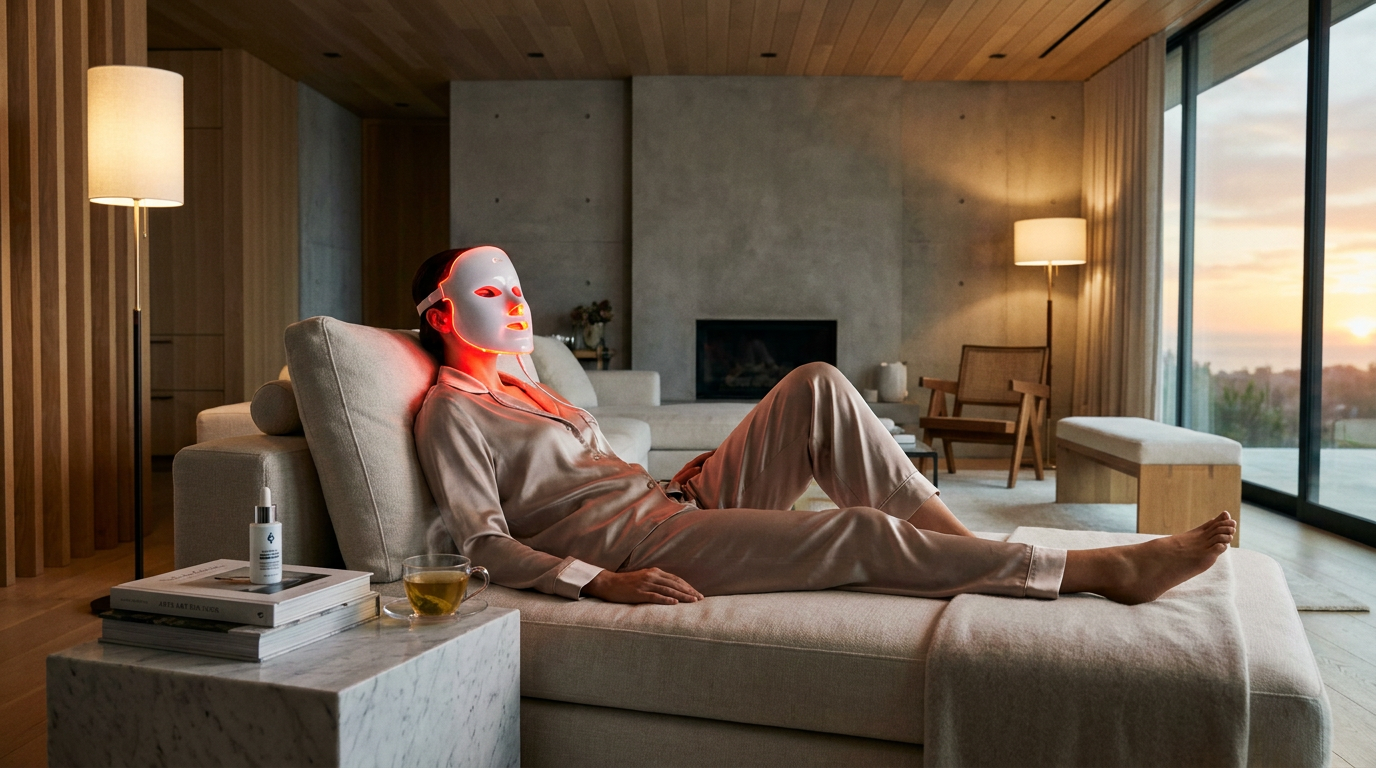
For years, they looked like props from a science fiction film. Today, light-emitting diode face masks are one of the fastest-growing categories in consumer skincare, promising to bring dermatologist-grade treatments into the living room.[3][4]
The marketing attached to these glowing devices is sweeping: they purport to erase fine lines, banish acne, and stimulate collagen, all while the user watches television. But as the market floods with devices ranging from $50 to over $2,000, consumers are left asking a fundamental question: does shining colored light on your face actually do anything?[1][5]
The short answer is yes, but with significant caveats. The underlying science, known as photobiomodulation, is well-documented in medical literature. When specific wavelengths of light penetrate the skin, they interact with mitochondria, the energy centers of our cells.[6][7]
When it comes to reducing fine lines and boosting collagen, the clinical evidence is remarkably strong. Red light, typically measuring between 630 and 660 nanometers, and near-infrared light, between 800 and 850 nanometers, penetrate deep into the dermis layer of the skin.[2][7]

Once absorbed, this light stimulates fibroblasts, the cells responsible for producing collagen and elastin. A 2025 multi-center, double-blind clinical trial published in medical journals evaluated the use of home LED masks specifically for treating periorbital wrinkles, commonly known as crow's feet.[2]
The study found that after 16 weeks of consistent use, participants using a combination of 630-nanometer red and 850-nanometer near-infrared light saw statistically significant improvements in wrinkle depth and skin elasticity compared to a control group using a sham device.[2]
The evidence for clearing mild-to-moderate acne is also robust, though the biological mechanism is entirely different. Blue light, which operates at a shallower wavelength of around 415 to 465 nanometers, does not penetrate deeply enough to stimulate collagen production.[5][7]
Instead, blue light creates a toxic environment for the specific bacteria responsible for inflammatory breakouts. By destroying this bacteria at the surface level, blue light can significantly reduce active blemishes. Many high-end masks combine blue light with red light to simultaneously kill bacteria and reduce the associated redness and inflammation.[3][7]
Instead, blue light creates a toxic environment for the specific bacteria responsible for inflammatory breakouts.
However, the claim that at-home masks deliver the exact same results as in-office dermatologist treatments is demonstrably false. The critical difference between a consumer mask and a clinical laser is power density, or irradiance, which is measured in milliwatts per square centimeter.[6][7]
Clinical devices typically deliver 100 to 200 milliwatts per square centimeter of targeted light energy. In contrast, most cleared at-home masks deliver a fraction of that power, usually hovering between 10 and 50 milliwatts per square centimeter.[7]

Because of this vast power gap, achieving clinical results at home requires immense patience and consistency. A ten-minute session in a dermatologist's office might deliver a dose of light energy that takes an at-home user weeks of daily wear to accumulate.[1][7]
Clinical studies indicate that while some users notice a superficial glow within a few weeks, the structural cellular changes required to visibly reduce wrinkles typically take 12 to 16 weeks of consistent, multi-day-per-week use. It is a marathon, not a sprint.[4][6]

Regarding safety, the evidence strongly supports the profile of these devices, with a few important medical exceptions. Unlike tanning beds or the sun, LED masks do not emit ultraviolet light, meaning they cannot cause DNA damage, sunburns, or skin cancer.[1][6]
Dermatologists do caution that they are not for everyone. Individuals with photosensitive conditions, such as lupus or polymorphous light eruption, should avoid them entirely. Furthermore, certain medications, including some antibiotics and retinoids, can temporarily increase skin sensitivity to light.[5][6]
Eye protection also remains a topic of debate among professionals. While red light is generally considered safe for the eyes, the intense brightness—particularly from blue light—can cause strain or discomfort, leading many medical professionals to recommend using built-in eye shields during treatment.[5][6]
For consumers ready to invest, beauty editors and dermatologists emphasize that device quality matters immensely. Flexible silicone masks from established brands are frequently cited as gold standards because they sit flush against the skin, maximizing light absorption, and are backed by independent clinical testing.[3][4]

How we got here
1960s
Hungarian physician Endre Mester accidentally discovers that low-level red light stimulates hair growth and wound healing in mice.
1990s
NASA begins experimenting with red light therapy to promote plant growth in space and heal astronauts' wounds.
2000s
Dermatologists begin using high-powered LED and laser devices in clinical settings for skin rejuvenation and acne treatment.
2010s
The first wave of consumer-grade, at-home LED masks hits the market, though many lack sufficient power density.
2020s
Advances in flexible silicone and LED technology lead to a boom in FDA-cleared, clinically backed at-home masks.
Viewpoints in depth
Dermatologists & Clinical Researchers
Medical professionals who focus on the peer-reviewed evidence and the biological mechanisms of photobiomodulation.
Clinical researchers emphasize that while the science of photobiomodulation is real, the efficacy of at-home devices is entirely dependent on power density and wavelength accuracy. They frequently caution patients that consumer masks output significantly less energy than in-office lasers, meaning results require strict adherence to a months-long routine. Their primary concern is managing patient expectations, ensuring consumers understand that LEDs are an adjunct to, not a replacement for, foundational skincare like sunscreen and retinoids.
Beauty Editors & Consumers
Skincare enthusiasts who value the convenience, non-invasive nature, and visible aesthetic benefits of regular use.
For beauty editors and dedicated consumers, LED masks represent a paradigm shift in at-home skincare. They value the devices for their ability to deliver a visible 'glow' and reduce inflammation without the downtime or irritation associated with chemical peels or harsh active ingredients. This camp views the masks as a long-term investment in a daily wellness routine, often highlighting the psychological benefits of taking ten minutes of dedicated self-care each day.
Medical Skeptics
Professionals who warn that the marketing of consumer LED devices often outpaces the actual clinical science.
Skeptics within the medical community do not deny that light therapy works, but they heavily criticize the beauty industry's marketing tactics. They argue that many cheap, unverified devices flood the market with incorrect wavelengths or insufficient power to trigger any biological response. This camp warns consumers against expecting facelift-level results from consumer-grade plastics and advocates for spending money on proven, inexpensive interventions—like daily SPF—before investing hundreds of dollars in light therapy.
What we don't know
- The exact long-term effects of daily blue light exposure on skin aging are still being studied.
- Whether combining LED therapy with specific active skincare ingredients enhances or hinders the light's penetration.
- The precise minimum power density required to trigger a biological response, as many cheap devices remain untested.
Key terms
- Photobiomodulation
- The process by which specific wavelengths of light stimulate cellular functions, such as energy production and tissue repair.
- Wavelength
- The measurement of light, expressed in nanometers (nm). Different wavelengths penetrate the skin at different depths, determining their specific therapeutic effects.
- Irradiance
- The amount of light energy delivered to a specific area of skin, usually measured in milliwatts per square centimeter (mW/cm²).
- Fibroblasts
- Cells within the skin's dermal layer responsible for producing collagen and elastin, which keep the skin firm and youthful.
- Adenosine Triphosphate (ATP)
- The primary energy carrier in cells. Red light therapy stimulates mitochondria to produce more ATP, accelerating cellular repair.
Frequently asked
Do I need to wear eye protection while using an LED mask?
While red light is generally safe, many dermatologists recommend eye protection, especially for masks that emit blue light or if you have light-sensitive eyes.
Can I use an LED mask with retinol or vitamin C?
Yes, but it is usually recommended to use the mask on clean, bare skin first, and apply active ingredients like retinol or vitamin C afterward to avoid irritation.
How often should I use an at-home red light mask?
Most clinical studies and manufacturers recommend using the device for 10 to 20 minutes, three to five times a week, for optimal results.
Does red light therapy cause sunburns or skin cancer?
No. Unlike UV light from the sun or tanning beds, red and near-infrared light do not damage cellular DNA or cause sunburns.
Sources
Source coverage
7 outlets
3 viewpoints surfaced







[1]National GeographicMedical Skeptics
LED light therapy for skin is trendy—but does it work?
Read on National Geographic →[2]PubMedDermatologists & Clinical Researchers
Clinical study to evaluate the efficacy and safety of home-used LED and IRED mask for crow's feet: A multi-center, randomized, double-blind, sham-controlled study
Read on PubMed →[3]Women's HealthBeauty Editors & Consumers
6 Best LED Face Masks in 2026, Tested by Dermatologists and Beauty Editors
Read on Women's Health →[4]ForbesBeauty Editors & Consumers
Best Red Light Therapy Masks 2026
Read on Forbes →[5]Global NewsMedical Skeptics
The Curator: A dermatologist's expert evaluation on LED face masks
Read on Global News →[6]Boulder Medical CenterDermatologists & Clinical Researchers
At-Home Light Therapy Masks: Are They Effective and Safe?
Read on Boulder Medical Center →[7]DoctronicDermatologists & Clinical Researchers
Red Light Therapy Masks: Do They Actually Work for Skin Conditions?
Read on Doctronic →

Every angle. Every day.
Get shopping stories with full source coverage and perspective breakdowns delivered to your inbox.