
Sustainable 'Eco-Vinyl' Reaches Commercial Scale as Music Industry Shifts Away from PVC
Driven by artist advocacy and new bioplastic technology, the music industry is rapidly transitioning to eco-friendly vinyl, cutting carbon emissions by up to 90% without sacrificing audio quality.

The vinyl revival has been a rare and lucrative bright spot for physical media over the last decade, but it has long harbored a dirty secret: the severe environmental toll of polyvinyl chloride, commonly known as PVC. Now, the global music industry is officially turning the page.
Driven by high-profile artist advocacy and years of dedicated material science research, sustainable 'eco-vinyl' has reached full commercial scale in 2026. This breakthrough offers a non-toxic, climate-friendly alternative that sounds just as warm and authentic as the original format, fundamentally reshaping how physical music is manufactured and consumed.[4][5]
For decades, the manufacturing of records has relied on highly energy-intensive mechanical presses and toxic chemical baths to mold petroleum-based materials into the discs fans love. Standard PVC records take an estimated 1,000 years to decompose in a landfill, making the recent explosion in vinyl sales a mounting environmental concern for climate scientists and sustainability advocates.
Most pressing plants have been operating the exact same machinery and utilizing the exact same chemical processes since the 1970s, creating a massive bottleneck for innovation in an industry otherwise defined by rapid technological change.[4]
A comprehensive study conducted by Keele University highlighted the staggering scale of the problem, revealing that a standard modern vinyl record contains roughly 153 grams of PVC. That specific material composition translates to a carbon footprint of half a kilogram of carbon dioxide per individual disc. When multiplied by the millions of records sold globally each year—with sales consistently breaking modern records—the physical music sector has been generating thousands of tons of emissions annually, directly contradicting the climate pledges made by major record labels.
The push for systemic change was ultimately catalyzed by major artists refusing to accept the environmentally damaging status quo. Billie Eilish made global headlines by releasing her highly anticipated album Hit Me Hard and Soft using innovative 'BioVinyl' and 'Eco-mix' materials. These advanced compounds utilize non-fossil fuel inputs, such as used cooking oil and recycled industrial scraps, to replace virgin plastics. By leveraging her massive commercial influence, Eilish forced supply chains to adapt, proving that a major global release could be executed sustainably without sacrificing chart performance.[1][3]
Coldplay followed suit with an equally ambitious initiative, partnering with the manufacturing giant Sonopress to release their album Moon Music—and eventually their entire extensive back catalog—on a new format dubbed 'EcoRecords.' These clear, 140-gram discs are manufactured using 100% recycled polyethylene terephthalate (PET), which is recovered directly from post-consumer plastic bottles. By intercepting waste before it reaches landfills or oceans, the band demonstrated a viable circular economy model that could be applied to the broader entertainment merchandise sector.[2]
The recycled PET injection-molding process utilized for EcoRecords drastically reduces the sheer volume of energy required for manufacturing. By entirely eliminating the need for virgin plastic extraction and bypassing the traditional steam-heated pressing method, the EcoRecord format cuts carbon emissions by a staggering 85% compared to traditional vinyl production.
Furthermore, the injection-molding technique significantly reduces the amount of edge-trim waste that typically occurs when a traditional PVC puck is squashed into a record shape. This efficiency represents a massive leap forward for an industry historically plagued by high defect rates and material waste.[4]
But perhaps the most significant breakthrough for independent labels and legacy pressing plants has been the successful commercialization of plant-based bioplastics. UK-based enterprise Evolution Music recently achieved a major milestone by scaling 'Evovinyl,' a fully compostable biopolymer derived entirely from natural sugars and starches.
Unlike recycled PET, which still relies on existing plastic waste streams, Evovinyl introduces a completely renewable, non-toxic material into the supply chain, offering a true zero-petroleum solution for the future of physical media. The launch of this material in commercial quantities marks the culmination of nearly a decade of rigorous research and development.[4][5]
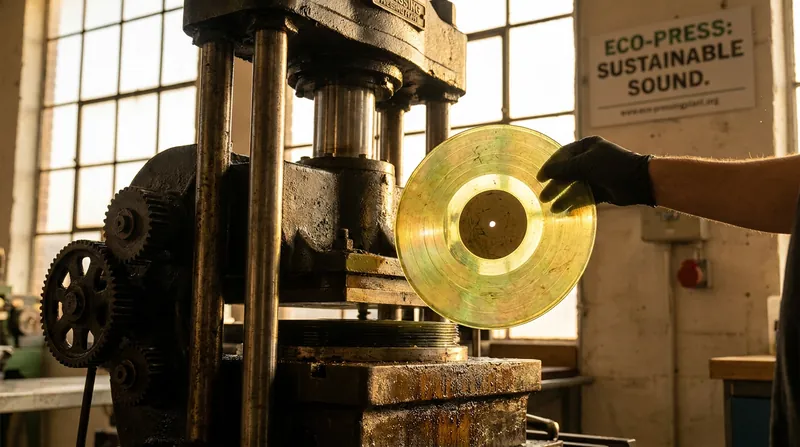
The crucial, industry-altering advantage of Evovinyl is its seamless backward compatibility. Rather than requiring independent pressing plants to invest millions of dollars in new injection-molding infrastructure, the bioplastic can be pressed using the exact same mechanical machinery that has stamped out PVC records for the last fifty years.
Facility operators only need to make minor temperature adjustments and perform a simple machine flush to switch between materials, removing the primary financial barrier that had previously prevented smaller plants from going green. This plug-and-play capability is widely viewed as the key to achieving universal industry adoption.[5]
Audio fidelity, long the primary concern of notoriously discerning audiophiles and purists, has proven remarkably resilient throughout this material transition. Extensive blind testing conducted by veteran pressing plants and Grammy-winning audio engineers confirms that both the recycled PET and bioplastic variants maintain the acoustic depth, dynamic range, and optical quality that collectors demand. The dreaded surface noise and groove wear that plagued early eco-friendly prototypes have been entirely engineered out of the modern commercial releases. Listeners report that the warmth and crackle inherent to the vinyl experience remain perfectly intact.[3][5]
The packaging ecosystem surrounding the records has also undergone a comprehensive green overhaul to match the discs inside. Artists are increasingly mandating that their album sleeves be constructed from 100% post-consumer recycled fibers and printed exclusively with raw, plant-based dispersion inks. Furthermore, the industry is rapidly phasing out the traditional, non-recyclable plastic shrink-wrap, replacing it with reusable eco-sleeves or entirely eliminating outer wrapping in favor of secure, recyclable shipping boxes designed specifically for direct-to-consumer fulfillment. This holistic approach ensures that the entire product lifecycle minimizes environmental harm.[1][3]
As these sustainable technologies move from boutique experiments to mandatory industry standards, the financial economics are finally beginning to align for labels of all sizes. While bioplastic pressings initially carried a slight premium of roughly ten percent, the elimination of toxic waste management protocols and the sharp reduction in facility energy costs are making eco-vinyl increasingly competitive.
Industry analysts project that as production volumes continue to scale throughout 2026, the cost parity between green vinyl and toxic PVC will be permanently achieved. This economic shift removes the last remaining excuse for clinging to outdated manufacturing methods.[4][5]
For a generation of music lovers who desperately want their physical collections to align with their environmental values, this transition marks a profound and uplifting victory. The music industry is definitively proving that the tactile joy of dropping a needle on a record, studying the liner notes, and building a physical library doesn't have to come at the expense of the planet.
As eco-vinyl becomes the undisputed new normal, fans can finally enjoy the resurgence of analog sound with a completely clear conscience. It is a rare instance of technological innovation successfully preserving a beloved cultural tradition while entirely reinventing its ecological footprint.[5]
Key points
- The music industry is rapidly replacing toxic PVC vinyl with sustainable bioplastics and recycled PET formats.
- New 'EcoRecord' and 'BioVinyl' technologies reduce carbon emissions by 85% to 90% compared to traditional manufacturing.
- Plant-based bioplastics like Evovinyl are fully compatible with existing pressing machinery, avoiding costly infrastructure upgrades.
- Major artists, including Billie Eilish and Coldplay, have driven the transition by mandating eco-friendly materials for their releases.
What we don’t know
- Whether the long-term durability of plant-based bioplastics will match the multi-generational lifespan of traditional PVC records.
- How quickly smaller, independent artists will be able to afford the slight premium currently associated with eco-vinyl pressings.
- If the global supply of high-quality recycled PET will be sufficient to meet the surging demand of the physical music market.
How we got here
2018
Evolution Music begins research into plant-based biopolymer alternatives to traditional PVC.
Early 2024
Billie Eilish announces her album will use BioVinyl and Eco-mix materials, reducing carbon emissions by 90%.
Mid 2025
Coldplay re-releases their entire back catalog on EcoRecords made from 100% recycled PET plastic bottles.
Late 2025
Evolution Music officially launches Evovinyl, proving the bioplastic can be used on existing pressing machinery.
June 2026
Sustainable vinyl alternatives reach commercial scale, allowing major and independent labels to phase out virgin PVC.
- Climate Advocates & Artists
- Argue that the music industry has a moral obligation to eliminate toxic PVC and virgin plastics.
- Pressing Plants & Manufacturers
- Focus on the logistical and economic realities of transitioning away from a 50-year-old manufacturing standard.
- Audiophiles & Collectors
- Prioritize acoustic fidelity, longevity, and the tactile experience of physical media.
Perspectives this story doesn't cover
- Independent Record Stores
- Streaming Platform Executives
Sources
Source coverage
5 outlets
3 viewpoints surfaced





- [1]Music WeekClimate Advocates & Artists
Billie Eilish reveals sustainability strategy for new album including recycled and Eco-mix vinyl
Read on Music Week → - [2]ESG TodayClimate Advocates & Artists
Coldplay to Re-release All Albums on Recycled Plastic Records
Read on ESG Today → - [3]Plastics EngineeringPressing Plants & Manufacturers
New Billie Eilish Album to Use Recycled and Bio-based Vinyl
Read on Plastics Engineering → - [4]RouteNote BlogAudiophiles & Collectors
The future of vinyl: New technology is making records better and greener
Read on RouteNote Blog → - [5]Evolution MusicPressing Plants & Manufacturers
Evovinyl Launch: The World's First Bioplastic Vinyl LP Moves Into Commercialisation
Read on Evolution Music →

More in Entertainment
See all →Streaming Economics
New Streaming Service 'Tapedeck' Launches Penny-Per-Play Model to Challenge Industry Payouts
3 sources

AI Music Rights
Music Industry Draws Hard Line on AI as Creators Demand Consent and Labels Acquire Tracking Tech
6 sources

Eco-Vinyl
The Music Industry's Green Revolution: Bioplastic Vinyl Reaches Mass Production
6 sources
Sustainable Audio
The Music Industry's 'Green Vinyl' Breakthrough: Sugarcane Records Lead a Sustainable Shift
3 sources
Comments
Every angle. Every day.
Get Entertainment stories with full source coverage and perspective breakdowns, free every day.