
SpaceX's Record $85 Billion IPO Ushers in the 'MANGOS' Era for Wall Street
SpaceX shattered records with an $85.7 billion public debut, pushing its valuation to $2.5 trillion and prompting investors to crown a new tech leadership group.
By Factlen Editorial Team
- Growth Investors
- Bullish on the MANGOS thesis, prioritizing AI and space infrastructure over legacy software.
- Retail Traders
- Enthusiastic participants driving record-breaking volume and momentum.
- Market Skeptics
- Warning of severe overvaluation given the company's multi-billion-dollar cash burn.
- Space & Tech Enthusiasts
- Focused on the historical milestones for space exploration and Musk's trillionaire status.
Why this matters
The sheer scale of SpaceX's public debut proves the market's appetite for frontier technology remains insatiable. It marks a definitive shift in Wall Street's focus from consumer software platforms to physical infrastructure and artificial intelligence, reshaping how retirement funds and retail portfolios will be allocated for the next decade.
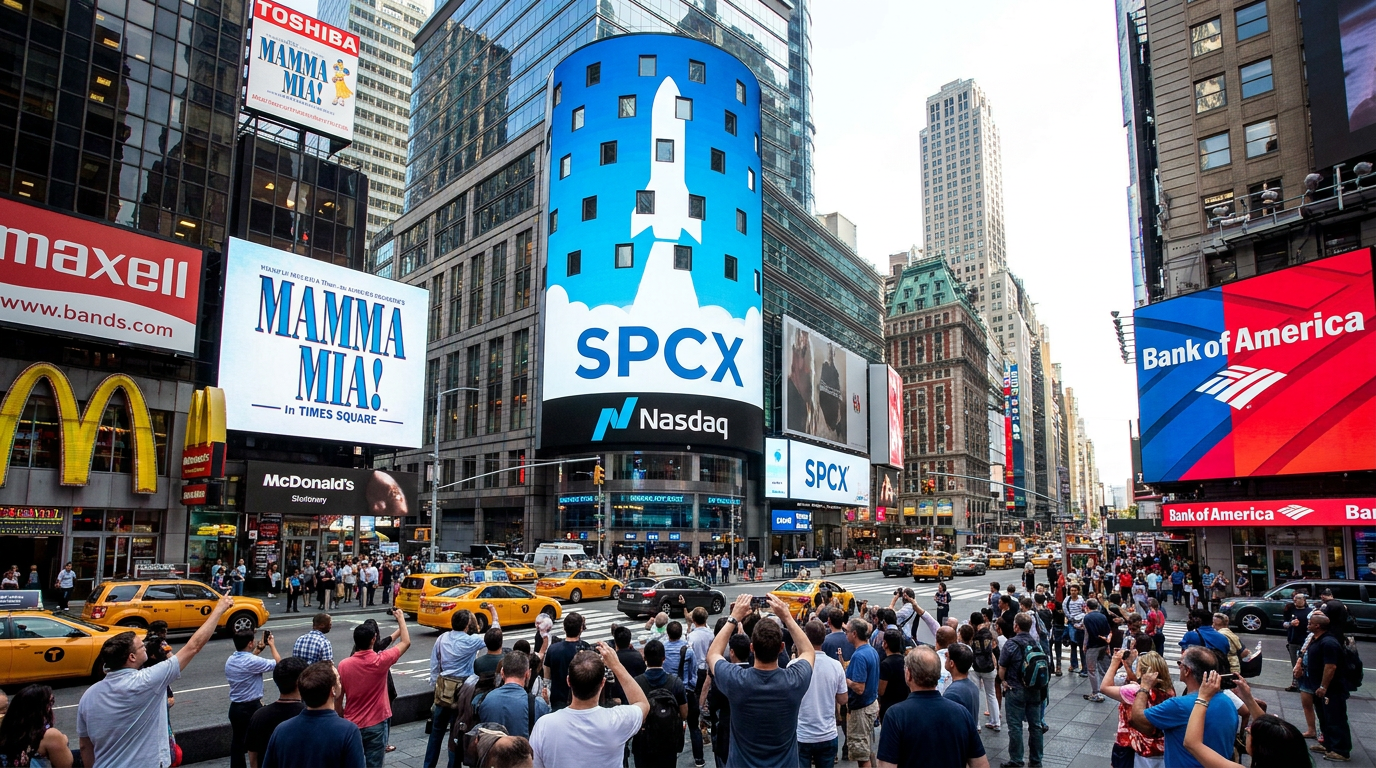
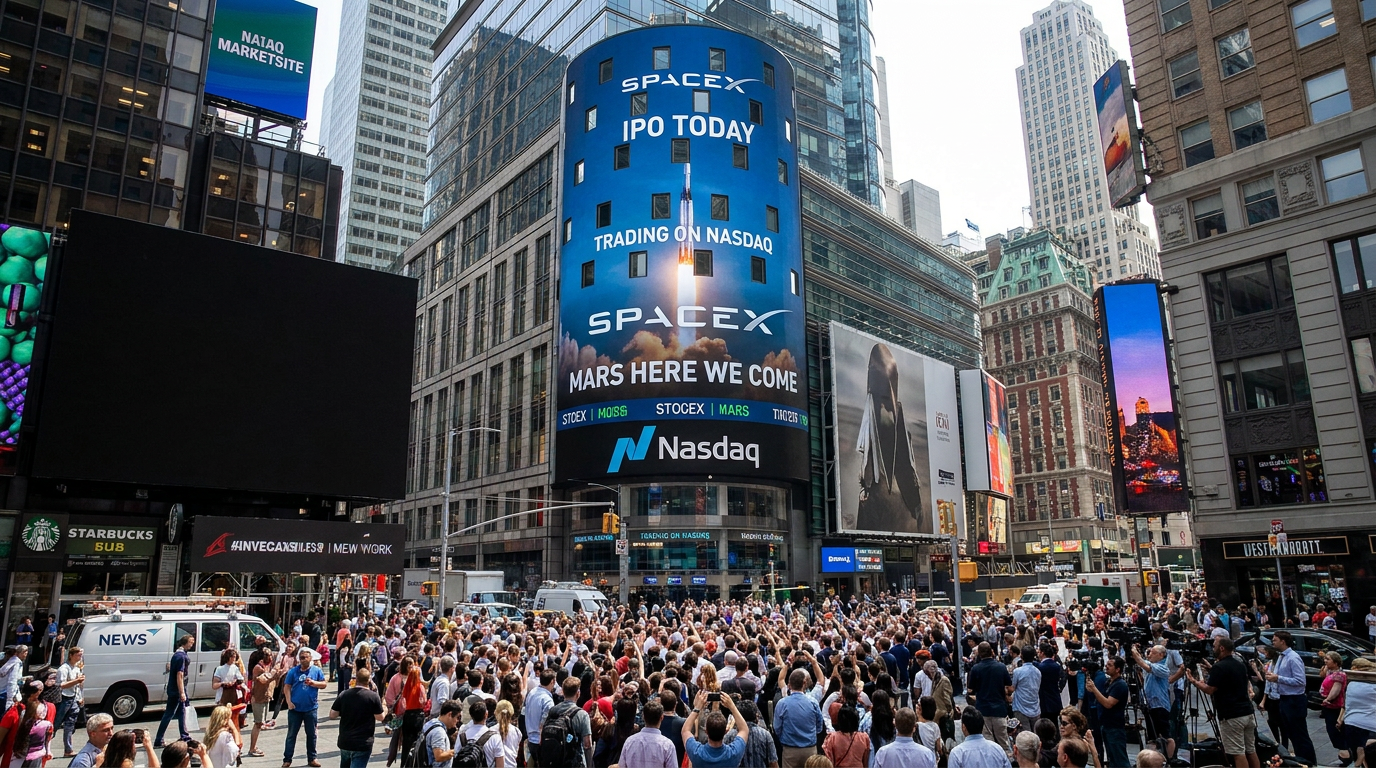
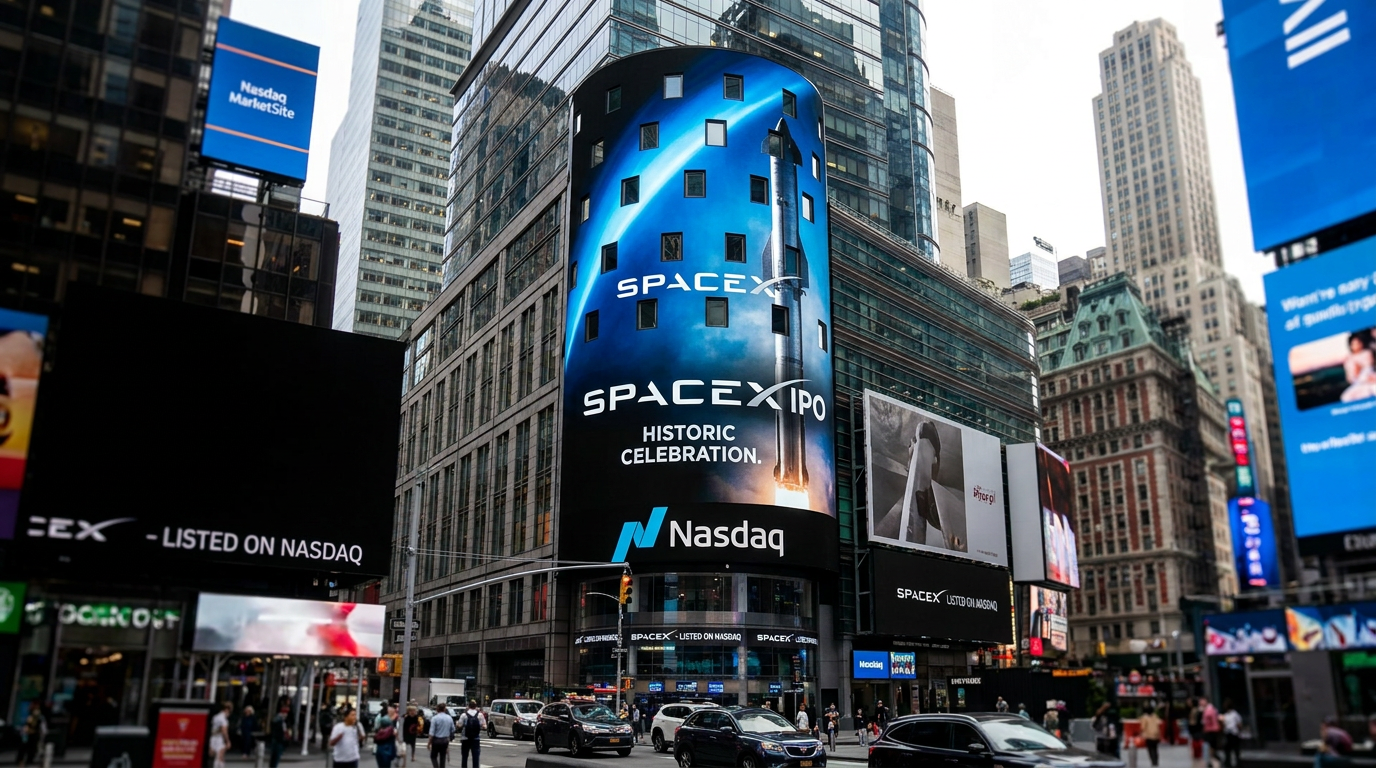
Wall Street has officially entered a new era. On Friday, June 12, SpaceX made its long-awaited debut on the Nasdaq, executing the largest initial public offering in the history of global financial markets. The aerospace and artificial intelligence giant shattered previous records, fundamentally altering the hierarchy of the world's most valuable companies and minting CEO Elon Musk as the world's first trillionaire.[1][8]
The sheer velocity of the stock's ascent caught even bullish analysts off guard. Initially priced at a fixed $135 per share, the stock opened at $150 and closed its first day at $160.95. By the end of trading on Monday, shares had surged another 20 percent to close at $192.46. That two-day rally added $412 billion in market value, pushing SpaceX's total valuation past $2.5 trillion and making it the sixth-largest public company on Earth.[4][8]
The capital raised is unprecedented. After underwriters exercised their "greenshoe" over-allotment option, SpaceX pulled in $85.7 billion. To put that figure in perspective, it is nearly three times larger than the previous record holder—Saudi Aramco's $29.4 billion offering in 2019. The demand was so overwhelming that the company reportedly stopped taking institutional orders days before the launch, with total bids exceeding $350 billion.[1][2][4]

Retail investors played a massive role in the frenzy. Allocated roughly 20 percent of the offering, everyday traders lapped up $117.6 million worth of SpaceX shares on Friday alone. That single-day volume easily surpassed the previous retail IPO record set by Coinbase in 2021. According to Vanda Research, retail traders bought as much SpaceX stock over its first two days as they did across the entire U.S. stock market during the previous week.[3][4]
Beyond the staggering numbers, the IPO has catalyzed a broader shift in market psychology. For years, the "Magnificent 7"—Apple, Microsoft, Alphabet, Amazon, Meta, Nvidia, and Tesla—dominated index returns and investor attention. But as SpaceX soared, financial strategists began coalescing around a new acronym to define the next decade of tech leadership: MANGOS.[5][6]

Beyond the staggering numbers, the IPO has catalyzed a broader shift in market psychology.
Standing for Meta, Anthropic, Nvidia, Google (Alphabet), OpenAI, and SpaceX, the MANGOS grouping represents a pivot away from legacy e-commerce and cloud platforms. Instead, it focuses strictly on the companies building frontier artificial intelligence and the physical infrastructure required to support it. The transition highlights a market consensus that the internet era has matured, and the next wave of multi-trillion-dollar growth will come from space connectivity and superintelligence.[6][7]
Wall Street is already moving to package this new thesis. Corgi, a thematic ETF issuer, filed paperwork this week for a dedicated MANGOS ETF. The fund aims to offer bundled exposure to the six companies, anticipating that both OpenAI and Anthropic—currently valued at a combined $965 billion in private markets—will follow SpaceX's lead and go public in the near future.[7]

However, not everyone is convinced the astronomical valuation is justified. Investment research firm Morningstar issued a stark warning ahead of the debut, calculating SpaceX's fair value at just $63 per share. Analysts pointed to the company's $4.9 billion net loss in 2025 and the massive cash burn required by its Starship rocket development and newly integrated xAI division, calling the current price "extremely speculative."[1][2]
The bull case rests heavily on Starlink, the company's satellite internet constellation. In its IPO prospectus, SpaceX revealed that Starlink generated nearly 69 percent of its revenue—$4.69 billion in the latest quarter alone—and is currently the only profitable segment of the business. Investors are betting that Starlink's cash flow, combined with future plans for space-based data centers, will eventually subsidize the capital-intensive missions to the Moon and Mars.[2]

Institutional heavyweights are ignoring the skeptics. Billionaire Ron Baron, a long-time backer, purchased an additional $1 billion in shares on Friday, bringing his firm's total position to $25 billion. Australian mining magnate Gina Rinehart also disclosed a new $1 billion stake. Their conviction is bolstered by the structural mechanics of the modern stock market; SpaceX is on a fast track for inclusion in the Nasdaq 100, FTSE Russell, and MSCI indexes, which will force passive funds to buy billions of dollars of the stock regardless of its price.[2][3]
The flawless execution of an $85 billion offering has broader implications for the IPO pipeline. By proving that public markets can easily absorb a mega-cap debut without draining liquidity from other sectors, SpaceX has effectively cleared the runway for OpenAI and Anthropic. As the MANGOS era officially begins, the center of gravity on Wall Street has decisively shifted upward.[4][5]
Viewpoints in depth
Growth Investors
Focused on the transition from software platforms to physical AI and space infrastructure.
This camp views the SpaceX IPO as the starting gun for a new market paradigm. They argue that the 'Magnificent 7' era, which relied on cloud computing and digital advertising, has matured. Instead, they are aggressively buying into the 'MANGOS' thesis, betting that the next decade of wealth creation will come from companies building frontier AI models (OpenAI, Anthropic) and the physical infrastructure to support them (Nvidia's GPUs and SpaceX's orbital data centers). For these investors, a $2.5 trillion valuation is justified by the sheer scale of the total addressable market.
Retail Traders
Driven by accessibility, momentum, and the cultural gravity of Elon Musk.
Retail participants see SpaceX as a generational wealth-building opportunity that they were previously locked out of. Having watched the company achieve historic milestones in private markets for two decades, everyday traders flooded brokerages to secure shares, breaking Coinbase's single-day retail purchasing record. This camp is less concerned with traditional price-to-earnings ratios and more focused on momentum, index inclusion catalysts, and the belief that Musk's companies consistently defy conventional valuation metrics.
Market Skeptics
Warning of a speculative bubble detached from underlying financial fundamentals.
Value investors and traditional analysts point out that SpaceX is currently a cash furnace, having lost nearly $5 billion in 2025. They argue that while the Starlink segment is profitable, it cannot sustainably subsidize the massive capital expenditures required for the Starship program and the newly integrated xAI division. Firms like Morningstar peg the company's fair value at roughly half of its IPO price, warning that the current $2.5 trillion market cap is pricing in flawless execution across three incredibly difficult industries: aerospace, telecommunications, and artificial intelligence.
What we don't know
- How quickly SpaceX can achieve overall profitability given the massive R&D costs of Starship and xAI.
- When private MANGOS members OpenAI and Anthropic will officially file for their own IPOs.
- How the stock will perform once the initial retail frenzy subsides and lock-up periods for early investors expire.
Sources
Source coverage
8 outlets
4 viewpoints surfaced






[1]The GuardianMarket Skeptics
Initial public offering for aerospace and AI company made Musk the world's first trillionaire
Read on The Guardian →[2]ForbesMarket Skeptics
SpaceX Says Historic IPO Raised More Than $85 Billion
Read on Forbes →[3]BNN BloombergRetail Traders
Retail investors lap up SpaceX shares in record-breaking debut
Read on BNN Bloomberg →[4]The Straits TimesRetail Traders
SpaceX shares jump in second day of trading, adding $412 billion in market value
Read on The Straits Times →[5]Yahoo FinanceGrowth Investors
SpaceX IPO signals attention widening beyond the 'Magnificent 7'
Read on Yahoo Finance →[6]MoomooGrowth Investors
Wall Street may have just witnessed the beginning of a new era
Read on Moomoo →[7]Crypto BriefingGrowth Investors
The thematic ETF issuer betting MANGOS will replace FAANG
Read on Crypto Briefing →[8]Space.comSpace & Tech Enthusiasts
SpaceX goes public with a mind-bogglingly historic IPO
Read on Space.com →

Every angle. Every day.
Get business stories with full source coverage and perspective breakdowns delivered to your inbox.