
Beyond Sustainability: How Regenerative Tourism is Rewriting the Rules of Travel
The travel industry is shifting from 'leaving no trace' to actively restoring ecosystems and communities. Programs like Mālama Hawaiʻi and New Zealand's Tiaki Promise are leading a global movement to leave destinations better than they were found.
By Factlen Editorial Team
- Regenerative Advocates
- Argue that minimizing harm is no longer enough and that travel must actively restore ecosystems.
- Tourism Industry Leaders
- Focus on the rising consumer demand for purpose-driven travel and the business case for community integration.
- Local Communities & Analysts
- Emphasize the need to prevent greenwashing and ensure that tourism wealth stays within the host destination.
What's not represented
- · Workers in traditional mass-market hospitality who may face job displacement
- · Airlines struggling to align high-emission long-haul flights with regenerative goals
Why this matters
As popular destinations buckle under the weight of overtourism, regenerative travel offers a blueprint for the future of vacations. By choosing trips that actively restore environments and fund local communities, travelers can turn their leisure time into a force for global ecological and economic healing.
Key points
- Regenerative tourism shifts the focus from minimizing harm to actively restoring destinations.
- Over 66% of travelers now seek experiences that positively impact local communities.
- Programs like Mālama Hawaiʻi reward tourists with hotel discounts for volunteering.
- New Zealand's Tiaki Promise asks visitors to pledge to protect the nation's environment and culture.
- The model aims to reverse economic leakage by keeping tourism profits within host communities.
- Industry analysts warn that strict oversight is needed to prevent corporate greenwashing.
For decades, the gold standard of responsible travel was encapsulated in a single, well-meaning phrase: "leave no trace." The goal of sustainable tourism was to minimize harm, ensuring that a visitor's carbon footprint and ecological impact were kept as close to zero as possible. But as global travel volumes rebound and climate pressures mount, a consensus is emerging among environmental scientists, local communities, and industry leaders that simply sustaining the status quo is no longer sufficient. Many of the world's most beloved destinations are already degraded by decades of overtourism and ecological strain. In response, a paradigm shift is sweeping the travel industry in 2026: the rise of regenerative tourism.[3][6]
If sustainable travel is about minimizing a negative footprint, regenerative travel is about maximizing a positive "handprint." It asks a fundamentally different question of the traveler. Instead of asking how to visit a place without damaging it, regenerative tourism asks how a visitor can leave a destination measurably better than they found it. This approach treats destinations not as static backdrops for consumption, but as living, interconnected ecosystems of people, culture, and nature. It demands active participation in restoration, shifting the traveler's role from a passive observer to an active steward.[3][6]
The momentum behind this shift is largely driven by changing consumer expectations. According to recent industry data, more than 66 percent of travelers now actively seek out experiences that directly enhance the local communities they visit. This is not merely a niche preference for eco-lodges; it represents a mainstream demand for purpose-driven travel. Travelers are increasingly aware that their vacation dollars can either contribute to the extraction of local resources or fund the revitalization of local habitats and heritage.[1][6]

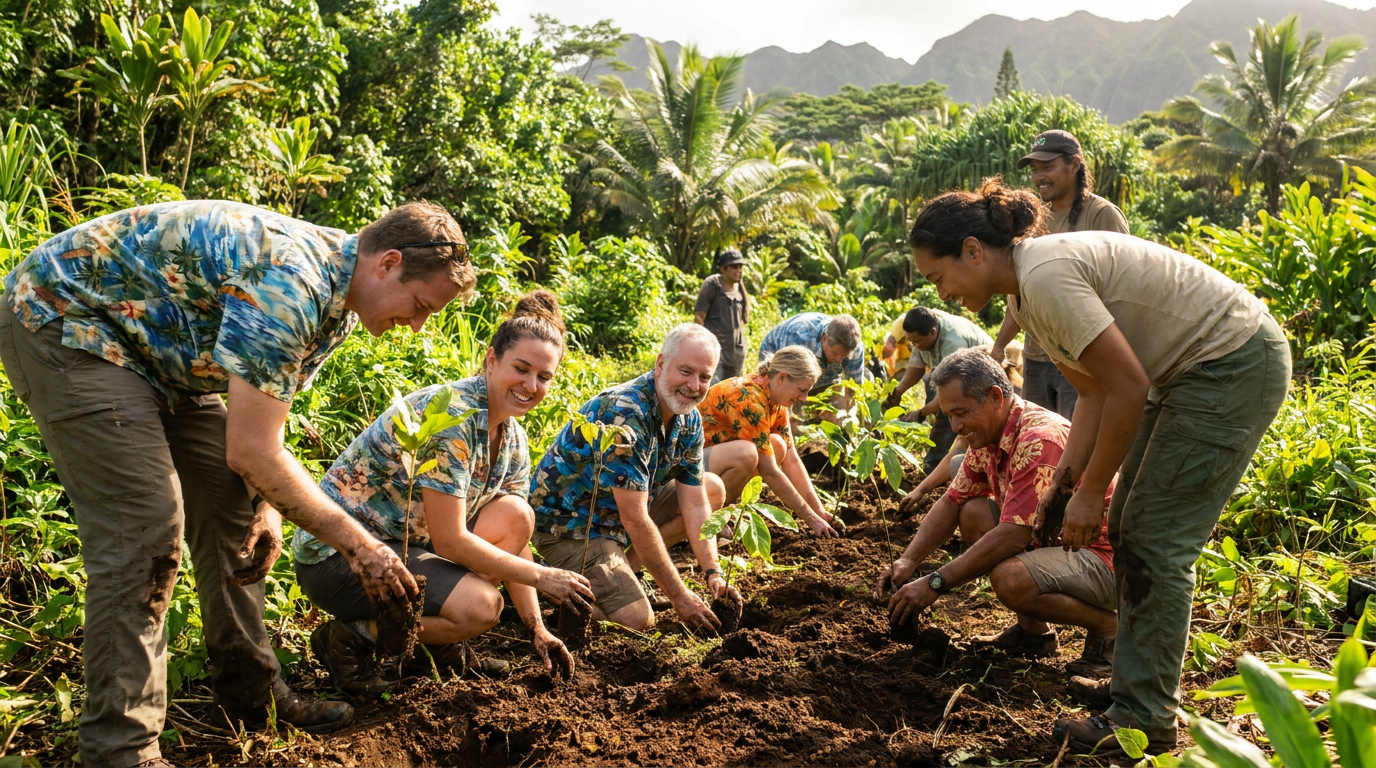
One of the most prominent and successful examples of this model in action is the Mālama Hawaiʻi program. Rooted in the indigenous Hawaiian concept of "mālama," which translates to caring for and protecting, the initiative was launched by the Hawaiʻi Tourism Authority to fundamentally alter the relationship between visitors and the islands. The program invites tourists to step away from the resort pool and engage in hands-on volunteer work, ranging from clearing invasive species and restoring ancient fishponds to participating in beach cleanups.[2][4]
The genius of the Mālama Hawaiʻi initiative lies in its incentive structure. By partnering with local non-profits and major hospitality brands, the program rewards participating travelers with tangible perks, such as a free night's stay or discounted room rates. This creates a reciprocal relationship where the destination receives vital ecological labor, and the visitor receives both financial savings and a deeper, more authentic connection to the land. To date, volunteers have planted more than 20,000 native trees across the archipelago, demonstrating the massive potential of channeling tourist energy into conservation.[4]
A similar philosophy is reshaping the visitor experience in New Zealand through the Tiaki Promise. "Tiaki" is a Māori word meaning to care for, conserve, and protect. Rather than a specific volunteer program, the Tiaki Promise functions as a national social contract. It asks every visitor to formally commit to acting as a guardian of Aotearoa, protecting nature, keeping the country clean, and respecting local culture. It is an explicit attempt to alter the inner paradigm of the tourist, establishing clear social norms before they even step off the airplane.[5]

A similar philosophy is reshaping the visitor experience in New Zealand through the Tiaki Promise.
The Tiaki Promise is deeply intertwined with the Māori concept of kaitiakitanga, or environmental guardianship. By embedding indigenous values into the national tourism marketing strategy, New Zealand is signaling that visitors are entering a shared ecosystem where they have responsibilities, not just consumer rights. This cultural framing helps prevent the resentment that often builds in heavily touristed areas, fostering a sense of mutual respect between hosts and guests.[5]
Beyond the Pacific, regenerative practices are taking root in diverse environments globally. In Wales, the Bluestone National Park Resort has spent over a decade transforming former dairy farmland—once described by ecologists as a biological desert—into a thriving, biodiverse habitat. By prioritizing ecosystem restoration over mere footprint reduction, the resort proves that hospitality infrastructure can actually be a catalyst for environmental healing, rather than a cause of degradation.[1]
The economic mechanics of regenerative tourism also differ sharply from traditional models. Historically, mass tourism has suffered from severe economic leakage, where the bulk of vacation spending is captured by multinational airlines, foreign-owned hotel chains, and international tour operators, leaving only a fraction of the wealth in the host community. Regenerative tourism actively works to reverse this flow by prioritizing community-led enterprises and ensuring that profits directly fund local development and conservation.[3][6]

A striking example of this economic restructuring can be found in the Peruvian Amazon. The Posada Amazonas lodge, operated by Rainforest Expeditions, channels 75 percent of its profits directly to the Indigenous Ese Eja de Infierno community. This revenue stream not only supports local healthcare and education but also funds the stewardship of a 9,500-hectare reserve, protecting critical habitats for macaws, caimans, and giant river otters. When the economic incentives align with conservation, the local community becomes the strongest defender of the ecosystem.[1]
Despite its rapid growth and noble intentions, the regenerative travel movement faces significant challenges and uncertainties. The most pressing risk is "greenwashing"—the practice of using regenerative buzzwords as a marketing veneer without implementing meaningful, systemic changes. As the term becomes more popular, there is a danger that hotels and tour operators will rebrand basic sustainability measures, like reusing towels or eliminating plastic straws, as "regenerative" to attract premium prices.[3][6]
Furthermore, the concept of "voluntourism" carries its own inherent risks. If not carefully managed by local experts, short-term volunteer projects can become transactional or even disruptive. Planting the wrong type of tree, or taking jobs away from local workers to provide "experiences" for wealthy tourists, can do more harm than good. True regeneration requires that initiatives be community-led and scientifically grounded, ensuring that the needs of the destination dictate the activities of the visitors, rather than the other way around.[2][6]

There is also an ongoing debate about the scalability of regenerative tourism. Can a model built on deep, slow, and mindful engagement survive the sheer volume of global travel? Some industry analysts argue that regenerative travel is inherently incompatible with mass tourism and will remain a niche luxury product. Others contend that systemic regeneration is possible if governments implement strict destination management policies, such as capping visitor numbers, imposing regenerative taxes, and redesigning infrastructure to prioritize local well-being.[3][6]
Ultimately, the transition from sustainable to regenerative tourism represents a profound maturation of the travel industry. It acknowledges that humans are not separate from the ecosystems they visit, and that travel should be an act of reciprocity rather than mere extraction. As travelers increasingly seek out destinations that offer the chance to leave a positive legacy, local guides and community organizations will become the most vital architects of the future travel experience.[6]
How we got here
1980s–1990s
Ecotourism emerges as a niche market, focusing on minimizing environmental impact in fragile natural areas.
2010s
Sustainable tourism becomes the industry standard, popularizing the 'leave no trace' philosophy and carbon offsetting.
2018
New Zealand launches the Tiaki Promise, formally asking visitors to commit to caring for the country's people and places.
2020
The Hawaiʻi Tourism Authority introduces the Mālama Hawaiʻi program, incentivizing tourists to participate in volunteer restoration projects.
2026
Regenerative tourism is widely recognized as the defining travel trend of the year, shifting the focus from minimizing harm to active restoration.
Viewpoints in depth
Regenerative Advocates
The push to move beyond the 'leave no trace' baseline.
Environmental scientists and destination managers argue that sustainability is fundamentally flawed because it seeks to maintain a status quo that is already degraded. They advocate for a 'handprint' approach, where tourism acts as a mechanism for ecological healing. This camp believes that every visitor interaction should be designed to restore biodiversity, revitalize indigenous cultures, and repair the damage caused by decades of extractive mass tourism.
Tourism Industry Leaders
Adapting to the new consumer demand for purpose-driven travel.
Hospitality brands and tour operators are recognizing that regenerative travel is not just an ethical imperative, but a massive market opportunity. With a significant majority of modern travelers seeking trips that align with their values, the industry is rapidly redesigning itineraries to include conservation and community engagement. For these leaders, the challenge is scaling these authentic experiences without diluting their impact or alienating guests who still expect traditional luxury.
Local Communities & Analysts
Guarding against greenwashing and transactional voluntourism.
While welcoming the shift in rhetoric, local advocates and industry analysts remain cautious about execution. They warn that without strict oversight, 'regenerative' could become the new 'eco-friendly'—a meaningless marketing buzzword used to justify premium pricing. This camp stresses that true regeneration requires transferring economic power and decision-making authority back to the host communities, ensuring that volunteer efforts address actual local needs rather than merely providing photo opportunities for tourists.
What we don't know
- Whether regenerative tourism can be successfully scaled to accommodate the billions of global trips taken annually without losing its authenticity.
- How the industry will standardize and audit 'regenerative' claims to prevent widespread greenwashing by major hospitality brands.
- If travelers will remain willing to pay the premium prices often associated with community-led, low-volume regenerative travel experiences during economic downturns.
Key terms
- Regenerative Tourism
- A travel model focused on actively improving and restoring the ecological and social health of a destination, rather than simply minimizing harm.
- Sustainable Tourism
- A travel approach that seeks to reduce negative impacts on the environment and local communities, often summarized by the phrase 'leave no trace.'
- Mālama
- A Hawaiian cultural value that translates to caring for, protecting, and preserving the land and community.
- Tiaki
- A Māori word meaning to care for people and place, which serves as the foundation for New Zealand's national visitor pledge.
- Greenwashing
- The deceptive practice of marketing a product or service as environmentally friendly or regenerative when it does not actually produce meaningful ecological benefits.
- Voluntourism
- A form of tourism in which travelers participate in voluntary work, typically for a charity or conservation project, during their vacation.
Frequently asked
What is the difference between sustainable and regenerative tourism?
Sustainable tourism aims to minimize harm and 'leave no trace,' keeping the environmental impact as close to zero as possible. Regenerative tourism goes a step further, asking travelers to actively restore ecosystems and leave the destination better than they found it.
How does the Mālama Hawaiʻi program work?
The program connects visitors with local volunteer opportunities, such as beach cleanups and tree planting. In exchange for their labor, participating hotels often reward travelers with perks like a free night's stay or discounted rates.
What is the Tiaki Promise?
It is a national initiative in New Zealand that asks visitors to formally pledge to care for the country's land, sea, and culture. It is rooted in the Māori concept of kaitiakitanga, or environmental guardianship.
Does regenerative travel cost more?
Not necessarily. While some luxury eco-lodges charge a premium to fund conservation, many regenerative activities—like volunteering through Mālama Hawaiʻi—are free and can actually earn travelers discounts on their accommodations.
Sources
Source coverage
6 outlets
3 viewpoints surfaced






[1]ForbesTourism Industry Leaders
What Is Regenerative Travel and Who's Leading in 2026
Read on Forbes →[2]Travel CourierTourism Industry Leaders
What is Malama Hawaii?
Read on Travel Courier →[3]Les RochesRegenerative Advocates
Regenerative Tourism: Beyond Sustainability in Hospitality
Read on Les Roches →[4]Hawaiʻi Tourism AuthorityRegenerative Advocates
Mālama Hawaiʻi | Travel With Care
Read on Hawaiʻi Tourism Authority →[5]Tourism New ZealandRegenerative Advocates
Tiaki - care for New Zealand
Read on Tourism New Zealand →[6]Factlen Editorial TeamLocal Communities & Analysts
Synthesis by Factlen editorial team
Read on Factlen Editorial Team →
Every angle. Every day.
Get travel stories with full source coverage and perspective breakdowns delivered to your inbox.