
Solid-State Batteries Move From Lab to Production Line in 2026
After decades of research, next-generation solid-state batteries are entering commercial production, promising electric vehicles with double the range, 10-minute charging, and zero fire risk.
By Factlen Editorial Team
- Battery Developers & Automakers
- Argue that solid-state technology is the holy grail of electrification, ready for commercialization, and will eliminate range anxiety.
- Materials Scientists
- Focus on the chemical stability, the elimination of flammable liquid electrolytes, and the technical achievement of suppressing lithium dendrites.
- Market Analysts
- Emphasize the massive economic potential of the technology while cautioning that manufacturing scale-up will keep initial costs high.
What's not represented
- · Oil and Gas Industry Analysts
- · Lithium Mining Operators
Why this matters
Solid-state batteries solve the three biggest hurdles to electric vehicle adoption: range anxiety, long charging times, and fire risks. As this technology hits the market, it will make EVs lighter, safer, and as fast to refuel as a gas-powered car.
Key points
- Solid-state batteries replace flammable liquid electrolytes with stable solid materials like ceramics or polymers.
- The solid architecture allows for pure lithium-metal anodes, nearly doubling the energy density of current batteries.
- Major manufacturers like QuantumScape, Toyota, and Greater Bay Technology are launching pilot and mass production lines in 2026.
- A recent real-world test saw a solid-state equipped vehicle drive 1,205 kilometers on a single charge.
- The technology enables ultra-fast charging, taking a battery from 10% to 80% in under 10 minutes.
For decades, the electric vehicle industry has chased a singular, elusive breakthrough: a battery that charges as fast as a gas tank fills, carries enough energy to cross multiple states, and poses zero risk of catching fire. Known as the solid-state battery, it has long been dismissed as a perpetual "five years away" lab experiment. But in 2026, the timeline has finally collapsed. Across the globe, from Silicon Valley to Guangzhou, next-generation solid-state cells are officially moving off laboratory benches and onto automated production lines.[1][2]
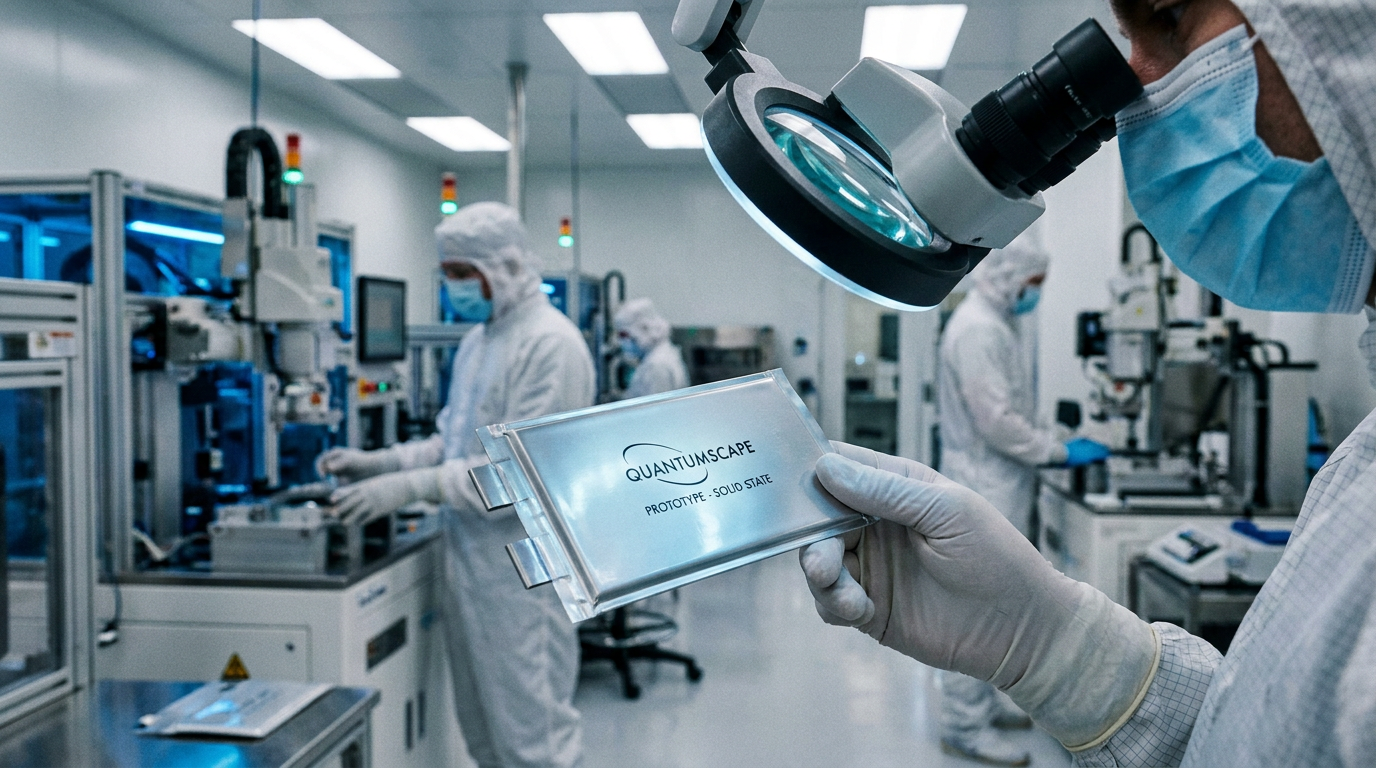
The shift marks what industry analysts consider the most significant leap in energy storage since the commercialization of the lithium-ion battery in the 1990s. In California, QuantumScape recently inaugurated its "Eagle Line," a highly automated pilot facility designed to crank out solid-state cells for automotive testing. Meanwhile, in China, Greater Bay Technology announced that its first mass-producible all-solid-state cells have rolled off the line, targeting gigawatt-hour scale production by the end of the year.[1][2][4]
To understand why this transition is so monumental, one must look inside the battery powering today's smartphones and electric vehicles. Conventional lithium-ion batteries rely on a liquid electrolyte—a chemical soup that shuttles lithium ions back and forth between the cathode and the anode during charging and discharging. While effective, this liquid is inherently volatile. It is composed of organic solvents that are highly flammable, meaning that if the battery is punctured, overcharged, or overheated, it can trigger a catastrophic chain reaction known as thermal runaway.[3][7]
Solid-state batteries eliminate this vulnerability by replacing the liquid soup with a solid material—typically a specialized ceramic, polymer, or sulfide glass. This solid electrolyte still allows lithium ions to pass through, but it acts as a rigid physical barrier. Because there is no flammable liquid to boil or ignite, the safety profile of the battery transforms entirely. Comparative testing shows that while traditional liquid cells can begin to fail dangerously at 90 degrees Celsius, solid-state systems remain stable up to 247 degrees Celsius.[3][6]

But safety is only half the equation; the true prize is energy density. The rigid nature of a solid electrolyte allows battery engineers to swap out the bulky graphite anode used in today's cars for an anode made of pure lithium metal. In a liquid battery, a lithium-metal anode is incredibly dangerous because it forms "dendrites"—microscopic, needle-like structures that grow through the liquid and short-circuit the cell. A solid ceramic separator physically blocks these dendrites from growing, unlocking the "golden combination" of battery chemistry.[3][4]
But safety is only half the equation; the true prize is energy density.
The result is a staggering increase in how much power can be packed into a given space. Today's best lithium-ion batteries max out around 200 to 300 watt-hours per kilogram (Wh/kg). The solid-state cells entering production in 2026 are targeting 400 to 500 Wh/kg. In practical terms, this means an automaker can either double the range of an electric vehicle without increasing the battery's size, or cut the battery's weight in half while maintaining the same range.[1][6]

This theoretical math is already translating to real-world asphalt. In a landmark test, a Mercedes-Benz EQS equipped with solid-state cells from US-based Factorial Energy drove 1,205 kilometers (roughly 750 miles) from Stuttgart, Germany, to Malmö, Sweden, on a single charge. Crucially, this was not achieved on a closed test track under perfect conditions, but on ordinary highways crossing three international borders, proving the technology's viability in everyday driving scenarios.[6]
Beyond range, the solid architecture fundamentally alters the charging experience. Because the solid electrolyte is highly resistant to degradation and heat buildup, the battery can accept massive amounts of electrical current without sustaining damage. Automakers and battery developers are targeting 10-to-80 percent charge times of under 10 minutes. At that speed, the charging experience becomes virtually indistinguishable from a traditional trip to the gas station, effectively neutralizing the internal combustion engine's final major advantage.[1][5]
Despite the clear advantages, the road to commercialization has been grueling. The primary bottleneck has not been the chemistry itself, but the manufacturing process. Building a solid-state cell in a pristine laboratory environment is one thing; manufacturing millions of them flawlessly at high speeds is another. The solid layers must be pressed together with immense precision to ensure perfect contact, as even microscopic air gaps can ruin the battery's performance.[4][7]
Companies are finally cracking this manufacturing code. QuantumScape's new production line utilizes a proprietary "Cobra" process to rapidly manufacture its ceramic separators at scale. Similarly, automotive giant Toyota, which holds more solid-state battery patents than any other company, has broken ground on a large-scale solid electrolyte pilot plant in partnership with Idemitsu Kosan. Toyota has validated its technology for initial production in 2026, with plans to scale up to mass-market volumes between 2027 and 2028.[2][5]

As these production lines spin up, the initial rollout will be highly targeted. Because early solid-state cells will carry a premium price tag, they will not immediately appear in budget-friendly commuter cars. Instead, the technology will debut in luxury flagship vehicles, high-performance sports cars, and premium electric motorcycles, where buyers are willing to pay for cutting-edge range and rapid charging. The technology is also drawing intense interest from the aerospace and defense sectors, where the high energy density and fireproof nature of the cells are ideal for drones and electric aviation.[4][6]
Market analysts project that as manufacturing scales and production yields improve, costs will inevitably fall, following the same cost-curve trajectory that made traditional lithium-ion batteries affordable over the last decade. Forecasts suggest the solid-state battery market could swell to $10 billion by the mid-2030s. While the complete phase-out of liquid electrolytes will take years, the milestones of 2026 signal a definitive turning point. The next era of electrification has officially arrived, promising a future where range anxiety and charging delays are relics of the past.[4]
How we got here
1990s
Lithium-ion batteries are commercialized, becoming the standard for portable electronics and early electric vehicles.
2020
Automakers announce initial solid-state research, but struggle with manufacturing scale and dendrite growth.
2023
Major breakthroughs in ceramic and polymer separators allow for stable lithium-metal anodes in lab settings.
Early 2026
QuantumScape inaugurates its Eagle Line pilot facility, and Greater Bay Technology rolls out mass-producible A-sample cells.
2027-2028
Toyota and Idemitsu Kosan target mass-market commercialization of solid-state EVs.
Viewpoints in depth
Battery Developers & Automakers
Argue that solid-state technology is the holy grail of electrification, ready for commercialization, and will eliminate range anxiety.
Automotive giants and battery startups view solid-state technology as the ultimate unlock for mass EV adoption. By effectively neutralizing the internal combustion engine's last remaining advantages—range and refueling speed—developers argue that solid-state cells will win over the most stubborn EV skeptics. Companies like Toyota and QuantumScape point to their 2026 production milestones as proof that the technology has graduated from the lab to the factory floor, emphasizing that the focus is now entirely on scaling up volume rather than proving the chemistry.
Materials Scientists
Focus on the chemical stability, the elimination of flammable liquid electrolytes, and the technical achievement of suppressing lithium dendrites.
For the scientific community, the triumph of the solid-state battery is fundamentally a story of materials engineering. Researchers highlight the sheer difficulty of creating a solid separator that is conductive enough to let lithium ions pass through quickly, yet rigid enough to physically block the growth of microscopic lithium dendrites. They emphasize that the true breakthrough isn't just the increased range, but the elimination of volatile organic solvents, which fundamentally rewrites the safety parameters of high-capacity energy storage.
Market Analysts
Emphasize the massive economic potential of the technology while cautioning that manufacturing scale-up will keep initial costs high.
Financial and industry analysts project a massive $10 billion market for solid-state batteries by the mid-2030s, but they urge patience regarding consumer pricing. Analysts note that the highly precise manufacturing techniques required—such as dry electrode processing and specialized ceramic pressing—will initially result in low production yields and high costs per kilowatt-hour. Consequently, they predict the technology will be confined to luxury vehicles, aerospace, and premium motorcycles for several years before economies of scale bring it to mass-market commuter cars.
What we don't know
- Exactly how quickly manufacturing yields can improve to bring the cost of solid-state cells down to parity with traditional lithium-ion.
- How the long-term durability of solid ceramic separators will hold up after a decade of real-world road vibrations and extreme weather.
Key terms
- Solid-State Battery
- A battery that uses a solid material, rather than a liquid, to conduct ions between its electrodes.
- Electrolyte
- The medium inside a battery that allows electrical charge (ions) to flow between the cathode and anode.
- Energy Density
- A measure of how much energy a battery can hold relative to its weight, typically expressed in watt-hours per kilogram (Wh/kg).
- Thermal Runaway
- A dangerous chain reaction where a battery overheats uncontrollably, often leading to a fire or explosion.
- Lithium Dendrites
- Microscopic, needle-like metal structures that can grow inside a liquid battery and cause short circuits, which solid electrolytes are designed to block.
Frequently asked
What is the main advantage of a solid-state battery?
They offer significantly higher energy density and safety, allowing for longer driving ranges, faster charging times, and the elimination of flammable liquid components.
When will solid-state cars be available to buy?
Initial luxury models and premium electric motorcycles are debuting in 2026, with broader mass-market availability expected between 2027 and 2030.
Will solid-state batteries make EVs cheaper?
Not immediately. Early solid-state cells will carry a premium price, but costs are projected to fall significantly as manufacturing scales up into the 2030s.
Are solid-state batteries completely fireproof?
While no energy storage is entirely without risk, solid-state batteries eliminate the flammable liquid electrolyte, pushing the threshold for dangerous thermal events from 90°C to nearly 250°C.
Sources
Source coverage
7 outlets
3 viewpoints surfaced






[1]ElectrekBattery Developers & Automakers
China ramps up solid-state EV battery production
Read on Electrek →[2]InsideEVsBattery Developers & Automakers
QuantumScape inaugurates Eagle Line pilot for solid-state battery production
Read on InsideEVs →[3]Built InMaterials Scientists
What Is a Solid-State Battery?
Read on Built In →[4]IDTechExMarket Analysts
Solid-State Batteries 2026-2036: Technology, Forecasts, Players
Read on IDTechEx →[5]Green Car ReportsBattery Developers & Automakers
Toyota will ramp up EV production to at least one million units in 2026
Read on Green Car Reports →[6]EleportBattery Developers & Automakers
New battery technologies 2026: what actually matters
Read on Eleport →[7]MurataMaterials Scientists
What Are Solid-State Batteries? An Explainer
Read on Murata →

More in guides
See all 5 stories →Brain Health
The Science of Brain Washing: How the Glymphatic System Clears Toxins During Deep Sleep
0 sources

Battery Tech
How Solid-State Batteries Work: The Mechanism Behind the Next Leap in Energy Storage
0 sources
Oncology Tech
How Personalized mRNA Vaccines Are Reprogramming the Immune System to Hunt Cancer
0 sources
Every angle. Every day.
Get guides stories with full source coverage and perspective breakdowns delivered to your inbox.